
RKI SC-8000: The Sample-Draw Toxic Monitor for Gases With No Personal Detector
The RKI SC-8000 is a portable sample-draw toxic gas monitor built around interchangeable electrochemical sensor units, covering gases that have no personal detector — arsine, phosphine, silane, diborane, germane, hydrogen fluoride, chlorine, ozone, and more, 24 gases in its detectable table. Its built-in pump draws about 0.5 L/min from the space being checked, so the atmosphere is sampled before a person enters it. Prices run $2,673.30–$3,153.05 at CPS Calibrations depending on battery and the sensor fitted.
Open a standard personal monitor's sensor list and you'll find the same short roster almost everywhere: combustible, oxygen, carbon monoxide, hydrogen sulfide, sometimes a fifth. That roster covers the common hazards honestly — but industry runs on a much longer list of toxic gases, and most of them will never have a belt-worn personal detector. The RKI SC-8000 is the instrument class built for the long list.
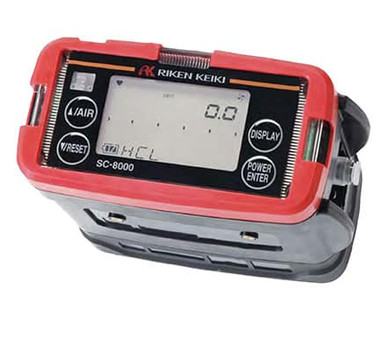
RKI SC-8000 Toxic Sample Draw Gas Monitor
The RKI SC-8000 ($2,673.30–$3,153.05 by battery and sensor at CPS) is a sample-draw toxic gas monitor with interchangeable sensor units for gases no personal detector covers — arsine, phosphine, silane, diborane, germane, HF, chlorine and more — drawing about 0.5 L/min from the space so nobody enters it first.
$2,673.30–$3,153.05 configured
See the SC-8000 Toxic SampleWhich Gases Have No Personal Detector — and Why?
Personal detectors exist where the exposure is routine and the market is broad. The gases on the SC-8000's detectable table are the opposite: process gases, fumigants, etchants, and dopants that are acutely toxic at very low concentrations, in specific industries. Read a few of its ranges and the character of the list is clear:
- Arsine (AsH3), 0–0.200 ppm and phosphine (PH3), 0–1.00 ppm — semiconductor dopant gases and fumigants, dangerous at fractions of a part per million.
- Silane (SiH4), 0–15 ppm, diborane (B2H6), 0–0.300 ppm, and germane (GeH4), 0–0.800 ppm — pyrophoric process gases from the same semiconductor world.
- Hydrogen fluoride (HF), hydrogen chloride (HCl), chlorine (Cl2), fluorine (F2), and chlorine trifluoride (ClF3) — corrosive halogen gases from chemical processing and etching.
- Ozone (O3), 0–1.00 ppm, ammonia (NH3), 0–75 ppm, hydrogen cyanide (HCN), 0–15.0 ppm, sulfur dioxide (SO2), nitrogen dioxide (NO2) — the wider industrial toxic list.
In total, the SC-8000's own record lists 24 detectable gases. Nobody wears a personal monitor for most of them because most workers never meet them — but the maintenance tech opening a gas cabinet, the crew answering a process leak alarm, or the hygienist verifying a space meets them on a schedule, and 'no personal detector exists' cannot be the end of the measurement plan.
Why Sample-Draw? The Pump Does the Entering
The SC-8000 draws its sample: approximately 0.5 L/min, pulled through a probe or hose from the space, the cabinet, the duct, or the valve bonnet to the sensor in the instrument — while the operator stands outside the atmosphere in question. That single design decision changes the safety geometry of the job:
- Check before entry. A space, enclosure, or gas cabinet can be sampled and cleared — or condemned — before anyone's breathing zone goes into it.
- Reach the point. Sample draw interrogates the specific place: the fitting, the low corner where a heavy gas pools, the inside of the enclosure. A diffusion instrument in your hand reads where your hand is.
- Stand off from the source. On a suspected leak of a gas that's toxic at 0.2 ppm, distance between the operator and the sample point is not comfort — it's the control measure.
The rest of the record is built for that work in real plants: intrinsically safe (Ex ia IIC T4) with IECEx, ATEX, TIIS, and CE approvals; IP-67 sealing; a 95 dB alarm; a datalogger with IrDA transfer; and continuous operation of 25 hours on the lithium-ion battery or 18 hours on AA alkalines, in a body of about 1.1 kg.
One Monitor, Many Gases — One at a Time
The SC-8000's coverage comes from interchangeable sensor units: the monitor is ordered with a battery choice (alkaline or Li-ion) and a sensor for the gas you face, and units are also sold with no sensor, to be fitted as the work requires. The honest limit belongs in the same paragraph as the capability: one sensor unit is fitted at a time, so the instrument measures one target gas per configuration. It is not a 24-gas simultaneous monitor, and it doesn't pretend to be — it is a specialist you configure for the gas of the day, which is exactly how these hazards present: one process, one gas, one job.
That also sets its relationship to the rest of the kit. A wrist-worn single-gas monitor like the RKI GasWatch 3 protects a worker continuously against a known everyday gas; a fixed/sample-draw discussion for refrigerant and specialty spaces is a different instrument again. The SC-8000 is the one you fetch when the gas on the line is one the everyday kit simply doesn't cover.
What Does an SC-8000 Cost, Configured?
At CPS, the SC-8000 runs $2,673.30–$3,153.05, and the spread is configuration, not mystery: the lithium-ion battery version with a sensor fitted is $3,153.05; the alkaline version with a sensor is $2,777.80; and no-sensor units — bought to be paired with sensor units you choose — are $2,673.30 (Li-ion) and $2,998.05 (alkaline). The sensor list on the product page shows the exact ranges offered per gas; if the gas on your process isn't in the dropdown, call us — the record's full detectable table is wider than any one dropdown.
Calibration for a Shelf of Sensor Units
A sample-draw toxic monitor's readings carry unusual weight — a clearance decision gets made on them. CPS calibrates the SC-8000 in-house at the $55 single-gas rate for the fitted configuration, with as-found and as-left readings on the certificate; start from calibration services or call 865-900-8844 and name the gas and sensor you're running. Calibrated instruments are enrolled in the CPS Calibration Program so due dates don't live in somebody's memory, and who can calibrate my gas detector explains the standard any calibration provider should meet.
Frequently Asked Questions
What is the RKI SC-8000?
The RKI SC-8000 is a portable sample-draw toxic gas monitor. It uses interchangeable electrochemical sensor units and a built-in pump drawing about 0.5 L/min to sample gas from a space, enclosure, or process point while the operator stays outside it. It is intrinsically safe (Ex ia IIC T4), IP-67 sealed, datalogging, and covers 24 toxic gases in its detectable table — most of them gases for which no personal belt-worn detector exists.
How much does the RKI SC-8000 cost?
At CPS Calibrations the SC-8000 runs $2,673.30–$3,153.05 depending on configuration: with a sensor fitted, the lithium-ion version is $3,153.05 and the alkaline version is $2,777.80; without a sensor, the Li-ion unit is $2,673.30 and the alkaline unit is $2,998.05. Which sensor you fit — arsine, phosphine, silane, chlorine, HF, and many others — is chosen on the product page.
What gases can the SC-8000 detect?
Its record lists 24 detectable gases: ammonia, arsine, bromine, carbon monoxide, chlorine, chlorine trifluoride, diborane, fluorine, germane, hydrogen bromide, hydrogen chloride, hydrogen cyanide, hydrogen fluoride, hydrogen iodide, hydrogen peroxide, hydrogen selenide, hydrogen sulfide, nitrogen dioxide, nitrogen monoxide, ozone, phosphine, phosphorus trifluoride, silane, and sulfur dioxide. Ranges run from 0–0.200 ppm for arsine and hydrogen selenide up to 0–100 ppm for nitrogen monoxide. One sensor unit is fitted at a time, so the instrument measures one target gas per configuration.
Why does the SC-8000 use sample draw instead of diffusion?
Because the jobs it exists for are the ones where you should not be standing in the atmosphere to measure it. Sample draw pulls about 0.5 L/min through a probe or hose from the space, cabinet, or fitting to the sensor, so a space can be checked and cleared before entry, a specific point can be interrogated, and the operator keeps distance from a suspected toxic leak. A diffusion instrument can only read the air where it physically is.
Can the SC-8000 measure several gases at once?
No. The SC-8000 is built around interchangeable sensor units, and one unit is fitted at a time — so it measures one target gas per configuration. That is the honest trade for its breadth: instead of four or five fixed channels like a personal monitor, it covers a 24-gas list by swapping the sensor unit to match the gas the job involves. Facilities that face several of these gases keep the monitor and a shelf of sensor units.
How long does the SC-8000 run on a charge or batteries?
RKI's record for the SC-8000 gives continuous operation of 25 hours on the lithium-ion battery (about 3 hours to charge) or 18 hours on three AA alkaline batteries. The battery is chosen at order — Li-ion or alkaline variants are both sold — and the instrument weighs approximately 1.1 kg with the battery unit fitted.
Is the SC-8000 intrinsically safe and waterproof?
It is rated IP-67 for ingress protection and is intrinsically safe to Ex ia IIC T4, with IECEx, ATEX, TIIS, and CE approvals listed in its record. Those ratings are what allow it to be used as a clearance and leak-check instrument in classified industrial areas where the gases it hunts are present.
What industries use the SC-8000?
Anywhere a toxic process gas has no personal detector: semiconductor fabrication (silane, diborane, germane, arsine, phosphine), chemical processing (chlorine, fluorine, hydrogen fluoride and chloride), fumigation work (phosphine), and water/wastewater and industrial hygiene surveys (ozone, ammonia, sulfur dioxide, nitrogen dioxide). The pattern is the same in each: a specialist gas, measured occasionally but critically, by drawing a sample instead of sending a person.
Does the SC-8000 log its readings?
Yes. The SC-8000 has a datalogger with interval, alarm trend, and station ID control, communicating by IrDA, plus peak and average value displays. For clearance work that record matters: the reading that justified an entry decision is stored with its time and context rather than living only in the operator's notebook.
Who can calibrate an RKI SC-8000, and what does it cost?
CPS Calibrations calibrates the SC-8000 in-house at 109 S. Front Street, Rockwood, TN at the $55 single-gas rate for the fitted sensor configuration, with as-found and as-left readings on the certificate. Call 865-900-8844 and name the gas and sensor unit you're running so the right span gas is ready. Every calibrated instrument is enrolled free in the CPS Calibration Program for due-date tracking and reminders.
The Bottom Line
The SC-8000 covers the gases the standard kit can't: 24 toxics — arsine at 0.2 ppm full scale, silane, phosphine, HF, chlorine, ozone — measured by drawing the sample to the operator instead of sending the operator to the sample. One sensor at a time, by design; the right sensor, on purpose. $2,673.30–$3,153.05 configured.
Facing a gas your personal monitors don't cover? Call CPS Calibrations at 865-900-8844 and name the gas. We'll configure the SC-8000 around it, and we calibrate every channel we sell.
CPS Calibrations · 109 S. Front Street, Rockwood, TN 37854 · Calibration Services · The CPS Calibration Program
Need a calibration you can file?
In-house calibration at CPS in Rockwood, Tennessee — $55 for single-gas instruments, $90 for 4- and 5-gas — every channel, as-found and as-left data, full certificate.
See Calibration Servicesor call 865-900-8844
Recent Posts
-

What Is Remote Monitoring for Fixed Gas Detection?
Remote monitoring for fixed gas detection means a fixed system's live readings, trends, and alarm hi …Nov 23rd 2026 -

What Are the Key Differences Between the GX-6000 and GX-6100?
The RKI GX-6100 is the current replacement for the discontinued GX-6000: both are pumped 6-gas monit …Nov 22nd 2026 -

How to Read a PID Correction Factor Chart
To read a PID correction factor chart, find your vapor’s row, take the factor under your own lamp en …Nov 21st 2026