
RKI GP-03 Single-Gas Monitor: LEL-Only Protection in a 2.8 oz Clip-On
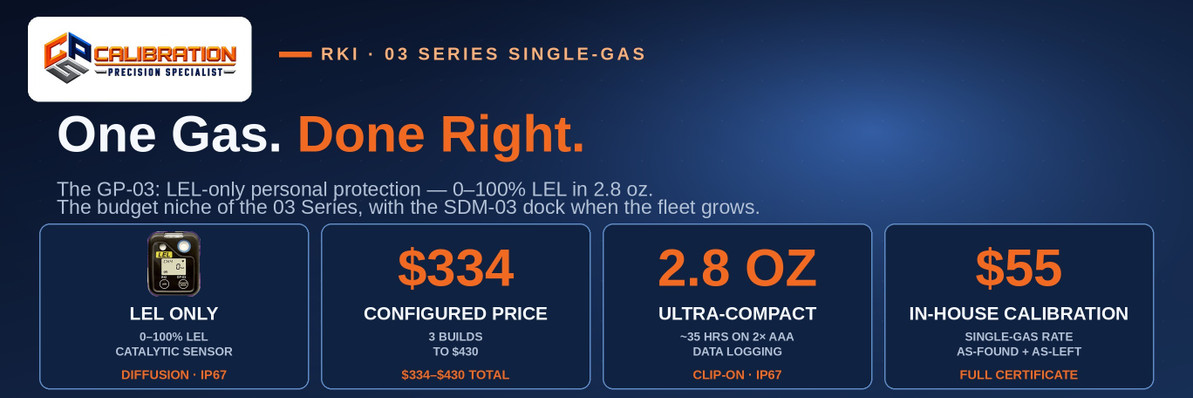
The RKI GP-03 is a single-gas personal monitor that does one job — combustible gas, 0–100% LEL, through a catalytic combustion sensor — in a 2.8 oz, IP67 housing that clips to a pocket and runs about 35 hours on two AAA alkaline batteries. It is the budget LEL-only niche of RKI's 03 Series: no oxygen channel, no toxic sensors, no pump, and a configured price of $334–$430 at CPS Calibrations across its 3 builds — the lower headline figure sometimes shown for this model matches no actual configuration, so the configured range is the number to budget.
Plenty of workers need exactly one warning: *the air in front of me is becoming flammable.* A welder working near a fuel line, a utility hand opening a vault, a maintenance tech in a compressor building — for that job, a four-gas instrument bundles three channels nobody asked for, at several times the price, with three more sensors to calibrate and replace. The GP-03 is RKI's answer to that narrower problem, and this spotlight covers it on its own terms: what it detects and how, the specifications that actually matter in the field, where it sits inside the 03 Series (and why you will not find it in the 04 Series roundup), its SDM-03 docking option, and who should — and should not — buy one. The instrument itself is the RKI GP-03, and CPS's single-gas shelf is the single-gas monitors category.
One clarification up front, because the naming invites it: the GP-03 belongs to RKI's 03 Series, the earlier single-gas family — not the 04 Series covered in RKI 04 Series: which single-gas monitor do you need. Different generation, different dock, different price point. Everything below is the 03 Series instrument as it is sold today.
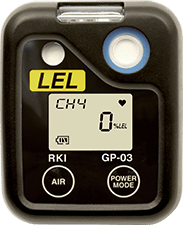
RKI GP-03 Combustible Gas LEL Single Gas Monitor
Ultra-compact LEL-only personal monitor — catalytic sensor, diffusion sampling, 2.8 oz.
$334–$430 configured
See the GP-03What Does the GP-03 Actually Detect?
Combustible gas, expressed as a percentage of the lower explosive limit — %LEL. The catalytic combustion sensor burns a tiny sample of the surrounding gas on a heated element and measures the heat released, which is why catalytic sensors are the long-standing standard for combustible monitoring: they respond to the broad family of flammable gases and vapors, with methane (CH₄) the reference gas in the GP-03's specification. The reading that matters is proportional — 10% LEL is one-tenth of the concentration at which the atmosphere can ignite — and the GP-03 displays it continuously on its digital LCD from 0 to 100% LEL at 1% LEL resolution.
What it does not detect is just as important, and this post will not blur it: there is no oxygen channel, so the GP-03 cannot warn of oxygen deficiency or enrichment, and there are no toxic sensors — no CO, no H₂S. Sampling is by diffusion: the instrument reads the air that reaches it where it is worn, with no internal pump and no remote sampling. If your hazard list includes toxics or oxygen, this is the wrong instrument no matter how attractive the price — that is a multi-gas job.
Which Specifications Actually Matter on a GP-03?
Strip the brochure down and five numbers decide whether this monitor fits your work:
- Range and alarms: 0–100% LEL, defaults at 10% and 50% LEL. The first and second alarm points are user-adjustable, so a site standard tighter than the defaults can be set on the instrument. Audible buzzer, flashing LEDs, flashing gas value, and vibration fire together — the alarm has to cut through noise, darkness, and gloves.
- Response: T90 in approximately 30 seconds, accuracy ±5% of reading or ±2% LEL, whichever is greater. That is the honest pace of a diffusion catalytic sensor — fast enough for personal protection worn in the work zone, not a leak-p pinpointing tool.
- Size and sealing: 2.1 × 2.64 × 0.94 in., 2.8 oz, IP67. At under three ounces with a rubber protective boot and alligator clip, it is worn rather than carried — which is the whole point of a personal monitor. IP67 means dust-tight and immersion-resistant for the knocks and weather of field work.
- Battery: two AAA alkaline (~35 hours) or Ni-MH (~30 hours). AAA cells are the logistics story — no proprietary pack, no charger queue; a pack of alkalines in the truck keeps a fleet running.
- Data logging: gas readings, alarms, alarm trends, calibration and bump-test history — about 5 hours at 10-second intervals, 150 hours at 5 minutes, 300 hours at 10 minutes. The log is what turns an alarm event from a story into a record, and it downloads over the instrument's IrDA infrared link with RKI's 03 Series software.
The approvals complete the picture: ATEX/IECEx approved and CSA classified intrinsically safe for Class I, Division 1, Groups A, B, C & D — the rating that lets it be worn in the classified areas where combustible monitoring usually matters — across a −4 °F to 122 °F operating range, with a 2-year warranty covering the instrument and the original sensor.
Where Does the GP-03 Sit in the 03 Series — and What Is the SDM-03?
The 03 Series is RKI's single-gas line built around one idea: one instrument, one gas, worn all shift. Within that family the GP-03 holds the combustible slot — the LEL member alongside the series' toxic and oxygen models. Its field-replaceable sensor, replaceable boot, and calibration cap keep ownership simple: the consumable parts swap without sending the instrument away.
For fleets, the accessory that changes the ownership math is the SDM-03 docking station — the 03 Series calibration station listed among the GP-03's optional accessories. A dock turns bump tests and calibrations from a bench procedure with a cylinder and regulator into a place-the-instrument-and-press-one-button routine, and it keeps the event records the instruments already log. A single GP-03 calibrates perfectly well by hand; a truck fleet of them is where the dock earns its shelf space. CPS calibrates the GP-03 in-house either way — the published single-gas rate is $55, with as-found and as-left readings on the certificate.
Who Should Buy a GP-03 — and Who Should Not?
Use this when the hazard assessment names combustible gas and nothing else: hot-work watch near fuel systems, leak-response first entry where the question is flammability, personal LEL protection for utility and plant hands whose other hazards are covered by other means, and budget-driven fleet buys where every worker gets a worn LEL alarm instead of a shared multi-gas meter that stays in the truck.
Do not use this when the space or the process can produce carbon monoxide, hydrogen sulfide, or low oxygen — which is most confined spaces, most wastewater work, and most oil-and-gas tasks. The GP-03 will sit silent through a lethal H₂S exposure because silence is all it can offer on a gas it cannot see. The honest rule: the instrument must cover the hazard list, not the budget list. If you are unsure which list your job produces, call CPS at 865-900-8844 and describe the work before ordering.
Frequently Asked Questions
How much does the RKI GP-03 cost?
Configured, $334–$430 at CPS Calibrations across its 3 builds. A lower headline figure is sometimes displayed for this model, but it matches none of the actual configurations — the configured range is the price to budget. The live builds are on the RKI GP-03 product page.
What gas does the GP-03 detect?
Combustible gas only, read as 0–100% LEL through a catalytic combustion sensor, with methane as the reference gas in its specification. It has no oxygen channel and no toxic sensors — it cannot detect carbon monoxide, hydrogen sulfide, or oxygen deficiency. If your hazard list includes those gases, you need a different instrument.
Does the GP-03 have a pump?
No. The GP-03 samples by diffusion — it reads the air where it is worn, which is the correct design for a personal monitor clipped in the breathing zone. It is not a remote-sampling or leak-pinpointing instrument.
How long does the GP-03 battery last?
Approximately 35 hours of continuous operation on two AAA alkaline batteries, or about 30 hours on compatible Ni-MH rechargeables. The AAA format is the point: no proprietary battery pack and no charging queue — spare cells in the truck keep the monitor running.
Is the GP-03 intrinsically safe?
Yes. It is ATEX/IECEx approved and CSA classified intrinsically safe for Class I, Division 1, Groups A, B, C & D hazardous locations, and the housing is IP67 — dust-tight and water-resistant. Those two ratings together are what make it wearable in the classified, wet, dirty places where LEL monitoring is usually required.
What are the GP-03's alarm settings?
The default first alarm is 10% LEL and the second is 50% LEL, with a 100% LEL over-range alarm, and the first and second points are user-adjustable to a site standard. Alarms are audible (buzzer), visual (flashing LEDs and flashing gas value), and vibrating, and the LCD backlights automatically in alarm.
Does the GP-03 log data?
Yes. It records gas readings, alarms, alarm trends, calibration history, bump-test history, instrument information, and settings — roughly 5 hours of storage at 10-second intervals, 150 hours at 5-minute intervals, or 300 hours at 10-minute intervals. Data moves to a PC over the instrument's IrDA infrared connection using RKI's 03 Series data-logging software.
What is the SDM-03, and do I need one?
The SDM-03 is RKI's docking (calibration) station for the 03 Series, listed among the GP-03's optional accessories. It automates bump tests and calibrations and collects the event records. One or two instruments calibrate fine by hand or through a service like CPS's; a fleet that bump-tests daily is where a dock pays for itself in time and records.
How much does it cost to calibrate a GP-03?
$55 at CPS Calibrations — the published in-house rate for single-gas instruments, performed at our Rockwood, Tennessee bench (never an on-site price). The meter returns with a full certificate showing as-found and as-left readings and the calibration gas's Certificate of Analysis link, and its record joins the CPS Calibration Program for due-date reminders. The mail-in process is explained in how mail-in gas detector calibration works.
Is the GP-03 part of the RKI 04 Series?
No — and this trips people up. The GP-03 is an 03 Series instrument; RKI's 04 Series is the newer single-gas family covered in a separate CPS post. The GP-03 is not in that roundup, uses the 03 Series SDM-03 dock rather than the 04 Series station, and sits at a lower, budget LEL-only price point. Both families are single-gas; they are simply different generations.
The Bottom Line
The GP-03 is the honest minimum for personal combustible protection: one gas, read properly — 0–100% LEL on a catalytic sensor, triple alarms, data logging, intrinsic safety, and 2.8 oz you will actually wear — for $334–$430 configured. Buy it for the jobs where LEL is the whole hazard list, respect the line where toxics or oxygen enter that list, and keep it calibrated at the $55 single-gas rate with the records to prove it.
Questions about whether LEL-only coverage fits your hazard assessment? Call CPS Calibrations at 865-900-8844 — describe the work, and we will tell you plainly if this monitor covers it or if you need more instrument.
--- CPS Calibrations · 109 S. Front Street, Rockwood, TN 37854 · RKI GP-03 · Single-Gas Monitors · Calibration Services
Need a calibration you can file?
In-house calibration at CPS in Rockwood, Tennessee — $55 for single-gas instruments, $90 for 4- and 5-gas — every channel, as-found and as-left data, full certificate.
See Calibration Servicesor call 865-900-8844
Recent Posts
-

What Is Remote Monitoring for Fixed Gas Detection?
Remote monitoring for fixed gas detection means a fixed system's live readings, trends, and alarm hi …Nov 23rd 2026 -

What Are the Key Differences Between the GX-6000 and GX-6100?
The RKI GX-6100 is the current replacement for the discontinued GX-6000: both are pumped 6-gas monit …Nov 22nd 2026 -

How to Read a PID Correction Factor Chart
To read a PID correction factor chart, find your vapor’s row, take the factor under your own lamp en …Nov 21st 2026