
RKI GX-Force vs. GX-6100: Pumped 4-Gas vs. Pumped 6-Gas
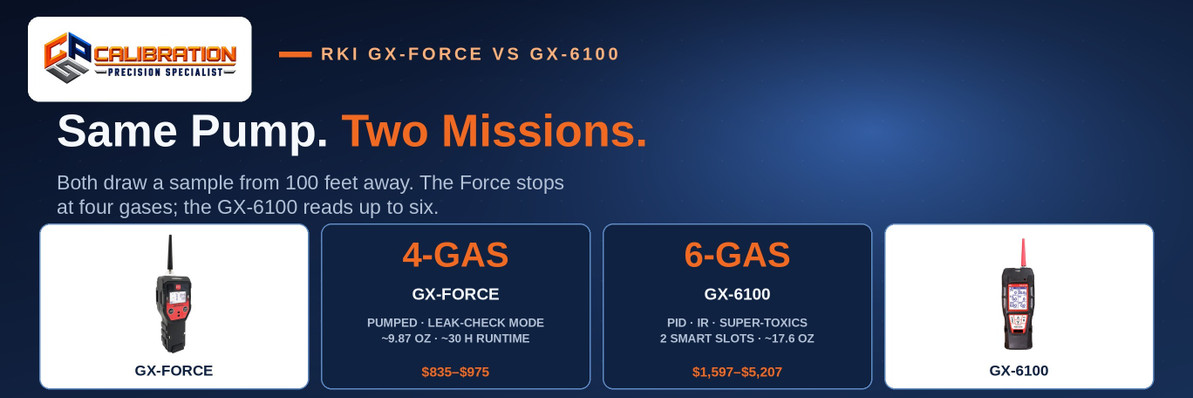
Both of these RKI instruments draw a sample from up to 100 feet away — the difference is what they can read when the sample arrives: the GX-Force ($835–$975) is a dedicated pumped 4-gas monitor (LEL, O₂, CO, H₂S) with a leak-check mode and about 30 hours of runtime, while the GX-6100 ($1,597–$5,207) carries the standard four plus two interchangeable smart-sensor slots — PID, infrared, or super-toxic sensors — for up to six gases at once. If the job is four gases and a hose, buy the Force; if the job names VOCs, benzene, or a fifth or sixth gas, only the GX-6100 can read it.
This is the cleanest comparison in the RKI pumped line, because the pump is not the question — both pull 100 feet. The question is channel count and sensor technology, and the price gap (roughly $760 at the bottom, over $4,000 at the top) is exactly the price of those two extra slots. Here is what each instrument actually is, from the live store records for the GX-Force and the GX-6100.
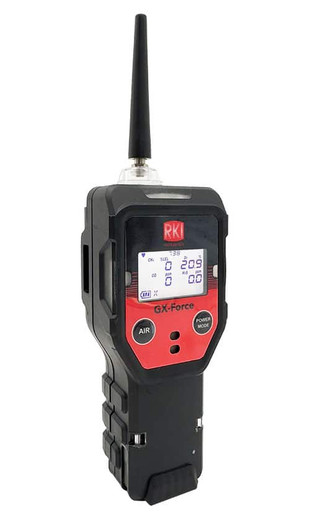
RKI GX-Force Pumped 4-Gas Monitor – LEL, O₂, CO & H₂S
Both pump to 100 ft. The GX-Force is a dedicated pumped 4-gas at $835–$975; the GX-6100 adds two smart slots — PID, IR, toxics — up to 6 gases at $1,597–$5,207. Compared.
$835–$975 configured
See the GX-ForceWhat Do the GX-Force and GX-6100 Share?
The pumped core. Both have an internal sample-draw pump rated to a 100-foot sampling range (GX-Force nominal flow 0.5 L/min; GX-6100 approximately 0.45 L/min), both read the standard confined-space four — LEL 0–100%, O₂ 0–40.0% vol., CO 0–2,000 ppm, H₂S 0–200 ppm — both are IP67 dust- and water-resistant, both log data, both alarm audibly, visually, and by vibration, and both are built for the same headline work: testing a space before entry and investigating atmospheres a worker should not walk into untested. They live side by side among pumped monitors for a reason.
What Is the GX-Force Built to Do?
One job, done light. The GX-Force is a pumped 4-gas personal and entry monitor: about 9.87 oz, approximately 30 hours of runtime in Normal Mode on its rechargeable Li-ion pack (about 20 hours in Leak Check Mode, about an 8-hour recharge, USB-C charging and data), field-replaceable sensors and filters, and a 3-year warranty. Its second mode is its signature: Leak Check Mode turns the same instrument into a combustible-gas leak investigator for valves, piping, and equipment — work the standard entry monitor does awkwardly. Configured prices run $835–$975: the variables are the charger package (AC, DC, or both) and the sampling hose and probe — no hose, or 5, 10, 15, or 20 feet of hose and probe, which adds $70–$85. Nothing else moves the price, because nothing else changes: it is a 4-gas instrument, full stop.
What Does the GX-6100 Add?
Two smart-sensor slots, and the technologies that plug into them:
- PID for VOCs — 10.6 eV in two ranges (0–40,000 ppb low range; 0–4,000 ppm high range), an 11.7 eV lamp (0–1,000 ppm), and a 10.0 eV benzene-specific option (0–50 ppm) — with a library of more than 600 VOCs and support for dual PID configurations.
- Infrared sensors — methane, hydrocarbons, and CO₂, including %volume combustible measurement options for inerted or high-concentration work.
- Super-toxic electrochemical sensors — NH₃ (0–400 ppm), Cl₂ (0–10 ppm), HCN (0–15 ppm), NO₂ (0–20 ppm), PH₃ (0–20 ppm), SO₂ (0–99.9 ppm).
Around those slots: Bluetooth and IrDA communication, man-down and panic alarms, a peak-bar display with auto-rotating screen, interchangeable Li-ion (up to about 28 hours, about a 6-hour recharge) and alkaline (about 8 hours) battery packs, IECEx/ATEX/cCSAus intrinsic-safety approvals — and about 17.6 oz of instrument with the Li-ion pack, in an IP67 case. Configured prices run $1,597–$5,207 across 250 builds, and the honest way to read that range is: the sensors you choose are the price. A 6100's cost is a configuration decision, not a sticker.
Which Pumped Monitor Fits the Job?
Buy the GX-Force when the work is confined-space pre-entry testing, personal pumped monitoring, and leak investigation on the standard four gases. It is roughly half the GX-6100's starting price, nearly 8 oz lighter, runs slightly longer per charge (about 30 hours vs. 28), and its leak-check mode is purpose-built for the valve-and-piping work that fills a lot of pumped-monitor days. For a turnaround fleet that needs many pumped 4-gas units, the arithmetic is decisive.
Buy the GX-6100 when the hazard assessment names anything beyond the four: VOC screening or benzene-specific measurement on remediation and HazMat work, chlorine or HCN channels, IR CO₂, %volume combustibles in inert atmospheres, or any job where one instrument must cover a changing list of gases by swapping smart sensors. No hose, mode, or accessory turns a GX-Force into a 5- or 6-gas instrument — the channel count is the instrument. Crews who buy the Force for four-gas work and later win VOC work buy a second instrument; crews who know VOC work is coming buy the 6100 once.
Both are instruments we sell, calibrate, and repair, within the wider portable multi-gas monitors range. We calibrate every channel — PID and smart-sensor channels included — through calibration services: the GX-Force calibrates at the flat $90 in-house 4-gas rate, and GX-6100 calibration is priced per configuration, so call and we will quote the instrument you actually own.
Frequently Asked Questions
What is the difference between the RKI GX-Force and GX-6100?
Channel count and sensor technology. Both are pumped monitors drawing from up to 100 feet and reading LEL, O₂, CO, and H₂S. The GX-Force stops there — a dedicated 4-gas instrument (about 9.87 oz, ~30-hour runtime, $835–$975) with a leak-check mode. The GX-6100 adds two interchangeable smart-sensor slots (PID, infrared, or super-toxic sensors) for up to six gases at once (about 17.6 oz, ~28-hour Li-ion runtime, $1,597–$5,207).
How much does the RKI GX-Force cost?
$835–$975 configured at CPS Calibrations. Builds start at $835 with a single charger package and no hose; adding a 5- to 20-foot hose and probe adds $70–$85, and the combined AC + DC charger builds start at $890 and reach $975 with the 20-foot hose. The gas configuration — the standard four — is the same on every build.
How much does the RKI GX-6100 cost?
$1,597–$5,207 configured, across 250 builds. The range is wide because the price is the sensors: a build is priced by which smart sensors fill its two slots (PID type and range, infrared, or toxic sensors), whether the standard four are fitted, and the battery package. Quote a GX-6100 by configuration, never by headline price.
How far can the GX-Force and GX-6100 pump a sample?
Up to 100 feet for both. The GX-Force's internal pump runs at a nominal 0.5 L/min (minimum suction 0.35 L/min); the GX-6100's at approximately 0.45 L/min. Both are built to test a confined space or remote point before a worker enters it — the draw distance is not a reason to choose between them.
What gases can the GX-6100 detect that the GX-Force cannot?
Everything beyond the standard four. The GX-6100's two smart slots take PID sensors for VOCs (including a benzene-specific 0–50 ppm option and a 600+ VOC library), infrared sensors for methane, hydrocarbons, and CO₂, and electrochemical sensors for ammonia (0–400 ppm), chlorine (0–10 ppm), hydrogen cyanide (0–15 ppm), nitrogen dioxide (0–20 ppm), phosphine (0–20 ppm), and sulfur dioxide (0–99.9 ppm). The GX-Force reads LEL, O₂, CO, and H₂S only.
Can the GX-6100 measure benzene specifically?
Yes — that is one of its signature configurations. A 10.0 eV PID lamp with the benzene pre-filter tube setup gives a benzene-specific range of 0–50 ppm (with a 0–100 ppm VOC range on the same configuration). The GX-Force has no PID option at any price, so benzene-specific work is GX-6100 work.
How long do the GX-Force and GX-6100 batteries last?
The GX-Force runs approximately 30 hours in Normal Mode (about 20 hours in Leak Check Mode) on its rechargeable Li-ion pack, with about an 8-hour recharge via USB-C. The GX-6100 runs up to about 28 hours on its Li-ion pack (about a 6-hour recharge) or about 8 hours on the interchangeable alkaline pack — the alkaline option is the field answer when charging is not available.
Which is better for confined space entry, the GX-Force or GX-6100?
For standard four-gas pre-entry testing, the GX-Force: same 100-foot draw, same four channels, roughly half the starting price, and nearly 8 oz lighter in the hand all day. The GX-6100 earns its place at entries where the assessment adds a fifth or sixth hazard — VOCs, chlorine, HCN, CO₂ by IR — because it is the only one of the two that can read them.
How much does it cost to calibrate a GX-Force or GX-6100?
The GX-Force calibrates in-house at CPS Calibrations for $90 flat — the 4-gas rate — with ship-in billed the same. GX-6100 calibration is priced per configuration, because PID lamps and smart-sensor channels are serviced differently from the standard four; call 865-900-8844 with your configuration and we will quote it. On-site work is quoted in writing and costs more than bench work.
Can a GX-Force be upgraded to detect VOCs later?
No. The GX-Force is a fixed 4-gas instrument — there is no PID slot, smart-sensor bay, or upgrade path. VOC, benzene, infrared, and super-toxic capability exists only in the GX-6100's two smart-sensor slots. If VOC work is on your horizon, that horizon is the reason to buy the 6100 first.
The Bottom Line
Same pump, same 100-foot draw, same standard four gases — different instruments. The GX-Force ($835–$975, ~9.87 oz, ~30 hours) is the dedicated pumped 4-gas with a leak-check mode; the GX-6100 ($1,597–$5,207, ~17.6 oz, ~28 hours) adds two smart slots for PID, IR, and super-toxic sensors and reads up to six gases. Four-gas work belongs to the Force; the moment a fifth gas, a VOC, or benzene is named, it belongs to the 6100.
Speccing a pumped monitor for an entry program or a turnaround? Call CPS Calibrations at 865-900-8844 — monitors, calibration, and the CPS Calibration Program behind them, from Rockwood, Tennessee.
CPS Calibrations · 109 S. Front Street, Rockwood, TN 37854 · Calibration Services · The CPS Calibration Program
Need a calibration you can file?
In-house calibration at CPS in Rockwood, Tennessee — $55 for single-gas instruments, $90 for 4- and 5-gas — every channel, as-found and as-left data, full certificate.
See Calibration Servicesor call 865-900-8844
Recent Posts
-

What Is Remote Monitoring for Fixed Gas Detection?
Remote monitoring for fixed gas detection means a fixed system's live readings, trends, and alarm hi …Nov 23rd 2026 -

What Are the Key Differences Between the GX-6000 and GX-6100?
The RKI GX-6100 is the current replacement for the discontinued GX-6000: both are pumped 6-gas monit …Nov 22nd 2026 -

How to Read a PID Correction Factor Chart
To read a PID correction factor chart, find your vapor’s row, take the factor under your own lamp en …Nov 21st 2026