
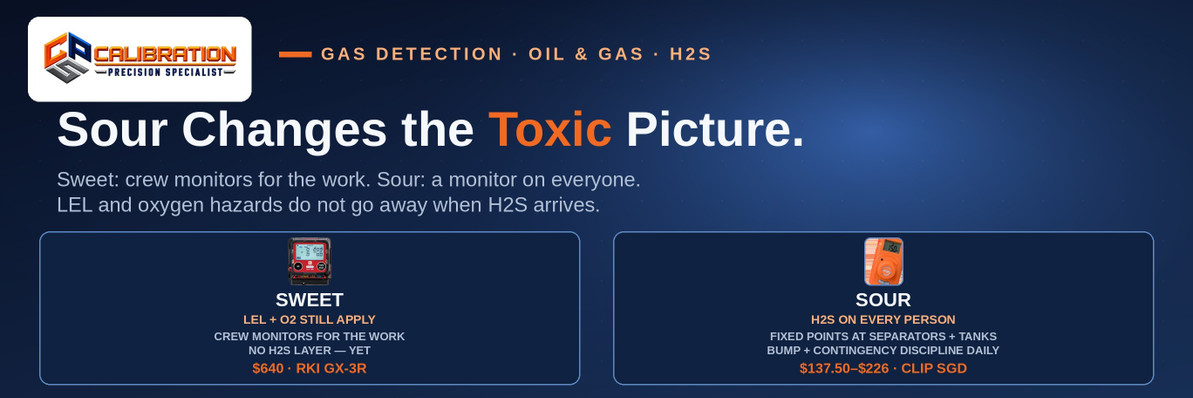
Sour vs. Sweet Wells: How H2S Changes Your Gas Detection Program
A sour well puts a personal hydrogen sulfide (H2S) monitor on every person on location — not just the crew doing the work — and adds fixed H2S points at separators, tanks, and low spots, because at 100 ppm H2S shuts off the sense of smell, the only warning an unmonitored person has. A sweet well still needs LEL and oxygen monitoring; going sour changes the toxic picture, it does not remove the flammable and oxygen hazards that were already there.
That is the change in two sentences. Everything below is what it means in practice: who gets a monitor, where the fixed points go, what happens to training and bump discipline, and — just as important — what does not change when a field turns sour.
What Do "Sour" and "Sweet" Actually Mean?
The words describe the gas, not the well's mood. A sweet well produces gas with little or no hydrogen sulfide in it. A sour well produces gas that contains H2S — the rotten-egg gas that is toxic at concentrations far below anything flammable. The iron, the process, and the crew can be identical on both. What changes is one line on the gas analysis, and that one line changes who needs protection: on a sweet well the hazard is mostly where the work is; on a sour well the hazard can be anywhere the gas can travel or collect, which is the whole location.
Why Does H2S Change Who Wears a Monitor?
On a sweet well, personal monitoring usually follows the task: the hands doing work that can release gas wear monitors, and that is a defensible program. H2S breaks it for three reasons:
- It travels and collects. H2S moves with the gas stream and with the wind, and it settles into low spots — cellars, sumps, tank areas, and depressions — away from the work that released it. A person can walk into it without doing anything that looks like "gas work": a delivery driver, an inspector, a water hauler, a visitor being shown around.
- The nose is not a backup. People smell H2S at very low concentrations, but continued exposure dulls the smell — and at 100 ppm, the concentration NIOSH classifies as Immediately Dangerous to Life or Health (IDLH), OSHA's effects table lists loss of smell within 2 to 15 minutes. An unmonitored person on a sour location has no reliable warning at exactly the concentrations where warning matters most.
- There is no task boundary. A toxic release does not check who was assigned to the job. If H2S can be present anywhere on location, the monitor rule has to be location-wide, not crew-wide.
That is why sour programs monitor everyone on location — employees, contractors, drivers, and visitors included — and why the batch companion post, H2S in oil and gas: why every hand on location wears a monitor, treats the personal H2S monitor as non-negotiable rather than as crew equipment.
What Does the Sour Personal-Monitor Program Look Like?
Use this when a field, lease, or facility is classified sour, or when H2S shows up in a stream that used to run sweet:
- A personal H2S or multi-gas monitor on every person, in the breathing zone. The low-cost end is a disposable single-gas H2S unit such as the Crowcon Clip SGD ($137.50–$226) — the right shape for visitors, drivers, and short-rotation hands, because there is nothing to service or swap. Crew who also face LEL and oxygen hazards carry a 4-gas monitor such as the RKI GX-3R ($640), which covers LEL, O2, CO, and H2S in one instrument. Browse single-gas monitors and portable multi-gas monitors for the current range.
- Monitors issued at the gate, not at the toolbox. If the rule is everyone, the handout point is entry to the location — a monitor picked up after the first hour on site protects nobody during that hour.
- Spares at the location. A sour program with exactly enough monitors has a plan for the first unit that fails a bump test or dies mid-shift: that person leaves location, or a spare goes on. There is no third option that keeps them monitored.
Where Do Fixed H2S Points Go on a Sour Location?
Personal monitors warn the person wearing them. Fixed points watch the places gas reaches first, and they warn people who have not arrived yet. On a sour location, the priority points are the release and collection points:
| Location | Why it gets a point |
|---|---|
| Separators | First place the produced stream is opened up and pressure is dropped — a classic release point |
| Storage tanks | Vapor space and thief-hatch work put people at openings where H2S comes out |
| Low spots — cellars, sumps, pits | H2S collects low; these are the places a person descends into the gas |
| Wellhead / production manifold area | The source itself, and the area hands work in most |
| Enclosed or semi-enclosed process areas | Gas that would disperse outdoors accumulates instead |
A fixed point is built from a detector head — the Crowcon Xgard family runs $784–$2,016 depending on gas and housing, and the SENKO SI-200E is $950 — reporting to a controller such as the RKI Beacon 110 ($1,275, single channel), which can sound alarms where people will hear them and trigger ventilation or shutdown through its relays. The general placement and layering logic is in fixed vs. portable gas detection and the full fixed systems range. Wiring, mounting, and commissioning depend on the location and are quoted in writing after a site review — there is no honest catalog price for an installed point.
What Changes About Training and Bump Discipline?
On a sweet well, a weak bump habit is a program flaw. On a sour well, it is a person relying on an unverified instrument against a gas that removes their backup warning. Going sour should tighten three things:
- Bump test before each day's use — every monitor, every person. That is OSHA's guidance, following the ISEA position, and on a sour location it includes the visitor and driver units, not just crew instruments. A disposable that fails, or a 4-gas that fails, is replaced from the spares before that person works — not noted and carried anyway.
- Training covers people who never had gas training before. The everyone rule pulls in office visitors, delivery drivers, and contractors from other trades. Their training can be short, but it has to cover what the alarm means, what to do when it sounds — leave, upwind, and report — and the one fact that saves lives: a fading rotten-egg smell is not the gas clearing.
- Calibration stays on schedule, on every channel. Full calibration at the manufacturer's interval, and whenever a bump test fails. CPS calibrates every channel on an instrument, not just the channel that was questioned — in-house calibration is $55 for a single-gas instrument and $90 for a multi-gas instrument, and those are in-shop rates; on-site work is quoted in writing. Every calibration gas cylinder we sell carries a QR code that opens its SDS and Certificate of Analysis, so the gas behind a bump or calibration is traceable — and CPS never charges a hazmat fee on calibration gas.
What About Contingency Planning and Breathing Air?
At program level — and this post stays at program level on purpose — a sour location needs thinking done before the first alarm, not during it:
- A written H2S contingency plan for the location: who is accounted for and how, where people muster, how a release is communicated to everyone on site including visitors, and who is authorized to do what. The monitor program feeds it — alarms are only useful if every person hearing one knows the plan it triggers.
- Breathing-air awareness, not improvisation. Where the contingency plan contemplates work or rescue in atmospheres that could exceed safe H2S levels, supplied breathing air and the training and medical/fit programs behind it are part of the operator's H2S program — planned, equipped, and trained in advance by qualified people. That is a specialist program of its own; this post deliberately does not turn it into a how-to, and no detector purchase substitutes for it.
- Detectors are the warning layer of that plan, not the plan itself. Monitors tell people to execute the contingency plan early, while escape is still easy. A location whose whole H2S plan is "the meters will alarm" has a warning system, not a contingency plan.
What Does NOT Change When a Well Goes Sour?
This is the honest half of the comparison, and the half that gets skipped:
- LEL is still there. Sour gas is still produced hydrocarbon gas. The flammable hazard at the wellhead, separator, and tanks did not shrink because a toxic one appeared beside it — which is why crew instruments stay 4-gas, not H2S-only.
- Oxygen is still there. Cellars, tanks, and enclosed spaces on a sour location carry the same oxygen-displacement and enrichment hazards as on a sweet one, and pre-entry testing still calls for a pumped instrument such as the RKI GX-Force ($835–$975) or the pumped SENKO SP-MGTP ($850 base) — see pumped monitors.
- Sweet never meant safe. A sweet well with an LEL release or an oxygen-deficient cellar can still kill a crew. Sour changes the toxic picture — who must be monitored, where fixed points go, how seriously the plan is drilled — not the existence of the underlying program.
Sour vs. Sweet, Side by Side
| Program element | Sweet well | Sour well |
|---|---|---|
| Who wears a personal monitor | Crew exposed by their task | Everyone on location — crew, contractors, drivers, visitors |
| Personal instrument | 4-gas for exposed crew | H2S single-gas for everyone else ($137.50–$226 disposable) + 4-gas for crew ($640 GX-3R) |
| Fixed detection | At known LEL/O2 hazards as laid out | Adds fixed H2S points at separators, tanks, wellhead, and low spots |
| Bump discipline | Before each day's use | Before each day's use — enforced location-wide, spares on site |
| Training | Crew gas training | Adds location-wide H2S awareness for every entrant |
| Contingency / breathing air | Site emergency plan | Written H2S contingency plan; breathing-air program planned in advance |
| Hazards still monitored | LEL, O2, CO as applicable | LEL, O2, CO — plus H2S; nothing comes off the list |
Frequently Asked Questions
What is the difference between a sour well and a sweet well? A sweet well produces gas with little or no hydrogen sulfide in it; a sour well produces gas containing H2S, a gas that is toxic at concentrations far below flammable levels. The equipment and process can be identical. The difference is the toxic hazard: on a sour well, H2S can travel and collect away from the work, so the detector program has to cover the whole location instead of only the crew doing the work.
Does everyone on a sour well location really need a personal monitor? Yes — that is the central change a sour classification makes. H2S does not stay at the workface; it moves with the gas and the wind and collects in low spots, so drivers, inspectors, visitors, and contractors can walk into it without doing any gas work themselves. At 100 ppm H2S removes the sense of smell, so an unmonitored person has no reliable warning. A disposable single-gas H2S monitor at $137.50–$226 is the low-cost way to cover everyone who does not need a full 4-gas instrument.
What gas detector should workers wear on a sour well? Crew exposed to the full hazard set wear a 4-gas monitor — LEL, oxygen, CO, and H2S — such as the RKI GX-3R at $640, worn in the breathing zone. Everyone else on location wears at minimum a personal H2S monitor; a disposable single-gas unit such as the Crowcon Clip SGD at $137.50–$226 covers that role with nothing to service or swap. The rule is not one model for all — it is no person on location without a working, bump-tested monitor for the gas that defines the location.
Where should fixed H2S detectors be placed at a sour well? At the release and collection points: separators, where the produced stream is first opened up; storage tanks, especially around vapor openings; the wellhead and production manifold area; low spots such as cellars, sumps, and pits where H2S collects; and any enclosed or semi-enclosed process area where gas can accumulate instead of dispersing. Points are detector heads — $784–$2,016 for the Crowcon Xgard family, $950 for a SENKO SI-200E — reporting to a controller such as the $1,275 single-channel RKI Beacon 110.
Can you smell H2S and just leave if it gets strong? No — smell is the warning H2S takes away. It is detectable by odor at very low concentrations, but continued exposure causes olfactory fatigue that dulls the smell, and at 100 ppm — the NIOSH IDLH — OSHA's table lists loss of smell within 2 to 15 minutes. A fading rotten-egg smell usually means the nose has quit, not that the gas has cleared. The only reliable warning is an instrument, which is why sour programs monitor everyone instead of trusting anyone's nose.
Do sweet wells need gas detectors at all? Yes. Sweet describes the absence of significant H2S, not the absence of hazard. A sweet well still produces flammable hydrocarbon gas (LEL) and still has cellars, tanks, and enclosed spaces where oxygen can be displaced or enriched. Crew doing gas-exposed work still wear personal monitors, and confined and low spaces still get tested with a pumped instrument before entry. Sour adds a toxic layer to that program; it does not create the program from nothing.
What happens to bump testing when a well goes sour? The standard does not change — a bump test before each day's use, following OSHA guidance and the ISEA position — but the enforcement net widens. On a sour location every monitor gets bumped, including visitor and disposable units, a failure is replaced from on-site spares before that person works, and full calibration stays on schedule at the manufacturer's interval on every channel. The difference is that an unverified monitor on a sour location is backing up a warning system — the nose — that the gas itself disables.
How much does it cost to put an H2S monitor on everyone at a well site? At the instrument level, a disposable single-gas H2S monitor runs $137.50–$226 per person, and a full 4-gas monitor for crew runs $640 per person at the RKI GX-3R level. Add the program behind them: calibration gas for bump tests and calibrations, spares so a failed unit never leaves a person unmonitored, and scheduled calibrations — $55 single-gas and $90 multi-gas for in-house calibration at CPS. Fixed H2S points are priced per point plus controller and installation after a site review.
What is an H2S contingency plan, in plain terms? It is the written plan for what happens when H2S is released on that specific location: how everyone on site — including visitors and drivers — is warned and accounted for, where they muster, who communicates what, and who is equipped and trained to respond. Personal and fixed detectors are the warning layer that triggers the plan early. This post covers the plan at program level only; breathing-air and rescue work inside it belong to a specialist H2S program, planned and trained in advance, not improvised from a blog post or a detector purchase.
When a sweet well starts producing H2S, what should change first? The monitor rule, on day one: everyone on location gets a personal monitor, issued at entry, with spares on site — before the first full shift works the new stream. Then, in order: fixed H2S points laid out at separators, tanks, wellhead, and low spots; location-wide H2S awareness for every entrant, including the smell-fatigue fact; bump discipline enforced for every unit; and the written contingency plan updated to the sour hazard. LEL and oxygen monitoring already in place stays in place — nothing comes off the list when H2S goes on it.
The Bottom Line
Sour does not replace the sweet-well detector program — it widens it. The day H2S enters the stream, the monitor rule goes from "the crew doing the work" to "every person on location," fixed H2S points go in at the separators, tanks, and low spots, and bump testing, training, and contingency planning become location-wide discipline. The LEL and oxygen hazards that justified the original program are still there underneath, unchanged — sour changes the toxic picture, not the whole program.
Reclassifying a field, or not sure your current program covers a sour stream? Call 865-900-8844 or reach us through Contact Us. We will walk the monitor list with you — single-gas monitors, portable multi-gas monitors, fixed systems, calibration gas with QR-linked SDS and CoA on every cylinder and no hazmat fee, and calibration services that calibrate every channel.
CPS Calibrations · 109 S. Front Street, Rockwood, TN 37854 · Calibration Gas · Calibration Services · Contact Us
Need a calibration you can file?
In-house calibration at CPS in Rockwood, Tennessee — $55 for single-gas instruments, $90 for 4- and 5-gas — every channel, as-found and as-left data, full certificate.
See Calibration Servicesor call 865-900-8844
Recent Posts
-

What Is Remote Monitoring for Fixed Gas Detection?
Remote monitoring for fixed gas detection means a fixed system's live readings, trends, and alarm hi …Nov 23rd 2026 -

What Are the Key Differences Between the GX-6000 and GX-6100?
The RKI GX-6100 is the current replacement for the discontinued GX-6000: both are pumped 6-gas monit …Nov 22nd 2026 -

How to Read a PID Correction Factor Chart
To read a PID correction factor chart, find your vapor’s row, take the factor under your own lamp en …Nov 21st 2026