
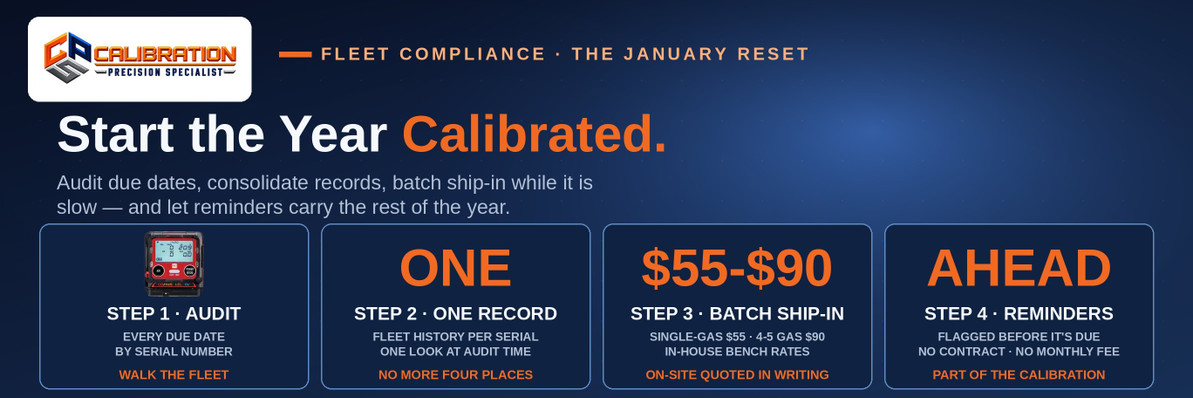
Start the Year Calibrated: The January Compliance Reset
The January compliance reset works like this: in the year's slowest month, audit every instrument's calibration due date, pull the whole fleet's records into one history, batch ship-in the instruments that are due while operations are slow — bench-calibrated at CPS in-house rates of $55 for a single-gas instrument and $90 for a 4- or 5-gas instrument — and set the reminder cadence that will flag each next due date for the rest of the year. Done once, in January, it turns calibration compliance from a year of surprises into a schedule you already hold.
Every fleet has the same failure pattern, and it never happens in January. It happens in the busiest week of the year: a confined-space job is loading out, someone reads a calibration sticker, and three instruments are past due — with the audit trail to match. Nothing about that week caused the problem. The problem was a due date nobody saw coming, in a fleet whose records lived in four places. January is when that gets fixed, precisely because January is when most operations can spare the instruments. This post is the reset, step by step — and it is deliberately evergreen: it works the same every January, so save it and run it again next year. It builds on the CPS Calibration Program, and the ship-in mechanics are covered in full in how mail-in gas detector calibration works.
Step 1 — Audit Every Due Date in One Sitting
Walk the fleet physically, instrument by instrument, and write down three things for each: model, serial number, and the calibration due date from its sticker or last certificate. Serial number is the key that makes everything after this step possible — records, reminders, and history all hang off it. Expect the audit to find the usual three buckets: instruments comfortably in date, instruments due inside the quarter (these become the January batch), and the honest embarrassments — instruments past due, instruments nobody can find a record for, and instruments nobody knew the fleet owned. All three buckets are better found by you in January than by an auditor in any other month.
Step 2 — Pull the Fleet's Records Into One Place
Scattered records are why due dates ambush people: last year's certificates in an email inbox, the year before in a filing cabinet, a spreadsheet one person maintains. The reset move is to consolidate — one record per instrument, by serial number, holding its whole history. That is exactly the structure of CPS's fleet calibration history: every instrument CPS calibrates carries one history that builds calibration by calibration, so at any future audit the answer for any serial number is one look, not a search party. Instruments calibrated elsewhere in the past are not a problem — start their consolidated record with the January calibration and let it build from there.
Step 3 — Batch Ship-In While Operations Are Slow
Send the due and past-due instruments in together, in the slow weeks, instead of one at a time as each sticker gets noticed during the busy season. Batching in January buys three things: the instruments are genuinely spareable now, the whole fleet comes back onto a small number of shared due dates (which makes next year's audit trivial), and the work is done at published in-house bench rates — $55 for a single-gas instrument, $90 for a 4- or 5-gas instrument. Ship to CPS Calibrations, 109 S. Front Street, Rockwood, TN 37854 — instrument and charger, no calibration gas cylinders — after a call to 865-900-8844 to confirm the bench queue. We calibrate every channel each instrument carries, record as-found readings before adjustment, and return each instrument with a certificate showing as-found and as-left data and the calibration-gas Certificate of Analysis trail. Two honest boundaries: those rates are in-house rates — on-site work is quoted in writing and never billed at $55/$90 — and return shipping is the customer's cost, arranged when the service is booked.
Step 4 — Set the Year's Reminder Cadence
A reset that ends when the boxes come back will decay by summer. The durable part is the reminder system: every instrument in the CPS Calibration Program gets calibration due-date reminders before its next date arrives — flagged while there is still time to schedule, not after an audit finds it expired. There is no contract and no monthly fee for the program; the record and the reminders come with the calibration. Pair that with one internal habit — whoever receives the reminder owns booking the shipment that week — and the fleet's compliance stops depending on anybody's memory, including yours.
What Does the Reset Cost? a Worked Example
At the published in-house rates, the arithmetic is plain. A fleet of ten 4-gas instruments batch-calibrated in January is 10 × $90 = $900 in calibration service. A mixed fleet — say six 4-gas instruments and four single-gas instruments — is (6 × $90) + (4 × $55) = $760. Add the shipping in both directions at the customer's cost, and any sensor or repair an instrument turns out to need — which, if it happens, is quoted in writing for your approval before the work is done, never folded silently into a calibration bill. Against that, price the alternative honestly: one past-due instrument found during permitted work costs the job delay, the expedited scramble, and the audit conversation — in the busiest month, not the slowest.
Frequently Asked Questions
What is a January compliance reset for gas detectors?
It is a once-a-year fleet routine done in the slow month: audit every instrument's calibration due date by serial number, consolidate the fleet's records into one history per instrument, batch ship-in the instruments that are due or past due for bench calibration, and set the reminder cadence that flags each next due date through the year. Run every January, it replaces a year of due-date surprises with one planned week of work.
How much does in-house calibration cost during the reset?
The published CPS in-house rates are $55 for a single-gas instrument and $90 for a 4- or 5-gas instrument, whether the instrument is shipped in or dropped off at the Rockwood bench. A fleet of ten 4-gas instruments is therefore $900 in calibration service; a mixed fleet of six 4-gas and four single-gas instruments is $760. Shipping is separate, and any sensor or repair work is quoted in writing before it is done.
Are the $55 and $90 rates also the price for on-site calibration?
No. $55 and $90 are in-house bench rates, and they are stated that way every time. On-site calibration — a technician coming to your facility — is quoted in writing for the job and is never billed at the in-house rates. The January reset is deliberately a ship-in exercise, which is what makes the published flat rates possible.
How do I audit due dates if my calibration records are scattered?
Start from the instruments, not the paperwork: walk the fleet, record model, serial number, and the due date on each instrument's sticker or last certificate, and let that list expose which records are missing. Then consolidate going forward — one history per instrument by serial number, as in CPS's fleet calibration history — beginning with the January calibrations, so next year's audit starts from one place instead of four.
Can I ship several gas detectors in for calibration at once?
Yes — batching is the point of the reset. Send the due and past-due instruments together in the slow weeks, each with its charger and a note giving your company, a contact, and each instrument's serial number. Do not send calibration gas cylinders; CPS calibrates with its own documented gas. Call 865-900-8844 first to confirm the rate and the current bench turnaround for the batch.
What records do I get back from a ship-in calibration?
A full certificate for each instrument — one tier, with the complete breakdown: as-found readings recorded on arrival and as-left readings after calibration, for every channel the instrument carries, plus a Certificate of Analysis link for each calibration gas bottle used. That certificate starts (or continues) the instrument's consolidated history in the CPS Calibration Program.
How do calibration reminders work for the rest of the year?
Every instrument CPS calibrates is kept in the program by serial number, and due-date reminders reach you before the next calibration comes due — early enough to schedule the shipment in a quiet week rather than discover the date during an audit or a load-out. There is no contract and no monthly fee; the reminders and the history come with the calibration.
What happens if an instrument needs a sensor or repair during the reset?
You find out in writing before money moves. The bench records as-found readings first; if an instrument cannot be calibrated back into specification, the work it needs — a sensor, a part, a repair — is quoted in writing for your approval. Approve it and the instrument returns repaired and calibrated; decline it and it returns as-is with its as-found documentation, which is a factual basis for a repair-or-replace decision.
Do I need a contract or a program subscription to do this?
No. The CPS Calibration Program carries no contract and no monthly fee — the per-instrument history and the due-date reminders are part of the calibration service itself. The reset is simply a January batch of ship-in calibrations at the published $55 and $90 in-house rates, plus the record-keeping that comes with them.
Our slow month is not January. Does the reset still work?
Yes — January is the common case, not a rule. The reset works in any month when your operations can spare the fleet for a bench turnaround: audit the due dates, consolidate the records, batch the ship-in, set the reminders. What matters is picking the same slow month every year and running it on schedule, so due dates cluster where you can handle them.
The Bottom Line
Compliance is cheapest in the slowest month. Audit the fleet by serial number, pull its records into one history, batch ship-in what is due at $55 single-gas and $90 for 4- and 5-gas in-house rates, and let reminders carry the rest of the year — and next January, the whole reset takes an afternoon, because this January built the system it runs on.
Start your reset with one call: CPS Calibrations at 865-900-8844, 109 S. Front Street, Rockwood, TN 37854.
CPS Calibrations · 109 S. Front Street, Rockwood, TN 37854 · The CPS Calibration Program · How Mail-In Gas Detector Calibration Works · Fleet Calibration History
Ready to mail yours in?
Start the ship-in request, pack the meter, and we handle the rest — every channel calibrated as configured, full certificate returned with it.
Start Your Ship-In Requestor call 865-900-8844
Recent Posts
-

What Is Remote Monitoring for Fixed Gas Detection?
Remote monitoring for fixed gas detection means a fixed system's live readings, trends, and alarm hi …Nov 23rd 2026 -

What Are the Key Differences Between the GX-6000 and GX-6100?
The RKI GX-6100 is the current replacement for the discontinued GX-6000: both are pumped 6-gas monit …Nov 22nd 2026 -

How to Read a PID Correction Factor Chart
To read a PID correction factor chart, find your vapor’s row, take the factor under your own lamp en …Nov 21st 2026