
How Do You Store a Gas Detector Between Jobs?
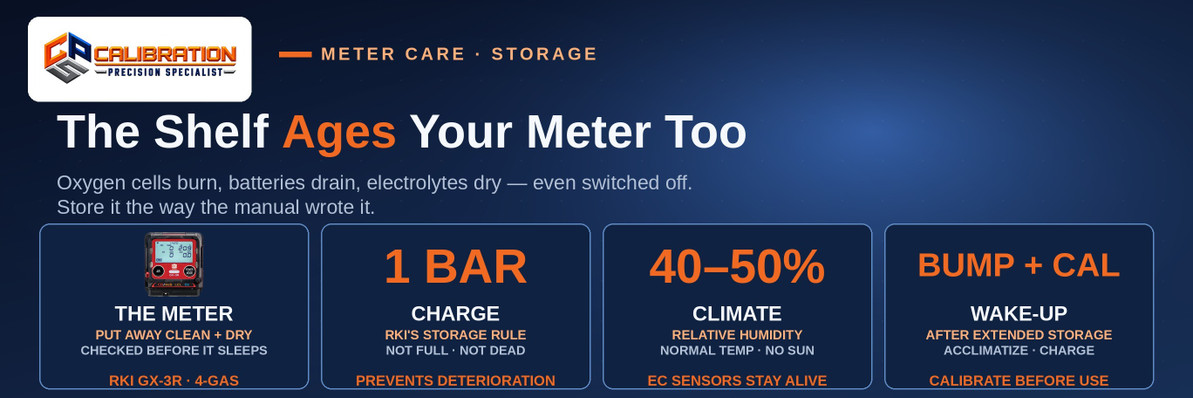
Store a gas detector between jobs indoors at normal temperature and humidity, out of direct sunlight and away from gases, solvents, vapors, and dust — and put it away with the battery run down, not full: RKI's GX-3R manual instructs users to discharge the battery to 1 bar on the battery icon for storage, to prolong battery life and prevent battery deterioration. Storage does not pause the meter's clocks — the oxygen sensor keeps consuming itself in room air and the battery keeps draining while the instrument is off — so charge it, bump test it, and calibrate it before it goes back to work after extended storage.
Most gas detectors do not die on the job. They die in the drawer, the job box, and the truck cab — slowly, quietly, and on a schedule nobody wrote down. The crew pulls the meter out for the first entry of the season, it fails its bump test or will not span on the oxygen channel, and the post-mortem usually blames the sensor. The sensor is only the messenger. What actually happened is months of storage doing exactly what storage does to electrochemical sensors and lithium-ion batteries when nobody manages it. This post is the storage routine the manuals actually describe — the charge level, the climate, the places to never leave a meter, and the wake-up checks that decide whether a stored instrument goes back to work or goes in for a sensor. It applies to any portable, from the RKI GX-3R to the SENKO SP-MGT and the rest of the portable multi-gas monitors CPS sells and services.
Why Does a Turned-Off Gas Detector Still Age in Storage?
Because three separate clocks keep running with the power off, and none of them cares that the display is dark:
- The oxygen sensor is burning itself to measure. A galvanic oxygen cell produces its signal by consuming a lead anode in the presence of oxygen — and room air is 20.9% oxygen whether the meter is on a collar or in a cabinet. That is why a typical portable oxygen sensor lasts 1–2 years total, shelf time included, as covered in why oxygen sensors die. Storage cannot stop that clock; it can only stop feeding it heat.
- The battery drains while the instrument sleeps. RKI states it plainly in the GX-3R manual: the instrument draws a small amount of power even while shut off, keeping its clock and internal processes alive. A GX-3R put away with a full battery can sit for 3 years before it loses power; the same meter put away already in low-battery alarm lasts about 3 months — and if it fully dies in storage, it wakes up with a clock failure and the wrong date and time in every record until someone resets it.
- Electrochemical electrolytes dry out. The CO, H2S, and other toxic sensors in a portable are electrochemical cells with an aqueous electrolyte. In dry air that electrolyte slowly evaporates through the sensor's membrane, and sensitivity goes with it. Industrial Scientific's maintenance guidance is blunt: dry winter air can damage some electrochemical sensors more than cold does, and storing and charging instruments at 40–50% relative humidity is what keeps the cells healthy. A meter stored for a season in a heated, bone-dry shop is aging its toxics channels the whole time.
Add a fourth, mechanical clock for pumped instruments: RKI's storage chapter says that for long-term storage the instrument should be turned on every 6 months and the pump run for at least 3 minutes, so the pump motor's grease does not solidify. A pump that sat seized for a year does not announce itself until the morning it is asked to pull a sample from the far end of a confined space.
What Charge Should You Store a Gas Detector At?
Run it down to about one bar — do not store it full, and never store it dead. This is the instruction that surprises people, because the instinct is to top the meter off so it is "ready." RKI's GX-3R storage chapter says the opposite, in so many words: discharge the battery to 1 bar in the battery icon, to help prolong battery life and prevent battery deterioration. A lithium-ion pack held at full charge for months sits at its highest cell voltage the whole time, which is exactly the state that ages the chemistry fastest. The one-bar rule is the detector version of the mid-charge storage every lithium-ion manufacturer recommends — low enough to rest the cells, high enough that months of slow self-discharge cannot drag the pack into deep discharge.
The two failure modes bracket that middle:
- Stored dead or nearly dead: the slow off-state drain finishes the job. On the GX-3R the manual's numbers are about 3 months from low-battery alarm to fully flat — after which the clock fails and, on many instruments, a deeply discharged lithium-ion pack may refuse a normal charge or never recover its capacity. Lead-acid packs are even less forgiving: Crowcon's Detective+ area-monitor manual warns that the unit should never be left fully discharged for more than a week, because it significantly shortens the pack's life.
- Stored full on the charger: weeks of sitting at 100% in a warm charging room combines the two worst storage inputs — full voltage and heat — and shows up later as a runtime problem, the subject of how long gas detector batteries really last.
One exception to file correctly: disposable single-gas monitors that run continuously by design are not charged or switched off at all — for those, storage is purely a climate question (below), and cool, dry, and out of the sun is what stretches their fixed service life. For everything rechargeable, the routine is: finish the job, clean the meter, run or charge it to roughly one bar if it will sit more than a few weeks, and write the date on the case tag.
What Temperature and Humidity Should You Store a Gas Detector At?
Normal indoor temperature and humidity — the manual's own words — out of direct sunlight. RKI's storage list is short enough to tape to the cabinet door: away from direct sunlight; normal temperature and humidity; free of gases, solvents, and vapors; away from dust and dirt. SENKO's MGT manual lands in the same place: store the detector in a clean, dry environment within its specified temperature range.
Put numbers around "normal" using the instruments' own envelopes:
- Temperature: the GX-3R's continuous operating range is −20°C to 50°C (about −4°F to 122°F), and its wider temporary range — up to 60°C — is rated for 15 minutes at a time, not for a summer in storage. Heat is the accelerator for every aging process in the box: the oxygen cell's chemistry, the battery's deterioration, and electrolyte evaporation all run faster hot. At the cold end, electrochemical electrolytes are aqueous and can freeze in extended storage below −20°C, the oxygen sensor typically first — a frozen cell can crack its housing and does not come back.
- Humidity: the target for the room is the 40–50% relative humidity band Industrial Scientific recommends for storing and charging, because it protects electrochemical sensors from drying out. That is a band, not a maximum: the other failure is a damp, condensing space, where moisture sits on sensor faces, corrodes contacts and charging pins, and loads filters. A climate-controlled room or office cabinet beats both the dry heated shop and the humid outbuilding.
- Charging temperature is its own limit: the GX-3R manual rates charging for ambient temperatures of 0°C to 40°C. A meter brought in from a freezing truck or a hot one should come back to room temperature before it goes on the charger — which is the same acclimatization habit the wake-up routine below depends on.
Where Should You Never Store a Gas Detector?
Four locations account for most of the early sensor and battery deaths a service bench sees:
- The truck cab, the dash, and the toolbox in the bed. A parked cab in summer sun runs far past the 50°C continuous rating and can approach the 60°C point where sensor casings themselves are at risk — while baking the battery at full or random charge. In winter the same cab is the freeze risk. The truck is transport, not storage.
- Next to solvents, paints, fuels, and cleaning chemicals. RKI's rule — store free of gases, solvents, and vapors — is a sensor-health rule, not housekeeping. Solvent vapors and silicone-bearing sprays are classic poisons for catalytic LEL sensors, and chronic low-level vapor exposure loads the filters and cells of everything stored nearby. The full list of offenders is in what happens when a sensor is poisoned.
- In the case, still dirty and damp from the last job. A meter sealed into its carry case wet closes the moisture in with the sensors and contacts. Wipe it down, let it dry in open air, inspect the sensor filters and the calibration cap, and only then put it away. Dust and dirt are on RKI's storage list for the same reason: a loaded filter slows the next job's response before the meter is ever switched on.
- On the shelf beside the calibration gas — treated as the same problem. Calibration gas has its own storage rules (cool, upright, regulators off), covered separately in how to store calibration gas. The shared principle is that the shelf is a system: gas, meters, and spare sensors all age there, and all three need the same cool, clean, temperate room.
How Should You Store Spare Sensors?
Spares age faster than the sensors in the meter if they are handled wrong, because most people stock them like hardware. They are chemicals with a date code:
- Leave the seal sealed. Replacement electrochemical and oxygen sensors ship in sealed, often nitrogen-flushed packaging that effectively pauses their aging. The pause ends when the seal breaks. Do not open a spare "to check it" — check the date code printed on the package instead.
- Buy few, buy fresh, rotate first-in-first-out. Most electrochemical sensors carry a stated shelf life of roughly 6 months, and a galvanic oxygen spare is consuming its 1–2-year life in room air from manufacture whether it sits in your drawer or in a distributor's. Keep only the spares your fleet size justifies, mark the delivery date on each package, and install the oldest first. When a spare does go in, the RKI oxygen sensor for the GX-3R family is the pattern: date-checked stock, installed, then calibrated — a sensor swap without a calibration after it is not a repair.
- Same climate rules as the meters: room temperature, never colder than −20°C, never near the 60°C ceiling, out of dry extremes that evaporate electrolyte through the membrane even in storage. A refrigerator is acceptable for sensor storage per manufacturer guidance; a freezer is not.
What Should You Do Before a Stored Detector Goes Back to Work?
Storage ends with a wake-up routine, not with grabbing the meter off the shelf on the way to an entry. Riken Keiki's guidance for the GX-3R line sets the spine of it: after extended storage, calibrate before resuming use — and the steps that get there are:
- Acclimatize first. If the storage location and the work location differ by 15°C or more, power the instrument on and let it stand for about 10 minutes in conditions like the work environment before any fresh-air adjustment. Zeroing a cold-soaked or heat-soaked meter and walking straight into different air builds the temperature swing into the readings. Cold-soaked instruments have their own set of behaviors, covered in what cold weather does to a gas detector.
- Charge it fully and check the clock. A full charge is for the job, not for the shelf — this is when the meter earns its 25-hour shift. If the battery died in storage, reset the date and time; every log the instrument writes carries them.
- Inspect the sample path. Sensor filters clean and dry, calibration cap and any pump and hose intact, no cracks, no loaded dust. On pumped units that sat past 6 months, the pump should already have had its 3-minute run during storage.
- Fresh-air zero, then bump test — every channel. The bump test is the verdict on the storage period: each sensor must respond to its challenge gas inside the expected time. A sluggish oxygen channel or a toxic channel that barely moves is the shelf damage showing itself while there is still time to act on it.
- Calibrate if it is due — and after extended storage, treat it as due. RKI's instruction is to calibrate after extended storage before resuming use, full stop. If the meter fails span after a proper calibration attempt, that is a sensor at the end of its life, not a storage mystery, and it gets replaced and recalibrated. If the fleet's stored units all need that bench work at once, that is exactly what CPS's in-house calibration handles — every channel, as-found and as-left, full certificate — through calibration services or by shipping the instruments in.
Frequently Asked Questions
How should you store a gas detector when it is not in use?
Store it indoors at normal temperature and humidity, out of direct sunlight, away from gases, solvents, vapors, dust, and dirt — the storage list in RKI's GX-3R manual — after wiping it clean and letting it dry. Put rechargeable models away at about one bar of battery rather than full, tag the case with the date, and keep the room near 40–50% relative humidity so the electrochemical sensors do not dry out.
Should you store a gas detector fully charged?
No. RKI's GX-3R manual instructs users to discharge the battery to 1 bar on the battery icon for storage, to prolong battery life and prevent battery deterioration — a lithium-ion pack held at full charge for months ages faster. The other extreme is just as bad: put away dead, the GX-3R's small off-state drain flattens the pack in about 3 months, after which the instrument's clock fails.
Can you leave a gas detector in a truck?
Not as storage. A parked truck cab in summer sun exceeds the GX-3R's 50°C continuous temperature rating and can approach 60°C, the point where sensor casings are at risk, while heat accelerates oxygen-sensor consumption and battery deterioration. In winter the same cab risks freezing the aqueous electrolyte in electrochemical sensors, which can freeze in extended exposure below −20°C. Transport the meter in the truck; store it in a climate-controlled room.
Does a gas detector battery drain in storage?
Yes. RKI states that the GX-3R draws a small amount of power even while shut off, for its clock and internal processes. Its manual gives the storage endurance directly: a GX-3R stored with a full battery can hold power for 3 years, while one stored with the battery already in low-battery alarm lasts about 3 months — and if it loses power completely, the date and time must be reset before the logs it writes are trustworthy.
Do gas detector sensors go bad in storage?
Yes — the oxygen sensor fastest. A galvanic oxygen cell consumes its lead anode whenever it is exposed to air, installed or not, so its typical 1–2-year life includes shelf time. Electrochemical toxic sensors lose electrolyte to evaporation in dry storage, which costs sensitivity, and spare sensors carry a stated shelf life of roughly 6 months. Heat speeds up every one of these processes.
What temperature should you store a gas detector at?
Normal room temperature, out of direct sunlight — inside the instrument's own envelope, not at its edges. The GX-3R is rated for continuous use from −20°C to 50°C, and its 60°C temporary rating covers 15 minutes, not a summer on a shelf. Keep storage well away from both extremes: sustained heat accelerates sensor and battery aging, and extended storage below −20°C can freeze electrochemical electrolytes, the oxygen sensor first.
How long can a gas detector sit unused?
Months, if it is stored correctly — charged to about one bar, in a temperate, moderately humid room, and woken up on schedule. Pumped instruments should be turned on every 6 months and the pump run for at least 3 minutes so its motor grease does not solidify, per RKI's storage chapter. Whenever it comes back out after extended storage, it needs the full wake-up: acclimatize, charge, inspect, bump test, and calibrate.
Should you remove the battery from a gas detector for storage?
On most modern portables there is nothing to remove — the GX-3R's lithium-ion pack, for example, is not user-replaceable, and the manual's storage method is to discharge it to 1 bar in the instrument. Where a model does use removable alkaline cells or a detachable pack, follow that model's manual; the goal is the same in every case — the pack must neither sit at full charge for months nor be allowed to drain completely flat.
Do you have to calibrate a gas detector after storage?
After extended storage, yes. Riken Keiki's guidance for the GX-3R is to perform calibration before resuming use after a period of extended storage, and the bump test comes first in the same routine: zero in fresh air, challenge every channel with gas, and calibrate when the meter is due or responds weakly. A sensor that will not span after calibration is at the end of its life and gets replaced, not stored again.
How do you store spare gas detector sensors?
Leave each spare in its sealed packaging — the seal, often nitrogen-flushed, is what pauses the sensor's aging — and store the packages at room temperature, away from heat above 60°C, freezing cold, and very dry air that evaporates electrolyte. Mark the delivery date on every package, keep only a few spares, and install the oldest first: most electrochemical sensors state a shelf life of about 6 months, and a galvanic oxygen spare is spending its 1–2-year total life from the day it was made.
The Bottom Line
A gas detector on a shelf is not paused — its oxygen cell is consuming itself in room air, its battery is draining toward a dead clock, and its toxic sensors are drying out or cooking depending on the room you chose. The manual's storage routine is short and specific: clean and dry, normal temperature and humidity around 40–50%, no sunlight, no solvents, battery at 1 bar, a pump run every 6 months, and a bump test plus calibration before the meter works again. Follow it and storage costs you nothing but the shelf. Skip it and you pay in sensors, batteries, and one bad morning at the permit desk. CPS Calibrations in Rockwood, Tennessee calibrates stored fleets back to service — every channel, as-found and as-left data, full certificate — and date-checks every replacement sensor it installs.
Need a calibration you can file?
In-house calibration at CPS in Rockwood, Tennessee — $55 for single-gas instruments, $90 for 4- and 5-gas — every channel, as-found and as-left data, full certificate.
See Calibration Servicesor call 865-900-8844
Recent Posts
-

What Is Remote Monitoring for Fixed Gas Detection?
Remote monitoring for fixed gas detection means a fixed system's live readings, trends, and alarm hi …Nov 23rd 2026 -

What Are the Key Differences Between the GX-6000 and GX-6100?
The RKI GX-6100 is the current replacement for the discontinued GX-6000: both are pumped 6-gas monit …Nov 22nd 2026 -

How to Read a PID Correction Factor Chart
To read a PID correction factor chart, find your vapor’s row, take the factor under your own lamp en …Nov 21st 2026