
What Does a 4-Gas Meter Detect — and What Can It NOT Detect?
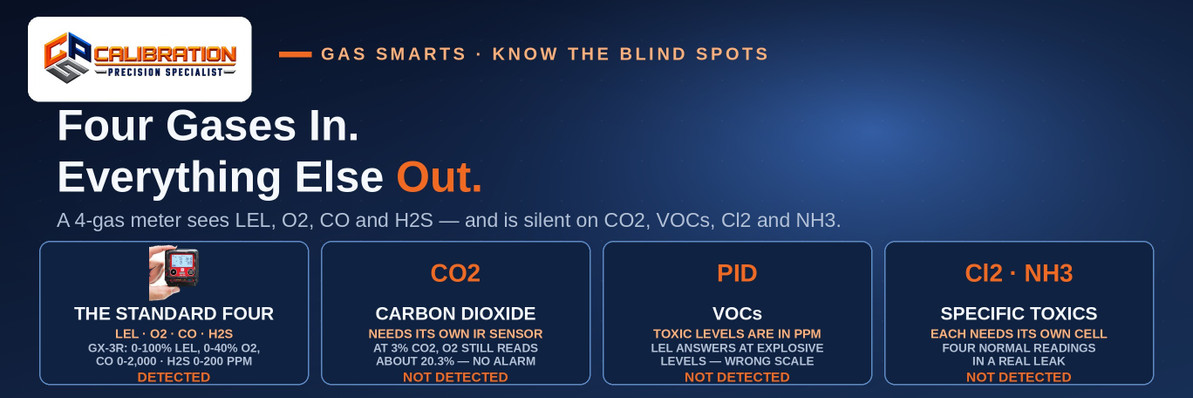
A standard 4-gas meter detects combustible gas as 0–100% LEL, oxygen at 0–40.0% by volume on the RKI GX-3R, carbon monoxide at 0–2,000 ppm, and hydrogen sulfide at 0–200 ppm — and it cannot detect carbon dioxide, VOCs at toxic levels, chlorine, ammonia, or any other gas without its own dedicated sensor.
Every buyer asks what a 4-gas meter detects. The safer question is the second half of this post's title — what it cannot detect — because most 4-gas mistakes are not failures of the four sensors fitted. They are failures of assumption: a crew walks into a space carrying a hazard the instrument was never built to see, and a quiet display gets read as safe air. This post gives both halves with the numbers attached: the standard four channel by channel, then the blind spots one by one, with the sensor each blind spot actually requires. For the shorter introduction to the four channels themselves, see what a 4-gas monitor detects.
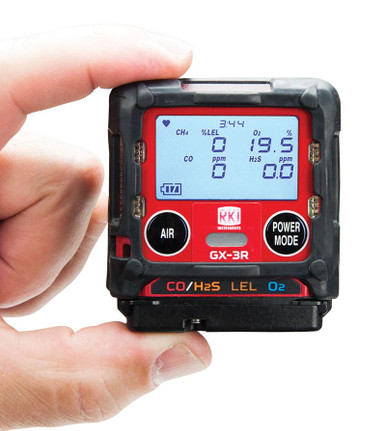
RKI GX-3R 4-Gas Monitor – LEL, O₂, CO & H₂S
The standard four in the smallest package CPS sells — diffusion personal monitor, about 25 hours per charge, 3-year warranty.
$462.40–$586.50 configured
See the GX-3RWhat a 4-Gas Meter Detects: The Standard Four
The standard four is the same across brands — RKI, SENKO, and every other maker CPS services — because it covers the three ways a bad atmosphere kills: too little oxygen to breathe, enough fuel to explode, and toxic gas that poisons at concentrations far below either of those. On the worked example used throughout this post, the RKI GX-3R, the four channels are:
| Gas / channel | Detects? | Why — and what it takes instead |
|---|---|---|
| Combustible gas (%LEL) | Yes — 0–100% LEL | Catalytic bead (or infrared on some models). Alarms typically at 10% LEL (low) and 20% LEL (high) — a command to stop and ventilate, far below the ignition threshold itself. |
| Oxygen (O₂) | Yes — 0–40.0% by volume (GX-3R) | Electrochemical cell. Fresh air is 20.9%; alarms typically at 19.5% (deficient) and 23.5% (enriched) — both directions are dangerous. |
| Carbon monoxide (CO) | Yes — 0–2,000 ppm (GX-3R) | Electrochemical cell. Typical alarm 35 ppm. CO binds hemoglobin roughly 240 times more readily than oxygen, so it poisons while the O₂ reading still shows a healthy 20.9%. |
| Hydrogen sulfide (H₂S) | Yes — 0–200 ppm (GX-3R) | Electrochemical cell. Typical alarm 10 ppm. H₂S deadens the sense of smell as it rises, so the nose is never a detection method. |
Two limits are built into even these four "yes" answers. The LEL channel does not identify which combustible gas is present — it reports %LEL of whatever mixture reaches the sensor, relative to the gas it was calibrated with, and other gases read through correction factors. And a catalytic LEL sensor needs oxygen in the sample to burn its trace of gas — in an oxygen-depleted atmosphere it under-reads, which is one reason entry procedure tests oxygen first.
What a 4-Gas Meter Cannot Detect
| Gas / channel | Detects? | Why — and what it takes instead |
|---|---|---|
| Carbon dioxide (CO₂) | No | CO₂ is toxic in its own right at a few percent — and at 3% CO₂ the oxygen reading is still about 20.3%, above the 19.5% low alarm. The O₂ sensor does not cover it. CO₂ takes a dedicated infrared sensor: a fifth channel or a dedicated CO₂ monitor, as used in breweries, dry-ice storage, and beverage plants. |
| VOCs at toxic levels | No — not usefully | Solvent and fuel vapours harm health at ppm levels, far below the %LEL concentrations the combustible channel responds to. VOCs take a photoionization detector (PID) — see PID vs. LEL for VOC detection. |
| Chlorine (Cl₂) | No | Chlorine needs its own electrochemical cell, ranged in low ppm for water-treatment and chemical work. No channel on a standard four responds to it in any usable way. |
| Ammonia (NH₃) | No | Ammonia likewise needs a dedicated electrochemical cell — the refrigeration and cold-storage hazard. A standard four carried through an ammonia leak shows four normal readings. |
| Sulfur dioxide, nitrogen dioxide, and other specific toxics | No | Each specific toxic gas needs its own electrochemical sensor, chosen for the process. Single-gas and configurable instruments exist precisely to carry the one extra cell a site actually needs. |
| Hydrogen (H₂) on an infrared LEL channel | No | A standard infrared hydrocarbon sensor does not absorb on hydrogen and is blind to it. A catalytic bead does respond to hydrogen, but its reading is calibration-gas dependent — and hydrogen cross-responds on plain CO cells, which is why H₂-compensated CO sensor options exist. |
| The identity of a combustible gas | No | %LEL is a how-close-to-ignition number, not a name. The meter cannot tell methane from propane from solvent vapour — identification takes a different instrument or sampling method. |
| Inert gases (nitrogen, argon, helium) directly | No — only by displacement | No channel measures an inert gas itself. The protection is indirect: the oxygen sensor falls as the inert gas displaces air. That is enough to alarm — provided the O₂ channel is fitted, working, and bump-tested. |
Why the Blind Spots Matter More Than the Spec Sheet
A spec sheet lists what an instrument does. Incidents come from the other list. Three patterns repeat. First, the normal-reading trap: a 4-gas meter in a carbon dioxide or ammonia atmosphere displays four reassuring numbers, and a display that shows no alarm gets treated as evidence of safe air when it is only evidence that the four fitted sensors found nothing. Second, the wrong-scale trap: a solvent vapour at a health-hazard concentration in ppm is a rounding error on a %LEL channel — the meter is not broken, the scale is simply three orders of magnitude away from the hazard. Third, the substitution trap: assuming one channel covers a neighbouring hazard — oxygen for CO₂, LEL for VOCs, a CO cell for every toxic — when each of those gases earned a separate sensor in larger instruments precisely because no substitution works.
When Do You Need More Than a 4-Gas Meter?
Use the standard four when the hazard assessment names only the hazards it covers — the general confined-space case: tanks, vaults, sewers, and utility spaces where oxygen, combustible gas, CO, and H₂S are the credible threats. Step up when the assessment names anything else:
- Add CO₂ sensing where fermentation, carbonation, dry ice, or CO₂ fire suppression is present.
- Add a PID where solvents, fuels, or unknown vapours must be measured at toxic — ppm — levels, not just explosive levels; the pumped 5- and 6-gas class in the portable multi-gas range exists for exactly this step.
- Add the specific toxic cell — chlorine at water treatment, ammonia around refrigeration, SO₂ around combustion — as a fifth channel or a dedicated single-gas instrument.
- Choose the LEL technology for the gas list: infrared for poison-heavy or oxygen-poor service, catalytic where hydrogen is on the list — the SENKO SP-MGT is sold both ways, as the SP-MGT catalytic and NDIR variants show.
The rule never changes: the hazard assessment names the gases first, and the instrument is built to match it — never the other way around. And whichever configuration you carry, it only detects what it claims to while it is bump-tested before each day's use and calibrated on interval with in-date calibration gas — our walk-through of how to calibrate an RKI GX-3R shows what that discipline looks like on the worked example.
Frequently Asked Questions
What does a 4-gas meter detect?
A standard 4-gas meter detects combustible gas as 0–100% LEL, oxygen (0–40.0% by volume on the RKI GX-3R), carbon monoxide (0–2,000 ppm on the GX-3R), and hydrogen sulfide (0–200 ppm on the GX-3R). Those four — the standard four — cover oxygen deficiency and enrichment, explosion risk, and the two most common industrial toxic gases.
What can a 4-gas meter not detect?
A standard 4-gas meter cannot detect carbon dioxide, VOCs at toxic ppm levels, chlorine, ammonia, sulfur dioxide, or any other gas without its own dedicated sensor. It also cannot identify which combustible gas is present — the LEL channel reports only %LEL relative to its calibration gas.
Does a 4-gas meter detect carbon dioxide?
No. A standard 4-gas meter has no CO₂ sensor, and its oxygen sensor does not substitute for one: at 3% carbon dioxide the oxygen reading is still about 20.3%, above the 19.5% low-oxygen alarm, while the CO₂ itself is already a health hazard. CO₂ requires a dedicated infrared sensor.
Can a 4-gas meter detect natural gas?
Yes — as combustible gas on the LEL channel, which responds to methane, the main component of natural gas, and reports it as %LEL. The meter does not identify the gas as methane; it reports how close the mixture is to its lower explosive limit, relative to the gas it was calibrated with.
Does a 4-gas meter detect carbon monoxide?
Yes. Carbon monoxide is one of the standard four, measured by an electrochemical cell at 0–2,000 ppm on the RKI GX-3R, with a typical alarm at 35 ppm. CO needs its own sensor because it poisons the blood while the oxygen reading remains a normal 20.9%.
Can a 4-gas meter detect VOCs?
Not at the levels that matter for health. The LEL channel responds to combustible vapours only as they approach explosive concentrations, while VOC exposure limits sit in ppm — far below that scale. VOCs require a photoionization detector (PID), fitted as an extra channel on a 5- or 6-gas instrument or carried as a standalone PID.
Does a 4-gas meter detect ammonia or chlorine?
No. Ammonia and chlorine each require a dedicated electrochemical sensor ranged for that gas. A standard 4-gas meter carried through an ammonia or chlorine release shows four normal readings, because none of its four channels responds to those gases in a usable way.
Can a 4-gas meter detect hydrogen?
It depends on the LEL sensor. A catalytic bead responds to hydrogen, though its reading depends on the calibration gas and correction factor. A standard infrared hydrocarbon LEL sensor is blind to hydrogen — it does not absorb infrared the way hydrocarbons do — so hydrogen service rules out an infrared-only LEL channel.
Why are there exactly four gases in a 4-gas meter?
Because the standard four covers the three ways a hazardous atmosphere kills: the oxygen channel guards breathing (deficiency and enrichment), the LEL channel guards against fire and explosion, and the CO and H₂S channels guard against the two toxic gases most common in industrial and confined-space work. Process-specific hazards are added on top of that floor, not instead of it.
Can you add a fifth sensor to a 4-gas meter later?
Generally no — the four sensor positions in a 4-gas instrument are fixed, so a CO₂, PID, or specific-toxic channel cannot be retrofitted to the same unit. The step up is a 5- or 6-gas platform built with the extra positions from the start, which is why the hazard assessment should name every gas before the instrument is bought.
The Bottom Line
A 4-gas meter is an excellent instrument for the four jobs it was built for — LEL, oxygen, CO, and H₂S, with the ranges and alarms above — and it is silent, not safe, on everything else: CO₂, VOCs at toxic levels, chlorine, ammonia, and every other specific toxic. Read a quiet 4-gas display for exactly what it is — four channels reporting — then let the hazard assessment, not the instrument you happen to own, decide whether those four are enough for the space in front of you.
Need a calibration you can file?
In-house calibration at CPS in Rockwood, Tennessee — $55 for single-gas instruments, $90 for 4- and 5-gas — every channel, as-found and as-left data, full certificate.
See Calibration Servicesor call 865-900-8844
Recent Posts
-

What Is Remote Monitoring for Fixed Gas Detection?
Remote monitoring for fixed gas detection means a fixed system's live readings, trends, and alarm hi …Nov 23rd 2026 -

What Are the Key Differences Between the GX-6000 and GX-6100?
The RKI GX-6100 is the current replacement for the discontinued GX-6000: both are pumped 6-gas monit …Nov 22nd 2026 -

How to Read a PID Correction Factor Chart
To read a PID correction factor chart, find your vapor’s row, take the factor under your own lamp en …Nov 21st 2026