
What Is IDLH? The Concentration You Never Plan Around
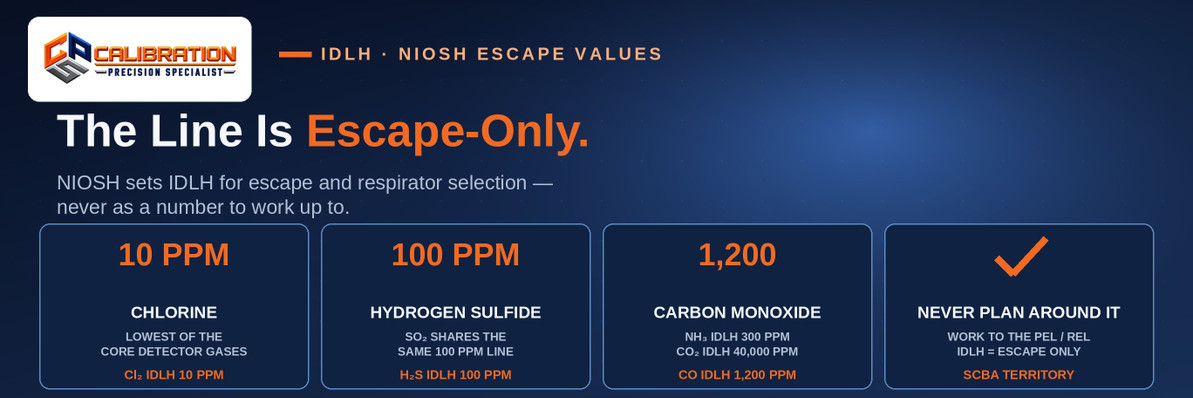
IDLH stands for Immediately Dangerous to Life or Health, and it is the concentration NIOSH sets for escape, not for work: chlorine is IDLH at just 10 ppm, hydrogen sulfide at 100 ppm, ammonia at 300 ppm, and carbon monoxide at 1,200 ppm. You never plan around an IDLH value — you plan so no one is ever in one without a pressure-demand SCBA or supplied-air respirator, because at IDLH the only job left is getting out.
Every exposure limit in gas detection answers a different question. The PEL and REL answer "how much can a worker breathe across a shift?" The IDLH answers a grimmer one: "at what concentration does this air stop being a workplace and become a rescue problem?" This post gives the verified NIOSH values for the core detector gases, explains what the number legally controls — respirator selection — and shows why the IDLH belongs in your emergency plan and nowhere near your work plan. For the short version, see what IDLH means; this post is the deeper treatment.
What Does IDLH Stand For?
IDLH stands for Immediately Dangerous to Life or Health. NIOSH — the National Institute for Occupational Safety and Health, part of the CDC — publishes IDLH values for individual chemicals. An atmosphere is IDLH when the concentration of a toxic, corrosive, or asphyxiant substance poses an immediate threat to life, would cause irreversible or delayed adverse health effects, or would interfere with a worker's ability to escape. Read that third clause carefully: a concentration can be IDLH not because it kills outright, but because it blinds, disorients, or overwhelms the worker before they can get out. That escape test is what makes IDLH different from every other limit on this page.
What Are the IDLH Values for Common Gases?
Every value below is taken from NIOSH's own Table of IDLH Values (CDC) and verified for this post:
| Gas | NIOSH IDLH | Note |
|---|---|---|
| Chlorine (Cl₂) | 10 ppm | Lowest IDLH of the common detector gases |
| Nitrogen dioxide (NO₂) | 13 ppm | Current NIOSH value, updated from 20 ppm |
| Hydrogen cyanide (HCN) | 50 ppm | — |
| Hydrogen sulfide (H₂S) | 100 ppm | — |
| Sulfur dioxide (SO₂) | 100 ppm | — |
| Ammonia (NH₃) | 300 ppm | — |
| Carbon monoxide (CO) | 1,200 ppm | — |
| Carbon dioxide (CO₂) | 40,000 ppm | 4% by volume |
Two things stand out. First, the spread: chlorine reaches escape-only territory at 10 ppm, while carbon monoxide's IDLH is 120 times higher — IDLH tracks acute escape danger, not general toxicity rankings, and each gas earns its own number. Second, how far these sit above working limits: hydrogen sulfide's enforceable OSHA ceiling is 20 ppm and its IDLH is 100 ppm; carbon monoxide's PEL is 50 ppm and its IDLH is 1,200 ppm. The gap between the working limit and the IDLH is the space your controls, ventilation, and alarms are supposed to defend. The working limits themselves are laid out in what a PEL is.
Why Do You Never Plan Around an IDLH Value?
Because an IDLH value is not a target, a threshold for scheduling, or a "maximum allowable" for a short task. It is the boundary of an atmosphere a worker may not be able to escape unaided. Planning work "just below IDLH" means planning work one sensor error, one ventilation failure, or one pocket of stratified gas away from an atmosphere that can prevent escape. Sound programs treat the IDLH the way aviation treats terrain: it defines where you must never be without life-support equipment, and everything about the job — monitoring, ventilation, permits, standby rescue — is arranged so the question never comes up. If a hazard assessment shows a space can reach IDLH concentrations, the controls change (isolate, ventilate, monitor continuously, stage rescue), not the schedule.
What Does an IDLH Atmosphere Require?
Respiratory protection is where the IDLH stops being a definition and becomes law. Under OSHA's respirator standard (29 CFR 1910.134), entry into an IDLH atmosphere requires a pressure-demand self-contained breathing apparatus (SCBA) or a pressure-demand supplied-air respirator with an auxiliary escape supply. Air-purifying respirators — cartridge masks — are not permitted for IDLH entry, because a cartridge cannot supply oxygen and can be overwhelmed or break through at IDLH concentrations. Two related rules matter just as much:
- Unknown atmospheres are treated as IDLH until monitoring proves otherwise — you do not get to assume a space is below IDLH because it smelled fine yesterday.
- Oxygen deficiency is IDLH. An atmosphere below 19.5% oxygen is treated as immediately dangerous under OSHA's respirator and confined-space rules, whatever the toxic readings say — which is why the oxygen channel on a portable multi-gas monitor is never the optional one.
What Does a Detector Reading Near IDLH Mean?
Your detector's alarms should never be set anywhere near IDLH values — working alarms belong at or below the PEL/REL and STEL levels, so the instrument warns while there is still a wide margin to act. A reading climbing toward an IDLH value means the margin is already gone: the correct response is escape and emergency procedure, not finishing the task or re-checking the reading. And the reading only means anything if the instrument is telling the truth — a hydrogen sulfide channel that has drifted low will report 60 ppm in air that is already at the 100 ppm IDLH. We calibrate every channel on the instruments we sell and service, through calibration services — in-house at our Rockwood, Tennessee shop, or shipped in from anywhere.
Frequently Asked Questions
What does IDLH stand for?
IDLH stands for Immediately Dangerous to Life or Health. It is the term NIOSH uses for an atmospheric concentration of a toxic, corrosive, or asphyxiant substance that poses an immediate threat to life, would cause irreversible or delayed adverse health effects, or would interfere with a worker's ability to escape. Chlorine's IDLH is 10 ppm, hydrogen sulfide's is 100 ppm, and carbon monoxide's is 1,200 ppm.
What is the IDLH for hydrogen sulfide?
100 ppm, per NIOSH's Table of IDLH Values. For scale, OSHA's enforceable ceiling for H₂S is 20 ppm and NIOSH's recommended ceiling is 10 ppm for 10 minutes — the IDLH sits five to ten times above the working limits, in air where the only correct action is escape in proper respiratory protection.
What is the IDLH for carbon monoxide?
1,200 ppm, per NIOSH. OSHA's PEL for CO is 50 ppm as an 8-hour average and NIOSH's REL is 35 ppm with a 200 ppm ceiling, so the IDLH is 24 times the legal working limit. CO earns a high IDLH number because it does not irritate or warn the senses — which is also why it is so dangerous: nothing about the air feels different as the concentration climbs.
What is the IDLH for chlorine?
10 ppm, per NIOSH — the lowest IDLH of the common detector gases in this post. Chlorine is a severe eye and respiratory irritant and injures lung tissue at low concentrations, so its escape line arrives far earlier than gases like ammonia (300 ppm) or carbon monoxide (1,200 ppm).
Who sets IDLH values?
NIOSH, the National Institute for Occupational Safety and Health (part of the CDC), sets and publishes IDLH values in its Table of IDLH Values. NIOSH has been re-evaluating values under its Current Intelligence Bulletin 66 criteria; where an updated value exists it is current policy — nitrogen dioxide, for example, is now 13 ppm, updated from the older 20 ppm figure still quoted in many secondary sources.
Is IDLH the same as a PEL?
No — they answer different questions and differ by an order of magnitude or more. A PEL is OSHA's enforceable limit on average exposure across a shift (CO 50 ppm, ammonia 50 ppm). An IDLH is NIOSH's escape line (CO 1,200 ppm, ammonia 300 ppm). Work is planned against the PEL; the IDLH is used for respirator selection and emergency planning and is never a working target.
What respirator is required in an IDLH atmosphere?
Under OSHA 29 CFR 1910.134, a pressure-demand SCBA, or a pressure-demand supplied-air respirator with an auxiliary self-contained escape supply. Air-purifying (cartridge) respirators are not permitted for IDLH entry — they supply no oxygen and can be overwhelmed at IDLH concentrations. Unknown atmospheres are treated as IDLH until monitoring proves otherwise.
Is an oxygen-deficient atmosphere considered IDLH?
Yes. OSHA treats an atmosphere with less than 19.5% oxygen as IDLH under its respirator and confined-space rules, regardless of what the toxic gas channels read. That is why oxygen is one of the four standard channels on a multi-gas monitor and why a pumped pre-entry test reads oxygen first among equals.
Can you work in an IDLH atmosphere?
Only under a full respiratory-protection and rescue framework: pressure-demand SCBA or supplied-air with escape supply, trained users, a standby person, and rescue capability — the conditions of emergency response and permitted confined-space rescue, not routine production work. No ordinary job task is planned into an IDLH atmosphere; if the air can reach IDLH, the controls are changed so workers are never relying on escape.
How much does it cost to calibrate a gas detector?
At CPS Calibrations, in-house calibration is $55 for a single-gas instrument and $90 for a 4- or 5-gas instrument; ship-in calibration is billed at the same rates. On-site work at your facility is quoted in writing and costs more than bench work. Calibration matters to this page because an IDLH decision is only as good as the reading behind it — a drifting channel can report air as safe that is already at the escape line.
The Bottom Line
IDLH — Immediately Dangerous to Life or Health — is NIOSH's escape line, not a working limit: chlorine 10 ppm, nitrogen dioxide 13 ppm, hydrogen cyanide 50 ppm, hydrogen sulfide and sulfur dioxide 100 ppm, ammonia 300 ppm, carbon monoxide 1,200 ppm, carbon dioxide 40,000 ppm. You never plan around it; you plan so it never arrives, and if it can arrive, the respirator is a pressure-demand SCBA and the job is escape.
Building an emergency and monitoring plan around real limits? Call CPS Calibrations at 865-900-8844 — monitors, calibration, and the CPS Calibration Program behind them, from Rockwood, Tennessee.
CPS Calibrations · 109 S. Front Street, Rockwood, TN 37854 · Calibration Services · The CPS Calibration Program
Need a calibration you can file?
In-house calibration at CPS in Rockwood, Tennessee — $55 for single-gas instruments, $90 for 4- and 5-gas — every channel, as-found and as-left data, full certificate.
See Calibration Servicesor call 865-900-8844
Recent Posts
-

What Is Remote Monitoring for Fixed Gas Detection?
Remote monitoring for fixed gas detection means a fixed system's live readings, trends, and alarm hi …Nov 23rd 2026 -

What Are the Key Differences Between the GX-6000 and GX-6100?
The RKI GX-6100 is the current replacement for the discontinued GX-6000: both are pumped 6-gas monit …Nov 22nd 2026 -

How to Read a PID Correction Factor Chart
To read a PID correction factor chart, find your vapor’s row, take the factor under your own lamp en …Nov 21st 2026