
Can You Put a Gas Detector on a Tailpipe? Places a 4-Gas Meter Should Never Sample
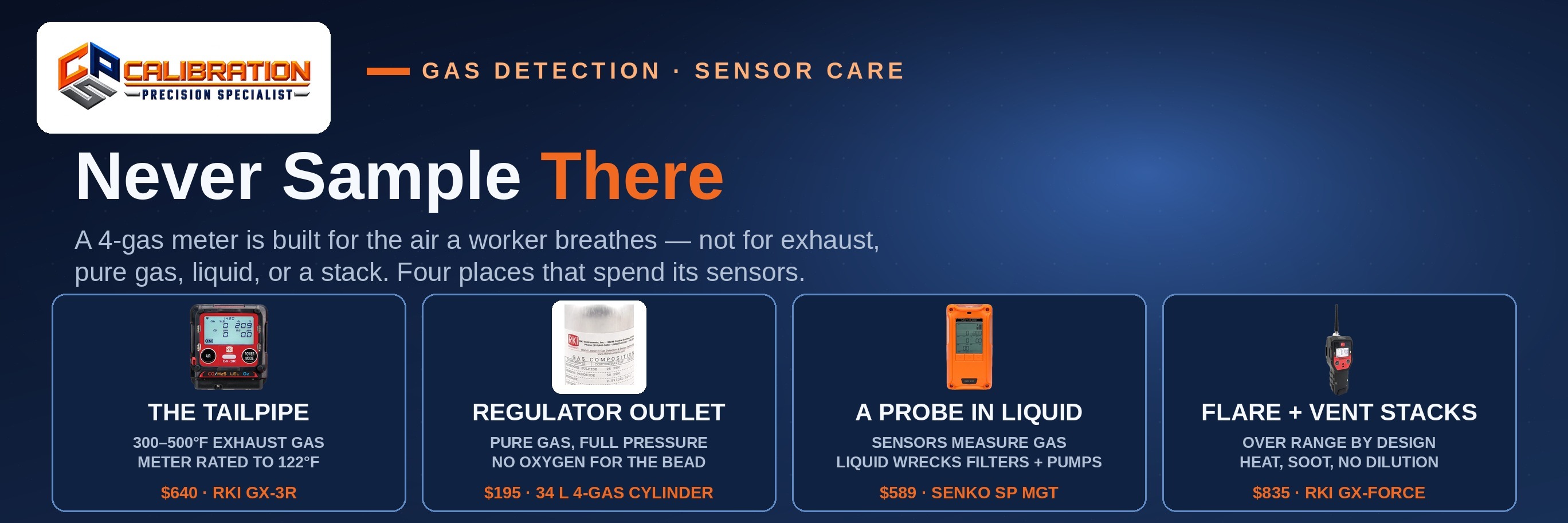
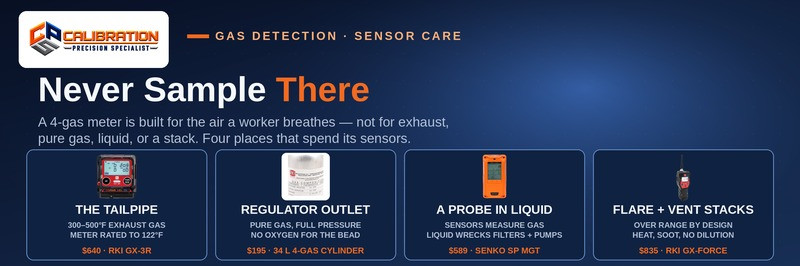
No — a tailpipe exhaust stream runs about 300–500°F at the muffler and tailpipe in normal driving, while a typical 4-gas safety monitor such as the RKI GX-3R is rated for continuous use at −4°F to +122°F, and the stream itself defeats the sensors a second way: it is hot, wet, soot-laden, and far over range, so the catalytic LEL bead — which must burn gas with oxygen to read at all — can be damaged into reading low, and the electrochemical CO and H₂S cells are driven far past the prolonged high exposure their manufacturers warn degrades them. A 4-gas meter measures the air a worker breathes; a tailpipe, a pure product stream, a regulator outlet, a liquid, and a flare or vent stack are process streams, and sampling any of them spends the meter's sensors to produce a number that was never accurate in the first place.
Every calibration shop has heard some version of the story. Someone wanted to know whether a vehicle "was making CO," so they held the shop's 4-gas meter at the tailpipe. Someone else cracked a regulator on a gas line and put the pumped probe at the outlet "to see if it was really gas." A probe went into a tank — past the vapor space, into the liquid. The meter alarmed, or pegged, or read something odd, and then it went back in the gang box. Weeks later it fails a bump test, or worse, it passes readings nobody should trust. This post is the list of places a workplace-air instrument should never sample, what each one physically does to each sensor type, and what the right tool for each job actually is.
Why Does the Tailpipe Kill the Meter First?
Start with temperature, because the comparison is not close. Exhaust gas leaves the engine extremely hot and cools as it travels the exhaust system; by the muffler and tailpipe it is still typically 300°F to 500°F during normal driving. The RKI GX-3R ($640) — a current, well-built 4-gas monitor — is rated by RKI for a continuous operating environment of −4°F to +122°F at 10 to 90% relative humidity, non-condensing, with a temporary 15-minute allowance up to +140°F. Tailpipe gas starts at roughly two and a half times the meter's continuous temperature limit and goes up from there under load. Holding a diffusion monitor at the pipe, or drawing that gas through a pumped unit's hose and filters, puts every sensor, seal, and filter in the path of gas the instrument was never built to touch.
Temperature is only the first of four problems in the same stream:
- It is wet. Combustion produces water vapor, and exhaust condenses as it cools through the sampling path. The GX-3R's rating is explicitly non-condensing; condensing moisture on a catalytic element drifts its characteristics, and liquid water reaching the sensor face is a soaking event, not a sampling event.
- It is dirty. Soot and particulate load the filters that protect the sensors. A loaded filter starves every channel behind it — the meter reads the filter, not the air — and on a pumped instrument the pump works against the blockage until flow faults follow.
- It is over range. The GX-3R's channels end at 100% LEL, 40.0% oxygen, 200 ppm H₂S, and 2,000 ppm CO — its overscale alarms sit exactly at those ceilings. An undiluted exhaust stream is a combustion product mixture, not workplace air: concentrations at the pipe are orders of magnitude above the air around the vehicle, and the instrument pegs instead of measuring.
- It can come back wrong, not just dead. That is the part that matters most, and it is covered next.
What Does an Over-Range Stream Do to Each Sensor?
A meter that dies outright gets replaced. A meter that survives with damaged sensors gets carried into the next confined space. Here is what a stream like exhaust — or any pure or near-pure process stream — does channel by channel.
The catalytic LEL bead: it needs oxygen, and rich gas can break it quietly
A catalytic bead sensor does not detect gas the way a cell does — it burns it. Gas oxidizes on the heated bead, the temperature change is the reading, and that combustion requires oxygen in the sample. In a stream that is too rich — above the upper explosive limit, with too little oxygen — there is not enough oxygen to burn the gas properly, and the instrument can indicate a very low reading or no reading at all in gas that is unquestionably present. Worse, subjecting a catalytic bead sensor to very high gas concentrations can damage it, including a loss of sensitivity that produces erroneously low readings afterwards. The meter powers up, zeros cleanly in fresh air, and then under-reads the hazard it exists to catch. RKI builds the GX-3R's LEL sensor with two active filaments so a silicone-poisoned filament has a backup — a genuine durability feature for workplace air, and not a license to sample process streams with it.
The electrochemical CO and H₂S cells: high exposure is a consumable cost
Electrochemical toxic cells are consumable chemical reactors: the target gas reacts at an electrode and the cell is spent a little by everything it measures. Manufacturers state the limit plainly — prolonged exposure to high levels of the target gas may prematurely degrade sensor performance. A diffusion cap held at a tailpipe, or a pumped probe in a concentrated stream, spends months of a CO or H₂S cell's life in minutes, and the bill arrives as drift, slow response, and calibration failures weeks later, long after anyone connects it to the afternoon at the tailpipe. The full picture of what degrades these cells is in what happens when a gas detector sensor is poisoned.
The oxygen cell: it is reading a stream with no air in it
An electrochemical oxygen sensor measures the partial pressure of oxygen in a gas that is supposed to be mostly air. Undiluted exhaust, a pure product stream, and a regulator outlet contain little or no free oxygen to measure — the reading collapses toward zero not because the workplace is dangerous but because the sample is not air. Teams have chased phantom "oxygen-deficient" readings that were really a probe in the wrong stream, and the reverse error is worse: trusting a low reading from a rich stream as proof about the room.
The pump, filters, and hose: the damage nobody prices
On a pumped instrument — an RKI GX-Force ($835) or a SENKO SP MGT ($589) — the sample path takes the abuse first: hot gas through a hose rated for ambient sampling, condensate collecting in the line and the water trap, soot loading the particulate filter, and corrosive or solvent-laden streams attacking the filters and pump diaphragm. The sensors may survive an exposure the pump and filters do not, and a restricted sample path then falsifies every later reading by starving the sensors. Browse the instruments built for drawn samples of air under pumped monitors — every one of them assumes the far end of the hose is in a space a person might enter, not inside a process.
The Full Never-Sample List
The tailpipe is the famous case. These are the rest of the family, and they share the same root cause: the stream is a product or a process, not air.
| Place | Why the 4-gas meter fails there | What happens to the meter | The right tool for that job |
|---|---|---|---|
| Tailpipe / engine exhaust | 300–500°F gas vs. a 122°F continuous rating; wet, sooty, over range | Bead heat and rich-gas damage, spent toxic cells, loaded filters | A vehicle exhaust/emissions analyzer — built and ranged for the tailpipe stream — or sample the shop air around the vehicle with the 4-gas meter |
| Pure product stream (a line, a header, a sample port) | Gas at or near 100% concentration; little or no oxygen for the catalytic bead | Bead can read low or zero in pure gas and lose sensitivity; every channel pegs or collapses | A % volume instrument — thermal-conductivity or NDIR detection, the methods used for above-LEL measurement — or a dilution fitting that brings the sample into range with air |
| Regulator outlet | The full cylinder or line stream at the fitting: pure gas, full pressure, no dilution | Same rich-stream bead damage in seconds; pressure and flow the sample system was never built for | Leak-check the fitting with a combustible leak detector or leak-detection fluid; verify cylinder contents from the label and Certificate of Analysis, never by sampling the outlet |
| Probe in liquid | The sensors measure gas; liquid is drawn or splashed into the sample path | Flooded filters and pump, soaked sensor faces, drift and failures that appear days later | Sample the vapor space above the liquid with the probe held at the surface — that headspace reading is the one that describes the space a worker will enter |
| Flare or vent stack | Over range by design, radiant and stream heat, soot, and a stream whose composition swings with the process | Heat damage, bead damage, readings that swing with the process instead of describing any workplace | Fixed, process-rated monitoring engineered for the stack, or sampling the work area downwind at breathing height — the air people actually occupy |
| Any stream the instrument was never ranged for | The four channels end at 100% LEL / 40% O₂ / 200 ppm H₂S / 2,000 ppm CO | Overscale alarms are the instrument saying so; repeated overscale exposure is cumulative sensor abuse | Match the instrument to the stream first: range, temperature, and sampling method are selection criteria, not fine print |
One line under the table is worth saying out loud: an overscale alarm is not a measurement. When a GX-3R shows its over alarm — 100% LEL, 40.0% O₂, 200 ppm H₂S, 2,000 ppm CO — it is reporting that the stream is beyond what it can quantify. Writing that number down as a result, for any of these streams, records a ceiling as if it were a reading.
What Should You Measure Instead?
In nearly every case that tempts someone to sample a stream, the real question is about a place, not a pipe — and the 4-gas meter answers it correctly from the place:
- "Is this running vehicle making the shop dangerous?" Sample the air in the shop — at breathing height, near the work, with the doors in their normal position. That is the exposure question, and it is exactly what a personal monitor is for. If the question is really "what is coming out of this engine," that is an emissions measurement, and it belongs to an analyzer built for exhaust.
- "Is this tank safe to enter?" Sample the vapor space from outside, top, middle, and bottom, with the probe in the headspace — never submerged, never resting in product. The headspace is the atmosphere the entrant will breathe.
- "Is this fitting leaking?" A leak is a small amount of gas escaping into air — the one stream on this page a combustible instrument reads honestly, with a leak detector swept slowly around the joint, or leak-detection fluid that bubbles at the escape point. The outlet stream itself tells you nothing the cylinder label does not.
- "What is in this line?" That is a process question. It is answered by the system's design documents, its fixed process-rated instrumentation, or a % volume measurement with the right detection principle — not by a safety monitor whose bead needs the oxygen the line does not contain.
The instruments under portable gas detection and portable multi-gas monitors are all built on the same contract: the sample is air, at ambient temperature, at concentrations somewhere inside 0–100% LEL and the ppm ranges on the datasheet. Honor the contract and they run for years; break it and the failure is usually quiet.
If a Meter Has Already Been There
It happens. A meter comes back from a job where someone sampled something they should not have, and the question is whether it can still be trusted. Work it in this order:
- Bump test it before it goes back into service. Challenge every channel with certified calibration gas and confirm response and alarms — the procedure is in how to bump test a gas detector. A bead that lost sensitivity at a rich stream announces itself here, as a slow or low LEL response, before it can announce itself in a confined space.
- Inspect the sample path. On a pumped unit, replace loaded filters, drain and dry the water trap and hose, and confirm free flow. Half of the "bad sensor" readings after a stream exposure are a starved sample path.
- Calibrate, and read the as-found data honestly. A channel that needs an unusually large adjustment, or will not hold calibration, is a spent or damaged sensor, not a nuisance. Strange behavior after an exposure is also the subject of why a gas detector alarms when there is no gas.
- Retire what fails. A sensor that fails bump or calibration after a known over-range or hot-stream exposure has told you its history. Replace the sensor; do not return the instrument to a collar on hope.
At CPS, that triage is bench work: calibration services calibrate every channel — $55 for a single-gas instrument, $90 for a four- or five-gas — and when a channel will not calibrate, the certificate says so, with the as-found readings behind it. If a meter in your fleet has sampled a tailpipe, a pure stream, or a stack, tell us when you send it in. Knowing the exposure history is the difference between a calibration and a diagnosis.
Frequently Asked Questions
Can you put a gas detector on a tailpipe?
No. Exhaust gas at the tailpipe runs about 300–500°F during normal driving, while a typical 4-gas monitor such as the RKI GX-3R is rated for continuous use at −4°F to +122°F, non-condensing. The stream is also wet, soot-laden, and far over range, and its low oxygen content defeats the catalytic LEL bead, which must burn gas with oxygen to read. The result is heat damage, spent electrochemical cells, loaded filters, and — worst — a bead that can come back reading low in gas that is really there. To check an engine's exhaust, use an emissions analyzer built for the tailpipe; to check the air in the shop, sample the shop air.
What happens if you put a gas detector on a tailpipe?
Four things at once. Heat far above the instrument's rating reaches sensors, seals, and filters. Water vapor condenses in the sampling path of an instrument rated non-condensing. Soot loads the filters and starves the channels behind them. And the over-range, oxygen-poor stream attacks the sensors themselves: a catalytic bead exposed to very high gas concentrations can lose sensitivity and afterwards read erroneously low, and electrochemical CO and H₂S cells suffer premature degradation from prolonged high-level exposure. The meter may still power up and zero in fresh air, which is why a bump test after any such exposure is mandatory before the instrument is trusted again.
Can a gas detector measure pure gas from a regulator outlet?
No — a 4-gas meter cannot quantify a pure stream. Its LEL channel ends at 100% LEL, and the catalytic bead needs oxygen to burn the sample: in gas at or near 100% concentration there is too little oxygen, so the bead can indicate a very low reading or none at all, and the exposure itself can damage the bead's sensitivity. The oxygen channel collapses toward zero because the stream contains no air. Verify a cylinder from its label and Certificate of Analysis, and leak-check its fitting with a combustible leak detector or leak-detection fluid — never by sampling the outlet.
Why does a catalytic LEL sensor read zero in pure gas?
Because it is a combustion sensor with nothing to combust with. The bead reads the heat of gas burning on its surface, and burning requires oxygen — a catalytic sensor cannot properly operate in a zero- or low-oxygen atmosphere, and roughly 10–12% oxygen is the working floor commonly cited for accurate readings. In a stream above the upper explosive limit the mixture is too rich to burn correctly, so the indication falls toward zero precisely when the concentration is at its highest. That false zero is the most dangerous reading in gas detection, and it is why above-LEL measurement uses thermal-conductivity or infrared instruments ranged in % volume instead.
What temperature can a gas detector handle?
Only its datasheet rating, and it is lower than most people assume. The RKI GX-3R, as one current example, is rated for continuous use at −20°C to +50°C (−4°F to +122°F) at 10 to 90% relative humidity, non-condensing, with a temporary 15-minute environment allowance to +60°C (+140°F). Any stream hotter than that — tailpipe gas at 300–500°F, stack gas, steam — is outside the instrument's design, regardless of how briefly the probe is held there. Check the operating-environment line of your own model's specification before sampling anything warm.
Can you put a gas detector probe in liquid?
No. The sensors measure gas, and a probe submerged in liquid draws or splashes liquid into the sample path: filters flood, pumps ingest fluid they were never built to move, and sensor faces get soaked — an exposure that changes sensor characteristics and causes drift and failures days later. The measurement you actually want in a tank or sump is the vapor space above the liquid. Hold the probe in the headspace, at the surface, and sample top, middle, and bottom of the air — that is the atmosphere a worker will enter and breathe.
How do you check for CO from a running vehicle in a shop?
Measure the air the workers breathe, not the exhaust stream. Put the 4-gas meter at breathing height in the work area, with ventilation and doors in their normal working position, and let it log the room. That reading answers the exposure question — what the people in the shop are actually breathing — and it is the measurement a personal safety monitor is designed and ranged to make. If the question is what the engine itself is emitting, that is a tailpipe measurement for a vehicle emissions analyzer, an instrument built for hot, wet, over-range exhaust gas.
What instrument measures gas above 100% LEL?
An instrument ranged in % volume rather than % LEL, using a detection principle that does not need oxygen. For concentrations above the LEL range, the commonly used methods are thermal conductivity (TC) and nondispersive infrared (NDIR): neither burns the sample, so both keep reading through rich, oxygen-poor streams where a catalytic bead falls to zero. Sample-draw instruments for high-concentration work may also use a dilution fitting that mixes the stream with air to bring it into a measurable range. A standard 4-gas safety monitor is none of these — its overscale alarm at 100% LEL is a ceiling, not a reading.
Will one trip to a tailpipe ruin a gas detector?
It can, and the damage is not always visible. A brief exposure may only load filters and spend some electrochemical cell life; a longer one can heat-damage sensors and permanently reduce the catalytic bead's sensitivity, so the meter reads low afterwards while appearing to work normally. There is no reliable way to judge it from the display in fresh air — zeroing cleanly proves nothing about span response. Bump test the instrument with certified gas before it returns to service; if any channel is slow, low, or fails, it needs a full calibration and, if it will not calibrate, sensor replacement before it goes back on a worker.
What should you do if a gas detector was used on exhaust or a pure stream?
Treat it as a suspect instrument until it proves itself. Bump test every channel with certified, in-date calibration gas and confirm response and alarms; on a pumped unit, replace the filters, drain and dry the hose and water trap, and confirm free flow; then run a full calibration and look at the as-found readings — a channel needing an unusually large adjustment is telling you it was damaged. Record the exposure in the instrument's history so the next technician knows. At CPS, in-house calibration is $55 for a single-gas instrument and $90 for a four- or five-gas, with every channel calibrated — and telling us about the exposure when you send it in turns a routine calibration into a proper diagnosis.
The Bottom Line
A 4-gas meter is an air instrument: it is ranged for 0–100% LEL and workplace ppm levels, rated for ambient temperatures like the GX-3R's −4°F to +122°F, and built on sensors that need oxygen and clean, dry sample paths. A tailpipe at 300–500°F, a pure product stream, a regulator outlet, a probe in liquid, and a flare or vent stack all break that contract in the same ways — heat, moisture, soot, and concentrations so high the catalytic bead can be damaged into reading low. Sample the air people breathe, use % volume and process-rated instruments for streams, and bump test any meter that has already been somewhere it should not have been. The most dangerous gas detector is not the one that dies — it is the one that comes back from the tailpipe still smiling.
Has a meter in your fleet sampled something it shouldn't have — or failed a bump test after an over-range exposure? Call 865-900-8844 or reach us through Contact Us. We calibrate every channel on RKI, SENKO, and the other lines we service, and we will tell you plainly whether you are looking at a loaded filter, a spent cell, or a bead that needs replacing.
CPS Calibrations · 109 S. Front Street, Rockwood, TN 37854 · Calibration Gas · Calibration Services · Contact Us
Need a calibration you can file?
In-house calibration at CPS in Rockwood, Tennessee — $55 for single-gas instruments, $90 for 4- and 5-gas — every channel, as-found and as-left data, full certificate.
See Calibration Servicesor call 865-900-8844
Recent Posts
-

What Is Remote Monitoring for Fixed Gas Detection?
Remote monitoring for fixed gas detection means a fixed system's live readings, trends, and alarm hi …Nov 23rd 2026 -

What Are the Key Differences Between the GX-6000 and GX-6100?
The RKI GX-6100 is the current replacement for the discontinued GX-6000: both are pumped 6-gas monit …Nov 22nd 2026 -

How to Read a PID Correction Factor Chart
To read a PID correction factor chart, find your vapor’s row, take the factor under your own lamp en …Nov 21st 2026