
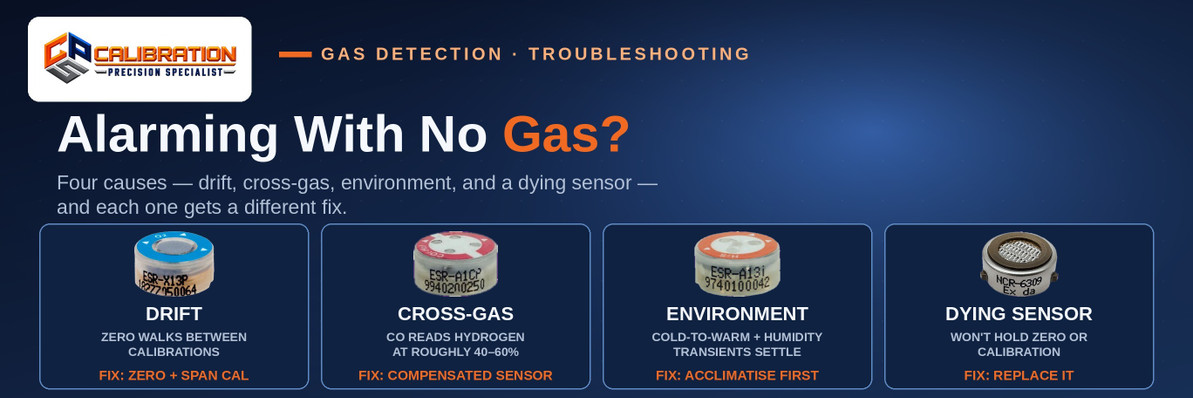
Why Does My Gas Detector Alarm When There Is No Gas?
A gas detector usually alarms with no target gas present for one of four reasons: the sensor's zero or span has drifted, another gas the sensor cross-responds to is present — a standard carbon monoxide sensor, for example, reads hydrogen at roughly 40–60% of its value as if it were CO — a sudden temperature or humidity change has upset the reading, or the sensor is dying and can no longer hold calibration. Treat every alarm as real first: move to clean air, and only diagnose the instrument once people are out of the area.
A false alarm is not a harmless alarm. Crews that hear a monitor cry wolf start to silence it faster, trust it less, and eventually work around it — and the next alarm may be the real one. This post works through the four causes in the order to check them, how each one behaves differently on the display, and the point at which the fix stops being a calibration and becomes a sensor replacement. The safety rule comes first, though, because it outranks all of the troubleshooting: you do not get to decide an alarm was false while you are still standing in the air that triggered it.
What Should You Do First When a Gas Detector Alarms?
Respond as if the gas is real. Leave the area, account for the crew, and ventilate or isolate the source if that can be done from outside the hazard. Only then, in known clean air, start the instrument diagnosis:
- 1. In clean air, watch what the reading does. A real exposure decays as you leave it. A reading that sits at the same value outdoors, in fresh air, long after the move is an instrument story, not an atmosphere story.
- 2. Note which channel alarmed and what was happening. One channel or several? Was welding, battery charging, engine exhaust, cleaning solvent, or a temperature swing — indoors to outdoors, cold dock to warm plant — part of the picture? The pattern is the diagnosis.
- 3. Fresh-air zero, then bump test. Zero the instrument only in air you know is clean — never zero it in the suspect area, which teaches the detector that contaminated air is "zero" and hides real gas afterwards. Then bump test with certified calibration gas: a healthy sensor responds quickly and reaches the expected value.
- 4. Cross-check with a second instrument. Two independent monitors agreeing means believe them. One monitor alarming alone, next to a quiet one reading the same air, points at the alarming instrument.
- 5. If it will not zero, will not bump, or drifts again within days, take it out of service. That is a bench diagnosis or a sensor, not another morning zero. CPS calibration services run exactly this triage — in-house calibration is $55 for a single-gas instrument and $90 for a four- or five-gas, with every channel calibrated.
Cause 1: Drift — The Detector's Zero or Span Has Moved
Every gas sensor drifts. Electrochemical cells age, catalytic beads change with exposure, and the instrument's idea of "zero" and of a known concentration slowly walk away from the truth between calibrations. Drift produces the classic false alarm: a channel that reads a few ppm — or a few %LEL — in provably clean air, creeps upward over a shift, or alarms at a threshold it is only just crossing.
Zero drift and span drift look different. Zero drift is an offset: the detector reports gas where a fresh-air zero should read nothing, and a correct zero in clean air clears it until it walks again. Span drift is a scaling error: the zero looks fine, but the response to real gas — checked on a bump test or calibration — is high or low. Both are why calibration is a zero and a span procedure, not just a zero; our post on why a gas detector reads negative covers the same offset physics when it pushes a reading below zero instead of above it.
The fix: a full zero-and-span calibration with in-date, correct-mix gas. The warning sign: drift that returns in days rather than months, or a span adjustment that has to move a long way to pass, is not drift any more — it is Cause 4, a dying sensor being repeatedly recalibrated back into service.
Cause 2: Cross-Sensitivity — A Different Gas Is Really There
Sometimes the detector is not wrong at all. It is accurately reporting a gas it was never meant to measure. Electrochemical sensors react chemically, and other gases that drive the same reaction produce a reading on that channel — the full pair-by-pair picture is in our post on electrochemical toxic sensor cross-sensitivities.
The pairs that cause the most "no-gas" alarms in real facilities:
- CO sensors and hydrogen — the big one. A standard CO sensor reads roughly 40–60% of ambient hydrogen as if it were carbon monoxide. Battery charging rooms, refineries, and anywhere hydrogen evolves will climb a CO channel with no CO present. The engineered answer is a hydrogen-compensated CO sensor, which RKI builds into its GX-3R family for exactly this reason.
- H₂S sensors and sulfur compounds. Hydrogen sulfide sensors cross-respond to carbon monoxide (roughly 10–20%) and to mercaptans — the odorants added to natural gas. An "H₂S alarm" beside odorized-gas equipment is often the odorant, not H₂S.
- Combustible (LEL) channels and solvent vapours. A catalytic LEL sensor burns what reaches it; solvent, fuel, and cleaning-product vapours are combustible, so the channel responds — correctly, on its own terms — to air that contains no target leak.
How to tell it apart from drift: a cross-sensitivity alarm tracks an activity — charging batteries, a solvent job, an odorized-gas line opened nearby — and clears when that activity stops or the instrument moves away. Drift sits still and follows the instrument. The fix is selection, not calibration: no calibration removes a chemical cross-response. Use a compensated sensor variant where one exists, relocate fixed points away from the interfering source, and brief crews on the pairs their instruments carry so the pattern is recognised in minutes, not shifts.
Cause 3: Temperature, Humidity, and Shock — The Environment Moved
Sensors are specified for an environment, and fast changes in that environment can move a reading before the sensor settles. Walking a cold instrument into warm, humid air, steam and washdown, rapid pressure or humidity swings, and condensation on a sensor face can all produce a transient climb or a brief alarm that clears as conditions stabilise. Manufacturer guidance on false alarms treats temperature- and humidity-driven transients as a distinct class for exactly this reason: the reading is an environmental artefact, not gas and not permanent drift.
How to tell it apart: the alarm coincides with the move or the washdown, the reading settles back toward zero in stable clean air without any adjustment, and the instrument then bumps and calibrates normally. The fix is handling: let a cold instrument acclimatise before zeroing and use, keep sensor faces dry and clean, and never fresh-air zero an instrument in saturated or contaminated air just to clear a nuisance reading — that bakes the error in. If transients become alarms every shift in the same location, that location needs a second look — a fixed point, a different sensor technology, or a process change — rather than a crew trained to ignore a daily alarm.
Cause 4: A Dying, Poisoned, or Damaged Sensor
The last cause is the one that matters most, because its "false" alarms are usually a sensor announcing the end of its life — and the same sensor will read low on real gas, which is the dangerous direction. The tells:
- It will not hold a zero, or the zero walks again within days of a calibration.
- It needs a large span adjustment to pass, or fails calibration outright.
- Its bump response is slow or low instead of snapping to value.
- One channel misbehaves while the rest of the instrument is stable.
A catalytic LEL sensor that has been poisoned — silicones, lead, and sulfur compounds are the classic poisons — loses sensitivity rather than gaining it, so poisoning belongs on the suspect list when alarms are odd and response is weak; the mechanism is covered in our post on what happens when a sensor is poisoned. Electrochemical and oxygen cells simply consume themselves with age and exposure. Either way, the endpoint is the same and it is not another calibration: the decision framework and real replacement prices are in when should you replace a gas detector sensor?
The rule: calibrate a drifting sensor once and watch it. Replace a sensor that will not hold that calibration. Every recalibration of a finished sensor buys an instrument whose next alarm — false or real — nobody can interpret.
At a Glance: Which Cause Is It?
| Pattern you see | Most likely cause | First move |
|---|---|---|
| Low reading in clean air that a fresh-air zero clears, creeping back over weeks | Zero drift | Zero in clean air, then full zero-and-span calibration |
| Clean zero, but bump/calibration response is high or low | Span drift | Full calibration; watch how far the span had to move |
| Alarm tracks battery charging, solvents, or odorized gas; clears when the activity stops | Cross-sensitivity | Identify the interfering gas; consider a compensated sensor |
| Alarm on a cold-to-warm move, steam, or washdown; settles on its own | Temperature / humidity transient | Acclimatise, dry the sensor face, re-zero only in stable clean air |
| Will not hold zero or calibration, slow bump, one channel only | Dying or poisoned sensor | Out of service — bench triage and replacement |
What Does This Mean for the Instruments You Buy and Carry?
False-alarm behaviour is partly a purchasing decision. A standard 4-gas monitor like the RKI GX-3R ($640) or a SENKO SP-MGT will serve most crews well — provided the sensor variants match the gases actually around the work, and the fleet is bump tested before use and calibrated on schedule. Browse the range under portable gas detection and portable multi-gas monitors, keep calibration gas in date and correct for the mix, and treat a monitor that alarms oddly twice as a bench job, not a personality trait. We calibrate every channel — and when a channel will not calibrate, we tell you which sensor it needs.
Frequently Asked Questions
Why does my gas detector alarm when there is no gas?
Usually one of four causes: the sensor's zero or span has drifted since its last calibration, a different gas the sensor cross-responds to is present, a sudden temperature or humidity change has produced a transient reading, or the sensor is dying and can no longer hold calibration. Work through them in clean air — fresh-air zero, bump test, cross-check with a second instrument — and take the detector out of service if it will not zero, will not bump, or drifts again within days.
Can a gas detector give a false positive?
Yes. Cross-sensitivity is a true false positive in the sense that the target gas is absent: the sensor is responding, accurately, to a different gas that drives the same chemistry. A standard carbon monoxide sensor reads hydrogen at roughly 40–60% of its value as CO, so a charging battery bank can alarm a CO channel with no carbon monoxide present. Drift and environmental transients produce false positives too. No calibration removes a chemical cross-response — the fix is a compensated sensor variant or moving the measurement point.
What is sensor drift in a gas detector?
Drift is the slow movement of a sensor's output away from the truth between calibrations. Zero drift is an offset — the detector reports a small reading in clean air where it should read zero. Span drift is a scaling error — the zero looks right, but the response to a known concentration of gas reads high or low. Zero-and-span calibration corrects normal drift; drift that returns within days, or that needs a very large span adjustment to pass, is a sign the sensor itself is failing.
Why does my CO detector alarm near batteries?
Because of hydrogen. Batteries give off hydrogen while charging, and a standard electrochemical CO sensor cross-responds to hydrogen at roughly 40–60% of its value — 100 ppm of hydrogen can present as roughly 40–60 ppm of apparent carbon monoxide. The CO channel is not broken and the calibration is not wrong; the sensor chemistry cannot tell the two gases apart. Facilities with regular charging areas use a hydrogen-compensated CO sensor, which is the variant RKI builds into its GX-3R family for this application.
Why does my gas detector alarm after going from cold to warm air?
A rapid temperature or humidity change can move a sensor's output before it stabilises — condensation forming on a sensor face in warm, humid air is a common version. The reading typically settles back toward zero in stable, clean air, and the instrument then bumps and calibrates normally. Let a cold instrument acclimatise before you zero and use it, keep the sensor face dry, and do not fresh-air zero it in saturated air to clear the reading, because that teaches the detector a false zero it will carry into real gas.
Can cleaning products set off a gas detector?
They can. Many cleaning products, solvents, and fuels release combustible vapours, and a catalytic LEL sensor responds to combustible vapour whether it came from a leak or a mop bucket — on its own terms, the reading is real. Solvent vapours can also upset toxic channels and, with sustained exposure, degrade sensors. If an alarm tracks a cleaning or solvent job and clears when the vapours clear, suspect the product first — then ventilate, because a space full of solvent vapour has an atmosphere problem whether or not it has a leak.
Should I just zero my gas detector to clear a false alarm?
Only in air you know is clean — outdoors, upwind, away from the suspect area and from exhausts. Zeroing a detector in contaminated air tells it that the contaminated air is zero, so it will under-read real gas afterwards by that amount. Zeroing is also not a repair: if the reading returns within days, or the instrument then fails a bump test or calibration, the cause is drift beyond normal limits or a failing sensor, and the detector should come out of service for a bench diagnosis rather than being zeroed every morning.
How do I know if a gas detector sensor is dying?
The pattern is consistent: it will not hold a zero, drift returns within days of a calibration instead of weeks or months, it needs a large span adjustment to pass or fails calibration outright, its bump-test response is slow or low, and often only one channel misbehaves while the rest of the instrument is stable. At that point further recalibration is the wrong move — each pass buys a detector that may read low on real gas. The sensor is a consumable; replace it.
Is a false alarm dangerous if there was no gas?
Yes, indirectly — and it is the main reason false alarms are worth fixing rather than tolerating. A crew that hears repeated false alarms responds more slowly to the next one, silences it sooner, and trusts the instrument less, so a real event meets a slower, more sceptical response. There is also no safe way to label an alarm false from inside the area that triggered it: the first response to every alarm is to treat it as real, leave, and diagnose the instrument afterwards in clean air.
How much does it cost to fix a gas detector that false-alarms?
If the cause is drift, the fix is a calibration: at CPS, in-house calibration is $55 for a single-gas instrument and $90 for a four- or five-gas instrument, with every channel calibrated — the $55/$90 rates are in-house rates, and on-site service is quoted in writing. If the cause is a finished sensor, the cost is the replacement sensor plus fitting, which depends on the instrument and channel; cross-sensitivity and environmental causes cost nothing at the bench, because the fix is a compensated sensor variant, a relocated measurement point, or a handling change, not a repair.
The Bottom Line
A gas detector that alarms with no gas is giving you information — about its zero, about a gas you were not looking for, about the environment it just walked through, or about a sensor at the end of its life. Answer every alarm as if it were real, diagnose in clean air with a zero, a bump test, and a second instrument, and sort the cause by its pattern: drift gets a calibration, cross-sensitivity gets a better-matched sensor, transients get better handling, and a sensor that will not hold calibration gets replaced. The one response that is never right is teaching a crew to ignore the box that is trying to talk to them.
Detector alarming with nothing to show for it — or failing to hold a calibration? Call 865-900-8844 or reach us through Contact Us. We will triage it the way this post does — calibration gas, calibration services, and a straight answer on whether it needs a sensor.
CPS Calibrations · 109 S. Front Street, Rockwood, TN 37854 · Calibration Gas · Calibration Services · Contact Us
Need a calibration you can file?
In-house calibration at CPS in Rockwood, Tennessee — $55 for single-gas instruments, $90 for 4- and 5-gas — every channel, as-found and as-left data, full certificate.
See Calibration Servicesor call 865-900-8844
Recent Posts
-

What Is Remote Monitoring for Fixed Gas Detection?
Remote monitoring for fixed gas detection means a fixed system's live readings, trends, and alarm hi …Nov 23rd 2026 -

What Are the Key Differences Between the GX-6000 and GX-6100?
The RKI GX-6100 is the current replacement for the discontinued GX-6000: both are pumped 6-gas monit …Nov 22nd 2026 -

How to Read a PID Correction Factor Chart
To read a PID correction factor chart, find your vapor’s row, take the factor under your own lamp en …Nov 21st 2026