
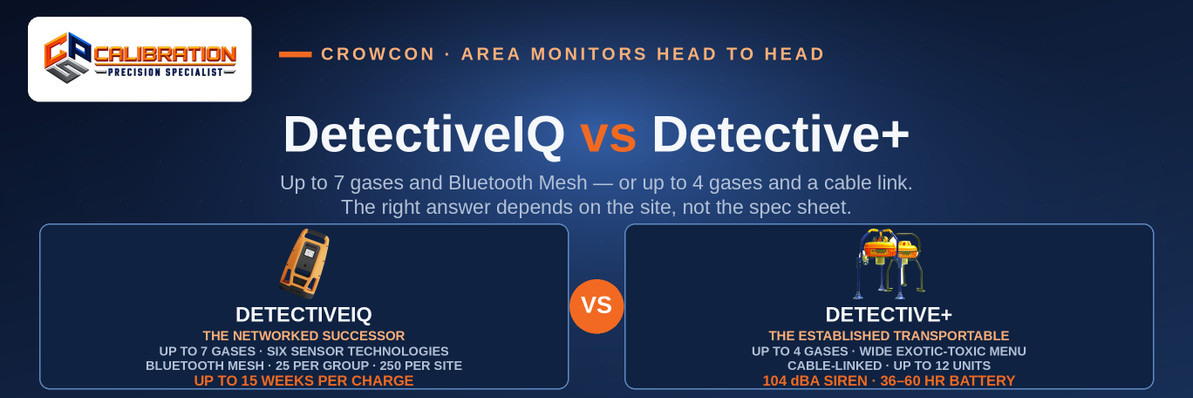
Crowcon DetectiveIQ vs Detective+: Which Area Monitor Fits Your Site?
Choose the DetectiveIQ when the job needs more than four gases, wireless alarm passing across a large or spread-out site, or battery life measured in weeks. Choose the Detective+ when four gases cover the hazard, your fleet already runs them, or a cable-linked perimeter with a 104 dBA siren is all the network the job needs. Both are Crowcon transportable area monitors and both are quoted per configuration — the difference is capacity and connectivity, not quality.
This comparison exists because of a change in Crowcon's line. Per Crowcon's technical note GEN126, the Detective+ — the transportable area monitor plants have run for years — closed to last orders on November 28, 2025, and the DetectiveIQ is its successor. That raises three practical questions: if you're buying new, which one do you spec? If your fleet already runs Detective+ units, are they stranded? And where the two genuinely differ, which differences matter on a live job? This post works through the decision in that order. For the deep dives, see our spotlights on the DetectiveIQ and the Detective+; for how networked area monitoring plays out across an outage, see area monitors for turnarounds and shutdowns. New to the category entirely? Start with what an area monitor is.
Side by Side
| DetectiveIQ | Detective+ | |
|---|---|---|
| Gases at once | Up to 7 | Up to 4 |
| Sensor technologies | Six: electrochemical, PID, infrared, MPS, pellistor, long-life O₂ | Three: catalytic pellistor or infrared flammable, infrared CO₂, electrochemical O₂/toxics |
| Networking | Bluetooth Mesh — 25 units per group, 250 devices per site, up to 100 m spacing | Interconnecting cable — up to 12 units, every unit repeats every alarm |
| Remote visibility | Crowcon Connect cloud: live alarms, dashboards, location, configuration | None — readings at the unit; logs downloaded afterward by PC |
| Battery | Up to 15 weeks diffusion (101+ days); ~20 days with PID; 9–15 days pumped; ~8 hr recharge | Up to 36 hrs standard pack; up to 60 hrs high-capacity pack; ~8 hr recharge in a safe area |
| Alarm | 97 dB sounder (at 30 cm), colour-coded display alerts, TWA/STEL | 104 dBA siren (at 1 m), three red LED beacon clusters |
| Pumped sampling | Optional module, draws up to 30 m | Optional internal pump, draws up to 30 m (100 ft) |
| Sealing | IP66 / IP68 — and it floats | IP65 |
| Weight | 8.1 kg | 7.5 kg |
| Certifications | ATEX II 1G / IECEx Zone 0; CSA listed as certification-pending on the datasheet | ATEX II 2G Ex ib d IIC T4 · IECEx |
| Price | Quoted per configuration | Quoted per configuration |
Gas Count and Sensor Technology
This is the widest gap between the two, and for many sites it's the whole decision.
The DetectiveIQ carries up to seven gases at once, drawn from six sensor technologies: electrochemical, PID, infrared, MPS, pellistor, and long-life O₂. Two of those technologies change what an area monitor can do. The PID reads VOCs from 0–4,000 ppm — solvent and hydrocarbon vapor at the ppm levels where exposure limits live and an LEL sensor sees nothing. The MPS flammable sensor reads 0–100% LEL with no catalyst bead to poison and no correction factors when the gas changes. A dual CO/H₂S sensor covers both standard toxics in one slot, which is how seven channels stretch as far as they do.
The Detective+ carries up to four gases from three technologies — catalytic pellistor or infrared for flammables, infrared for CO₂, electrochemical for oxygen and toxics — and within those four slots its toxic menu is genuinely broad: sixteen electrochemical options running past H₂S and CO to chlorine, hydrogen cyanide, phosphine, HF, chlorine dioxide, and ethylene oxide. A four-gas ceiling with an exotic in one slot is a real configuration, not a compromise. Two honest caveats from the Detective+ datasheet: only one infrared sensor fits per unit, and the dual-range IR flammable option (0–100% LEL plus 0–100% volume) occupies two channels, leaving two.
The decision rule is simple: count the gases your hazard assessment actually names. Four or fewer, with no ppm-level VOC requirement — the Detective+ covers it. Five or more, a PID channel, or MPS flammable sensing — that's DetectiveIQ territory, and no configuration of the + gets there.
Networking: Mesh vs Cable on a Live Turnaround
Both units pass alarms beyond the unit that senses the gas. They do it in opposite ways, and the difference is operational, not just technical.
The DetectiveIQ's Bluetooth Mesh links up to 25 units per group, spaced up to 100 m apart — about 2.5 km of coverage per group — with up to 10 groups and 250 devices across a site. An alarm on any unit passes across the group, and the fleet also reports into Crowcon Connect, so the safety office sees live alarms, locations, and compliance dashboards instead of waiting for a radio call. On a turnaround, the practical meaning is freedom of placement: units go where the work is, move when the work moves, and nobody runs cable across a live unit to do it. The honest costs are the ones wireless always carries: the rated 100 m spacing shrinks around dense steel, and a network is a thing to plan and manage, not just switch on.
The Detective+'s cable linking connects up to 12 units with interconnecting leads, and the array behaves like one instrument with twelve noses: every unit repeats every alarm, and the unit actually sensing the gas flashes its beacon clusters fastest, so the crew can see which corner of the site the hazard is in. On a turnaround, the practical meaning is certainty: the alarm path is a physical wire — no pairing, no network configuration, no wireless survey — and a green confidence blip on each unit tells a walking supervisor the array is healthy. The honest costs: someone lays, protects, and recovers the leads; the perimeter's shape is set by cable runs; and twelve units is the ceiling.
Neither answer is wrong. A ring around one work area, held for the duration of an outage, is cable's natural shape. A sprawling, multi-area site where units redeploy as work fronts move — or a fence line longer than a cable plan survives — is mesh's.
Battery Reality
The DetectiveIQ's battery is its headline: up to 15 weeks (101+ days) on a single charge in diffusion mode with the MPS, toxics, and O₂ build, recharging in about 8 hours. Read it with the configuration attached, because the number moves: a PID-equipped diffusion build runs about 20 days, and pumped builds run 9–15 days. Even the worst case covers a typical outage without a charger.
The Detective+ runs on sealed lead-acid: up to 36 hours on the standard pack — Crowcon's figure includes 30 minutes in full alarm — and up to 60 hours on the optional high-capacity pack, with about an 8-hour recharge that has to happen on AC power in a safe area.
Translated into operations: DetectiveIQ fleets mostly deploy and forget; the charging conversation happens between jobs. Detective+ fleets plan a rotation on anything past a long weekend — units in service, units on charge — which is a solved logistics problem for any site that already runs them, but it is a line item in the turnaround plan, not an afterthought.
Alarms: Local Loudness vs Network Reach
On raw local volume, the Detective+ is the louder instrument: a wailing, omni-directional siren rated at 104 dBA at 1 meter, backed by three large red LED beacon clusters — built to carry across an outdoor work area over plant noise, with every linked unit sounding at once.
The DetectiveIQ's sounder is rated 97 dB at 30 cm — note the different measurement distance before comparing the two numbers directly; they aren't measured the same way. The IQ's alarm philosophy is reach over volume: the sounder and colour-coded display handle the immediate area, and then the mesh passes the alarm to every linked unit and up to Crowcon Connect, so people nowhere near the sensing unit — including the safety office — get the warning.
If your hazard scenario is "the crew at this workface must hear it over this equipment," the +'s siren is the stronger local answer. If it's "a release at the far end of the site must reach people who can't hear any single unit," that's what the mesh is for.
Certification and Sealing
The DetectiveIQ carries the higher ratings: ATEX II 1G and IECEx, Zone 0 — the most demanding gas-zone category — plus IP66/IP68 sealing, and the sealed housing floats. One status to state plainly: Crowcon's datasheet lists CSA US Class I Division 1 Groups A–D with that certification marked pending. If your site standard requires the CSA mark specifically, ask us for the current certificate status when you request a quote and we'll confirm it in writing.
The Detective+ is certified ATEX II 2G Ex ib d IIC T4 and IECEx — intrinsically safe equipment for Zone 1 gas atmospheres — in an IP65 housing: dust-tight and protected against water jets, so rain and washdown splash are fine, but IP65 is not a submersion rating. For the great majority of turnaround and perimeter work, both units' certifications clear the bar; the Zone 0 requirement, where a site imposes one, points at the IQ.
Choose DetectiveIQ When
- Your hazard assessment names five or more gases — or any gases at all that need a PID channel for ppm-level VOCs or an MPS flammable sensor.
- The site is large, spread out, or multi-area: fence lines, tank farms, several simultaneous work fronts, or more than a dozen units.
- The job runs weeks, and a charging rotation would eat coverage or labor.
- The safety office wants live remote visibility — alarms, locations, and compliance records in Crowcon Connect.
- Your site standard calls for a Zone 0 rating.
Choose Detective+ When
- Your fleet already runs Detective+ units. Spares, sensors, interconnecting leads, crew familiarity, and service history all carry over — an established fleet is a working system, not an old one. CPS calibrates and services them, and Crowcon's succession doesn't strand a single unit in the field.
- Four gases cover the hazard assessment, full stop — including the exotic-toxic jobs (Cl₂, HCN, PH₃, HF) that its electrochemical menu handles in a single slot.
- You value cable-linked simplicity: a physical alarm path, no wireless to configure or survey, and an array a crew can set down, switch on, and read at a glance — the sensing unit flashes fastest, the green blip says all clear.
- Siren volume is the priority: 104 dBA and three beacon clusters over local plant noise.
- The crew is lower-tech by design — rotating contractors, minimal training time, an instrument whose whole interface is a backlit LCD and a confidence light.
Frequently Asked Questions
What is the main difference between the DetectiveIQ and the Detective+?
Capacity and connectivity. The DetectiveIQ monitors up to 7 gases from six sensor technologies, networks up to 250 units over Bluetooth Mesh, reports to the Crowcon Connect cloud, and runs up to 15 weeks per charge. The Detective+ monitors up to 4 gases, links up to 12 units by cable, runs 36–60 hours per charge, and announces alarms with a 104 dBA siren and three beacon clusters. Both are transportable area monitors, and both are quoted per configuration.
Can I still buy a Crowcon Detective+?
Crowcon succeeded the Detective+ with the DetectiveIQ and closed Detective+ last orders on November 28, 2025 (technical note GEN126), so new-unit availability is a quote-time question — ask us and we'll give you a straight answer for your configuration. Existing Detective+ fleets are fully supported: CPS calibrates and services them, and sensors, battery packs, and parts support continue for the installed base.
How many gases can each monitor detect at once?
The DetectiveIQ detects up to 7 gases simultaneously, from electrochemical, PID, infrared, MPS, pellistor, and long-life O₂ sensors. The Detective+ detects up to 4 — a flammable channel (pellistor or infrared), an infrared CO₂ channel, oxygen, and toxics from a 16-gas electrochemical menu. One Detective+ caveat: the dual-range IR flammable option occupies two channels, leaving two.
Which one has the longer battery life?
The DetectiveIQ, by a wide margin — up to 15 weeks (101+ days) in diffusion mode with the MPS/toxics/O₂ build, about 20 days with a PID fitted, and 9–15 days pumped. The Detective+ runs up to 36 hours on its standard sealed lead-acid pack and up to 60 hours on the high-capacity pack. Both figures depend on configuration, and both units recharge in about 8 hours.
How does the networking compare — mesh vs cable?
DetectiveIQ units link wirelessly over Bluetooth Mesh: up to 25 per group at up to 100 m spacing (about 2.5 km per group), 250 devices across a site, with alarms passed group-wide and reported to Crowcon Connect. Detective+ units link with interconnecting cables: up to 12 in an array, every unit repeating every alarm, with the sensing unit flashing fastest so the crew can locate the hazard. Mesh trades a physical guarantee for freedom of placement; cable trades placement freedom for a hardwired alarm path that needs no configuration.
Which area monitor is louder?
The Detective+ carries the louder local alarm: a wailing siren rated 104 dBA at 1 meter, plus three red LED beacon clusters. The DetectiveIQ's sounder is rated 97 dB at 30 cm — measured at a different distance, so the two figures aren't a direct like-for-like comparison. The IQ compensates with reach: its alarm passes across the mesh network and up to Crowcon Connect, warning people who were never within earshot of the sensing unit.
Can DetectiveIQ and Detective+ units be linked together?
Plan them as separate arrays. The two use different linking systems — Bluetooth Mesh on the DetectiveIQ, interconnecting cable on the Detective+ — and the models aren't documented as joining one shared network. Plenty of sites run both, each covering its own area; if a mixed deployment is on your table, tell us the layout when you request a quote and we'll confirm exactly what connects to what.
Which is better for a turnaround?
It depends on the outage's shape. A sprawling, multi-week, multi-area turnaround — or one whose hazard assessment names five-plus gases — fits the DetectiveIQ: mesh networking, weeks of battery, no cable plan. A single work area ringed for the duration, an existing Detective+ fleet, or a crew that needs set-down-and-go simplicity fits the Detective+. Our turnaround guide walks through the deployment planning for both.
How much do the DetectiveIQ and Detective+ cost?
Neither carries a published list price — Crowcon prices both by quotation, and so do we, because the configuration is the price: gas set, sensor technologies, pump option, battery, and how many units link together. Call CPS Calibrations at 865-900-8844 with the gases and the layout and we'll quote your exact configuration in writing.
What certifications does each monitor carry?
The DetectiveIQ is ATEX II 1G / IECEx certified for Zone 0, sealed IP66/IP68, with CSA US Class I Division 1 listed on Crowcon's datasheet as certification pending. The Detective+ is ATEX II 2G Ex ib d IIC T4 and IECEx certified, sealed IP65. If your site standard names a specific mark — a CSA requirement, a Zone 0 requirement — tell us when you request the quote and we'll verify the current certificate in writing.
The Bottom Line
The DetectiveIQ is the broader instrument: more gases, more sensor technologies, a wireless network that scales to a whole site, and battery life that removes charging from the turnaround plan. The Detective+ is the proven one: four gases, a cable-linked array that any crew can deploy and read at a glance, the loudest siren in the comparison, and a service history your fleet already owns. Crowcon has made the IQ the future of the line — but the right purchase is the one that matches your gas list, your site's shape, and your crew, and honest sites exist on both sides of that line.
CPS sells, calibrates, and services both. Crowcon specifies 6-monthly calibration for the DetectiveIQ, and a fleet unit of either model deserves a documented bump and calibration before it guards a crew — see our calibration services for how fleet service works. Tell us the gases, the footprint, and the job length, and we'll spec and quote the configuration that fits: 865-900-8844 — CPS Calibrations, 109 S. Front Street, Rockwood, TN 37854.
Need a calibration you can file?
In-house calibration at CPS in Rockwood, Tennessee — $55 for single-gas instruments, $90 for 4- and 5-gas — every channel, as-found and as-left data, full certificate.
See Calibration Servicesor call 865-900-8844
Recent Posts
-

What Is Remote Monitoring for Fixed Gas Detection?
Remote monitoring for fixed gas detection means a fixed system's live readings, trends, and alarm hi …Nov 23rd 2026 -

What Are the Key Differences Between the GX-6000 and GX-6100?
The RKI GX-6100 is the current replacement for the discontinued GX-6000: both are pumped 6-gas monit …Nov 22nd 2026 -

How to Read a PID Correction Factor Chart
To read a PID correction factor chart, find your vapor’s row, take the factor under your own lamp en …Nov 21st 2026