
Crowcon Tetra 3: The Configurable Multi-Gas Workhorse — Sensors, Prices, and Where It Fits
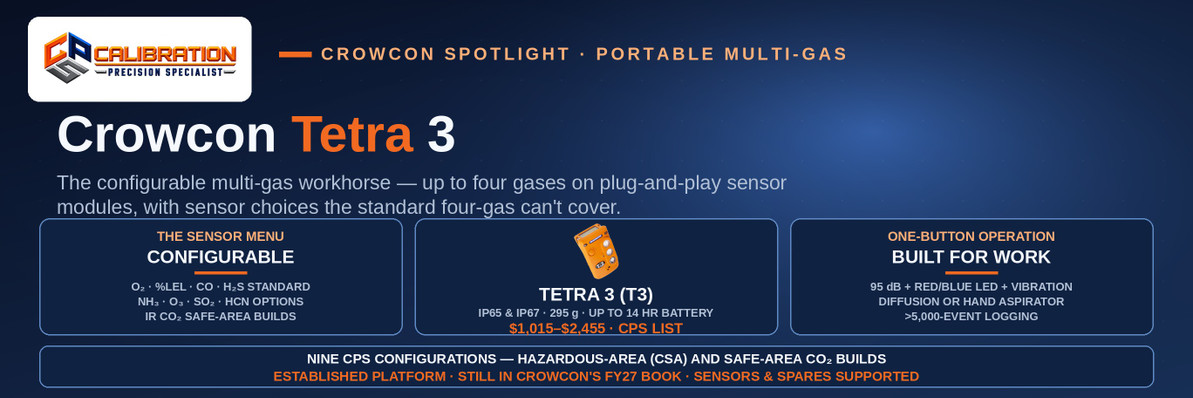
The Crowcon Tetra 3 (T3) is a personal multi-gas detector that monitors up to four gases at once on plug-and-play sensor modules — the standard four (oxygen, %LEL flammable, carbon monoxide, and hydrogen sulfide) or an expanded menu that adds ammonia, ozone, sulfur dioxide, hydrogen cyanide, hydrogen-filtered CO, and infrared CO₂ in safe-area versions. It is Crowcon's established, configurable platform: a 295 g (10.4 oz), IP65/IP67 instrument with one-button operation, a top-mount display, diffusion sampling or a hand aspirator, and event logging past 5,000 entries. CPS carries nine US configurations at list prices from $1,015 to $2,455.
Crowcon's current flagship personal 4-gas is the T4, and this post won't pretend otherwise. The Tetra 3 is the platform that came before it — and the reason it still earns a spotlight is that "before" is not the same as "replaced." The T3 remains in Crowcon's current price book, its sensors and spares remain available, and its one real party trick — a sensor menu wider than any standard 4-gas — is something the newer instrument doesn't try to match. If your hazard list is exactly the standard four, skip to the comparison section; the T4 is probably your buy. If your hazard list has an odd gas on it, or your site already runs T3s, read on.
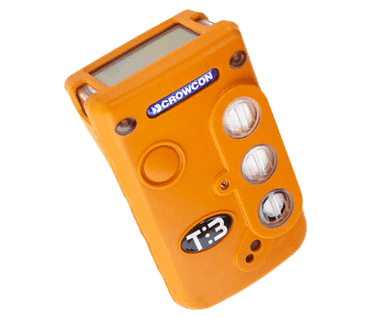
Crowcon Tetra 3 Portable Multi-Gas Detector
Crowcon Tetra 3 (T3): the configurable 1-to-4-gas workhorse — ammonia, ozone, SO₂ and IR CO₂ options beyond the standard four. CPS list: $1,015–$2,455.
$919.71–$2,104.29 configured
See the Tetra 3What the Tetra 3 Is
The Tetra 3 is a diffusion personal monitor built for confined-space and general industrial work, certified for Zone 1 and Zone 2 hazardous areas in its hazardous-area builds. The design brief was simplicity under stress:
- One-button operation. A single operator button runs the instrument — deliberate, because the person wearing it is often wearing gloves and thinking about something else. The top-mount, backlit graphic LCD shows all gas channels simultaneously, with peak readings and TWA (time-weighted average) values on recall.
- Plug-and-play i-module sensors. Each sensor is a modular i-module carrying its own intelligent processor with its calibration and sensor information stored on board. A replacement module is automatically identified by the instrument — the design that makes the wide sensor menu below practical, because an unusual combination is a configuration, not a special order.
- Alarms you can't miss. 95 dB audible alarm with selectable tones, a vivid red/blue LED visual alarm, and an internal vibrating alarm. Each channel carries two instantaneous alarm levels; toxic channels also carry TWA alarms.
- Built for the environment. Shatterproof housing with rubber over-moulding, water and dust protection to IP65 and IP67 — Crowcon rates it submersible — at 295 g and 114 × 71 × 48 mm (4.5 × 2.8 × 1.9 in).
- A shift-plus battery. Rechargeable lithium-ion: Crowcon's datasheet rates a four-gas unit at up to 14 hours of continuous use from a 12-hour charge, and at least 12 hours from a 5-hour charge.
- A paper trail. Timed data logging holds 50 hours at a 1-minute rate (more than 12,000 logs across four channels), plus threshold logging and an event log of more than 5,000 events. Configuration and log download run through Crowcon's Portables PC software, with the PC link provided through the charger.
- Approvals. The hazardous-area builds carry ATEX II 2G Ex ia d IIC T4 Gb, IECEx Ex ia d IIC T4 Gb, and CSA Class I, Division 1, Groups A, B, C and D — the CSA rating is what the US configurations CPS sells are built to.
The Sensor Menu Is the Point
A standard 4-gas monitor answers four questions. The Tetra 3's sensor range — from Crowcon's datasheet — answers more:
- Flammable: 0–100% LEL (calibration available for methane, propane, butane, pentane, hydrogen, and ethylene)
- Oxygen (O₂): 0–25%
- Hydrogen sulfide (H₂S): 0–100 ppm
- Carbon monoxide (CO): 0–500 ppm, including a hydrogen-filtered version for steel plants
- Sulfur dioxide (SO₂): 0–20 ppm
- Ozone (O₃): 0–1 ppm
- Ammonia (NH₃): 0–100 ppm standard — and CPS's build includes a 1,000 ppm ammonia configuration
- Hydrogen cyanide (HCN): 0–30 ppm
- Carbon dioxide (CO₂), infrared: 0–5% vol — safe-area versions only
The nine configurations CPS carries, at list:
- O₂ + infrared CO₂ (safe area) — $1,015
- O₂ + CH₄ (%LEL) — $1,073
- O₂ + CO + H₂S — $1,449
- O₂ + CH₄ + CO — $1,462
- O₂ + CH₄ + H₂S — $1,462
- O₂ + CH₄ + dual CO/H₂S sensor — $1,581
- O₂ + SO₂ + infrared CO₂ (safe area) — $1,783
- O₂ + O₃ — $1,919
- O₂ + CH₄ + NH₃ (1,000 ppm) — $2,455
Two honest notes on that list. First, the two infrared-CO₂ configurations are safe-area versions — they are not the CSA hazardous-area builds, and they shouldn't be carried into a classified location. Second, sampling: the Tetra 3 is a diffusion instrument. For remote sampling it uses a hand-operated aspirator assembly (flow plate, bulb, and 2 m / 6 ft tubing); there is no built-in electric pump. If your pre-entry testing needs a powered pump drawing from depth, that's a different instrument conversation — start with what a pumped monitor does differently.
Who Still Buys the Tetra 3 — and Why
Existing Tetra fleets. The strongest reason is the least glamorous one: commonality. A site running T3s already owns the chargers (including the vehicle and multi-way options), the T3 Gas Tester bump station, the i-module spares, and a crew trained on one button and one display. Adding T3s keeps one platform, one sensor stock, and one calibration routine. Fleets standardize for exactly this reason, and a detector your people already know is a safety feature in itself.
The odd-gas jobs. When Crowcon expanded the T3's sensor range, it named the targets: chemical and pharmaceutical plants, food and beverage processing, and water and wastewater treatment — the industries where the hazard list runs past the standard four. Ammonia in refrigeration and food processing, ozone and SO₂ in water treatment, HCN in chemical work, infrared CO₂ where fermentation or dry ice fills a safe area with an invisible asphyxiant: these are Tetra 3 combinations that a standard 4-gas simply doesn't offer, in a certified personal instrument rather than a specialty rig.
Buyers who value proven over new. The T3's design has been in the field for years, its failure modes are known, and its support chain — sensors, chargers, testers, parts — is established. For a compliance-driven purchase, "the platform we've already validated" is a legitimate engineering argument, not nostalgia.
Tetra 3 vs. T4: Which One Should You Buy?
Plainly: for a standard 4-gas purchase today, buy the T4. It is Crowcon's current flagship personal multi-gas detector — the newer platform, and at CPS the T4's US configurations run $465.75–$900, well under Tetra 3 money. Our Crowcon T4 spotlight works through it in full, and What Does a 4-Gas Monitor Detect? covers what the standard four do and don't see.
Buy the Tetra 3 instead when one of these is true:
- Your gas list includes ammonia (especially at the 1,000 ppm range), ozone, sulfur dioxide, hydrogen cyanide, or an infrared CO₂ safe-area build.
- Your site already runs T3s and fleet commonality — chargers, testers, spares, training — is worth more than a newer platform.
- Your procedures, permits, or validation paperwork already name the Tetra 3.
That's the whole comparison. The T3 is not the value pick and not the technology pick; it is the configuration pick and the continuity pick.
Calibration, Bump Testing, and Service
Crowcon's datasheet gives the Tetra 3 two routine calibration routes: Crowcon's Portables PC software, or the Checkbox IMH. For daily verification, Crowcon's T3 Gas Tester bumps up to four gases in about 60 seconds — the detector drops in, switches to bump mode automatically, and logs the result. However you test it, the discipline is the same as for any monitor in a confined-space entry program: bump before use, calibrate on schedule, and keep the records.
CPS calibrates the instruments it sells — calibration services run in-house at our Rockwood shop, and for gas detection our commitment is the bounded one: we calibrate every channel. A Tetra 3 with a non-standard sensor set is exactly the kind of instrument to ask about before you buy — the calibration gas has to match the combination, and that's a conversation we have daily.
Frequently Asked Questions
How many gases can the Crowcon Tetra 3 detect at once? Up to four gases simultaneously, all displayed at once on its top-mount graphic LCD. You choose the combination from its sensor menu — the standard four (oxygen, %LEL flammable, CO, H₂S) or a mix that includes ammonia, ozone, sulfur dioxide, hydrogen cyanide, hydrogen-filtered CO, or infrared CO₂ in safe-area versions.
What gases and ranges can the Tetra 3 measure? Per Crowcon's datasheet: flammable 0–100% LEL, oxygen 0–25%, hydrogen sulfide 0–100 ppm, carbon monoxide 0–500 ppm, sulfur dioxide 0–20 ppm, ozone 0–1 ppm, ammonia 0–100 ppm (CPS also carries a 1,000 ppm ammonia configuration), hydrogen cyanide 0–30 ppm, and infrared carbon dioxide 0–5% vol in safe-area versions.
How much does a Crowcon Tetra 3 cost? At CPS, the nine US configurations run $1,015 to $2,455 at list. The infrared CO₂ + oxygen safe-area build is the entry point at $1,015; standard hazardous-area combinations sit at $1,449–$1,581; the 1,000 ppm ammonia build tops the range at $2,455.
Is the Crowcon Tetra 3 discontinued? It is no longer Crowcon's flagship — the T4 holds that spot, and if you're buying a standard 4-gas, the T4 is usually the better buy. But the Tetra 3 is not a dead platform: its configurations remain priced in Crowcon's current FY27 price book, CPS stocks nine US configurations, and its i-module sensors, chargers, and testers remain available. It is an established platform with live support, not a clearance item.
What is the difference between the Tetra 3 and the Crowcon T4? The T4 is Crowcon's newer flagship personal 4-gas — a standard-four instrument (O₂, %LEL, CO, H₂S) at lower prices ($465.75–$900 at CPS). The Tetra 3 is the configurable platform: a wider sensor menu (ammonia, ozone, SO₂, HCN, IR CO₂), plug-and-play i-module sensors, and continuity for existing T3 fleets. Choose the T4 for the standard four; choose the T3 for an odd gas list or an existing fleet.
Does the Tetra 3 have a built-in pump? No. The Tetra 3 is a diffusion instrument; for remote sampling Crowcon offers a hand-operated aspirator assembly with a flow plate, bulb, and 2 m (6 ft) of tubing. There is no internal electric pump option — if your confined-space program needs powered sample draw, plan on a pumped instrument instead.
How long does the Tetra 3 battery last? Crowcon's datasheet rates the rechargeable lithium-ion battery, on a four-gas unit with a flammable sensor, at up to 14 hours of continuous use from a 12-hour charge — and at least 12 hours from a 5-hour charge. That's a full shift with margin, on the configuration that draws the most power.
Is the Tetra 3 intrinsically safe? The hazardous-area builds are certified ATEX II 2G and IECEx (Ex ia d IIC T4 Gb) and CSA Class I, Division 1, Groups A, B, C and D — the rating the US configurations CPS sells are built to. The two infrared CO₂ configurations are safe-area versions and are not certified for classified locations.
How do you calibrate a Tetra 3? Crowcon's datasheet lists two routine routes: the Portables PC software or the Checkbox IMH, with configuration and data/event-log access through the charger link. Bump testing can run through Crowcon's T3 Gas Tester, which tests up to four gases in about 60 seconds and logs the result. CPS also calibrates Tetra 3s in-house — every channel, with the gas matched to your sensor combination.
What is an i-module sensor? Crowcon's name for the Tetra 3's plug-and-play sensor modules. Each i-module carries an intelligent processor that stores that sensor's calibration and configuration information, and the instrument identifies a replacement module automatically. It's what makes the T3's unusual sensor combinations practical — and what makes a sensor swap a minutes-long job instead of a service event.
The Bottom Line
The Tetra 3 is the detector you buy for the gas list, not the price list. As a standard 4-gas it is outsold by its own successor, and this post has said so plainly. But no standard 4-gas — Crowcon's included — will hand you a certified personal monitor watching ammonia at 1,000 ppm, or ozone, or an infrared CO₂ build for a safe area, on the same one-button platform your fleet already charges and calibrates. If that's your hazard list, or if your site already speaks Tetra, the T3 remains a rational, supported, current-book purchase — at $1,015 to $2,455 across CPS's nine configurations.
Pricing a Tetra 3 configuration, or keeping an existing T3 fleet calibrated? Call 865-900-8844 or reach us through Contact Us. See the Crowcon Tetra 3 configurations, compare it with the Crowcon T4, and check our calibration services before the next entry.
CPS Calibrations · 109 S. Front Street, Rockwood, TN 37854 · Calibration Gas · Calibration Services · Contact Us
Need a calibration you can file?
In-house calibration at CPS in Rockwood, Tennessee — $55 for single-gas instruments, $90 for 4- and 5-gas — every channel, as-found and as-left data, full certificate.
See Calibration Servicesor call 865-900-8844
Recent Posts
-

What Is Remote Monitoring for Fixed Gas Detection?
Remote monitoring for fixed gas detection means a fixed system's live readings, trends, and alarm hi …Nov 23rd 2026 -

What Are the Key Differences Between the GX-6000 and GX-6100?
The RKI GX-6100 is the current replacement for the discontinued GX-6000: both are pumped 6-gas monit …Nov 22nd 2026 -

How to Read a PID Correction Factor Chart
To read a PID correction factor chart, find your vapor’s row, take the factor under your own lamp en …Nov 21st 2026