
Gas Detection on Tank Barges and Towboats
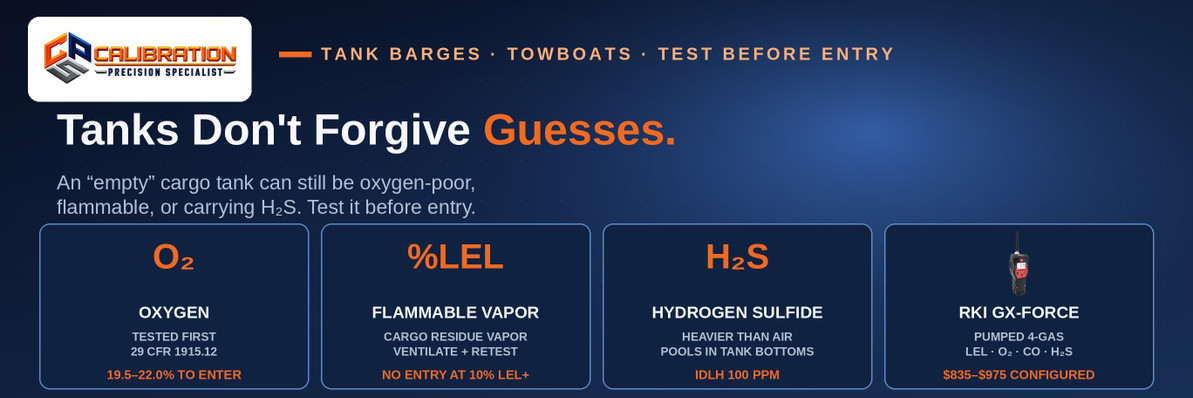
Gas detection on a tank barge or towboat means testing cargo tanks and vessel confined spaces for oxygen, flammable vapor in %LEL, and toxic gases — above all hydrogen sulfide (H₂S) and carbon monoxide (CO) — before anyone enters, and ventilating and retesting whenever gas is found. Federal vessel rules require a calibrated analyzer on board vessels carrying listed hazardous materials, with the hold and adjacent spaces tested before entry (46 CFR 148.415 and 148.420), and OSHA's shipyard entry standard bars entry at 10% LEL or more and outside 19.5–22.0% oxygen (29 CFR 1915.12).
CPS sits in Rockwood, Tennessee, a short run from the Tennessee River, where towboats push tank barges loaded with petroleum products and chemicals past Watts Bar. The work this post covers is the gas testing that keeps that traffic safe: what lives in a cargo tank after the cargo is gone, which spaces on a towboat count as confined spaces, what the Coast Guard and OSHA frameworks actually say, and which instrument does the testing. The step-by-step testing procedure itself is covered in testing a vessel tank before entry.
What Gases Are in a Cargo Tank After Unloading?
An "empty" tank barge is rarely empty of gas. Four hazards account for nearly all of it:
- Flammable cargo vapor (%LEL). Residue and scale keep giving off hydrocarbon vapor long after discharge. The reading that matters is percent of the lower explosive limit — the same scale a pumped 4-gas monitor reports.
- Hydrogen sulfide (H₂S). Sour petroleum cargoes leave H₂S behind, and it is heavier than air (gas density 1.2, air = 1, per CDC/ATSDR), so it pools in tank bottoms and low spaces. The exposure numbers are unforgiving: OSHA's general-industry ceiling is 20 ppm, the shipyard 8-hour TWA is 10 ppm, NIOSH's recommended ceiling is 10 ppm over 10 minutes, and 100 ppm is immediately dangerous to life or health (IDLH).
- Oxygen deficiency — or enrichment. Rusting steel, inerting, and cargo reactions consume oxygen inside a closed tank; a tank can sit well below the 19.5% floor with no visible sign of it.
- Carbon monoxide (CO). Engine exhaust, heaters, and adjacent machinery spaces put CO into the picture on the towboat itself, and CO is also one of the gases named in the Coast Guard analyzer rules below.
None of these can be judged by eye or by smell — H₂S famously deadens the sense of smell at dangerous concentrations, which is why this work runs on instruments, not noses.
What Counts as a Confined Space on a Towboat?
Beyond the cargo tanks themselves, a working towboat carries the same inventory of tight, poorly ventilated spaces as any vessel: void spaces and cofferdams, double-bottom and ballast tanks, pump rooms, chain lockers, and engine-room bilge areas. On the barge side, rake and box compartments and ullage openings over cargo tanks are the access points where testing happens. The common thread is limited entry and exit, air that does not exchange freely, and a history — cargo, coating, rust, or residue — that can make that air dangerous. Shipyard and repair work on these spaces falls under OSHA's shipyard standard, 29 CFR Part 1915 Subpart B; work afloat is governed by the vessel's Coast Guard framework and the operator's own entry procedures. Either way, the testing discipline is the same, and it is spelled out in testing a vessel tank before entry.
What Do the Coast Guard Rules Require for Gas Analyzers?
The Coast Guard's rules in 46 CFR Part 148 are written around a simple pattern — analyzer on board, crew who can use it, test before entry, ventilate and retest:
- Toxic gases — 46 CFR 148.415. When Table 148.10 associates a material with this section, each vessel transporting it — other than an unmanned barge — must have on board a gas analyzer appropriate for the toxic gas, which the section lists as arsine, carbon monoxide, hydrogen cyanide, hydrogen sulfide, phosphine, and sulfur dioxide. At least two crew members must be knowledgeable in the use of the equipment. The equipment must be kept ready for use and calibrated according to the manufacturer's instructions. The atmosphere in the cargo hold and adjacent spaces must be tested before a person is allowed to enter, and if toxic gases are detected the space must be ventilated and retested before entry.
- Flammable gases — 46 CFR 148.420. The parallel rule for flammable gas analyzers (carbon monoxide, hydrogen, and methane are the listed gases) requires equipment capable of measuring 0 to 100 percent of the lower flammable limit, calibrated per the manufacturer's instructions, with the cargo hold tested before entry and the same ventilate-and-retest rule when gas is found.
- Gas carriers — 46 CFR 154.1345. Vessels under the liquefied-gas rules carrying flammable-designated cargo must have a fixed flammable gas detection system plus two portable detectors, each able to measure 0 to 100% of the cargo's lower flammable limit; toxic-designated cargo requires two portable detectors that show whether the concentration is above or below the 29 CFR 1910.1000 threshold limit value, plus fixed sampling tubes in hold and interbarrier spaces — positioned low for heavier-than-air cargo and high for lighter-than-air cargo.
Read the exception honestly: the Part 148 analyzer carriage rules except unmanned barges, which describes most tank barges under tow. That exception is about which vessel carries the analyzer — it does not make the tank safe to enter untested, and the towboat, the terminal, and any shipyard doing repair work each bring their own testing duties. Where hot work is planned, OSHA's shipyard framework adds the Marine Chemist: a certificate holder certified by the National Fire Protection Association who applies NFPA 306, the Standard for the Control of Gas Hazards on Vessels, and whose gas-free certificate USCG and OSHA require before hot work in certain vessel spaces.
What Are the Entry Numbers Under the Shipyard Standard?
For shipyard employment — the repair and maintenance work done on barges and towboats at fleets and yards — 29 CFR 1915.12 fixes both the order of testing and the go/no-go numbers. Testing runs oxygen first, then flammability, then toxicity, and:
- Oxygen: no entry below 19.5% or at or above 22.0% by volume. A failing space is labeled "Not Safe for Workers," ventilated until oxygen holds at or above 19.5% and below 22.0%, and retested.
- Flammable vapor: no entry at or above 10% of the lower explosive limit. The space is labeled "Not Safe for Workers" and "Not Safe for Hot Work" and ventilated until the concentration is maintained below 10% LEL.
- Toxics: no entry when a concentration exceeds its OSHA PEL or reaches IDLH. Ventilation must bring and hold the concentration within the PEL — or below IDLH where no PEL exists — and a space that cannot be ventilated to those levels must be retested by a Marine Chemist or Certified Industrial Hygienist before it can be certified "Enter with Restrictions" or "Safe for Workers."
Which Instrument Does This Work?
Tank testing is pumped work: the instrument stays on deck with the tester, and a hose and probe draw the sample from inside the tank — the method walked through in testing a vessel tank before entry and in our comparison of pumped vs. diffusion gas detectors. Two store-verified examples from our pumped monitors range:
- The RKI GX-Force pumped 4-gas monitor (LEL, O₂, CO, H₂S) is configured at $835–$975 depending on charger and hose-and-probe length — the hose options are exactly what tank work needs.
- The RKI GX-6100 pumped 6-gas monitor adds PID/VOC and specialty-gas capacity for chemical-cargo work, configured at $1,597–$5,207 depending on sensor loadout.
Both sit in the wider portable multi-gas monitors category. Whichever instrument a vessel carries, the Coast Guard pattern above makes calibration part of the rule itself — calibrated according to the manufacturer's instructions — and we calibrate every channel through calibration services, in-house in Rockwood or shipped in from fleets anywhere on the river system.
Frequently Asked Questions
What gases do you test for on a tank barge?
Four channels cover nearly all of it: oxygen, flammable vapor read in %LEL, hydrogen sulfide (H₂S), and carbon monoxide (CO). Cargo history can add a fifth question — chemical cargoes may call for a PID or a specialty toxic sensor. H₂S deserves its priority: it is heavier than air (density 1.2), pools in tank bottoms, carries a 20 ppm OSHA general-industry ceiling and a 10 ppm shipyard TWA, and is immediately dangerous at 100 ppm.
Does the Coast Guard require gas detectors on barges?
Under 46 CFR 148.415 and 148.420, a vessel transporting a material that Table 148.10 associates with those sections must carry an appropriate toxic or flammable gas analyzer, keep it calibrated per the manufacturer's instructions, and have at least two crew members knowledgeable in its use. The text of those sections excepts unmanned barges from the carriage requirement — which is most tank barges under tow — but the testing duty lands on the towboat, terminal, or shipyard instead, and no framework makes an untested tank a safe entry.
What is a Marine Chemist and when is one required?
A Marine Chemist is a certificate holder certified by the National Fire Protection Association who tests vessel spaces and applies NFPA 306, the Standard for the Control of Gas Hazards on Vessels. Per OSHA's shipyard guidance, the Coast Guard and OSHA require a Marine Chemist's gas-free certificate before hot work or fire-producing operations in certain vessel spaces, and under 29 CFR 1915.12 a space that cannot be ventilated within PEL or below IDLH must be retested by a Marine Chemist or Certified Industrial Hygienist before it can be certified for entry.
What oxygen level is required to enter a vessel tank?
Under OSHA's shipyard standard (29 CFR 1915.12), an employee may not enter a space with oxygen below 19.5% or at or above 22.0% by volume. A space outside that window is labeled "Not Safe for Workers," ventilated until oxygen holds inside the window, and retested before the label comes off. Oxygen is always the first test in the sequence, ahead of flammability and toxicity.
At what %LEL is a tank safe to enter?
Under 29 CFR 1915.12, entry is barred at or above 10% of the lower explosive limit, and the space must be ventilated until flammable vapor is maintained below 10% LEL. The Coast Guard's flammable-analyzer rule (46 CFR 148.420) requires instruments capable of measuring the full 0 to 100 percent LFL range so that judgment is made on a real reading, not an over-range guess.
Why is hydrogen sulfide such a problem in petroleum barges?
Sour crude and refined products leave H₂S in residues and scale, and the gas is heavier than air, so it collects in tank bottoms and low voids where a tester at deck level would never smell it — and at dangerous concentrations it deadens the sense of smell in any case. The limits leave little room: a 20 ppm general-industry ceiling, a 10 ppm shipyard 8-hour TWA, a 10 ppm NIOSH 10-minute ceiling, and an IDLH of 100 ppm.
Can you test a cargo tank from the deck without entering it?
Yes — that is the normal method. A pumped (sample-draw) monitor stays on deck with the tester while a hose and probe are lowered through the ullage opening, drawing samples from several depths. Instruments built for it, like the RKI GX-Force, are sold with hose-and-probe options in lengths up to 20 feet in our store configuration ($835–$975 configured). The full procedure is in our post on testing a vessel tank before entry.
What is the difference between a towboat's own confined spaces and its cargo tanks?
Cargo tanks carry cargo history — flammable vapor, H₂S, oxygen displaced or consumed by the load and its residues. The towboat's own voids, cofferdams, ballast and double-bottom tanks, pump rooms, and chain lockers carry a different history: rust consuming oxygen, coatings, bilge residues, and engine-space CO. Both groups are limited-entry, poorly ventilated spaces whose air can be dangerous, and both get tested before entry — the gas list and the paperwork framework are what differ.
How often does a vessel gas detector need calibration?
The Coast Guard analyzer rules require the equipment to be maintained ready for use and calibrated according to the manufacturer's instructions — the manufacturer's interval governs, and bump testing before use is the daily check that the sensors still respond. At CPS, in-house calibration is $55 for a single-gas instrument and $90 for a 4- or 5-gas instrument, with ship-in service at the same rates; we calibrate every channel, not a spot check.
How much does a pumped 4-gas monitor for tank testing cost?
Store-verified pricing: the RKI GX-Force pumped 4-gas monitor (LEL, O₂, CO, H₂S) is configured at $835–$975 depending on charger and hose-and-probe length. A 6-gas pumped instrument with PID for chemical cargoes, the RKI GX-6100, runs $1,597–$5,207 configured depending on sensors. Quote configured variant prices, not headline prices — on the GX-Force the headline and the configured prices differ, and the variant price is what you pay.
The Bottom Line
On tank barges and towboats, gas detection is a test-before-entry discipline with written numbers behind it: oxygen held at 19.5% to below 22.0%, flammable vapor held below 10% LEL for shipyard entry, H₂S measured against a 20 ppm ceiling and a 100 ppm IDLH, and a calibrated analyzer on board with crew trained to use it under 46 CFR 148.415 and 148.420. An "empty" tank is an untested tank until an instrument says otherwise.
Running river fleets or yard work out of East Tennessee? Call CPS Calibrations at 865-900-8844 — pumped monitors, calibration, and the CPS Calibration Program behind them, from Rockwood, Tennessee.
CPS Calibrations · 109 S. Front Street, Rockwood, TN 37854 · Calibration Services · The CPS Calibration Program
Need a calibration you can file?
In-house calibration at CPS in Rockwood, Tennessee — $55 for single-gas instruments, $90 for 4- and 5-gas — every channel, as-found and as-left data, full certificate.
See Calibration Servicesor call 865-900-8844
Recent Posts
-

What Is Remote Monitoring for Fixed Gas Detection?
Remote monitoring for fixed gas detection means a fixed system's live readings, trends, and alarm hi …Nov 23rd 2026 -

What Are the Key Differences Between the GX-6000 and GX-6100?
The RKI GX-6100 is the current replacement for the discontinued GX-6000: both are pumped 6-gas monit …Nov 22nd 2026 -

How to Read a PID Correction Factor Chart
To read a PID correction factor chart, find your vapor’s row, take the factor under your own lamp en …Nov 21st 2026