
Testing a Vessel Tank Before Entry: Marine Confined Spaces
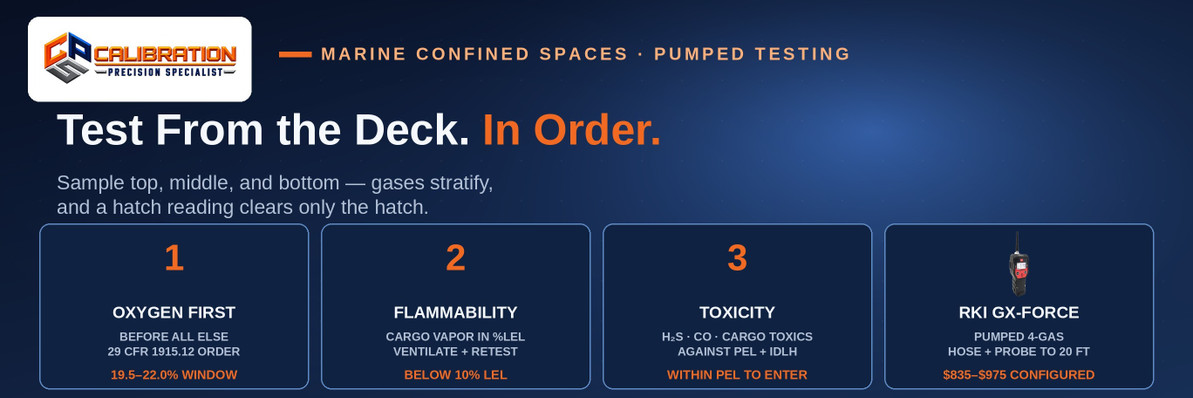
Testing a vessel tank before entry means sampling its air from outside the space with a pumped (sample-draw) monitor, in OSHA's shipyard order — oxygen first, then flammability, then toxicity (29 CFR 1915.12) — at the top, middle, and bottom of the tank, because gases stratify. Entry is barred below 19.5% or at/above 22.0% oxygen, at 10% LEL or more, and above a toxic's PEL or IDLH level; a failing tank is ventilated and retested, never entered on a hope.
This is the procedure companion to our overview of gas detection on tank barges and towboats. It follows the same discipline we teach for land-based entries in working in a manhole: gas testing — with the marine differences that matter: deeper tanks, stratified air over water, and rescue that has to happen from the deck.
Why Do You Test From the Deck Instead of Climbing In?
Because the first person in is otherwise the test instrument. A pumped monitor keeps the tester in clean air on deck while a hose and probe draw the sample from inside the tank — the core advantage laid out in pumped vs. diffusion gas detectors. A diffusion instrument can only read the air it sits in, which at deck level is the cleanest air on the vessel. Sample-draw is also what the regulators picture: the Coast Guard's gas-detection rule for gas carriers (46 CFR 154.1345) builds fixed sampling tubes into hold spaces precisely so air is pulled to the instrument, not the other way around.
Practical points that decide whether the reading means anything:
- Bump test and fresh-air zero first, on deck, before the probe goes anywhere near the tank.
- Let the sample arrive. The pump has to pull air the full length of the hose and the reading has to stabilize at each depth before it is recorded. Your instrument's manual governs the timing for its pump and hose — follow it rather than a rule of thumb, and use a hose long enough to actually reach the tank bottom (our GX-Force configurations run to a 20-foot hose and probe).
- Watch for hose problems. A kinked, cracked, or water-blocked hose reads clean air forever. Filters and float probes exist because tank bottoms are wet.
In What Order Do You Test a Vessel Tank?
29 CFR 1915.12 sets the sequence for shipyard work, and the order is not arbitrary: oxygen, then flammability, then toxicity.
- Oxygen first — because both of the other tests depend on it. A catalytic LEL sensor needs oxygen to burn its sample and reads falsely low in oxygen-poor air, and oxygen deficiency is itself the fastest killer in the tank. The entry window is 19.5% to below 22.0% by volume.
- Flammability second — entry is barred at or above 10% of the lower explosive limit, and the space must be ventilated until vapor is maintained below 10% LEL.
- Toxicity third — H₂S, CO, and any cargo-specific toxic are compared against their PEL and IDLH values; entry is barred above the PEL or at IDLH, and a space that cannot be ventilated into compliance must be retested by a Marine Chemist or Certified Industrial Hygienist before it can be certified "Enter with Restrictions" or "Safe for Workers."
Underway, the same sequence is sound practice under the vessel's Coast Guard framework and the operator's entry procedures; in a yard or at a fleet doing repair work, 1915.12 is the governing text.
Why Test the Top, Middle, and Bottom of the Tank?
Because tank air is layered, not mixed — stratification is the defining hazard of testing on the water, where a tank sits undisturbed for days. Gases sort by weight: hydrogen sulfide is heavier than air (density 1.2, air = 1) and pools at the bottom over residue and scale, while methane is lighter than air and collects high. Oxygen can be depleted at the bottom by rust and residue while the air at the hatch reads clean. The Coast Guard writes the same physics into hardware: 46 CFR 154.1345 requires fixed sampling tubes with their open ends in the lower part of a space for heavier-than-air cargo, the upper part for lighter-than-air cargo, and both when both kinds are carried.
So the probe goes down in stages — just below the deck opening, mid-depth, and at the bottom — with a stabilized reading at each level. A single sample at the hatch clears only the hatch.
What Happens When a Level Fails the Test?
Ventilate and retest — that is the entire remedy in 1915.12, and it is mechanical, not judgment-based:
- The space is labeled "Not Safe for Workers" (adding "Not Safe for Hot Work" where flammables or oxygen enrichment are involved).
- Ventilation runs at volumes and flow rates sufficient to hold the corrected condition — oxygen inside its window, flammables below 10% LEL, toxics within PEL or below IDLH.
- The space is retested before the label comes off and anyone enters, and testing continues during entry, because disturbing residue and scale can release gas that the pre-entry test never saw.
There is a narrow exception in the standard for emergency rescue and for short-duration entry to install ventilation equipment, and it comes with continuous monitoring and respiratory protection attached. It is not a shortcut for schedule pressure.
How Does Rescue Work From a Vessel Tank?
Honestly: with difficulty, which is why the plan is built before entry, not improvised after an alarm. A tank entrant who collapses at the bottom is below a deck opening, over water, in a space whose air just proved itself — the attendant does not climb in. 29 CFR 1915.12(e) requires the employer to establish a shipyard rescue team or arrange an outside team that will respond promptly; an in-house team must be equipped and trained for confined-space rescue, must practice at least once every 12 months using mannequins in facilities that closely approximate the real spaces, and must include at least one person currently certified in basic first aid including CPR. In practice, marine entries lean on non-entry retrieval — harness, tripod or davit, and a winch over the opening — rigged before the entrant goes down, with a tested communication method between entrant and attendant. If retrieval was not rigged before entry, it will not be rigged in time after a collapse.
Which Monitor Is Right for Vessel Tank Testing?
A pumped 4-gas monitor with a hose and probe long enough for the deepest tank you test. Store-verified: the RKI GX-Force pumped 4-gas monitor (LEL, O₂, CO, H₂S) is configured at $835–$975 with hose-and-probe options of 5, 10, 15, and 20 feet. Chemical-cargo work that adds VOCs points to a pumped PID instrument such as the RKI GX-6100, configured at $1,597–$5,207. Both are in our pumped monitors category. Whatever you carry, it has to read true on every channel — we calibrate every channel through calibration services, in-house in Rockwood at $55 single-gas / $90 for 4- & 5-gas instruments, ship-in at the same rates.
Frequently Asked Questions
What is the correct order for testing a confined space on a vessel?
Oxygen, then flammability, then toxicity — the sequence fixed by OSHA's shipyard standard, 29 CFR 1915.12. Oxygen goes first because a catalytic LEL sensor needs oxygen to read accurately and because oxygen deficiency is itself immediately dangerous. Flammability is judged next (entry barred at 10% LEL or more), and toxics last, against their PEL and IDLH values.
Can you test a vessel tank without entering it?
Yes — and you should. A pumped (sample-draw) monitor stays on deck with the tester while a hose and probe are lowered through the ullage or access opening, sampling each depth from outside the space. That is the standard method for tanks, voids, and double bottoms, and it is why pumped instruments are sold with hose-and-probe options up to 20 feet in our GX-Force configurations.
Why do you test at different depths in a tank?
Because gases stratify. Hydrogen sulfide is heavier than air (density 1.2) and pools at the bottom; methane is lighter than air and collects at the top; oxygen is often most depleted low in the tank where rust and residue consume it. A sample at the hatch describes only the hatch. Testing top, middle, and bottom — the same high/low logic the Coast Guard writes into fixed sampling-tube placement in 46 CFR 154.1345 — is what makes the clearance real.
What oxygen percentage is safe for tank entry?
Under 29 CFR 1915.12, entry is barred below 19.5% oxygen and at or above 22.0% oxygen by volume. A failing space is labeled "Not Safe for Workers," ventilated until oxygen holds at or above 19.5% and below 22.0%, and retested before entry. Both ends matter: too little oxygen suffocates, and oxygen enrichment makes materials burn with dangerous ease, which is why the enriched label adds "Not Safe for Hot Work."
How long should you pump before taking a reading?
Long enough for the sample to travel the full hose length and for the displayed reading to stabilize at that depth — and the governing numbers are your instrument manual's, for its pump and hose combination, not a universal seconds-per-foot rule. Rushing this step is the most common way deck testing goes wrong: the monitor happily displays deck air that is still in transit while the tank's real atmosphere has not arrived yet.
What do you do if a tank fails the pre-entry test?
Label it "Not Safe for Workers," ventilate it, and retest it. Under 29 CFR 1915.12, ventilation must be sufficient to hold the corrected atmosphere — oxygen in its 19.5% to below 22.0% window, flammable vapor below 10% LEL, toxics within their PEL or below IDLH — and the warning label comes off only when retesting shows the condition is maintained. If a toxic atmosphere cannot be ventilated into compliance, a Marine Chemist or Certified Industrial Hygienist must retest before the space can be certified for entry.
Do you need a Marine Chemist to test a vessel tank?
For routine pre-entry testing in shipyard work, a designated competent person performs the testing under 29 CFR Part 1915. A Marine Chemist — NFPA-certified, applying NFPA 306 — is required for gas-free certification before hot work in certain vessel spaces, and under 1915.12 a space that cannot be ventilated within PEL or below IDLH must be retested by a Marine Chemist or Certified Industrial Hygienist before it can be certified "Enter with Restrictions" or "Safe for Workers."
How is vessel tank testing different from manhole testing?
The order of testing and the go/no-go numbers are the same discipline — our manhole guide covers the land-based version — but vessel tanks are deeper, their air stratifies over days undisturbed on the water, access is through small ullage openings rather than a full manway, and rescue is a deck-rigged retrieval problem over water rather than a street-level one. The governing text also differs: shipyard vessel work runs on 29 CFR Part 1915, not the general-industry confined-space standard.
What is non-entry rescue and why does it matter on a vessel?
Non-entry rescue retrieves a collapsed entrant from outside the space — harness, tripod or davit, and winch over the tank opening, rigged before entry. It matters because the alternative, an attendant climbing into the same atmosphere that felled the entrant, is how single tank fatalities become double ones. OSHA's shipyard standard (29 CFR 1915.12(e)) additionally requires a rescue team — in-house or arranged outside — that responds promptly, practices at least every 12 months with mannequins, and includes a first-aid/CPR-certified member.
How much does it cost to calibrate a pumped 4-gas monitor?
At CPS Calibrations, in-house calibration is $90 for a 4- or 5-gas instrument and $55 for a single-gas instrument; ship-in calibration is billed at the same rates, and on-site work at your facility is quoted in writing and costs more. The monitor doing your tank testing has to read true on every channel — oxygen, LEL, H₂S, and CO — and we calibrate every channel.
The Bottom Line
Test from the deck, in order, at every depth: oxygen first (19.5% to below 22.0%), flammability second (below 10% LEL), toxicity third (within PEL, below IDLH), with a pumped monitor and a stabilized reading at the top, middle, and bottom of the tank. A failed level means label, ventilate, and retest — and rescue is a rigging job done before entry, not an improvisation after a collapse.
Testing tanks on the Tennessee River system or at a yard in East Tennessee? Call CPS Calibrations at 865-900-8844 — pumped monitors, calibration, and the CPS Calibration Program behind them, from Rockwood, Tennessee.
CPS Calibrations · 109 S. Front Street, Rockwood, TN 37854 · Calibration Services · The CPS Calibration Program
Need a calibration you can file?
In-house calibration at CPS in Rockwood, Tennessee — $55 for single-gas instruments, $90 for 4- and 5-gas — every channel, as-found and as-left data, full certificate.
See Calibration Servicesor call 865-900-8844
Recent Posts
-

What Is Remote Monitoring for Fixed Gas Detection?
Remote monitoring for fixed gas detection means a fixed system's live readings, trends, and alarm hi …Nov 23rd 2026 -

What Are the Key Differences Between the GX-6000 and GX-6100?
The RKI GX-6100 is the current replacement for the discontinued GX-6000: both are pumped 6-gas monit …Nov 22nd 2026 -

How to Read a PID Correction Factor Chart
To read a PID correction factor chart, find your vapor’s row, take the factor under your own lamp en …Nov 21st 2026