
Working in a Manhole: The Gas Testing That Happens Before the Ladder
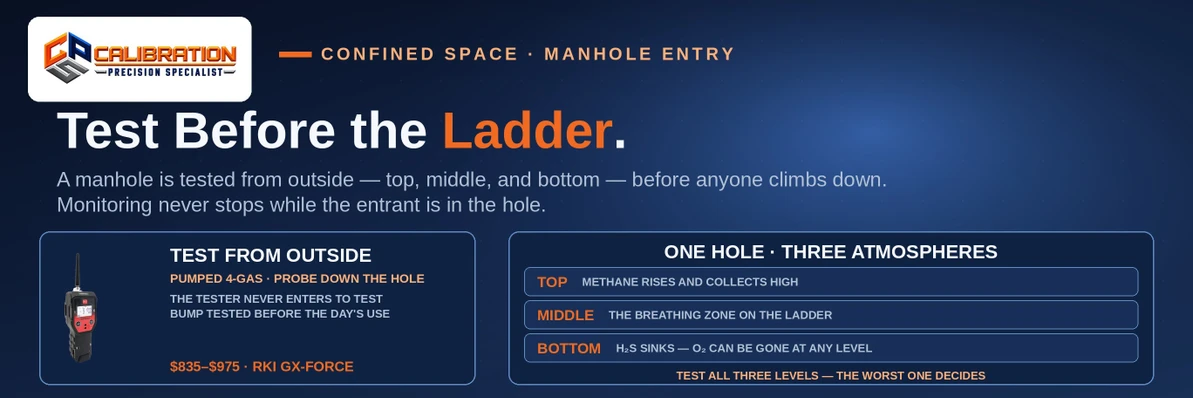
Before anyone climbs into a manhole, a pumped gas monitor tests the air from outside — at the top, the middle, and the bottom — because manhole gases stratify: methane rises and collects high, hydrogen sulfide sinks and pools low, and oxygen can be displaced at any level. Testing then continues for the entire entry, ventilation runs from a clean-air source, and a trained attendant stays topside with a retrieval system rigged — because the worker the monitor protects first is the one who never has to go in to find out what the air was like.
A manhole is the confined space most crews meet most often, and it punishes the two shortcuts that feel most natural: testing once at the rim, and trusting the air you tested an hour ago. This post is the full sequence as it should run — level by level, before the ladder, during the entry, and in the emergency nobody plans for. The general testing framework behind it is in how to test a confined space before entry; what follows is that framework applied to the specific geometry of a manhole. Whether a given manhole is a permit-required space is decided by the tests in what is a confined space? — but sewer and utility manholes with any hazardous-atmosphere potential should be worked as permit entries, with the full sequence below.
Why Is a Manhole Not Just a Small Confined Space?
Three features make manholes their own problem:
- The gases are generated inside the space. Sewage and organic matter decompose in place, producing hydrogen sulfide and methane continuously — the hazard is manufactured by the space itself, and it does not stop because you ventilated an hour ago. Disturbing sludge or flow during the work can release a fresh burst mid-entry.
- There is one way in and out, and it is vertical. Every entrant passes through every layer of the atmosphere on a ladder, and an incapacitated entrant cannot climb. Entry, work position, and rescue all happen in the same narrow column of air.
- The work is usually at the bottom. Benching, inverts, lines, and pumps sit at the low point — which is exactly where the heaviest, most dangerous gas collects.
That combination — self-generating gas, stratified layers, vertical access, work at the bottom — is why manhole procedure is more specific than "test the space." The space is tested in layers, because the layers are genuinely different atmospheres stacked in one hole.
Which Gases Live at Which Level in a Manhole?
| Level | What collects there | Why it matters |
|---|---|---|
| Top | Methane (lighter than air) rises and can collect under the cover and in the upper barrel | A rim-level whiff of clean air says nothing about the methane layer — or about anything below it |
| Middle | The ladder zone — the entrant's breathing zone while climbing; oxygen can be displaced here by gases rising or sinking through it | This is the air the entrant breathes on the way down, before ever reaching the work |
| Bottom | Hydrogen sulfide (heavier than air) sinks and pools at the invert and in sumps; oxygen is often lowest here too | The work position is the worst air in the hole — H₂S at the bottom can be lethal while the top tests clean |
| Any level | Oxygen displacement, and carbon monoxide where engine exhaust or connected systems contribute it | Displacement is not layered politely — a level that tested fine can be the one that changes during the entry |
The table is the whole argument for the testing pattern: a manhole is not tested at a point. It is tested as a column.
Step 1: How Do You Test a Manhole Before Entry?
All of it from outside, all of it before the cover work turns into entry:
- Bump test the monitor first. The pumped instrument — a monitor like the RKI GX-Force ($835–$975) is built for exactly this role — gets a bump test before the day's use. A pre-entry test performed with an unverified instrument is paperwork, not testing.
- Test before the space is fully opened, where the design allows, and from upwind. The tester stays out of the opening's direct vent path. The first air out of a manhole is the space announcing itself; nobody's head belongs in it.
- Lower the probe in stages: top, middle, bottom. At each level, wait long enough for the sample to travel the probe and hose and for the sensors to fully respond — hose length sets the wait, and the all-in times by hose length are worked out in how long do you test a confined space before entry. Rushing a level produces a reading of the previous level's air.
- Follow OSHA's testing order at each level: oxygen first, then combustible gases, then toxics. The order is physics, not preference — the full reasoning is in the confined-space testing sequence. Read all three levels before anyone decides anything: the entry decision belongs to the worst level the entrant will occupy or pass through, not the best.
- Record the readings on the permit. Levels, times, instrument, tester. If it is not written down, the next shift — and any investigation — has nothing.
- If any level fails, ventilate and retest. Nobody enters on a promise that the blower will fix it. Ventilation is step 2, below — and entry waits for a retest that passes at every level, including the bottom.
Step 2: How Should a Manhole Be Ventilated?
Ventilation fails in a predictable way: a blower set at the rim, blowing across the top of the hole, stirring the upper air while the bottom — the work position — keeps its atmosphere. Ventilating a manhole properly means:
- Deliver fresh air to the bottom. The blower's duct runs down the hole so clean air is discharged near the work level and pushes the contaminated air up and out past the levels above. Air that enters at the top and leaves at the top never visits the bottom at all.
- Draw the blower's intake from clean air. A blower parked beside a running truck or generator can pump exhaust — carbon monoxide included — straight into the space. Intake placement is part of the setup, not an afterthought.
- Ventilate continuously during the entry, not just before it. The space generates gas while you work; stopping the blower at the moment of entry lets the bottom layer rebuild under the entrant.
- Never ventilate with pure oxygen. Enriching the atmosphere creates a fire hazard worse than the one being corrected. Ventilation gas is clean air, full stop.
- Prove it by retesting. There is no universal number of minutes after which a manhole is "safe." Ventilation is finished when the retest — all levels, bottom included — reads acceptable, and it stays finished only while monitoring says so.
Step 3: What Monitoring Continues During the Entry?
The pre-entry test describes the space at one moment. The entry lasts longer than the moment:
- The entrant wears a personal monitor in the breathing zone — a standard 4-gas like the RKI GX-3R ($640) — for the whole entry. It is the alarm that travels with the person actually breathing the bottom layer.
- The pumped instrument keeps sampling from outside. The attendant monitors the space's air through the entry, watching for the change the pre-entry test cannot predict: a sludge disturbance, a flow surge, a ventilation failure.
- Any alarm ends the entry. Entrant out, space re-evaluated, cause found. An alarm that is silenced and worked through converts the monitor from a protection into a decoration.
- The attendant watches the monitor and the entrant, and nothing else. Monitoring during entry is a job, not a side task — the attendant has no other duties that take eyes or attention off the opening.
This two-instrument pattern — pumped tester outside, personal monitor on the entrant — is the same kit wastewater crews carry for vaults, wet wells, and lift stations; the wider kit list is in what gas detectors do wastewater workers need?.
Step 4: The Attendant, the Retrieval System, and the Would-Be-Rescuer Rule
The final layer is the one that operates when everything above has already gone wrong:
- A trained attendant stays topside for the entire entry, in communication with the entrant, with no other duties, and with one absolute rule: the attendant does not enter. Not for a collapse, not for a silence, not for a friend. The attendant raises the alarm and runs the retrieval system.
- A retrieval system is rigged before entry, not fetched after an emergency: a tripod or davit over the opening, a winch, and a full-body harness on the entrant, so an incapacitated worker can be lifted vertically out of the hole by people who never enter it. In a vertical space more than a few feet deep, non-entry retrieval is the rescue plan — it has to be in place and attached before the ladder is used.
- The would-be-rescuer rule. Confined-space safety guidance repeats one pattern so consistently that it is taught as a rule: when a confined-space incident kills more than one person, the additional deaths are typically would-be rescuers — workers who climbed in, unprotected, after the first victim. A manhole that has incapacitated one entrant has demonstrated exactly what its air does to a person. The second person who enters it unprotected is not a rescue; it is a second exposure to a proven hazard. Every part of the system above — attendant discipline, retrieval hardware rigged in advance, a rescue service that can be summoned — exists to make sure nobody ever has to choose between watching and climbing in.
What Equipment Does a Manhole Entry Kit Actually Need?
- One pumped 4-gas monitor for pre-entry and continuous external testing (pumped monitors — the GX-Force at $835–$975 is the dedicated example in our range).
- One personal 4-gas monitor per entrant, worn in the breathing zone (GX-3R, $640).
- A blower with ducting long enough to discharge at the bottom of the deepest hole on the route.
- Tripod or davit, winch, and harness — the retrieval system, sized to the opening.
- Calibration gas and bump-test discipline behind all of it. Every channel on both monitors gets bump tested before use and calibrated on schedule — sent to CPS in-house, calibration runs $55 for a single-gas instrument and $90 for a four- or five-gas, with every channel calibrated. Our calibration gas carries a QR code on each bottle linking to its SDS and certificate of analysis, and CPS charges no hazmat fee — we absorb it. The $55/$90 rates are in-house rates; on-site service is quoted in writing.
Frequently Asked Questions
How do you test a manhole for gas before entry?
From outside, with a pumped monitor, before anyone enters: bump test the instrument, then lower the sample probe in stages — top, middle, and bottom — testing at each level in OSHA's order (oxygen first, then combustible gases, then toxics) and waiting at each level long enough for the sample to travel the hose and the sensors to respond. Record every level's readings on the entry permit. The entry decision is based on the worst level the entrant will pass through or work in, not the reading at the rim.
Why do you test a confined space at the top, middle, and bottom?
Because gases stratify — they layer by density instead of mixing evenly. Methane is lighter than air and collects at the top; hydrogen sulfide is heavier and pools at the bottom, where manhole work is usually done; oxygen can be displaced at any level. A single test at any one point can read clean air directly above or below a lethal layer. Testing the column — top, middle, bottom — is the only way to know what the entrant will actually breathe on the ladder and at the work position.
What gases are commonly found in manholes?
The standard four a manhole monitor must read: hydrogen sulfide, produced by decomposing sewage and organic matter and the signature manhole killer; methane (read on the combustible/LEL channel), also from decomposition; oxygen deficiency, because decomposition and displacement consume or push out breathable air; and carbon monoxide, which can enter from connected systems or be introduced by engine exhaust near the opening. That is why the entry instrument is a 4-gas monitor — LEL, O₂, CO, and H₂S — and not a single-gas unit.
Do you need a pumped gas detector to test a manhole?
Yes, for the pre-entry test. The tester must draw samples from the top, middle, and bottom of the space while standing outside it, and only a pumped monitor with a probe and hose can do that — a diffusion monitor reads only the air that reaches it, which at the rim is the outside air. The RKI GX-Force ($835–$975) is a pumped 4-gas monitor built for this testing role. The entrant then wears a personal monitor (diffusion is correct there — the wearer and the monitor are in the same air), such as the RKI GX-3R at $640.
How long should you ventilate a manhole before entering?
There is no universal number of minutes, and any fixed time quoted for every manhole should be distrusted: the required ventilation depends on the hole's volume and depth, the blower's capacity, and how fast the space is generating gas. Ventilate with the duct discharging fresh air near the bottom, keep ventilating during the entry, and treat ventilation as finished only when a full retest — top, middle, and bottom — reads acceptable levels. The retest, not the clock, is what clears the entry.
Does gas monitoring continue while someone is in the manhole?
Yes — continuous monitoring during entry is required practice for permit-space entry, and a manhole is exactly why: the space generates hydrogen sulfide and methane while the work happens, and disturbing sludge or flow can release a sudden burst an hour after a clean pre-entry test. The entrant wears a personal 4-gas monitor in the breathing zone, the pumped instrument keeps sampling the space from outside under the attendant's watch, and any alarm ends the entry until the cause is found.
What should the attendant do if the entrant collapses in a manhole?
The attendant does not enter — ever. The attendant raises the alarm, summons the rescue response, and uses the retrieval system (tripod and winch with the entrant's harness) to lift the entrant out from the surface. Confined-space safety guidance teaches this as the would-be-rescuer rule: in multi-fatality confined-space incidents, the additional victims are typically rescuers who entered after the first worker. An atmosphere that has incapacitated one entrant will do the same to an unprotected rescuer, faster than help can arrive.
What is a retrieval system for manhole entry?
The non-entry rescue hardware rigged over the opening before entry begins: a tripod or davit arm spanning the manhole, a winch, and a line attached to the entrant's full-body harness, so an incapacitated entrant can be raised vertically out of the space by the attendant without anyone entering. For vertical entries like manholes, a retrieval system is the default rescue method under OSHA's confined-space standard — it must be in place and connected before the entry, not assembled during the emergency.
Is a manhole a permit-required confined space?
A manhole meets the confined-space definition — large enough to enter, limited entry and exit, not designed for continuous occupancy — and sewer and utility manholes that contain or can develop a hazardous atmosphere are worked as permit-required spaces, with the full program: permit, attendant, retrieval, testing, and ventilation. The classification tests are laid out in our post on what a confined space is. The practical rule: if a manhole can hold sewer gas — and manholes can — treat it as a permit entry and run the full sequence.
How much does the gas detection equipment for manhole entry cost?
The core instruments are a pumped 4-gas monitor for pre-entry and external testing — the RKI GX-Force runs $835–$975 — plus a personal 4-gas monitor for each entrant, such as the RKI GX-3R at $640. Add the blower and ducting, the tripod/winch/harness retrieval set, and the ongoing program behind the instruments: calibration gas and scheduled calibration ($55 single-gas / $90 four- or five-gas in-house at CPS, every channel calibrated; no hazmat fee on calibration gas). The instruments are a one-time purchase; the testing and rescue discipline is what actually protects the entrant.
The Bottom Line
A manhole entry is safe in proportion to what happens before and outside it. Test the column — top, middle, bottom — from the surface with a pumped monitor, in the right order, with enough wait at each level for the reading to be real. Ventilate to the bottom from a clean-air intake, and let a retest, not a timer, say when it worked. Keep monitoring for every minute of the entry, because the space makes its own gas while you work. And rig the rescue before the emergency: an attendant who never enters, a tripod and winch that lift from the surface, and a crew that understands the would-be-rescuer rule in its bones. The ladder is the last step of a manhole entry, not the first — everything that keeps the entrant alive happens before anyone's boot touches a rung.
Outfitting a manhole or confined-space crew, or checking your current kit against this sequence? Call 865-900-8844 or reach us through Contact Us. We will spec the testing and entry kit the way this post does — pumped monitors, calibration gas, and the calibration services that keep every channel honest.
CPS Calibrations · 109 S. Front Street, Rockwood, TN 37854 · Calibration Gas · Calibration Services · Contact Us
Need a calibration you can file?
In-house calibration at CPS in Rockwood, Tennessee — $55 for single-gas instruments, $90 for 4- and 5-gas — every channel, as-found and as-left data, full certificate.
See Calibration Servicesor call 865-900-8844
Recent Posts
-

What Is Remote Monitoring for Fixed Gas Detection?
Remote monitoring for fixed gas detection means a fixed system's live readings, trends, and alarm hi …Nov 23rd 2026 -

What Are the Key Differences Between the GX-6000 and GX-6100?
The RKI GX-6100 is the current replacement for the discontinued GX-6000: both are pumped 6-gas monit …Nov 22nd 2026 -

How to Read a PID Correction Factor Chart
To read a PID correction factor chart, find your vapor’s row, take the factor under your own lamp en …Nov 21st 2026