
How Accurate Are Detector Tubes?
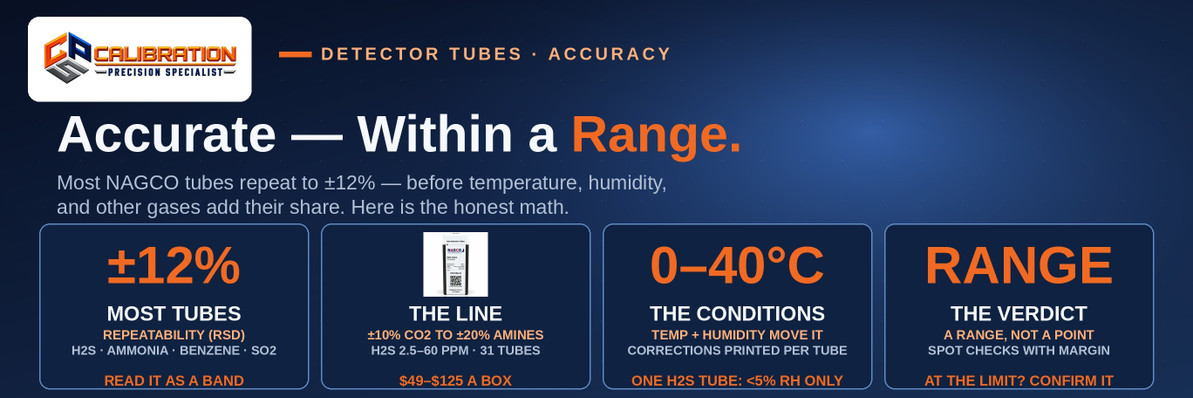
Detector tubes are accurate to a range, not a point: NAGCO specifies most of its tubes at ≤ ±12% relative standard deviation — ±10% on its carbon dioxide tubes, ±15% on its selective carbon monoxide tube, and ±20% on its amines, mercaptans, and diesel tubes — and that figure is repeatability alone, before temperature, humidity, cross-interferences, and pump condition add their share. A 10 ppm reading on a ±12% tube is really about 8.8 to 11.2 ppm, so a tube is the right tool for spot checks with margin and the wrong tool for settling a number that sits on a limit.
Every detector tube post in this series has circled this question — the water vapor measurement post did the ±12% math at the 7 lbs/MMCF pipeline limit, and the step-by-step tube procedure covered the technique errors. This post answers the question head-on: what the accuracy figure on the data sheet actually means, how much it varies from tube to tube, what else moves the number after the chemistry has done its best, and — the part that decides whether a tube belongs on a job at all — when that level of accuracy is enough and when it is not.
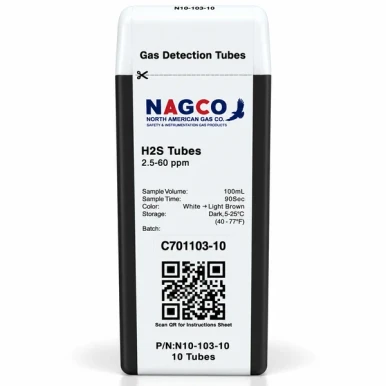
NAGCO Hydrogen Sulfide (H2S) Detector Tubes 2.5-60 ppm | N10-103-10
Box of direct-reading H2S tubes at ≤ ±12% RSD — the worked example in this post, with a 3-year storage life.
$49
See the H2S tubesWhat Does ±12% on a Detector Tube Actually Mean?
The precision figure on a NAGCO data sheet is a relative standard deviation (RSD) — a repeatability number. It describes how tightly repeated measurements of the same gas at the same concentration cluster around each other when the test is run correctly: same tube batch conditions, correct stroke count, specified sample time, inside the stated temperature and humidity window. It is not a promise that your field reading sits within ±12% of the true value, because the field adds errors the laboratory repeatability figure never met: temperature outside the corrected range, an interfering gas in the sample, a pump that leaks a little, a stain read in poor light.
That distinction is not a reason to distrust tubes. It is the reason to read them correctly:
- Read the number as a band. On a ±12% tube, a stain that reads 10 ppm means the concentration is most likely somewhere around 8.8 to 11.2 ppm before field errors are counted. A reading of 50 on the same class of tube is about 44 to 56.
- Keep margin at decision points. If your action level is 10 and the tube reads 9, the honest statement is "at or near 10," not "under." Tubes settle questions that have room in them; they do not settle arguments at a line.
- Compare like with like. The pipeline water vapor tubes at ±12% put a 7 lbs/MMCF tariff reading at roughly 6.2 to 7.9 lbs/MMCF in true value — close enough to run a dryer and decide whether gas ships, which is exactly the job that tube is sold for.
How Accurate Is Each Tube? It Depends Which One Is in the Pump
There is no single "detector tube accuracy," because each tube is a different chemistry. Across the 31-tube NAGCO line CPS carries ($49–$125 a box), the published precision runs from ±10% to ±20%:
| Tube | Range | Precision (RSD) | Storage life |
|---|---|---|---|
| Carbon Dioxide N10-104-40 | 0.05–1% | ≤ ±10% | 3 years |
| Hydrogen Sulfide N10-103-10 | 2.5–60 ppm | ≤ ±12% | 3 years |
| Ammonia N10-100-05 | 1–30 ppm | ≤ ±12% | 2 years |
| Benzene Specific N10-101-01 | 0.5–10 ppm | ≤ ±12% | 1 year |
| Sulfur Dioxide N10-107-15 | 2–30 ppm | ≤ ±12% | 2 years |
| Carbon Monoxide Selective N10-102-18 | 5–100 ppm | ≤ ±15% | 2 years |
| Amines N10-132-10 | 0.5–10 ppm | ≤ ±20% | 1 year |
| Mercaptans N10-129-20 | 5–120 ppm | ≤ ±20% | 1 year |
Two patterns worth knowing before you buy. First, the tightest tubes (±10%) are the carbon dioxide tubes — a high-concentration percent-range measurement is an easier chemistry than a low-ppm trace one. Second, the loosest tubes (±20%) are the ones measuring complex mixtures or families of compounds — amines as a class, mercaptans as a class, diesel vapor calibrated to undecane with per-fuel correction factors. The broader the chemistry's target, the wider the scatter. H2S is the best-stocked example of choosing your precision by choosing your range: CPS carries 13 different H2S tubes, from 0.2–3 ppm to 2–40%, because a tube read near the middle of its printed scale is a better measurement than the same gas read at the ragged end of a too-wide tube.
What Else Moves the Number: Temperature, Humidity, and Other Gases
The RSD is the floor of the error, not the ceiling. Three documented effects stack on top of it, and every one of them is printed on the tube's own data sheet — which is why the sheet, not habit, runs the test.
Temperature. Tubes in this line are specified for 0–40°C (32–104°F), and most print a correction table because the reaction rate shifts with temperature. The corrections are not small: the CO2 0.05–1% tube corrects by 1.2 at freezing and 0.75 at 104°F, and the H2S 2.5–60 ppm tube by 0.95 cold and 1.2 hot. Skip the correction on an extreme day and you have added an error as large as the tube's entire repeatability — in one direction, on top of it.
Humidity. For most of the line this is a non-issue inside a stated window — the CO selective tube, for example, specifies no humidity effect from 5–100% RH, and the H2S 2.5–60 tube none from 5–85%. Then there is the trap: the low-range H2S 0.2–3 ppm tube must be used at less than 5% relative humidity, and NAGCO states its reading drops sharply above that. In ordinary plant air, that tube can read low — the dangerous direction — for a reason that has nothing to do with the H2S present. The sheet is the only place that warning lives.
Cross-interference. A tube's reagent reacts with its target gas by design and with a short list of other compounds by chemistry. The sheets name them: sulfur dioxide and hydrogen sulfide can produce apparent readings on the CO2 tube; ammonia, H2S, and hydrogen fluoride produced apparent readings on the SO2 tube — and ammonia can reduce that tube's reading in a mixture, pushing it low; methyl and butyl mercaptan move the low-range H2S tube. Better tubes fight back with engineering — the benzene-specific tube carries a pre-tube that strips interfering compounds, and the CO tube is called "Selective" because a pretreatment layer removes most of its interferences — but no tube is immune in every mixture. In a space where a listed interference is present, a tube reading is evidence, not proof, and a second method settles it.
Age and the pump. Storage life across the line runs 1 to 3 years, counted in the dark at 40–77°F with refrigeration preferred. An expired tube is an unknown reagent producing an unknowable error — there is no correction factor for old chemistry. And the pump is half the instrument: a leaking pump under-draws every sample and reads low, which is why the procedure starts with a leak check and why pump seals are a $65 rebuild-kit maintenance item, not a footnote.
When Is a Detector Tube Accurate Enough — and When Is It Not?
A tube is accurate enough when the question has margin and the moment is the measurement: checking a space before work starts, verifying a dryer against a tariff limit, investigating an odor complaint, screening for a gas no personal monitor covers, or confirming a fixed analyzer that suddenly looks wrong. The job is pass/fail against a number the reading is clearly above or clearly below, and the tube's band fits inside that clearance. At $4.90 to $5.90 a test for the box-of-10 tubes, with no power, no calibration, and no warm-up, nothing else answers that shape of question as cheaply. The full lineup is in the gas detection tubes category, and the background on choosing tubes is in what gas detection tubes are and when to use them.
A tube is not accurate enough — or not the right shape of tool — when:
- The decision sits on the number. A reading at 9 against a limit of 10, on a ±12% or ±20% tube, has not cleared anything. Confirm with a calibrated electronic instrument before the decision is made on it.
- The exposure is the question. A tube measures a few minutes at one point. It says nothing about an average across a shift, and nothing about the air an hour later.
- Someone needs protection, not a measurement. A tube does not alarm, does not log, and does not watch. A worker in a changing atmosphere needs a calibrated electronic monitor — and calibrated is the operative word: unlike a tube, an electronic instrument can be zeroed and spanned against known gas, adjusted back to true, and returned with as-found and as-left data proving where it stood. That bench work is what CPS does in-house in Rockwood, Tennessee — every channel, full certificate.
- The result will be disputed. Custody, enforcement, and incident investigations need an instrument with a calibration record, not a spent glass tube and a handwritten number.
Used inside its limits, a tube's accuracy is not a weakness to apologize for — it is a known, published quantity, which is more than can be said for an uncalibrated electronic monitor whose drift nobody has measured. The honest comparison is not tube versus instrument; it is known uncertainty versus unknown uncertainty.
Frequently Asked Questions
How accurate are detector tubes?
Most NAGCO detector tubes are specified at ≤ ±12% relative standard deviation — ±10% on the carbon dioxide tubes, ±15% on the selective carbon monoxide tube, and ±20% on the amines, mercaptans, and diesel tubes. That figure is repeatability under correct procedure; temperature, humidity, cross-interferences, and pump condition add further error in the field, so a reading is best treated as a range — about 8.8 to 11.2 ppm for a 10 ppm reading on a ±12% tube.
What does relative standard deviation mean on a detector tube?
Relative standard deviation (RSD) is the tube's repeatability: how tightly repeated measurements of the same gas at the same concentration cluster when the test is run correctly — right stroke count, full sample time, inside the stated temperature and humidity window. It is not a guarantee that a field reading is within that percentage of the true value, because field conditions add errors the repeatability test never included.
Which detector tubes are the most accurate?
In the NAGCO line, the carbon dioxide tubes are the tightest at ≤ ±10% RSD — both the 0.05–1% and the 0.25–3% tubes. Most single-gas tubes (H2S, ammonia, benzene-specific, SO2, water vapor pipeline) are ≤ ±12%, the selective CO tube is ≤ ±15%, and the broad-chemistry tubes for amines, mercaptans, and diesel vapor are ≤ ±20%. The broader the family of compounds a tube reacts to, the wider its scatter tends to be.
Does temperature affect detector tube accuracy?
Yes. NAGCO tubes are specified for 0–40°C (32–104°F) and most print a temperature correction table. The corrections are large enough to matter: the CO2 0.05–1% tube corrects by a factor of 1.2 at 32°F and 0.75 at 104°F, and the H2S 2.5–60 ppm tube by 0.95 cold and 1.2 hot. Measuring the temperature and applying the printed factor is part of the test; skipping it can add an error as big as the tube's whole repeatability figure.
Does humidity affect detector tube accuracy?
Usually not inside the tube's stated window — the selective CO tube specifies no humidity effect from 5–100% RH and the H2S 2.5–60 ppm tube none from 5–85% RH. The exception is important: the low-range H2S 0.2–3 ppm tube must be used below 5% RH, and NAGCO states its reading drops sharply above that, which reads low in ordinary humid air. The data sheet for the tube in your hand is the authority.
Can other gases make a detector tube read wrong?
Yes — every tube's sheet lists its tested interferences. Sulfur dioxide and hydrogen sulfide can produce apparent readings on the CO2 tube; ammonia, H2S, and hydrogen fluoride produced apparent readings on the SO2 tube, and ammonia can reduce that tube's reading in a mixture; mercaptans move the low-range H2S tube. Some tubes fight interference by design — the benzene-specific tube's pre-tube and the CO selective tube's pretreatment layer — but where a listed interference is present, confirm the reading with a second method.
Do expired detector tubes read accurately?
There is no way to know, which is the problem. Storage life across the NAGCO line runs 1 to 3 years depending on the tube, stored in the dark at 40–77°F with refrigeration preferred. Past that date the reagent is an unknown: it may read high, low, or not at all, and no correction factor exists for aged chemistry. An expired tube used for a clearance decision is worse than no measurement, because it produces a confident-looking number with nothing behind it.
How do you make a detector tube reading as accurate as possible?
Use an in-date tube whose range brackets the expected concentration near the middle of its scale, leak-check the pump, pull the exact stroke count and full sample time on the tube's sheet, apply the temperature correction, and read the end of the stain at eye level in good light. Check the sheet's interference list against what else is in the space. The full procedure is in our step-by-step guide to using a detector tube; every step on it exists because skipping it moves the number.
Why do two detector tubes give different readings?
Because each reading carries the tube's repeatability scatter plus its own conditions. Two correct tests of the same 10 ppm atmosphere on ±12% tubes can legitimately read, for example, 9 and 11 — both inside the published precision — and the gap widens if the two tests differ in temperature, stroke timing, or an interfering gas that came and went. A difference inside the tubes' combined band is normal; a difference far outside it points to an interference, an expired tube, or a pump problem.
When should you use an electronic gas detector instead of a detector tube?
When the measurement must be continuous, alarmed, or logged; when a decision sits close to a limit and ±10–20% is too wide a band to decide on; when workers need personal protection rather than a spot check; or when the result needs a calibration record behind it. An electronic monitor can be zeroed and spanned against known gas and adjusted back to true — a tube cannot be adjusted at all. Tubes and monitors are partners: the tube answers a spot question cheaply, the monitor stands watch.
The Bottom Line
A detector tube's accuracy is a published range, not a single number: ±10% to ±20% repeatability depending on the tube — most often ±12% — plus whatever temperature, humidity, interferences, age, and pump condition add in the field. Read every tube result as a band, keep margin between the reading and the decision, confirm at-the-limit calls with a calibrated electronic instrument, and a $5 tube test is one of the most honest measurements in the plant. CPS Calibrations in Rockwood, Tennessee stocks the full NAGCO tube line and the PP-2025 pump, and calibrates the electronic monitors that handle the decisions tubes should not make — every channel, as-found and as-left, with a full certificate.
Need a calibration you can file?
In-house calibration at CPS in Rockwood, Tennessee — $55 for single-gas instruments, $90 for 4- and 5-gas — every channel, as-found and as-left data, full certificate.
See Calibration Servicesor call 865-900-8844
Recent Posts
-

What Is Remote Monitoring for Fixed Gas Detection?
Remote monitoring for fixed gas detection means a fixed system's live readings, trends, and alarm hi …Nov 23rd 2026 -

What Are the Key Differences Between the GX-6000 and GX-6100?
The RKI GX-6100 is the current replacement for the discontinued GX-6000: both are pumped 6-gas monit …Nov 22nd 2026 -

How to Read a PID Correction Factor Chart
To read a PID correction factor chart, find your vapor’s row, take the factor under your own lamp en …Nov 21st 2026