
How Far Can a Pumped Gas Detector Actually Sample?
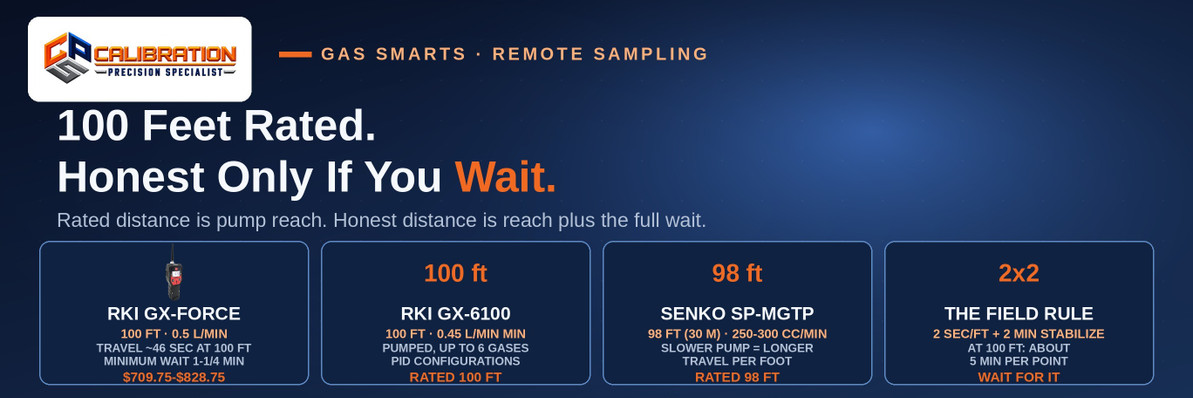
Pumped detectors in the RKI GX-Force and GX-6100 class are rated to sample up to 100 feet of hose — 98 feet (30 m) on the SENKO SP-MGTP at 250–300 cc/min — but the reading only becomes honest after the full wait: at 100 feet that is at least 1¼ to 2 minutes for sample travel plus sensor response, and about 5 minutes under the conservative 2-seconds-per-foot plus 2-minute stabilization rule.
The 100-foot number on the box answers the easy question — how far the pump can pull. It does not answer the question that decides whether a pre-entry test protects anyone: how far it can pull and still give you a reading you can trust, in the time you actually waited. Those are different distances on a rushed job. This post separates the rating, the wait, and the failure modes that quietly shorten the honest reach of every pumped instrument CPS sells and calibrates — RKI and SENKO alike. For the timing side in full, see how long you test a confined space before entry.
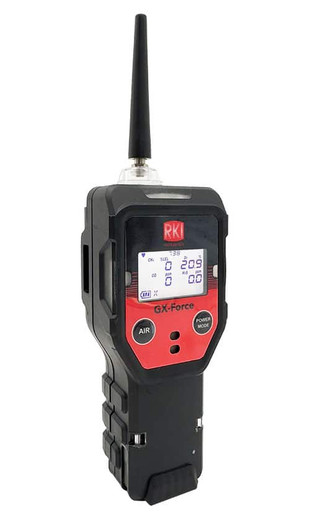
RKI GX-Force Pumped 4-Gas Monitor – LEL, O₂, CO & H₂S
Built-in pump rated to 100 ft at 0.5 L/min nominal flow — the worked example for this post.
$709.75–$828.75 configured
See the GX-ForceWhat Is the Rated Sampling Distance, Instrument by Instrument?
| Instrument | Rated maximum draw | Pump flow | What it is |
|---|---|---|---|
| RKI GX-Force | Up to 100 ft | 0.5 L/min nominal; 0.35 L/min minimum suction | Pumped 4-gas — LEL, O2, CO, H2S |
| RKI GX-6100 | Up to 100 ft | Minimum 0.45 L/min | Pumped up to 6 gases, including PID/VOC configurations |
| SENKO SP-MGTP | Up to 98 ft (30 m) | 250–300 cc/min (0.25–0.30 L/min) | Pumped up to 6 gases; slower pump, longer travel time per foot |
Flow is why two instruments with almost the same distance rating behave differently in the field. The GX-Force moves roughly twice the air per minute of the SP-MGTP, so the same 50 feet of hose clears in about half the travel time. Distance ratings are measured with the manufacturer's hose, a clean filter, and a healthy pump — not with a kinked line pulled around two corners in a wet vault. Browse the full range in pumped monitors, including the GX-6100 and the SENKO SP-MGTP.
How Long Does a Sample Take to Travel the Hose?
Typical detector sample hose is about 4 mm inside diameter and holds roughly 3.8 cc of air per foot. Divide that volume by pump flow and each foot costs about ½ second at 0.5 L/min, and about ¾ to 1 second at 250–300 cc/min. That math matches manufacturer documentation: RKI lists about 46 seconds of draw time for 100 feet at 0.5 L/min. Then the sensors still need their own response time — T90, the time to reach 90% of the final reading, is about 30 seconds for the standard four gases on this class of instrument. Travel and response run in series, never in parallel. See what T90 response time means for why the second clock cannot start early.
| Hose length | Sample travel time | Plus sensor T90 | Total wait before the reading is the space |
|---|---|---|---|
| 10 ft | ~5 sec at 0.5 L/min · ~8–9 sec at 250–300 cc/min | ~30 sec | About 40 seconds minimum; ~2 min 20 sec by the 2×2 rule |
| 50 ft | ~23 sec · ~38–46 sec | ~30 sec | About 1 minute minimum; ~3 min 40 sec by the 2×2 rule |
| 100 ft | ~46 sec · ~77–92 sec | ~30 sec | 1¼ to 2 minutes minimum; ~5 min 20 sec by the 2×2 rule |
Which wait should you use? The minimum column is physics — the reading cannot be the space before then. The 2×2 column — 2 seconds per foot plus 2 minutes for the sensors to fully stabilize at each point — is the conservative field rule taught for confined-space remote sampling, and it is the safer default whenever gas is actually present, the hose is old or wide, or the result will clear an entry. If readings are still moving, neither column matters: you wait until they stabilize.
When Does the Draw Stop Being Honest?
Past the rated length
Beyond 100 feet on an RKI pumped instrument — or 98 feet on the SP-MGTP — the pump is working outside the range the maker validated. Flow sags, travel time stretches past anything you budgeted, and a low reading may mean a weak sample, not clean air. If the point is farther than the rating, move the instrument closer, test from another access point, or use a fixed or sample-draw system designed for that distance — do not just add hose.
When the line leaks, kinks, or is the wrong material
A cracked hose, a loose fitting, or a kink does not stop the pump — it dilutes the sample with clean air pulled in along the way, and every channel reads low together. Reactive gases fail differently: chlorine, ammonia, hydrogen sulfide, and many VOCs are absorbed by ordinary urethane hose, so they arrive depleted or not at all. Use Teflon-lined hose for reactive gases and VOC work, keep the line as short as the job allows, and leak-check the full hose-and-probe assembly during the bump test — with the hose attached, not on the bench inlet alone.
When flow falls and nobody notices
The GX-Force specifies 0.35 L/min as its minimum suction flow, below its 0.5 L/min nominal. A clogged filter, a water-blocked probe, or a tired pump pulls that flow down and stretches every travel time in the table above. A blocked inlet should trigger a low-flow alarm — if it does not, that is a repair, not a quirk. Never silence a flow fault and keep sampling.
When the gas never survives the trip
Condensation in a cold hose, water drawn from a wet well, and heavy vapors settling in a low loop of hose all strip gas out of the sample before it reaches the sensors. Use the water-stop filter, keep the probe out of standing liquid, and route the hose without low traps. A dry, zero reading after sampling a wet space deserves a second test, not relief.
How Do You Sample Honestly at Distance? A Field Sequence
1. Bump test with the full sampling train attached — hose, probe, and filters — so a blocked or leaking line fails before the entry does. 2. Use the shortest hose that reaches, in the correct material for the gases expected. 3. Sample top, middle, and bottom, and about every 4 feet as the probe moves — gases stratify, and one point at one depth is not the space. 4. Restart the full wait at every new point — moving the probe starts both clocks again. 5. Keep sampling continuously during entry with the entrant's own monitor as the primary protection; the pumped pre-entry test cleared the space at test time, not for the whole job.
Pumped Sampling vs. Lowering a Diffusion Monitor: Which Is Right?
Lowering a diffusion monitor into a space on a rope was common practice, and it still shows up on job sites. It has one advantage — no hose lag — and three serious costs: you cannot read the display while it is in the space unless it logs or transmits, you cannot hear its alarm reliably, and retrieving it through a bad atmosphere exposes the attendant. A pumped instrument keeps the display, the alarms, and the decision-maker outside the space, which is why pumped remote sampling is the standard pre-entry method. The diffusion monitor's proper job in confined-space work is on the entrant, in the breathing zone, monitoring continuously.
Frequently Asked Questions
How far can a pumped gas detector sample?
Pumped detectors in the RKI GX-Force and GX-6100 class are rated to sample up to 100 feet of hose. The SENKO SP-MGTP is rated to 98 feet (30 m). Those are maximum validated distances with the manufacturer's hose and a healthy pump — not distances at which a rushed reading is automatically trustworthy.
How long should I wait for a gas reading through 100 feet of hose?
At 100 feet, allow at least 1¼ to 2 minutes — about 46 seconds of sample travel at 0.5 L/min, or 77–92 seconds at 250–300 cc/min, plus about 30 seconds of sensor T90 response. Under the conservative 2×2 field rule — 2 seconds per foot plus 2 minutes to stabilize — the wait is about 5 minutes 20 seconds per sampling point.
What is the 2×2 rule for remote gas sampling?
The 2×2 rule allows 2 seconds per foot of sample hose for the gas to travel to the instrument, plus 2 minutes at each sampling point for the sensors to fully respond and stabilize. At 10 feet that is about 2 minutes 20 seconds per point; at 50 feet, about 3 minutes 40 seconds.
Why does my gas detector read zero at the end of a long hose?
A zero at distance can mean clean air — or a sample that never arrived. Common causes are waiting less than the travel-plus-response time, a kinked or leaking hose diluting the sample, a clogged filter dropping pump flow, or a reactive gas such as chlorine or ammonia being absorbed by the hose material. Re-test with a shorter hose and a bump test through the full sampling train before trusting the zero.
Can I add extra hose to extend a gas detector past 100 feet?
No. Past the rated maximum — 100 feet on RKI GX-Force and GX-6100 instruments, 98 feet (30 m) on the SENKO SP-MGTP — pump flow and response are outside the manufacturer's validated range, and low readings may reflect a weak sample rather than clean air. Move the instrument closer or test from another access point instead.
Does a longer hose make a gas detector less accurate?
A longer hose does not change sensor accuracy once the sample fully arrives and stabilizes, but it increases travel time, dilution risk from leaks, and loss of reactive gases to the hose walls. In practice, a long hose makes a reading less trustworthy whenever the wait is cut short or the hose material is wrong for the gas.
What hose should I use for chlorine, ammonia, or VOC sampling?
Use Teflon-lined sample hose for chlorine, ammonia, hydrogen sulfide, and VOCs. Ordinary urethane hose absorbs those gases, so the sample reaching the sensors is weaker than the air at the probe — or, for a reactive gas at low concentration, effectively gone.
How often should I sample at different levels in a confined space?
Sample top, middle, and bottom before entry, and at intervals of about every 4 feet as the probe travels through the space, restarting the full travel-plus-response wait at each new point. Gases stratify by density, so a single reading at the opening does not describe the bottom of the space.
What pump flow rate does the RKI GX-Force have?
The RKI GX-Force has a nominal pump flow of 0.5 L/min and a specified minimum suction flow of 0.35 L/min, with a maximum sampling range of up to 100 feet. The RKI GX-6100's pump runs at a minimum of 0.45 L/min, also to 100 feet; the SENKO SP-MGTP runs slower, at 250–300 cc/min, to 98 feet (30 m).
Can CPS calibrate a pumped gas detector and check its pump?
Yes. CPS Calibrations in Rockwood, Tennessee calibrates every channel of pumped instruments such as the RKI GX-Force, GX-6100, and SENKO SP-MGTP as configured, with as-found and as-left data and a full certificate. In-house calibration is $55 for single-gas instruments and $90 for 4- and 5-gas instruments; ship-in service is available nationwide.
The Bottom Line
A pumped detector can reach 100 feet — but it only reads as far as your patience and your hose allow. Stay inside the rated distance, use the right hose material, bump through the full sampling train, and pay the full wait at every point: about 40 seconds at 10 feet at minimum, about a minute at 50, and 1¼ to 2 minutes — about 5 minutes by the conservative 2×2 rule — at the full 100. A reading taken early is not a reading of the space. It is a reading of the air that was already sitting in the hose.
Need a calibration you can file?
In-house calibration at CPS in Rockwood, Tennessee — $55 for single-gas instruments, $90 for 4- and 5-gas — every channel, as-found and as-left data, full certificate.
See Calibration Servicesor call 865-900-8844
Recent Posts
-

What Is Remote Monitoring for Fixed Gas Detection?
Remote monitoring for fixed gas detection means a fixed system's live readings, trends, and alarm hi …Nov 23rd 2026 -

What Are the Key Differences Between the GX-6000 and GX-6100?
The RKI GX-6100 is the current replacement for the discontinued GX-6000: both are pumped 6-gas monit …Nov 22nd 2026 -

How to Read a PID Correction Factor Chart
To read a PID correction factor chart, find your vapor’s row, take the factor under your own lamp en …Nov 21st 2026