
How to Calibrate a Crowcon Portable Gas Detector: Bump, Span, and the Stations That Automate It
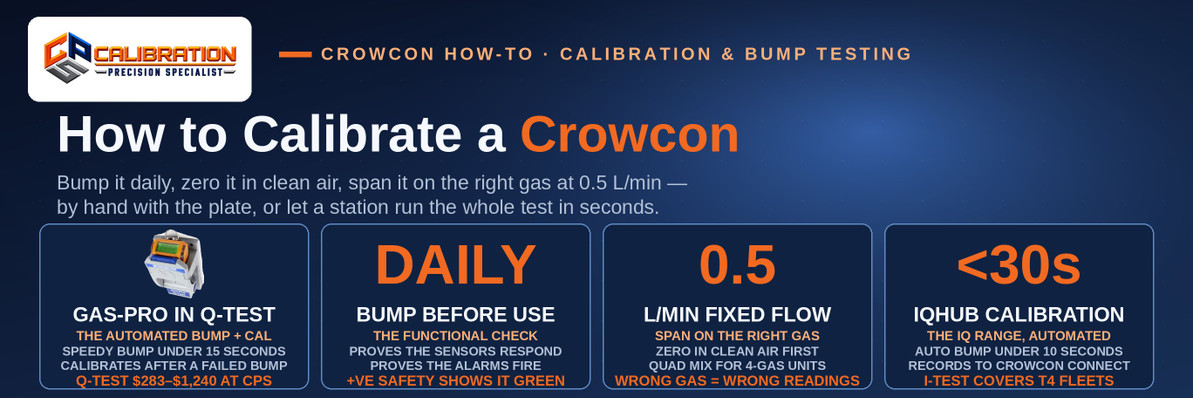
Calibrating a Crowcon portable gas detector is a two-part discipline: bump test the instrument before each day's use to prove its sensors respond and its alarms fire, and calibrate on schedule — zeroing the sensors in clean air, then spanning each channel against a known concentration of the correct calibration gas, delivered through the detector's calibration plate at a fixed flow of 0.5 L/min. A calibration is due on your site policy's schedule, after any failed bump test, and at least at the six-month service interval Crowcon recommends. The detector records every bump and calibration in its event log, the +ve Safety traffic light shows the fleet its compliance state at a glance — and stations (Q-Test for the Gas-Pro, I-Test for the T4, IQhub for the IQ range) automate the same workflow when hand calibration stops scaling.
This is the workflow for Crowcon's portables — the T4, the Gas-Pro, the Gasman and Tetra 3, and the IQ range — because the steps are the same discipline whatever the badge: the instrument can only read as well as the gas you last proved it against. Below: the difference between a bump and a calibration, the manual workflow step by step, what a pass and a fail mean, which gas each channel actually needs, how often all of this has to happen, and where the stations take over.
Bump Test vs. Calibration: Two Different Jobs
These two get confused constantly, and the confusion is expensive, so first the distinction:
- A bump test is a functional check. A known gas passes over the sensors to prove the detector responds, reaches its first alarm level, and sounds its audible, visual, and vibrating alarms. It answers one question: will this instrument warn its wearer today? It adjusts nothing.
- A calibration adjusts the instrument. Zero and span calibration set the detector's readings against known gas concentrations, correcting the drift every electrochemical and catalytic sensor accumulates with age and exposure.
A bump test is the daily habit; a calibration is the scheduled correction — and a failed bump is the most common trigger for an unscheduled one. We work through the distinction in full in Bump Test vs. Calibration and the manual bump routine in How Do You Bump Test a Gas Detector?
Crowcon builds the habit into the instruments. On the T4 and Gas-Pro, the +ve Safety indicator — the traffic-light status LED — shows green when the unit is operating correctly and in compliance with your bump-test and calibration policy, and flags attention (amber on the Gas-Pro, red on the T4) when it isn't. The Gas-Pro can also be configured with bump groups and warns at start-up when a gas test is due. A supervisor doesn't need a menu dive to know whether a unit is in date; the light says it.
Before You Start: Gas, Regulator, and Plate
A calibration is only as good as its inputs. Three things to have right before the instrument comes out of its case:
- The correct gas. The mix must match the instrument's channels — a quad mix (flammable/LEL, O₂, CO, H₂S) for a standard 4-gas unit, the matched single-gas cylinder for a single-gas instrument or an exotic channel. The concentrations are printed on the cylinder label; the instrument's calibration values must match them. Section below covers the exceptions.
- In-date gas. Calibration gas has an expiry date, and reactive gases degrade fastest. Spanning a detector on an expired cylinder calibrates it to a number nobody can certify.
- A fixed-flow regulator and the calibration plate. Crowcon calibrations feed gas at 0.5 L/min through a fixed-flow regulator — not a demand-flow regulator, which delivers only what a pump draws and starves a diffusion instrument. The detector's calibration/bump plate (every T4 ships with one; the Gas-Pro uses its plate or flow cap arrangement) seals over the sensors so the gas reaches every channel evenly, and the tubing runs plate → regulator → cylinder.
And one environmental rule that decides more bad calibrations than any other: zero in genuinely clean air. The zero step tells the instrument "this is zero gas." Do it in a workshop with solvent vapor, vehicle exhaust, or process gas in the background and you have taught the detector that contamination is clean air — every reading afterward is offset by that lie.
The Manual Calibration Workflow, Step by Step
This is the plate-and-cylinder routine Crowcon's manuals describe for the T4, Gas-Pro, and the wider portable range. Exact menu names vary slightly by model; the sequence does not.
- Start in clean air and power the detector on. Let it complete its start-up and self-tests and settle on its home screen showing readings in fresh air.
- Zero the sensors. Select the zero (fresh-air) calibration from the instrument's calibration menu while it is still in clean air. Every channel should read zero — with oxygen reading 20.9% vol, its clean-air value. If a toxic channel shows a residual reading in supposedly clean air, your air isn't clean; move before you zero, don't zero over contamination.
- Fit the calibration plate. Clip the plate over the sensor face so it seals, with the tubing connected to the regulator on the calibration cylinder.
- Enter span calibration and turn the gas on. Select the calibration function; when the instrument prompts for gas, open the regulator. Gas flows at the fixed 0.5 L/min across all channels at once.
- Let every channel settle, then confirm the values. Each sensor needs time to respond and stabilise at the cylinder's concentration — rushing this step is how a calibration "passes" a sensor that was still climbing. The instrument compares readings against the calibration values set for the cylinder in use. Check the values on the label match what the instrument expects; a mismatch here is the classic wrong-gas failure.
- Read the verdict per channel. The instrument reports pass or fail channel by channel. A pass stores the new zero and span values and advances the calibration date in the instrument's memory.
- Turn the gas off, remove the plate, and watch the readings fall. In clean air the channels should return to zero (20.9% for O₂). A channel that hangs high or drifts is telling you something the calibration screen didn't.
- Check the +ve Safety light and log the job. Green means the fleet can see the unit is in date. The calibration is already in the instrument's event log (the Gas-Pro logs 1,000 events; the T4 roughly 3,500, including calibrations and bump tests) — add your own record of gas lot, date, and technician if your program keeps one.
A practiced technician does this in a few minutes per instrument. Multiply it by a fleet and a daily bump on top, and you have the entire business case for the stations below.
What a Fail Is Telling You
A failed calibration is information, not an inconvenience to retry until it passes. Work the causes in order:
- Wrong or expired gas. The cylinder doesn't match the channel, the values set in the instrument don't match the label, or the gas is past its date. This fails correctly — check it first because it's free to fix.
- Flow problems. A demand-flow regulator on a diffusion instrument, a kinked tube, or a plate that isn't sealed starves the sensors; readings climb slowly and never settle.
- A poisoned or exhausted sensor. Catalytic LEL sensors are poisoned by silicones, sulfur compounds, and lead; electrochemical cells simply wear out. A sensor that cannot reach span concentration no matter how long the gas flows is not a calibration problem — it's a dead sensor asking to be replaced. Calibrating harder won't resurrect it.
- A zero taken in dirty air. If every channel behaves strangely by a similar offset, suspect the zero before you suspect four sensors at once.
One boundary Crowcon's own manual draws: calibrating a newly fitted sensor, and servicing generally, belong to a trained technician with the PC software (Crowcon's Portables Pro). Routine span calibration of a healthy instrument is a user job; rebuilding one is not.
How Often Does a Crowcon Need Calibrating?
Three clocks run at once:
- The bump test is daily — before each day's use. That isn't house style; under the ATEX directive, portable apparatus sensing flammable gases gets a functional check with gas before each day of use, and Crowcon's manuals build the reminder into the instruments.
- Calibration follows your site policy — the interval your safety program sets, enforced by the instrument's own due-date warnings and the +ve Safety light. Many programs run monthly or quarterly on top of the daily bump.
- Crowcon's floor is six months. The Gas-Pro manual recommends regular service and calibration every six months in the absence of other evidence that the instrument is holding its settings. Treat that as the maximum gap, not the target.
On top of the schedule: calibrate after any failed bump test (that's the bump doing its job), after a sensor is replaced, and whenever the instrument tells you it's due. An instrument that keeps failing span between intervals is on its way out — the interval isn't the problem.
The Automation Ladder: Plate, Q-Test, I-Test, IQhub
The workflow above is identical at every rung. What changes is who does the work and who keeps the records.
Rung 1 — the manual plate. Every Crowcon portable can be bumped and calibrated by hand with its plate, a cylinder, and a 0.5 L/min regulator. Right answer for a handful of instruments; the cost is technician minutes and records that live wherever you wrote them down.
Rung 2 — Q-Test, for the Gas-Pro only. Q-Test is the in-field bump and calibration module built for the Gas-Pro: the cylinder lives in the module's holder with its regulator fitted, the detector clicks in, and a speedy bump runs in under 15 seconds by Crowcon's rating — no power needed on the base module, so it works at the gate or in the truck. If a channel fails the bump, a Gas-Pro configured for it calibrates right there in the module. Note the boundary the series keeps repeating: Q-Test does not fit the T4. Q-Test configurations run $283–$1,240 at CPS list, by power and regulator options.
Rung 3 — I-Test, the T4's station. Crowcon's automated station for T4 fleets (it also serves the Gas-Pro) runs the bump and calibration automatically and, unlike Q-Test, keeps the fleet's records centrally. If your fleet is T4s and your problem is documentation as much as testing, I-Test is the rung you're shopping.
Rung 4 — IQhub, for the IQ range. The IQ range (UnoIQ, DuoIQ) docks with IQhub, which runs an automatic bump in under 10 seconds and a full calibration in under 30 seconds, then pushes results to Crowcon Connect. One caution the IQ range earns honestly: its sensors arrive in pre-calibrated swappable trays, and pre-calibrated does not mean calibration-exempt — the tray changes how fast a bad sensor is replaced, not whether the instrument gets bumped daily and calibrated on schedule.
Which Gas Do You Calibrate With?
Match the gas to the channel, and mind the exceptions:
- Standard 4-gas units (T4, Gas-Pro, Tetra 3 in 4-gas builds): a quad mix carrying the flammable gas, O₂, CO, and H₂S at the concentrations the instrument's calibration values expect. One cylinder spans all four channels in one application — that's the point of the mix. CPS stocks the quad mixes in our calibration gas range.
- PID channels span on isobutylene. A Gas-Pro's PID channel doesn't calibrate against the quad mix; it spans on isobutylene, the PID's reference gas, and its response to other vapors is factored from there.
- Single-gas and exotic channels take their own cylinders. A Gasman watching chlorine, phosgene, fluorine, or hydrogen fluoride — all gases Crowcon builds it for — calibrates on a cylinder of that gas, and reactive gases need the regulator built for them: reactive mixtures destroy ordinary regulator internals, which is why the reactive-gas regulator is the expensive line in every Q-Test configuration.
- Know which CO sensor your Gas-Pro carries. Crowcon builds an H₂-filtered CO version of the Gas-Pro for steel-plant work, where hydrogen in the atmosphere would otherwise push an unfiltered CO reading high. The filter lives in the sensor — and a calibration conversation starts with knowing which CO channel is actually in your instrument.
- Never span on a gas "close enough." A channel calibrated against the wrong concentration or the wrong gas is worse than an uncalibrated one, because now it's confidently wrong and the paperwork says otherwise.
Records: The Log Is the Proof
Calibration has two products: a detector that reads true, and the evidence it was reading true on the day it mattered. Crowcon's portables keep the second one for you. Bumps, calibrations, alarms, and on/off events are stored in the instrument's event log — 1,000 events on the Gas-Pro, roughly 3,500 on the T4 — downloadable through Crowcon's software, and the IQ range pushes its records to Crowcon Connect through IQhub. The +ve Safety light is the same data worn on the outside: a supervisor's glance replaces an audit for the daily question "is this unit in date?"
What the log doesn't replace is the service calibration's certificate. When CPS calibrates an instrument in-house, the certificate is the document that makes the event log's story hold up after an incident — which is why the six-month service calibration and the daily bump are partners, not substitutes.
The Honest Limits
- Calibration corrects drift; it does not repair damage. A poisoned catalytic sensor, a dried-out electrochemical cell, or a cracked PID lamp fails calibration because it's finished. The fix is a sensor, not another span attempt.
- A station automates the test, not the judgement. Q-Test, I-Test, and IQhub apply gas and record verdicts faithfully — including faithfully recording a calibration done with the wrong cylinder. The inputs still have to be right.
- Field calibration is not a service. In-module and on-plate calibrations keep a fleet honest day to day. New-sensor calibration, configuration changes, and the six-month service belong on a bench with the PC software — Crowcon's manual is explicit, and so are we.
- Exotic gases cost exotic money. If your instruments watch reactive or unusual gases, budget for matched single-gas cylinders and reactive-rated regulators; the quad mix doesn't cover them and never will.
Calibration at CPS
Do it yourself with the plate and the right gas, automate it with the station that fits your fleet, or send it to the bench: CPS calibrates every channel on the Crowcon range and every other line we sell and service. Published in-house rates are $55 for a single-gas instrument and $90 for 4- and 5-gas instruments; on-site work is quoted in writing, because site conditions set that price. We stock the calibration gas the Crowcon range runs on — quad mixes and single gases — and when a channel fails span because the sensor is done, we replace the sensor and prove the instrument on every channel before it goes back.
Frequently Asked Questions
How do you calibrate a Crowcon gas detector?
Power it on in clean air and zero the sensors from the calibration menu, then fit the calibration plate, apply the correct calibration gas at 0.5 L/min through a fixed-flow regulator, and run the span calibration — each channel settles at the cylinder's concentration and the instrument stores the new values and advances its calibration date. Verify the readings fall back to zero (20.9% for oxygen) in clean air afterward. The same workflow runs automatically in Crowcon's Q-Test, I-Test, and IQhub stations.
How often should a Crowcon detector be calibrated?
Bump test before each day's use, calibrate on your site policy's schedule, and never let the gap exceed six months — Crowcon's Gas-Pro manual recommends regular service and calibration every six months in the absence of other evidence. Calibrate sooner after any failed bump test or sensor replacement, and whenever the instrument's due-date warning or +ve Safety light says it's due.
What is the difference between a bump test and a calibration?
A bump test is a functional check: gas is applied to prove the sensors respond and reach the first alarm level with the audible, visual, and vibrating alarms firing. It adjusts nothing. A calibration adjusts the instrument: zero and span settings are reset against known gas concentrations to correct sensor drift. Bump daily; calibrate on schedule — and a failed bump means calibrate now.
What gas do you use to calibrate a Crowcon 4-gas detector?
A quad mix matching the four channels — flammable gas (LEL), oxygen, carbon monoxide, and hydrogen sulfide — at the concentrations the instrument's calibration values are set for, from an in-date cylinder. Exceptions: a Gas-Pro PID channel spans on isobutylene, and single-gas or exotic channels (a Gasman's chlorine or phosgene build, for example) calibrate on cylinders of their own gas.
What flow rate do you use to calibrate a Crowcon detector?
0.5 L/min, from a fixed-flow regulator, through the calibration plate. A demand-flow regulator is the wrong tool for a diffusion instrument — it only delivers gas when a pump draws, so the sensors starve and the span never settles. Crowcon's Q-Test configurations are built around the same 0.5 L/min fixed-flow feed.
Can I calibrate a Crowcon T4 myself, or does it need a station?
You can calibrate it yourself: every T4 ships with a bump/calibration plate, and the calibration runs from the instrument's menu with a cylinder and a 0.5 L/min regulator. The station is optional — Crowcon's I-Test automates the bump, calibration, and record-keeping for T4 fleets. Note that Crowcon's Q-Test module does not fit the T4; Q-Test is Gas-Pro only.
Why did my Crowcon fail calibration?
Work the causes in order: wrong or expired gas (the cylinder doesn't match the channel or the values set in the instrument), a flow problem (demand-flow regulator, kinked tubing, unsealed plate), a zero taken in contaminated air — or a sensor that is poisoned or worn out and physically cannot reach the span concentration. The first three are setup; the last one is a sensor replacement.
Does calibrating fix a poisoned sensor?
No. Calibration corrects drift on a healthy sensor. A catalytic LEL sensor poisoned by silicones or sulfur compounds, or an electrochemical cell at end of life, fails span because it can no longer respond — no amount of re-spanning restores it. Repeated calibration failures on the same channel are the instrument asking for a new sensor.
How long does a Crowcon calibration take?
The manual plate workflow takes a practiced technician a few minutes per instrument — the channels need time to settle at span. The stations compress it: Q-Test runs a speedy bump in under 15 seconds and can calibrate a Gas-Pro in the module after a failed bump, and IQhub calibrates an IQ-range instrument in under 30 seconds. The T4's manual bump test alone takes under a minute with its plate.
How much does it cost to have a Crowcon calibrated?
At CPS, published in-house rates are $55 for a single-gas instrument and $90 for 4- and 5-gas instruments, with every channel calibrated and a certificate issued. If you'd rather automate in-house, Crowcon's Q-Test module for the Gas-Pro runs $283–$1,240 at list depending on power and regulator options. On-site calibration is quoted in writing — site conditions set the price.
The Bottom Line
Calibrating a Crowcon is not complicated: clean-air zero, the right gas at 0.5 L/min through the plate, every channel settled and passed, the result in the log and the +ve Safety light green. What separates programs that work from programs that look good is rhythm — a bump every day, a calibration on schedule and never past six months, and the honesty to read a failed span as a sensor's verdict instead of retrying until it passes. Do it by hand, let Q-Test, I-Test, or IQhub do it for you, or send it to our bench — but make sure the gas, the flow, and the record are right, because the calibration is the only thing standing between a detector's display and the truth.
Want the workflow set up for your fleet — gas, regulators, stations, or bench service? Call 865-900-8844 or reach us through Contact Us. CPS Calibrations · 109 S. Front Street, Rockwood, TN 37854 · Calibration Gas · Calibration Services
CPS Calibrations · 109 S. Front Street, Rockwood, TN 37854 · Calibration Gas · Calibration Services · Contact Us
Need a calibration you can file?
In-house calibration at CPS in Rockwood, Tennessee — $55 for single-gas instruments, $90 for 4- and 5-gas — every channel, as-found and as-left data, full certificate.
See Calibration Servicesor call 865-900-8844
Recent Posts
-

Can You Add a Pump to a SENKO SGT-P or MGT?
Yes — SENKO's SP-Pump101 external sampling pump ($330, part AAA006000) fits the SGT, SGT-P, and MGT, …Nov 12th 2026 -

What Refrigerant Detection Does a Grocery Store Need?
A grocery store needs refrigerant detection in three places: low-mounted carbon dioxide (R-744) sens …Nov 11th 2026 -

What Is LEL and UEL? The Explosive Range, Gas by Gas
The LEL is the lowest concentration of a gas in air that can explode, and the UEL is the highest: me …Nov 10th 2026