
Renting vs. Buying Gas Detectors for a Turnaround or Outage: The Real Math
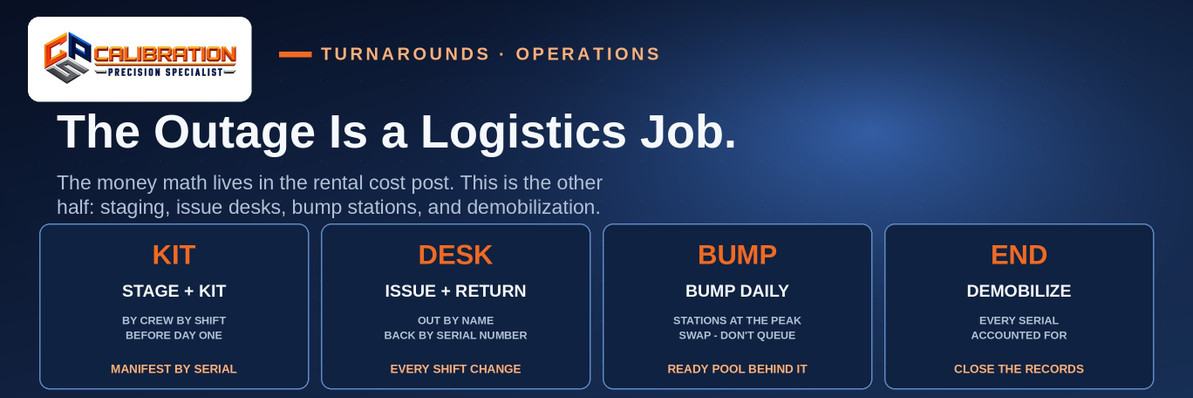
Here is the honest split of this question: the money math — what a rental quote is built from, and the breakeven week where renting starts costing more than buying — already lives in how much it costs to rent gas detectors for a turnaround, and this post does not re-derive a single dollar of it. What this post covers is the half of rent-vs-buy that money cannot settle: the outage itself is a logistics operation — staging and kitting before day one, an issue-and-return desk that reconciles every serial number, bump stations that survive shift change, contractor and plant fleets under one record discipline, and a demobilization that accounts for every instrument — and whichever way the money math lands, that operation has to be run.
Notice what that framing does to the rent-vs-buy decision. Renting does not rent you out of the logistics; buying does not buy your way out of them either. A rented fleet still has to be staged, issued, bumped, charged, tracked, and handed back in documented condition. An owned fleet still has to be pulled from its everyday assignments, serviced, kitted, and returned to service afterward. The fleets differ in who owns them the day after the outage — a difference the money post prices — but during the outage they are the same operational problem, wearing two different return addresses. Planners who run the operation well find that the logistics also feed back into the decision itself: how your plant actually handles staging, tracking, and demobilization is evidence about which fleet model your organization will execute faithfully. The deployment side of the same event — who wears what, and where area monitors go — is covered in gas detection for refinery turnarounds and shutdowns and area monitors for turnarounds and shutdowns.
Before Day One: Staging and Kitting
The outage's gas detection is won or lost in the week before it starts. Instruments — rented, owned, or a mix — should arrive or be assembled early enough to be worked on, not merely received: inspected, charged, bump tested, calibrated if due, and sorted before the first crew badges in. An instrument unboxed on day one with a dead battery and an expired calibration is not a fleet unit; it is a task. Kitting is what turns a pile of instruments into an operation: kits assembled by crew, by shift, and by job type — personal monitors together with their chargers and assignments, pumped units and their sampling gear staged with the entry program that will use them, area monitors with their deployment plan. The kit is also where the paperwork starts: a manifest of serial numbers per kit, created while everything is still in one room and countable. That manifest is the document the entire outage's accountability hangs from — issue, return, and demobilization all reconcile against it. Plants that skip staging discover the same lesson every outage: problems found at the staging table cost minutes; the same problems found at shift change cost crews.
The Issue-and-Return Desk: Where Fleets Are Actually Controlled
During the outage, the fleet lives at the issue desk, and the desk's discipline is the difference between a fleet and a rumor. The working pattern is simple and strict: instruments go out by name and come back by serial number. Every issue is a record — who took which instrument, when, for what job — and every return closes that record against the physical serial on the unit in hand, not against the count of units in the bin. Counts lie politely; serials do not. Shift change is the desk's rush hour and its audit point at once: outgoing crews returning units, incoming crews drawing them, chargers cycling, and the discrepancy — the unit that did not come back — surfaced the same shift, while the trail is warm and the crew that had it is still on site. Chasing a missing instrument three days later is archaeology; catching it at shift change is a question asked across a counter. The desk also owns the unglamorous infrastructure the fleet runs on: charging capacity for the whole fleet at once, not for the average day; a quarantine spot for units that failed, alarmed hard, or came back damaged, so a suspect instrument is never silently re-issued; and the running list that tells supervision, at any moment, how many instruments are out, how many are ready, and how many are down.
Bump Stations During the Outage
Bump testing is a daily rhythm on an outage, and like everything else it is a placement and throughput problem before it is a compliance one. Stations belong where shift change actually happens — on the path crews walk, with the gas, regulators, and tubing they need already rigged — because a bump station that requires a detour becomes a bump test that gets deferred. Throughput matters as much as location: the whole incoming shift needs to bump inside the shift-change window, so station count and layout are sized to the peak, not the average. The operational heart of the system is the swap pool: a ready rack of bumped, charged instruments, so a unit that fails its morning bump is exchanged on the spot and the worker proceeds — the failed unit goes to the quarantine and troubleshooting pile, not into a queue with a person standing in front of it. Calibration gas supply is part of the same planning: gas is a consumable the outage burns daily, and running out of bump gas mid-outage converts a routine into an improvisation. (What the gas and support do to the money side is, again, the rental cost post's territory — get it in the quote.) Owned fleets and rented fleets run this identically; the only difference is whose calibration is due when, which the staging step already answered.
Contractor Fleets and Plant Fleets in the Same Outage
Most turnarounds run two fleets under one fence: the plant's instruments and the instruments contractors bring with their crews. The split that works is decided before mobilization, in writing, and it answers four questions. Who supplies — which crews wear plant instruments and which wear their employer's, unit by unit, so no crew arrives assuming the other fleet covers them. Who bumps and calibrates — whether contractor instruments go through the plant's stations and gas or their own, and what evidence either way produces. Whose records — bump and calibration records are the outage's safety evidence; a contractor's word that its fleet is current is not a record, and the plant's system should hold, or at minimum hold copies of, the records for every instrument inside its fence. What standard — an instrument is acceptable because its calibration is current and its bump passes that day, whoever owns it; two standards under one fence is how an unverified fleet walks in on a contractor's badge. None of this is adversarial — good contractors expect it — but it has to be specified before the outage, because mid-outage is when nobody has time to negotiate record-keeping.
Damage, Loss, and Return Condition: The Honest Version
Turnarounds are hard on instruments. Units are dropped, driven over, contaminated, worn into vessels and not worn out, and exposed to everything an outage atmosphere contains. Plan for attrition as a normal operating cost of the event, not as a series of surprises: the quarantine-and-inspect habit at the issue desk is what keeps the accounting honest, because condition is documented when the unit comes back across the counter, by serial number, while the facts are fresh — not reconstructed at demobilization from memory. For rented fleets, the money consequences of damage and loss live in the rental quote's terms, and the time to read them is before signing; that analysis belongs to the cost post and is not repeated here. The operational side is identical for both fleets: return-condition inspection is a step in the workflow — exterior and sensor condition noted, data and records downloaded or filed, units cleaned and serviced before they go back on a truck or back on a shelf. An owned fleet that skips it has not avoided the cost; it has deferred it to the next time someone draws that instrument and finds out what the outage did to it.
A Weekend Outage Is Not a Small Turnaround
Duration changes the operation's shape, not just its length. A short weekend outage is a sprint with no slack: there is no mid-event resupply, no time to troubleshoot a balky instrument into health, no weekday to absorb a staging mistake. Everything must be staged, kitted, and proven before the gate opens, the swap pool carries the whole event's failures, and demobilization is compressed into the same weekend's end — which is exactly when fatigue makes serial reconciliation feel optional. It is not; on a sprint, the manifest discipline matters more, because there is no tomorrow shift to find what today lost. A multi-week turnaround is the opposite problem: a marathon of drift. Instruments rotate through charging and service continuously; calibrations come due during the event and must be scheduled like work, not discovered at a bump station; the swap pool erodes as quarantined units accumulate unless someone owns repairing or replacing them; records pile up faster than anyone files them unless the desk's rhythm holds daily. The multi-week outage rarely fails on day one — it fails in week three, when the staging discipline has quietly relaxed. Both shapes reward the same thing: a written fleet plan, made before mobilization, sized to the event you actually have.
The Day the Outage Ends
Demobilization deserves the same planning as mobilization and rarely gets it — everyone is tired, the milestones are done, and the instruments feel like cleanup. They are not cleanup; they are the closing audit of the whole fleet operation. Collect and reconcile: every serial on the manifest accounted for — in hand, quarantined with a documented reason, or missing and escalated while the crews who had them are still reachable. This is the last moment the trail is warm. Inspect and document condition unit by unit, so rented fleets go back with their condition on record and owned fleets go back into service with their state known. Close the records: bump and calibration documentation filed where the next audit — or the next outage's planner — will actually find it. Service what the outage used: owned instruments that spent weeks in turnaround service come home due for attention; between outages is precisely what a calibration program is for, and CPS's bench calibrates owned fleets in-house at $55 for a single-gas instrument and $90 for a 4- or 5-gas instrument — bench rates at our Rockwood shop, with on-site work quoted in writing — under the CPS Calibration Program, which keeps each instrument's history and due dates between events. The outage that ends cleanly hands the next outage a fleet and a file. The one that does not hands it a mystery.
Frequently Asked Questions
Where does the rent-vs-buy money math for a turnaround live?
In CPS's cost post: how much does it cost to rent gas detectors for a turnaround works the rental-quote drivers and the breakeven formula — purchase price divided by weekly rent — against verified purchase prices. This post deliberately does not repeat that math; it covers the operations side: staging, issue and return, bump logistics, fleet splits, and demobilization, which the decision needs but money alone cannot settle.
How early should gas detectors arrive before a turnaround starts?
Early enough to be worked on, not just received: inspected, charged, bump tested, calibrated if due, and kitted by crew and shift, with a serial-number manifest built while everything is in one room. Instruments unboxed on day one with dead batteries or expired calibrations consume the outage's first shift as a staging exercise. The staging window is measured in working days before mobilization, sized to the fleet — large fleets and mixed rented-plus-owned fleets need more of it.
How do you keep track of gas detectors during a turnaround?
With an issue-and-return desk that works by serial number. Every instrument goes out against a name, a time, and a job, and comes back reconciled against the physical serial on the unit — not against a bin count. Shift change is the daily audit point: discrepancies surface the same shift, while the crew that had the unit is still on site to ask. The pre-outage kit manifest is the baseline every reconciliation checks against.
How many bump stations does a turnaround need?
Enough to bump the entire incoming shift inside the shift-change window, placed where crews actually walk at shift change, rigged with gas and ready before the first crew arrives. The binding constraint is peak throughput, not daily average — a station shortfall at shift change becomes a queue of workers waiting to enter, and pressure to defer the bump. Pair the stations with a swap pool of ready instruments so a failed bump is an exchange, not a delay.
What happens when a gas detector fails a bump test during an outage?
The worker swaps it for a ready instrument from the swap pool and proceeds; the failed unit goes to a quarantine spot at the issue desk — never back into circulation — for troubleshooting, calibration, or service. Quarantine discipline is what stops a suspect instrument from being silently re-issued to the next shift. Failed units are a normal outage event, planned for with spares, not an exception handled by improvisation.
Should contractors use the plant's gas detectors or bring their own?
Either model works; an undecided model does not. The split must be written before mobilization: who supplies which crews, who bumps and calibrates contractor instruments and with whose gas, whose system holds the bump and calibration records for every instrument inside the fence, and the single acceptance standard — current calibration plus a passed bump that day — that applies regardless of ownership. Mid-outage is the wrong time to negotiate record-keeping.
How do you handle damaged or lost detectors during a turnaround?
Operationally: document condition at the issue desk when the unit returns, by serial number, while the facts are fresh — and escalate a missing unit the same shift, not at demobilization. The money side for rented fleets — damage and loss terms and valuations — lives in the rental quote and is analyzed in CPS's rental cost post; read it before signing. For owned fleets the same inspection habit applies, because an uninspected unit carries its outage damage silently into its next assignment.
How is a short weekend outage different from a multi-week turnaround for gas detection?
A weekend outage has no slack: no mid-event resupply, no time to nurse a failing instrument, and demobilization compressed into the event's tired final hours — so everything is staged and proven beforehand and the swap pool carries all failures. A multi-week turnaround drifts instead: calibrations come due during the event, the quarantined pile grows unless someone owns it, and records outpace filing unless the desk's daily rhythm holds. The first fails at the start if staging was skipped; the second fails in week three if discipline relaxes.
What should happen to the detector fleet on the last day of an outage?
A closing audit, not a cleanup: every serial on the manifest reconciled — in hand, quarantined with a documented reason, or escalated as missing while crews are still reachable. Condition is inspected and recorded unit by unit, bump and calibration records are filed where the next audit will find them, rented units go back with their condition on record, and owned units go into post-outage service — the calibration and attention the event used up — instead of straight back onto a shelf.
Does CPS rent gas detectors for turnarounds?
No — CPS Calibrations sells gas detectors and calibrates them; this guide and the companion cost post exist so a planner can run both sides of the decision well, whoever supplies the rental. For owned fleets, CPS's bench in Rockwood, Tennessee calibrates every channel on every instrument at in-house rates of $55 single-gas and $90 for 4- and 5-gas instruments, and the CPS Calibration Program keeps histories and due-date reminders between outages. On-site work is quoted in writing. Call 865-900-8844.
The Bottom Line
Strip the money out — it is handled, in full, in the rental cost post — and rent-vs-buy for a turnaround is an operations question wearing a finance costume: staged and kitted fleets, an issue desk that reconciles serials every shift, bump stations built for the shift-change peak with a swap pool behind them, one record standard for plant and contractor instruments alike, condition documented at the counter, and a demobilization run like an audit. Rent or buy, that operation decides whether the fleet protects the outage. The dollars decide who owns the fleet the day after — plan both, in that order of effort.
Planning an outage fleet — staging an owned baseline or checking the operation behind a rental? Call CPS Calibrations at 865-900-8844 — instruments, calibration, and the CPS Calibration Program behind them, from 109 S. Front Street, Rockwood, TN 37854.
--- CPS Calibrations · 109 S. Front Street, Rockwood, TN 37854 · How Much Does It Cost to Rent Gas Detectors for a Turnaround? · Area Monitors for Turnarounds and Shutdowns · Calibration Services
Need a calibration you can file?
In-house calibration at CPS in Rockwood, Tennessee — $55 for single-gas instruments, $90 for 4- and 5-gas — every channel, as-found and as-left data, full certificate.
See Calibration Servicesor call 865-900-8844
Recent Posts
-

What Is Remote Monitoring for Fixed Gas Detection?
Remote monitoring for fixed gas detection means a fixed system's live readings, trends, and alarm hi …Nov 23rd 2026 -

What Are the Key Differences Between the GX-6000 and GX-6100?
The RKI GX-6100 is the current replacement for the discontinued GX-6000: both are pumped 6-gas monit …Nov 22nd 2026 -

How to Read a PID Correction Factor Chart
To read a PID correction factor chart, find your vapor’s row, take the factor under your own lamp en …Nov 21st 2026