
Gas Detection for Refinery Turnarounds and Shutdowns
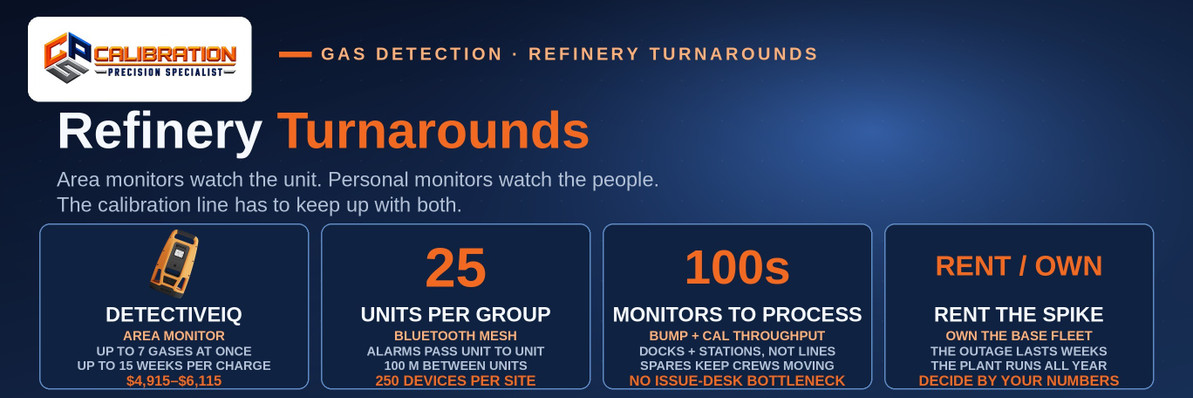
A refinery turnaround needs three layers of gas detection at once: networked area monitors watching the unit while equipment is open, a bump-tested personal monitor on every worker in it, and a calibration operation that can process hundreds of instruments without becoming the bottleneck — a Crowcon DetectiveIQ area monitor ($4,915–$6,115) links up to 25 units per group and runs up to 15 weeks on a charge, and the fleet that covers the outage spike is usually rented while the base fleet the plant runs all year is owned.
A turnaround is a detection problem of scale, not of exotic chemistry. The gases are the ones the unit always has — hydrocarbons, H2S, CO, oxygen displacement — but the exposure multiplies: equipment that is closed and fixed-monitored all year is opened, lines are broken, vessels are entered, and a workforce several times the unit's normal headcount works inside it for weeks. The program that hums along fifty weeks a year fails in the two weeks that matter most, and it usually fails on logistics: coverage, throughput, and fleet size. This post is those three problems, in that order. It builds on our outage coverage in area monitors for turnarounds and shutdowns and the instrument spotlight, Crowcon DetectiveIQ area monitor.
Why Does a Turnaround Break a Normal Gas Detection Program?
Three things change at once when a unit comes down:
- The hazard leaves its pipes. Fixed detection was placed for a running unit — leak sources at known fittings, watched continuously. An opened exchanger, a broken line, or a vessel with its head off is a new, temporary source that no fixed point was placed for, in a spot where crews now work all shift.
- The headcount multiplies. Contractors who do not know the unit arrive alongside the crews who do. Every one of them needs personal detection, training on it, and a bump test before the first shift — on the same morning.
- The instruments come home every night. A fleet that normally turns over a few calibrations a week suddenly needs every unit charged, bumped, issued, returned, and accounted for, daily, for weeks. The detection program becomes a logistics operation that happens to involve gas sensors.
Plan those three and the turnaround's detection is planned. Miss any one and the other two do not save it.
How Do Area Monitors Give a Unit Coverage During TAR Work?
Area monitors are the temporary layer that covers the opened unit: transportable, battery-powered instruments set at the work face, around opened equipment, and along the routes crews walk, watching the space itself — including the minutes when nobody is standing there. The current CPS example is the Crowcon DetectiveIQ ($4,915–$6,115 by configuration), and its numbers are why it anchors this layer:
- Up to 7 gases at once from interchangeable sensor slots — flammables, O2, CO, H2S, CO2, and PID VOCs in the combination the unit's hazard assessment calls for.
- Bluetooth Mesh networking: up to 25 units per group, up to 100 m between units, up to 250 devices across 10 groups — an alarm on one unit passes across the group, so the crew at the far end of the pipe rack hears about the leak at the exchanger from the unit nearest them.
- Battery measured in weeks: up to 15 weeks on one charge in diffusion mode for the MPS/toxics/O2 build; about 20 days with a PID fitted; 9–15 days pumped. Even the shortest configuration covers a typical outage without a mid-job battery rotation.
- Pumped option: an optional module draws a sample from up to 30 m away, so the instrument can sit outside a space or a dike while the sample point is at the hazard.
- Built for the areas it watches: IP66/IP68 sealed, ATEX/IECEx Zone 0 certified (its CSA Class 1 Division 1 listing is marked pending on Crowcon's datasheet — confirm status at quote time if your site requires that mark).
Use area monitors at opened equipment, hot-work clusters, tank and vessel work areas, and along the unit perimeter for the duration of the outage — then pull them when the unit restarts. The deployment patterns in depth, including fence lines and tank farms, are in area monitors for turnarounds and shutdowns, and the full instrument walk-through is the DetectiveIQ spotlight. What an area monitor is in the first place is covered in what is an area monitor.
The limit, stated plainly because outage plans get it wrong: an area monitor supplements personal monitors and never replaces them. It reads the air where it sits. The air in a worker's breathing zone, thirty feet away and downwind, can be different. Every worker in the hazard area still wears their own detector — which is the next problem.
How Do You Bump and Calibrate Hundreds of Personal Monitors?
This is the throughput problem, and it is where turnarounds are actually won or lost. A personal monitor is not issuable until it has been bump tested before the day's use, and the fleet's full calibrations fall due on the manufacturer's schedule whether or not an outage is running. Multiply "a few minutes per instrument" by hundreds of instruments and one morning, and the issue desk becomes the critical path of the entire shutdown.
What works is treating bump and calibration as a production line, not a bench task:
- Docking stations and calibration stations, in parallel. Automated docks bump, calibrate, and log a unit while a person does something else; several docks running at once convert a serial queue into throughput. The instrument goes on the dock, the record writes itself, the next instrument follows.
- Stage the fleet before the outage. Every unit calibrated, charged, sensor-checked, and documented before the workforce arrives — a fleet that starts the turnaround current does not spend the first week catching up. Units coming out of storage get a bump check before they deploy, not after a failed first shift.
- Spares sized to the failure rate. Instruments will fail bumps, take drops, and come back with damaged sensors mid-outage. A spare pool keeps a failed unit from becoming an unprotected worker or a stopped job; the failed unit goes to the bench while a spare goes on the chest.
- Gas on hand, traceable. Calibration gas consumption scales with the fleet, and the outage is the wrong time to discover the bottle is empty or the paperwork thin. Every CPS calibration gas bottle carries a QR code linking to that bottle's SDS and Certificate of Analysis — the record an outage audit asks for — and the Calibration Gas Finder matches each instrument model to its mix. A stainless fixed-flow regulator is $205, and CPS charges no hazmat fee on calibration gas.
- Records as a byproduct, not a project. Dock downloads and calibration certificates should accumulate as the work happens. The fleet's documentation is what the post-outage review — and any incident investigation — will read, and rebuilding it afterward from memory is not a plan. The 15-minute version of getting a new hand safe on a monitor is in how to train a new hire to use a gas detector.
The crew instruments themselves are the familiar ones: the RKI GX-3R ($640) as the standard 4-gas personal monitor, and the RKI GX-6100 ($1,597–$5,152) where the work needs up to six gases and a PID — tank work, product vapor, and sampling duties. Browse portable multi-gas monitors and single-gas monitors for the current range. For the permanent side of the fence — the fixed points that watch the unit the other fifty weeks — see fixed vs. portable gas detection and the process-plant map in gas hazards in a gas processing plant.
Rent or Buy: What Is the Honest Math for a Turnaround Fleet?
Honest first: this post does not quote rental pricing, because rental rates depend on the instrument, the outage length, and the market that month — and any per-week number printed here would be invented. What can be put on the table is the owning side, and the framework that decides it:
The owning side, in real numbers. A standard 4-gas personal monitor is $640 per person at the GX-3R level; an area monitor is $4,915–$6,115 at the DetectiveIQ level; in-house calibration runs $55 for a single-gas instrument and $90 for a four- or five-gas. Owned instruments also carry sensors over their lives, calibration gas, and dock infrastructure — and they sit in your fleet, ready, familiar to your crews, and documented in your system.
The framework:
- Own the base fleet. The monitors your own operators and maintenance crews wear all year, outage or not, should be owned. They are used fifty weeks a year, their per-year cost divides down well, and a plant that rents its everyday detection rents forever.
- Rent the spike. The difference between normal headcount and turnaround headcount is a fleet you need for weeks and store for a year. Renting that difference puts current, calibrated instruments on the contractor workforce without buying a second fleet that idles between outages — and the rental house carries the mid-outage replacement problem for the rented units.
- Area monitors split by frequency. A plant that runs an outage or a major shutdown most years, and uses area coverage for hot-work clusters between them, can justify owning DetectiveIQ-class units at $4,915–$6,115. A plant whose only area-monitor need is one turnaround gets that coverage more cheaply as part of the rental spike. Run your own outage frequency through that — nobody else's.
- Price the whole decision, not the day rate. Rental quotes, purchase prices, calibration at $55/$90, gas, docks, spares, and the labor of the issue desk all belong in the same spreadsheet. The cheapest line item routinely loses to the cheapest total program.
Anyone who gives you a rent-vs-buy verdict without your base headcount, your outage headcount, and your outage frequency is selling, not advising. Get both quotes — purchase from us in writing, rental from a rental house — and divide by your own numbers.
What Gas Detection Does Confined-Space Entry Need During a Shutdown?
Shutdowns concentrate confined-space entries the same way they concentrate everything else: vessels, towers, tanks, and sumps that are entered a few times a year are entered daily during a turnaround. The entry rules do not relax for the schedule:
- Test before entry, with a pumped portable, from outside the space — a fixed detector or an area monitor elsewhere in the unit does not test the space, and does not satisfy OSHA 29 CFR 1910.146. The background is in what is a confined space.
- Monitor continuously during entry, with the entrant wearing their own detector and the attendant stationed outside — an area monitor at the opening is good support for the attendant's position and the space's surroundings, and a pumped area unit can draw its sample from up to 30 m, but it supplements the entrant's personal monitor rather than replacing it.
- Keep the entry instruments at the front of the bump line. On a morning with hundreds of bump tests queued, the pumped entry instruments and the attendants' units are the ones whose delay stops permitted work. Sequence the line so entries are never waiting on the issue desk.
How Do You Get the Fleet Turnaround-Ready — and What Does It Cost?
Whether the fleet is owned, rented, or the usual mix, readiness is a checklist with a date on it, not a hope:
- Before the outage: full calibration current on every owned unit, sensors with life left for the whole outage, docks tested, gas on hand with QR-linked SDS and COA documentation, spares pooled, area monitors charged and bump-checked. CPS calibration services handle fleets as well as single instruments — send the fleet in ahead of the outage and it comes back documented and ready. In-house, that is $55 per single-gas instrument and $90 per four- or five-gas; we calibrate every channel, and a channel that will not hold calibration gets flagged before the outage finds it. On-site service is quoted in writing, because site conditions set the real price.
- During the outage: daily bumps at the docks, a bench path for failures that does not block the issue line, and a running record — the dock downloads and certificates accumulating as the work happens.
- After the outage: the debrief reads the records. Instruments that alarmed, failed, or vanished are accounted for while the outage is still rememberable, and the owned fleet goes back on its normal calibration cycle instead of into a cabinet to drift until the next shutdown.
Frequently Asked Questions
What gas detection do you need for a refinery turnaround? Three layers at once: networked area monitors covering the unit and its opened equipment, a bump-tested personal monitor on every worker in the hazard area, and a bump/calibration operation with docks and spares that can process the whole fleet daily. Underneath all three, the unit's permanent fixed detection stays in service. Turnarounds fail on a missing layer — area coverage without personal monitors, or a fleet without the throughput to issue it — more often than on any single instrument choice.
How many area monitors do you need for a turnaround? Enough to cover the work faces, opened equipment, hot-work clusters, and crew routes in the unit — placed near likely release points at the height the gas occupies, not spread on a grid. With Crowcon DetectiveIQ units, one Bluetooth Mesh group links up to 25 units spaced up to 100 m apart, so a unit-sized grid fits comfortably in a single group; a large outage can run up to 10 groups, 250 devices. The count comes from a plot walk of the unit's work list, not from square footage alone.
Can an area monitor replace personal gas detectors during a shutdown? No. An area monitor reads the air where it sits, and a worker's breathing zone thirty feet away can hold different air. Area monitors watch spaces, perimeters, and unoccupied ground — including between shifts — while every worker in the hazard area still wears their own bump-tested personal detector. The two layers answer different questions, and confined-space entrants in particular are never covered by an area unit standing outside.
How do you bump test and calibrate hundreds of gas detectors for a turnaround? By running it as a production line: automated docking and calibration stations in parallel instead of one instrument at a time, the whole fleet calibrated and documented before the workforce arrives, a spare pool so a failed bump never means an unprotected worker, calibration gas on hand with its SDS and COA traceable by the QR code on each bottle, and dock records accumulating automatically. Hundreds of instruments times a few minutes each is a queueing problem, and docks plus staging are how it is solved.
Should you rent or buy gas detectors for a turnaround? Own the base fleet your own crews wear all year — at $640 per 4-gas personal monitor (RKI GX-3R) that fleet earns its cost across fifty weeks a year. Rent the spike: the difference between normal headcount and turnaround headcount, needed for weeks and idle for a year otherwise. Area monitors split by frequency — worth owning at $4,915–$6,115 (Crowcon DetectiveIQ) for plants that use area coverage most years, more cheaply rented for a plant whose only need is one outage. Decide with your headcounts and outage frequency, not a rule of thumb.
How much does it cost to rent gas detectors for a turnaround? It depends on the instrument mix, the outage length, and that month's rental market, and any specific per-week figure quoted without those inputs would be invented — so this post does not print one. Price the decision whole instead: get a written rental quote for the spike fleet, set it against the owning numbers ($640 per 4-gas personal monitor, $4,915–$6,115 per area monitor, $55/$90 per in-house calibration, plus gas and docks), and include the issue-desk labor either way. The cheapest total program, not the cheapest line item, is the right answer.
What gas detection do you need for confined space entry during a shutdown? A pumped portable instrument to test the space from outside before entry, continuous monitoring during entry with the entrant wearing their own detector, and an attendant stationed outside — the OSHA 29 CFR 1910.146 sequence, unrelaxed by the outage schedule. An area monitor at the opening supports the attendant's position and can draw a pumped sample from up to 30 m, but it supplements the entrant's personal monitor and never replaces the pre-entry test.
How long do area monitor batteries last during a turnaround? On the Crowcon DetectiveIQ, up to 15 weeks on one charge in diffusion mode for the MPS/toxics/O2 configuration, about 20 days in diffusion with a PID fitted, and 9–15 days in pumped configurations. Even the shortest of those covers a typical outage without a charging rotation, which is the practical point: units deploy at the start of the job and stay out while the work runs. Plan around your actual sensor configuration, not the headline figure.
When should turnaround gas detectors be calibrated — before or during the outage? Before. The owned fleet should arrive at day one with full calibration current, sensors with life for the whole outage, and documentation complete — an outage is the worst possible environment for catching up, because the same people and docks are simultaneously running daily bumps for hundreds of instruments. During the outage, the program is bump tests, failure benching, and spares. Units pulled from storage also get a bump check before deployment.
What happens to turnaround gas detectors after the shutdown ends? Rented units go back to the rental house. Owned units go back on their normal calibration cycle — not into a cabinet to drift until the next outage. The post-outage step that matters is reading the records while the job is still rememberable: dock downloads, alarm events, failures, and missing instruments accounted for in the debrief. CPS in-house calibration at $55 single-gas / $90 four- or five-gas, calibrating every channel, is how the owned fleet gets reset for the year ahead.
The Bottom Line
A turnaround is covered by layers, not instruments: area monitors on the unit, a personal monitor on every worker, a calibration line that processes hundreds without becoming the critical path, and a fleet plan that owns the base and rents the spike. Build those four before the outage and gas detection disappears from the problem list — which, during a shutdown, is exactly where it belongs.
Planning detection for an outage or a shutdown? Call 865-900-8844 or reach us through Contact Us. We will spec the area-monitor build, the personal fleet, and the calibration plan with you — portable multi-gas monitors, calibration gas, and calibration services. Start with the outage patterns in area monitors for turnarounds and shutdowns and the plant-wide map in gas hazards in a gas processing plant.
CPS Calibrations · 109 S. Front Street, Rockwood, TN 37854 · Calibration Gas · Calibration Services · Contact Us
Need a calibration you can file?
In-house calibration at CPS in Rockwood, Tennessee — $55 for single-gas instruments, $90 for 4- and 5-gas — every channel, as-found and as-left data, full certificate.
See Calibration Servicesor call 865-900-8844
Recent Posts
-

What Is Remote Monitoring for Fixed Gas Detection?
Remote monitoring for fixed gas detection means a fixed system's live readings, trends, and alarm hi …Nov 23rd 2026 -

What Are the Key Differences Between the GX-6000 and GX-6100?
The RKI GX-6100 is the current replacement for the discontinued GX-6000: both are pumped 6-gas monit …Nov 22nd 2026 -

How to Read a PID Correction Factor Chart
To read a PID correction factor chart, find your vapor’s row, take the factor under your own lamp en …Nov 21st 2026