
Gas Hazards in a Gas Processing Plant
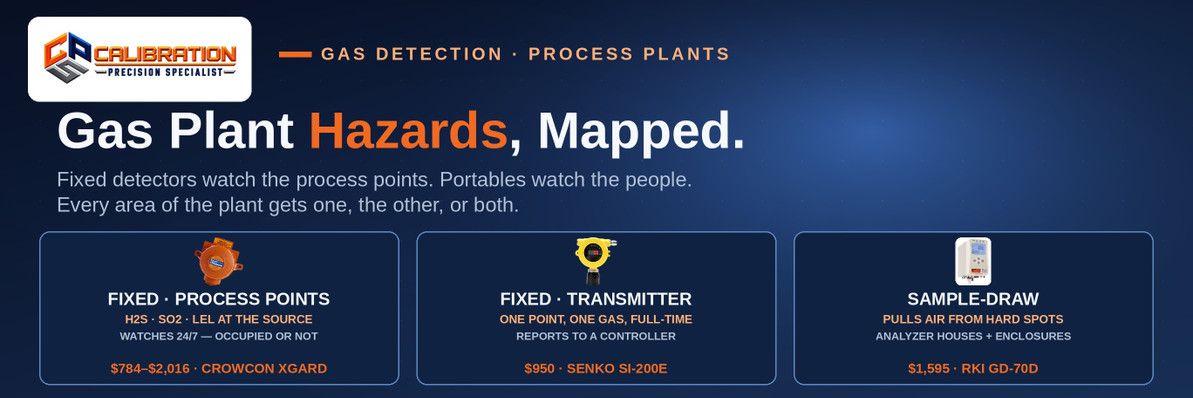
The gas hazards in a gas processing plant follow the process itself: hydrogen sulfide (H2S) arrives with the inlet gas and concentrates in the amine unit's acid gas, sulfur dioxide (SO2) appears in sulfur recovery, and flammable gas (%LEL) is the standing risk at propane refrigeration, product storage, and loading — so fixed detectors belong at those process points full-time, while portable monitors cover the people doing permit work, entries, and sampling between them.
A gas plant is not one hazard with one answer. It is a chain of process areas, and each link in the chain makes, concentrates, or moves a different gas. Walk the plant in process order and the detection map draws itself — which is exactly how this post is organized. If your plant also runs compression out at gathering sites, the companion map is fixed gas detection for compressor stations, and the wellhead end of the story is sour vs. sweet wells: how H2S changes your gas detection program.
What Are the Gas Hazards in Each Area of a Gas Processing Plant?
| Plant area | Main gas hazards | Primary coverage |
|---|---|---|
| Inlet and slug catchers | H2S in raw gas; flammable gas (LEL) at high-pressure fittings | Fixed H2S + LEL points; portables on rounds |
| Amine treating | H2S-rich acid gas off the regenerator; amine contactor leaks | Fixed H2S points — the highest-priority toxics coverage in the plant |
| Dehydration | Methane (LEL) at contactor, reboiler, and fittings | Fixed LEL points; portables for maintenance |
| Sulfur recovery | SO2 produced in the unit; H2S feed gas arriving | Fixed SO2 + H2S points |
| Refrigeration | Propane (LEL) from compressors, vessels, and seals | Fixed LEL points, mounted low — propane is heavier than air |
| Product storage and loading | LEL at tanks and loading connections; H2S where product is sour; VOC vapors during gauging and loading | Fixed LEL at the rack; pumped portables for gauging and hatch work |
Two patterns run through the whole table. First, the toxic risk is front-loaded: H2S is at its most dangerous where the gas arrives and where the amine unit concentrates it, long before the plant has made anything saleable. Second, the flammable risk never leaves — it just changes carrier, from raw gas at the inlet to propane in refrigeration to finished product at the rack. A detection plan that only watches one end of the plant is half a plan.
Where Does the H2S Hazard Sit — Inlet and Amine Treating?
Raw gas arrives at the inlet and slug catchers carrying whatever the wells sent, and at a sour plant that includes H2S at field concentrations. Every flange, valve stem, and sample connection at the front of the plant is a potential H2S leak at pressure, in an area operators visit on rounds but do not occupy continuously. That combination — high hazard, intermittent occupancy — is the textbook case for fixed points: the detector is on duty during all the hours nobody is standing there, and it warns the next person at the door instead of the first person at the leak. What makes a well sour in the first place, and what it changes upstream, is covered in sour vs. sweet wells.
The amine unit is where H2S stops being one component among many. The amine contactor absorbs H2S out of the gas stream, and the regenerator strips it back out as acid gas — a concentrated H2S stream on its way to sulfur recovery. Leaks around the contactor, the regenerator, and the acid-gas line carry that concentrated stream, which is why amine treating earns the densest fixed H2S coverage in the plant and why work there stays permit-driven with personal monitors on top of the fixed points. Use the fixed system to watch the unit; use portables on every person who opens, samples, or maintains it.
What Do You Monitor in Dehydration and Sulfur Recovery?
Dehydration removes water from the gas, usually with a glycol contactor — which means high-pressure natural gas around a contactor vessel, a reboiler, pumps, and a dense set of fittings. The hazard here is primarily flammable gas: methane leaks at pressure find ignition sources efficiently, and the area is another intermittent-occupancy space. Fixed LEL points near the likely leak sources, mounted for a gas lighter than air, plus portables on the maintenance crew, is the standard shape. The general placement method — one point per enclosed space, points at leak sources at the height the gas occupies — is laid out in where fixed gas detectors should be placed.
Sulfur recovery takes the amine unit's acid gas and converts H2S into elemental sulfur — and in doing so creates the plant's SO2 hazard. The sulfur unit and its tail-gas equipment are where SO2 monitoring belongs, alongside continued H2S coverage on the feed side, because the unit handles both gases: H2S arriving, SO2 being made. This is the area most often under-covered in older plants, because the feed gas gets the attention and the product gas is treated as the sulfur unit's internal business. It is not — a leak on either side of that unit is a toxic-gas event, and fixed points on both sides are what catch it while it is still small.
Why Are Refrigeration, Storage, and Loading LEL Areas?
The refrigeration section compresses propane to pull heat out of the gas stream, so the plant's propane inventory lives in compressors, vessels, and seal systems in one neighborhood. Propane is heavier than air: it sinks, spreads along grade, and collects in low spots, sumps, and enclosures. Fixed LEL points for propane belong low, near the equipment, with attention to the pockets where vapor pools — the opposite mounting instinct from methane, and the reason "LEL detector" is not a complete specification until someone says which gas and which height.
Storage and loading close the chain. Finished liquids sit in tanks and leave by truck or pipeline, and the loading connection — made and broken by hand, every load — is one of the most reliable leak points in any plant. Fixed LEL coverage at the rack watches the connection area continuously. The tasks around the tanks are different work: gauging, sampling, and hatch work put a person's face at the vapor source, and that work belongs to pumped portable monitors under permit, testing before and during the task. Fixed watches the rack; the portable watches the gauger. Neither one does the other's job.
Which Points Are Fixed — and Which Tasks Stay Portable?
The dividing rule is the same one that decides fixed vs. portable gas detection everywhere else:
- Fixed for every process point that can leak while unoccupied: inlet and slug catcher area, amine contactor and regenerator, acid-gas line, dehydration contactor area, sulfur unit and tail gas, refrigeration compressors and vessels, and the loading rack. These points report to a controller that can alarm outside the area, start ventilation, and shut equipment down — the full path is explained in how a fixed gas detection system works. Browse the fixed systems range to see how a point is built.
- Portable for every task a person performs between those points: rounds, sampling, line breaking, vessel and confined-space entry, tank gauging, and hot work. The standard crew instrument is a 4-gas monitor such as the RKI GX-3R ($640), worn in the breathing zone, bump tested before the day's use.
- Both, layered, in the amine unit and at the loading rack — the two areas where a concentrated hazard and routine hands-on work occupy the same square footage.
What About Analyzer Houses and Hard-to-Reach Points?
Some points need watching where a wall-mounted diffusion sensor does not belong: analyzer houses pulling process samples, small enclosures, cabinets, and sample-system shelters where the gas of interest is already being drawn through tubing. That is the sample-draw pattern at a general level: instead of asking gas to drift to a sensor, a pump draws air from the point being watched through a sample line to a transmitter mounted where people can reach, read, and calibrate it.
The CPS example is the RKI GD-70D ($1,595), a sample-draw transmitter built for exactly this duty — its full explainer is what the RKI GD-70D sample-draw detector is. Use sample-draw when the point is enclosed, hard to reach, or already plumbed for sampling; use a point sensor when the area is open and the gas can reach a properly placed detector on its own. The honest trade-off: a sample line is a component that can plug, leak, or add transport delay, so sample-draw points earn their place where a point sensor genuinely cannot — not as a default everywhere.
What Does Fixed Detection for a Gas Plant Cost?
Per point, the hardware is knowable; the installed total depends on the plant and is quoted in writing after a site review:
- Fixed point hardware runs $784–$2,016 across the Crowcon Xgard family — the range covers the family's types and gas configurations.
- A stand-alone fixed transmitter such as the SENKO SI-200E is $950 per point.
- Sample-draw for analyzer houses and hard spots: the GD-70D at $1,595.
- Portables for the crew: $640 per person at the GX-3R level, plus spares.
- Plus the system around the points: a controller, cable or conduit runs, mounting, commissioning, and startup calibration. Anyone who quotes a total installed price for a process unit without walking it is guessing — CPS quotes fixed work in writing after review, the same way on-site calibration services are quoted.
How Does a Gas Plant Keep This Many Detectors Honest?
A map this size fails quietly if the calibration program behind it is thin. Fixed points drift in place; portables drift in pouches; both read confidently while doing it. The working program is unglamorous:
- Calibrate every channel on every instrument, fixed and portable, at the manufacturer's interval — and after any sensor change. CPS calibrates every channel; a channel that will not hold calibration gets flagged, not passed.
- Keep the gas traceable. Every CPS calibration gas bottle carries a QR code that links to that bottle's SDS and Certificate of Analysis — the documentation trail a plant QA program will ask for. The Calibration Gas Finder matches instruments to their gas.
- Budget the consumables honestly. A stainless fixed-flow regulator is $205, and CPS charges no hazmat fee on calibration gas — we absorb it rather than adding it at checkout.
- Know the in-house numbers. Instruments sent in for calibration run $55 for a single-gas unit and $90 for a four- or five-gas unit. On-site work is quoted in writing, because process-plant conditions set the real price.
Frequently Asked Questions
What are the main gas hazards in a gas processing plant? Three families, distributed by process area: hydrogen sulfide (H2S), which arrives with raw inlet gas and concentrates in the amine unit's acid gas; sulfur dioxide (SO2), produced in sulfur recovery; and flammable gas measured as %LEL — methane through the front of the plant, propane in refrigeration, and hydrocarbon vapors at product storage and loading. Oxygen displacement can accompany any large release in an enclosed or low-lying area.
Where should fixed gas detectors be placed in a gas processing plant? At the process points that can leak while unoccupied: the inlet and slug catcher area, the amine contactor and regenerator and the acid-gas line, the dehydration contactor area, the sulfur recovery unit (both the H2S feed side and the SO2 side), refrigeration compressors and vessels, and the loading rack. Mount each point near the likely leak source at the height the gas occupies — high for methane, low for propane and other heavy vapors, breathing zone for toxics.
Why is the amine unit a hydrogen sulfide hazard? Because concentrating H2S is the amine unit's job. The amine contactor absorbs H2S out of the raw gas, and the regenerator strips it back out as acid gas — a concentrated H2S stream feeding sulfur recovery. A leak at the contactor, regenerator, or acid-gas line releases that concentrated stream rather than diluted raw gas, which is why the amine unit carries the plant's densest fixed H2S coverage and its work stays permit-driven with personal monitors as well.
What gas do you monitor in a sulfur recovery unit? Both sides of the conversion. The feed side handles hydrogen sulfide (acid gas arriving from the amine unit), and the unit produces sulfur dioxide as part of converting H2S to elemental sulfur, with SO2 present in the unit and its tail-gas equipment. Monitoring only the H2S feed and ignoring the SO2 the unit makes is the most common coverage gap in this area.
Do gas plant workers still need portable detectors if the plant has fixed detection? Yes. Fixed points watch places; they do not test a vessel before entry, follow an operator on rounds, or sit in the breathing zone of the person gauging a tank or breaking a line. Confined-space entry requires portable atmospheric testing under OSHA 29 CFR 1910.146 regardless of what is mounted on the walls. The standard crew instrument is a 4-gas portable — the RKI GX-3R at $640 — worn in the breathing zone and bump tested before each day's use.
What is sample-draw gas detection and where is it used in a gas plant? Sample-draw detection uses a pump to pull air from the point being watched through tubing to a transmitter mounted somewhere accessible, instead of relying on gas drifting to a wall sensor. In a gas plant it fits analyzer houses, sample-system shelters, small enclosures, and hard-to-reach points. The RKI GD-70D ($1,595) is a sample-draw transmitter built for this duty. The trade-off is the sample line itself, which can plug or leak, so sample-draw is used where a point sensor genuinely cannot do the job.
What gas detector do you need for propane refrigeration areas? Fixed flammable-gas (LEL) detection, mounted low. Propane is heavier than air, so it sinks and collects at grade, in sumps, and in low enclosures around the refrigeration compressors and vessels — a detector mounted at methane height will read late or never. Points belong near the compressor seals, vessels, and likely leak fittings at low level, reporting to a controller that can alarm and act. Fixed-point hardware in the Crowcon Xgard family runs $784–$2,016 per point depending on type and configuration.
How much does a fixed gas detector for a gas plant cost? Hardware per point: $784–$2,016 across the Crowcon Xgard family, $950 for a stand-alone SENKO SI-200E transmitter, and $1,595 for an RKI GD-70D sample-draw transmitter. On top of the point hardware come the controller, cable or conduit, mounting, commissioning, and startup calibration, which depend on the plant layout and are quoted in writing after a site review. There is no honest installed total without seeing the unit.
How often do fixed gas detectors in a gas plant need calibration? At the manufacturer's recommended interval, in place, at every point — and after any sensor replacement. A fixed sensor drifts while permanently exposed to its environment, and because the whole plant trusts that point's reading, an overdue fixed detector fails silently and continuously. CPS calibrates every channel on fixed and portable instruments alike; in-house calibration runs $55 for single-gas and $90 for four- or five-gas portables, and on-site fixed work is quoted in writing.
Can one gas detector cover a whole gas processing plant? No. A point detector samples the air at one location, and a gas plant's hazards are separated by process area, by gas, and by height — H2S at the inlet and amine unit, SO2 in sulfur recovery, propane low in refrigeration, methane high in dehydration. Coverage means a point per area and hazard, mounted for the gas it watches, plus portables on the people. One detector, however good, reads one point in one area and says nothing about the rest of the plant.
The Bottom Line
Draw the detection map the way the plant is built: fixed H2S where the gas arrives and where the amine unit concentrates it, fixed SO2 and H2S through sulfur recovery, fixed LEL high for methane and low for propane, fixed coverage at the loading rack — and a bump-tested portable on every person doing the permit work in between. The process decides where the gases are; the detection plan just has to follow it, area by area.
Planning or auditing coverage for a gas plant? Call 865-900-8844 or reach us through Contact Us. We will walk the map with you — fixed systems, portable multi-gas monitors, calibration gas, and the calibration services that keep every point honest. The upstream companion reads are fixed gas detection for compressor stations and our turnaround coverage in gas detection for refinery turnarounds and shutdowns.
CPS Calibrations · 109 S. Front Street, Rockwood, TN 37854 · Calibration Gas · Calibration Services · Contact Us
Need a calibration you can file?
In-house calibration at CPS in Rockwood, Tennessee — $55 for single-gas instruments, $90 for 4- and 5-gas — every channel, as-found and as-left data, full certificate.
See Calibration Servicesor call 865-900-8844
Recent Posts
-

What Is Remote Monitoring for Fixed Gas Detection?
Remote monitoring for fixed gas detection means a fixed system's live readings, trends, and alarm hi …Nov 23rd 2026 -

What Are the Key Differences Between the GX-6000 and GX-6100?
The RKI GX-6100 is the current replacement for the discontinued GX-6000: both are pumped 6-gas monit …Nov 22nd 2026 -

How to Read a PID Correction Factor Chart
To read a PID correction factor chart, find your vapor’s row, take the factor under your own lamp en …Nov 21st 2026