
How Much Does It Cost to Rent Gas Detectors for a Turnaround?
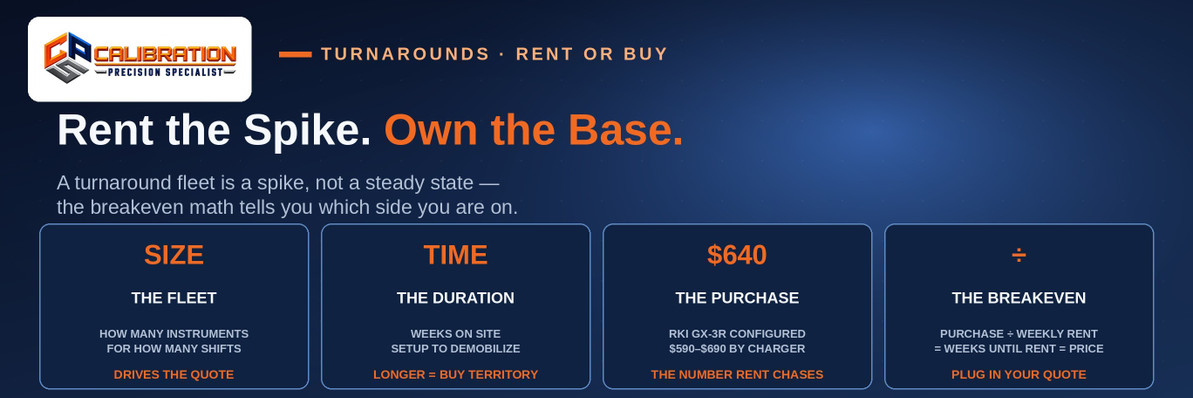
Renting gas detectors for a turnaround has no catalog price — every rental is quoted per job on fleet size, duration, gas and bump support, and freight, so any flat rate quoted without those answers is a guess. The number that actually decides the question is breakeven: a rental costs more than buying the moment your rental weeks × the weekly rate passes the purchase price — and a core 4-gas instrument like the RKI GX-3R buys outright at $590–$690 configured, which is a low bar for a long turnaround to clear.
This post will not invent a rental rate for you — rental pricing is set quote by quote, and a made-up "typical" figure would steer a real budget wrong. What it does instead is more useful: the four things that actually drive a rental quote, the breakeven formula with the purchase side anchored on verified live prices, and the honest cases where renting wins outright. The operational side of the same problem — who wears what, and where area monitors go — is covered in gas detection for refinery turnarounds and shutdowns.
What Drives a Turnaround Rental Quote?
Fleet size. How many instruments, of what mix — personal 4-gas monitors for the crew, pumped units for vessel entry, area monitors for the perimeter. This is the multiplier on everything else. Area monitoring is its own line item class; area monitors for turnarounds and shutdowns covers how those get deployed.
Duration. Rental terms are built around time on site — delivery before the first shift to demobilization after the last. A two-week outage and a two-month outage are different products even with identical fleets, and extensions past the planned window are where rental budgets quietly bleed.
Gas and bump support. Instruments on a turnaround get bump tested constantly and calibrated on schedule. Is calibration gas included in the quote? Bump stations? Replacement instruments when one fails a morning bump? A cheap headline rate with support excluded can cost more than a higher rate with it included — ask what the quote carries, line by line.
Freight and logistics. Instruments ship to the site and back. Freight both ways, delivery timing against the outage start, and what happens with a unit damaged or lost in a unit under turnaround conditions all belong in the quote conversation — before the outage, not during it.
The Breakeven Math: Renting vs. Buying
One formula decides most of it: breakeven weeks = purchase price ÷ your weekly rental rate. The purchase side is verifiable — live CPS store configurations:
| Instrument | Configured purchase price | Note |
|---|---|---|
| RKI GX-3R 4-gas | $590–$690 | $640 with the 100–240 VAC charger |
| RKI GX-3R Pro 5-gas | $1,005–$1,575 | By toxic sensor and charger options |
| RKI GX-Force pumped 4-gas | $835–$975 | $794 headline matches no variant |
The rental side is your quote. To show how the formula behaves, here is the GX-3R at $640 against three illustrative weekly rates expressed as a percentage of purchase price — these percentages are arithmetic examples for the formula, not quoted or market rates; replace them with the number on your actual quote:
| Illustrative weekly rent | Per week on a $640 GX-3R | Breakeven |
|---|---|---|
| 5% of purchase price | $32/week | 20 weeks |
| 10% of purchase price | $64/week | 10 weeks |
| 15% of purchase price | $96/week | About 6.7 weeks |
Read it the way a planner should: every week past breakeven, you are paying ownership money for an instrument you will hand back. And the comparison does not end at purchase — an owned instrument still needs calibration and gas, priced in how much it costs to own a gas detector for a year, while a rented instrument's support may or may not be inside its rate. Compare total against total.
When Renting Wins
The spike is short and huge. A two-week outage needing 80 instruments will never justify buying 80 instruments that then sit for two years. Renting converts a capital mountain into an operating line.
You need specialty instruments once. Pumped units for a specific entry program, PID-equipped instruments for a specific unit — the GX-Force vs. GX-6100 comparison shows how wide the pumped range runs — or area monitors for one perimeter. Buying a specialty fleet for a single event strands capital in a cabinet.
Capital is frozen but the outage is not. When the purchase cannot be approved in time and the work cannot move, rental is the bridge — chosen with open eyes and a breakeven date circled on the calendar.
When Buying Wins
The turnaround repeats. Plants turn around on cycles. A fleet bought for this outage is the fleet for the next one, and the purchase price is paid once while rental is paid every time.
The schedule stretches. Outages slip; scope grows. Every extension week is billed on a rental and free on an owned fleet that is already on site — and "free" matters, because the breakeven week computed above does not care why the extra weeks happened.
The instruments have year-round work. A core fleet that serves daily operations between outages is earning its keep 52 weeks a year; renting that baseline is paying rent on your own permanent need. The durable pattern is own the baseline, rent the spike.
Frequently Asked Questions
How much does it cost to rent gas detectors for a turnaround?
There is no standard rate to quote honestly: turnaround rental is priced per job on fleet size, duration, gas and bump support, and freight, and rates come from the rental house's quote for your specific outage. What can be priced exactly is the alternative — an RKI GX-3R buys outright at $590–$690 configured, a GX-Force pumped unit at $835–$975 — and the breakeven formula (purchase price ÷ weekly rent = weeks) tells you whether any given quote beats buying. Treat any flat per-week figure offered without those four drivers as a placeholder, not a price.
What drives the cost of a turnaround detector rental quote?
Four things: fleet size and mix (personal monitors, pumped entry units, area monitors); duration from delivery to demobilization, including extensions; gas and bump/calibration support — whether gas, stations, and replacement units are inside the quote; and freight and logistics both ways, including damage and loss terms. Two quotes with different support inclusions are not comparable until those lines are matched.
Is it cheaper to rent or buy gas detectors for a turnaround?
It depends on duration, and the math is one line: breakeven weeks = purchase price ÷ weekly rental rate. For an RKI GX-3R at $640 configured, a weekly rent of 10% of purchase reaches breakeven at 10 weeks — shorter than that, renting costs less; longer, buying does. Short, huge, one-time spikes favor renting; recurring outages, stretching schedules, and year-round baseline fleets favor buying. Most plants land on owning the baseline fleet and renting the spike.
How many gas detectors do I need for a turnaround?
Enough for every worker in a monitored area on every shift, plus pumped units for entry work, area monitors for perimeters and hot-work zones, and spares for the instruments that will fail a bump test during the outage — because some will. The count comes from your crew plan and permit map, not from a rule of thumb; the deployment thinking is worked through in gas detection for refinery turnarounds and shutdowns.
Are rental gas detectors calibrated?
That is a question to put in writing on the quote, not to assume. Ask what calibration and bump support the rental includes: whether instruments arrive with current calibration, whether gas and bump stations are supplied for the outage, and what happens when a unit fails mid-event. Whatever the answers, get them as quote lines — support that is not in the quote is not in the deal, and an uncalibrated detector on a turnaround is worse than a missing one because it looks like protection.
What happens if a rented gas detector is damaged or lost?
Terms vary by rental house and belong in the quote: who bears damage and loss, at what valuation, and how replacements reach the site during the outage. Turnarounds are hard on instruments — drops, contamination, and units that do not come back from a vessel entry are normal events, not exceptions — so the damage clause is a real cost driver, not boilerplate. Read it before signing, and count spares accordingly.
Does CPS rent gas detectors?
CPS Calibrations sells gas detectors and calibrates them in-house at our Rockwood, Tennessee shop — this guide exists to help you judge a rental quote against real purchase prices, whoever supplies the rental. If the breakeven math says buy, the instruments above are on our store at the configured prices quoted here; if it says rent, rent with the breakeven week circled. Either way, owned fleets between outages are covered by the CPS Calibration Program.
How much does a gas detector cost to buy for a turnaround fleet?
At verified CPS configurations: the RKI GX-3R 4-gas monitor runs $590–$690 depending on charger option, the 5-gas GX-3R Pro runs $1,005–$1,575, and the pumped GX-Force runs $835–$975. A 20-instrument GX-3R baseline fleet is therefore $12,800 in hardware at the $640 configuration — the fixed number a rental quote has to beat across your outage calendar, not just one event.
When does renting gas detectors make sense?
When the need is a spike: a short outage needing a fleet far larger than your baseline, a one-time requirement for specialty instruments such as pumped or PID-equipped units or area monitors, or a capital freeze that cannot move on the outage's schedule. In each case the rental premium buys impermanence — you pay for instruments only while the event lasts and hand back the storage, maintenance, and calibration tail.
How much does it cost to calibrate a gas detector?
At CPS Calibrations, in-house calibration is $55 for a single-gas instrument and $90 for a 4- or 5-gas instrument; ship-in calibration is billed at the same rates, and we calibrate every channel on every instrument. On-site work at your facility is quoted in writing and costs more than bench work. For an owned turnaround fleet, that per-event rate — not a rental line — is what calibration costs you between outages.
The Bottom Line
Turnaround rental has no honest flat price — it is quoted on fleet size, duration, support, and freight — so judge every quote with one line of math: purchase price ÷ weekly rent = the week renting starts costing more than owning. Against a GX-3R at $590–$690 configured, that week arrives fast on a long outage. Rent the spike, own the baseline, and never sign a rental quote whose gas, bump support, freight, and damage terms are not written into it.
Planning an outage fleet — buying the baseline or checking a rental quote against real prices? Call CPS Calibrations at 865-900-8844 — instruments, calibration, and the CPS Calibration Program behind them, from Rockwood, Tennessee.
CPS Calibrations · 109 S. Front Street, Rockwood, TN 37854 · Calibration Services · The CPS Calibration Program
Need a calibration you can file?
In-house calibration at CPS in Rockwood, Tennessee — $55 for single-gas instruments, $90 for 4- and 5-gas — every channel, as-found and as-left data, full certificate.
See Calibration Servicesor call 865-900-8844
Recent Posts
-

What Is Remote Monitoring for Fixed Gas Detection?
Remote monitoring for fixed gas detection means a fixed system's live readings, trends, and alarm hi …Nov 23rd 2026 -

What Are the Key Differences Between the GX-6000 and GX-6100?
The RKI GX-6100 is the current replacement for the discontinued GX-6000: both are pumped 6-gas monit …Nov 22nd 2026 -

How to Read a PID Correction Factor Chart
To read a PID correction factor chart, find your vapor’s row, take the factor under your own lamp en …Nov 21st 2026