
RKI GX-3R Pro Calibration Service: Mail In Your Meter
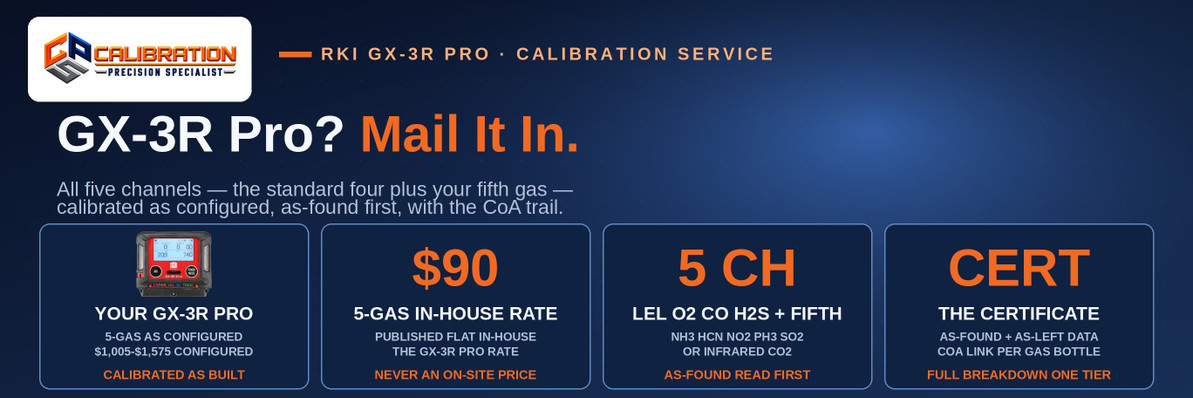
Mail-in calibration for the RKI GX-3R Pro costs $90 at CPS Calibrations — the published in-house rate for a 4- or 5-gas instrument — and covers every channel the meter carries: the standard four (combustible gas 0–100% LEL, oxygen 0–40.0% vol., carbon monoxide 0–2,000 ppm, hydrogen sulfide 0–200.0 ppm) plus its fifth channel as configured — ammonia 0–400 ppm, hydrogen cyanide 0–30 ppm, nitrogen dioxide 0–20 ppm, phosphine 0–20 ppm, sulfur dioxide 0–100 ppm, or infrared carbon dioxide 0–10,000 ppm — with as-found readings recorded before any adjustment, a sensor health check, and the meter returned with a certificate showing as-found and as-left data and a Certificate of Analysis link for each calibration gas bottle used. Ship it to 109 S. Front Street, Rockwood, TN 37854; call 865-900-8844 first to confirm the current turnaround.
The GX-3R Pro is the GX-3R's bigger assignment: the same compact diffusion monitor crews wear in the breathing zone, plus a fifth toxic-gas channel, Bluetooth, and man-down and panic alarms — about 4.58 oz, IP66/68, with roughly 25 hours of runtime (about 16 hours with the infrared CO₂ sensor fitted). That fifth channel is exactly why its calibration is not a generic 4-gas job. A bench that calibrates only the standard four has left the channel you paid extra for — the one your hazard assessment actually named — unverified. This post is the service page for the Pro: what its calibration covers channel by channel, what the bench checks around the calibration, and what comes back in the box. If you are still deciding between the two meters, the head-to-head is RKI GX-3R vs. GX-3R Pro; if you own the standard meter, its service page is RKI GX-3R calibration service. The Pro itself, configured, runs $1,005–$1,575 on our store — the RKI GX-3R Pro is priced by its fifth sensor and charger package, which is why this post quotes the configured range and never a single headline number.
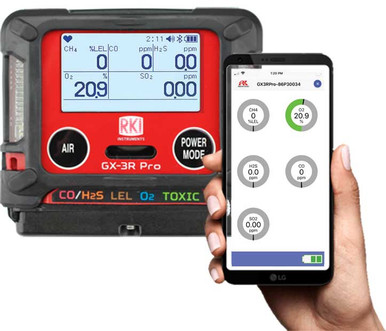
RKI GX-3R Pro 5-Gas Monitor
LEL, O2, CO, H2S + your fifth gas — NH3, HCN, NO2, PH3, SO2, or IR CO2.
$1,005–$1,575 configured
See the GX-3R ProWhy Does the Fifth Channel Change the Calibration?
Because the fifth channel is a different gas, a different sensor, and usually a different calibration gas. A Pro running ammonia for a refrigeration plant, sulfur dioxide for a paper mill, or infrared CO₂ for a brewery has almost nothing in common with the next Pro on the bench except the case. The bench therefore calibrates the meter as configured: the fifth channel is identified from the meter itself, calibrated against the correct documented gas for that gas and range, and reported on the certificate in its own units, alongside the standard four. A certificate that says “pass” for the meter but lists only four channels has not documented the instrument you own. We calibrate every channel — on a Pro, that means five sets of as-found and as-left readings, not four plus an assumption.
What a GX-3R Pro Calibration Covers, Channel by Channel
Every channel the meter carries, every time, against documented calibration gas:
- Combustible gas (LEL), 0–100% LEL. Its as-found reading is recorded first — what the sensor was actually reporting against known gas when the meter arrived — then it is adjusted and its as-left reading recorded.
- Oxygen (O₂), 0–40.0% vol. The channel that catches both deficient and enriched air. Oxygen sensors drift with age and exposure, so the as-found figure is the evidence of how far this one had moved.
- Carbon monoxide (CO), 0–2,000 ppm. Calibrated as configured, and reported in its own units on the same certificate.
- Hydrogen sulfide (H₂S), 0–200.0 ppm. The fast, unforgiving toxic channel — as-found and as-left beside the others, so one document tells the meter's whole story.
- The fifth channel, as configured. Ammonia (NH₃) 0–400 ppm, hydrogen cyanide (HCN) 0–30 ppm, nitrogen dioxide (NO₂) 0–20 ppm, phosphine (PH₃) 0–20 ppm, sulfur dioxide (SO₂) 0–100 ppm, or infrared carbon dioxide (CO₂) 0–10,000 ppm / 0–10% vol. Whichever sensor your Pro was built with is the channel the bench calibrates and the certificate names — by gas and range, not as a generic “fifth sensor.”
Those ranges are the GX-3R Pro's own specification, from the meter's product data. The certificate reports each channel separately — five channels, five results — rather than collapsing the instrument into a single pass.
The Pump Check and the Sensor Health Check
The Pro is a diffusion instrument, but many owners run it with RKI's RP-3R Pro clip-on sampling pump for pre-entry and remote sampling. Send the pump with the meter if you use one, and the bench checks it as part of the visit: that it draws, that its filters are inspected, and that the meter-and-pump combination you actually carry is the combination that leaves calibrated. A diffusion calibration on a meter that works through a starved pump and a clogged filter in the field is documentation for a different instrument than the one on the job.
Around the calibration itself sits the sensor health check. Calibration answers whether the meter reads correctly against known gas today; the health check answers whether anything is heading for trouble. A channel that calibrates back into specification behaves differently from one that is sluggish, unstable, or at the edge of its range, and the as-found data shows how far each channel had drifted since its last calibration — the fifth toxic channels included, because a specialty sensor is the one nobody else on your site can sanity-check. If a sensor is spent or failing, you hear it in a specific form: a written quote before any work, with the choice yours. For scale, the Pro's fifth toxic sensor lists at $255 on our store and the infrared CO₂ sensor at $420 — real figures to weigh in a repair-or-replace decision, quoted in writing for your meter before anything is fitted. A calibration booking is never a blank check.
What Comes Back in the Box
Your GX-3R Pro, calibrated — and its documentation. The certificate is the CPS standard, one tier with the full breakdown: as-found and as-left readings for every channel, and the gas trail behind them — when a calibration gas bottle enters service at CPS, the supplier QR code on it is scanned and its Certificate of Analysis link is stored on the bottle's record, and the certificate carries a clickable CoA link for each bottle used on your meter. The meter is checked in and tracked against its serial number from arrival to return, and its record joins the CPS Calibration Program: its history builds calibration by calibration behind one fleet history link, and a due-date reminder email arrives before the next calibration comes due. No contract, no monthly fee. Send the meter, its charger, and the clip-on pump if you use one; do not send calibration gas cylinders — we calibrate with our own documented gas. Return shipping is the customer's cost, arranged when the service is booked. The general ship-in process, for any instrument, is in how mail-in gas detector calibration works, and our calibration services page covers the wider bench.
Frequently Asked Questions
How much does it cost to calibrate an RKI GX-3R Pro?
Ninety dollars at CPS Calibrations. The GX-3R Pro is a 5-gas instrument as configured — and even a Pro built without a fifth sensor is a 4-gas instrument — so it takes the published in-house rate for 4- and 5-gas instruments: $90, the same rate as the standard GX-3R. That is a bench rate for calibration performed in-house at our Rockwood, Tennessee shop; it never applies to on-site work, which is quoted in writing. Shipping is separate in both directions, and any sensor or repair work beyond calibration is quoted in writing before it is done.
What does a GX-3R Pro calibration include?
Calibration of every channel the meter carries — LEL, O₂, CO, H₂S, and the fifth channel as configured — with as-found readings recorded before any adjustment and as-left readings after, a sensor health check on the bench, a draw and filter check on the RP-3R Pro clip-on pump if you send it with the meter, and a full certificate showing both sets of readings plus a Certificate of Analysis link for each calibration gas bottle used. The meter's record is entered in the CPS Calibration Program, so its history is kept by serial number and you are reminded before the next due date. There is one certificate tier; the full breakdown is the standard, not an upgrade.
Which fifth gas can a GX-3R Pro have, and is it calibrated too?
Yes — the fifth channel is calibrated as configured, against the correct gas for that sensor. From RKI's specification for the Pro, the fifth channel is one of: ammonia (NH₃) 0–400 ppm, hydrogen cyanide (HCN) 0–30 ppm, nitrogen dioxide (NO₂) 0–20 ppm, phosphine (PH₃) 0–20 ppm, sulfur dioxide (SO₂) 0–100 ppm, or infrared carbon dioxide (CO₂) 0–10,000 ppm / 0–10% vol. The certificate names the fifth channel by gas and range and reports its as-found and as-left readings separately — never as a generic fifth-sensor pass.
My GX-3R Pro has the infrared CO2 sensor. Can you calibrate that channel?
Yes — the meter is calibrated as configured, and an infrared CO₂ Pro is documented that way: the CO₂ channel's range (0–10,000 ppm / 0–10% vol.) and its as-found and as-left readings appear on the certificate alongside the standard four. Mention the fifth sensor when you call 865-900-8844 so it is noted on the work order before the meter ships. For scale on that sensor's value, the infrared CO₂ replacement sensor lists at $420 on our store, against $255 for a fifth toxic sensor.
Should I send the clip-on pump with my GX-3R Pro?
Yes, if you use one. Many Pro owners sample remotely with the RP-3R Pro clip-on pump, and the combination you carry is the combination that should leave calibrated: send the pump and the bench checks that it draws and inspects its filters as part of the visit. Also send the charger your configuration uses and a note inside the box with your company name, a contact, and the meter's serial number. Do not send calibration gas cylinders; CPS calibrates with its own documented gas, and the certificate links to that gas's Certificate of Analysis.
What happens if my GX-3R Pro's fifth sensor is failing?
The bench finds it and you decide what happens next. The as-found readings and the sensor health check show whether each channel — the fifth included — calibrated back into specification or whether a sensor is spent or failing. Anything beyond calibration is quoted in writing for your approval before work begins: for reference, a fifth toxic replacement sensor lists at $255 on our store and the infrared CO₂ sensor at $420. Approve the quote and the meter is repaired and calibrated; decline it and the meter returns as-is with its as-found record, which documents exactly where it stands.
Is GX-3R Pro calibration different from GX-3R calibration?
The bench discipline is identical — every channel, as-found first, full certificate — and so is the price: $90 in-house for either meter, because both fall in the published 4- and 5-gas rate. The difference is the work's scope: a GX-3R presents four channels (LEL, O₂, CO, H₂S), while a Pro presents those four plus a fifth toxic or infrared CO₂ channel that needs its own correct calibration gas and its own line on the certificate. The standard meter's service page is RKI GX-3R calibration service; the meters themselves are compared in GX-3R vs. GX-3R Pro.
Can I calibrate my GX-3R Pro myself instead?
You can — RKI designs the platform for user calibration, and our step-by-step how to calibrate an RKI GX-3R shows the routine on the sibling meter. The honest trade-off is gases and documentation: doing a Pro yourself means owning the standard 4-gas mix and the correct fifth-gas cylinder for your sensor, plus the record-keeping. Mailing the meter in means the bench does it with documented gas and returns a certificate with as-found and as-left data for all five channels and the gas's CoA trail, with the record kept in the CPS Calibration Program.
How long will my GX-3R Pro be gone?
Call 865-900-8844 before you ship and we will confirm the current turnaround for the bench queue. We do not publish a fixed turnaround, because it honestly depends on the queue that week and on what the meter needs — a straightforward calibration moves with the queue, while a meter waiting on your approval of a sensor quote waits on that decision and on parts. Transit time in both directions is the carrier's. The rate, by contrast, is fixed and published: $90 in-house for the Pro's channels.
What does a new GX-3R Pro cost, if mine is beyond repair?
Configured, $1,005–$1,575 on our store — builds without a fifth sensor run $1,005–$1,155, toxic-fifth builds start at $1,260, and infrared CO₂ builds start at $1,425, with charger packages moving the figure inside each band. The live page is the RKI GX-3R Pro. Most Pros that fail calibration need a sensor, not a replacement — and because repairs are quoted in writing first, you will have the real repair figure in hand before a repair-or-replace decision has to be made.
The Bottom Line
The GX-3R Pro's fifth channel is the reason you bought it — and the channel a generic 4-gas calibration leaves unverified. Mail yours to CPS Calibrations and for the published $90 in-house rate you get every channel calibrated as configured — the standard four plus NH₃, HCN, NO₂, PH₃, SO₂, or infrared CO₂ — as-found readings recorded before adjustment, a sensor health check and a pump check, a written quote before any repair, and a certificate with as-left data and the calibration gas's CoA trail, plus a program record that reminds you next time.
Ready to mail your GX-3R Pro in? Call CPS Calibrations at 865-900-8844 to confirm the turnaround, then ship it to 109 S. Front Street, Rockwood, TN 37854.
--- CPS Calibrations · 109 S. Front Street, Rockwood, TN 37854 · RKI GX-3R Pro · RKI GX-3R Calibration Service · Calibration Services
Ready to mail in your GX-3R Pro?
Start the ship-in request, pack the meter, and we handle the rest — every channel calibrated as configured, full certificate returned with it.
Start Your Ship-In Requestor call 865-900-8844
Recent Posts
-

What Is Remote Monitoring for Fixed Gas Detection?
Remote monitoring for fixed gas detection means a fixed system's live readings, trends, and alarm hi …Nov 23rd 2026 -

What Are the Key Differences Between the GX-6000 and GX-6100?
The RKI GX-6100 is the current replacement for the discontinued GX-6000: both are pumped 6-gas monit …Nov 22nd 2026 -

How to Read a PID Correction Factor Chart
To read a PID correction factor chart, find your vapor’s row, take the factor under your own lamp en …Nov 21st 2026