
Getting Your Own Fleet Ready for a Turnaround: The Calibration Push
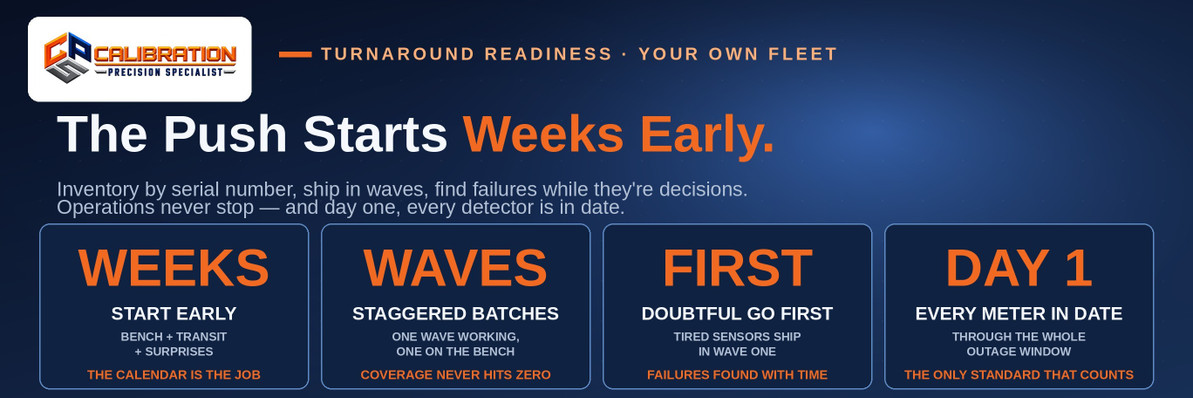
Getting an owned fleet ready for a turnaround is a timing problem, not a calibration problem: start weeks before the outage, inventory every instrument by serial number and due date, and ship the fleet to CPS in staggered batches — one wave on the bench while the next is still covering daily work — so operations never stop and every detector lands on outage day one in date, with failures found early enough to fix calmly. The fleets that get hurt are the ones that ship everything the week before: they discover the bench queue, the transit days, and the two tired sensors all at once, with no time left to answer any of them. Call 865-900-8844 to plan the waves against the real queue; the ship-in address is 109 S. Front Street, Rockwood, TN 37854.
A turnaround multiplies everything: more people, more confined-space entries, more hot work — and the same owned fleet you run the plant with the rest of the year. Every one of those extra entrants needs a detector that is in calibration, and 'in calibration' is judged on the outage's dates, not on the day you happen to check. An instrument whose due date falls on day nine of a fourteen-day outage is, for planning purposes, already expired.
This post is the push, planned as a project: the inventory, the waves, the failure buffer, and the rental cross-check for the gap your fleet genuinely cannot cover. The mechanics of moving a fleet through the mail are covered in shipping a whole fleet for calibration — this post is about when to move it, and in what order, so the plant never stands uncovered. The general process is the same one in how mail-in gas detector calibration works; what changes at turnaround scale is the calendar.
Step One: Inventory the Fleet Against the Outage Dates
Start with the list, because memory undercounts fleets. Pull every owned instrument — including the spares in the cabinet and the unit on loan to the other building — and record serial number, model, configuration, and current calibration due date. Your records in the CPS Calibration Program hold the instruments we have calibrated by serial number behind one fleet link, which makes this a download-and-check exercise instead of an archaeology project.
Then judge every instrument against the outage window, not against today. Three piles come out of the sort: instruments in date through the whole outage (they still get checked, bump discipline confirmed, and set aside as the known-good core); instruments expiring before or during the outage (the push — these are the waves); and instruments with any doubt attached — a sensor that was marginal last time, a pump that sounded tired, a due date nobody can find paperwork for (these go in the first wave, deliberately, because they are the ones most likely to need a quote, parts, or a replacement decision, and those decisions need weeks, not days). Also count heads honestly: outage staffing, including contractors' supervision and your own extra entrants, sets how many in-date instruments day one actually requires. The fleet number that matters is not how many you own; it is how many simultaneous wearers the outage puts in the field.
Step Two: Ship in Waves, So Operations Never Stop
The single-fleet mistake is shipping everything at once. Daily operations run right up to the outage, and a plant that mails its whole fleet in one box has grounded its own routine entries for the duration — bench time plus transit in both directions. The fix is the wave plan:
- Wave one — the doubtful and the soonest-due. Ship these first, weeks out. Their calibrations finish earliest, their failures surface while there is still time to approve a written quote, order a sensor, or decide on replacement, and they return to become the coverage that lets wave two leave.
- Wave two — the bulk of the expiring fleet. Ship as wave one returns. Coverage overlaps by design: at every moment, part of the fleet is in service at the plant and part is moving through the bench, and neither group ever reaches zero.
- Wave three — the stragglers and spares. The cabinet spares get calibrated last, on the freshest dates, so the units covering bench time and failures during the outage carry the longest remaining interval.
Two disciplines make the waves work. First, every box travels with its serial-number list, so check-in against the fleet record is immediate and nothing gets separated from its identity — the fleet-shipping mechanics are spelled out in shipping a whole fleet for calibration. Second, the waves are planned on a real call, not a hope: call 865-900-8844 before wave one ships and plan the sequence against the bench queue that actually exists. We do not publish a fixed turnaround, and a turnaround push is exactly where that honesty matters — the schedule is built from the queue, your dates, and the transit days, together.
Step Three: Plan for Failures, and Price the Gap Honestly
Every fleet push finds something. A sensor at the end of its life, a channel that will not hold, a pump that is done — in a fleet of any size, found failures are a statistical certainty, and the only question is whether they are found in week two, with options, or in outage week, without them. The buffer is built into the wave plan: doubtful instruments shipped first, quotes approved or declined with time to act, and spares calibrated and staged to cover whatever does not come back in time. A failure found early is a line item. The same failure found late is a scramble for rental instruments in the same weeks every other plant in the region is scrambling for them.
Which raises the gap question, and it should be asked with the inventory in hand: if the outage needs more simultaneous detectors than the owned fleet can field — after the push, with spares counted — how many, and for how long? That is a rental question, and it has a worked answer in renting vs. buying gas detectors for a turnaround: rent the surge, own the base. The push and the rental booking are the same project viewed from two sides — calibrate everything you own early, and reserve the difference while rental fleets are still available. Waiting to discover the gap until the instruments come back is how plants end up paying surge prices for whatever is left on the shelf.
Frequently Asked Questions
How early should I start calibrating my fleet before a turnaround?
Weeks before the outage — early enough for three full cycles of reality: bench time, transit in both directions, and the repair decisions a fleet push always produces. The working rule is to ship the first wave as soon as the outage dates are firm, starting with the instruments you most doubt. A push that begins the week before the outage has no slack for a single failed sensor, and fleets of any size always contain at least one. Call 865-900-8844 when the dates are set and the waves can be planned against the actual bench queue.
Should I ship my whole fleet at once for calibration?
No — ship in staggered waves. Daily operations keep running until the outage starts, and a plant that mails everything in one box has no in-date instruments for its routine entries while the fleet is in transit and on the bench. Waves solve it: the doubtful and soonest-due ship first and return as coverage, the bulk follows, and the spares go last on the freshest dates. At every point in the plan, part of the fleet is working at the plant. The mechanics of fleet shipping itself are covered in shipping a whole fleet for calibration.
What happens if some detectors fail calibration during the push?
Exactly what the timing is designed to absorb. The as-found failure is documented, adjustment is attempted, and anything beyond calibration is quoted in writing for your approval — approve and it is repaired and calibrated, decline and it returns as-is with its as-found record while a calibrated spare covers its slot. This is the core argument for starting early and shipping doubtful instruments first: a failure found weeks out is a decision; the same failure found in outage week is an emergency with a crew standing behind it.
How many detectors does my plant need for a turnaround?
Count simultaneous wearers, not instruments owned: every entrant, attendant rotation, supervisor, and contractor your site requires to carry one, at the outage's peak staffing, plus spares for bench time and failures. Then compare that number to the fleet that will be in date through the whole outage window. The owned fleet covers the base; the difference is the rental gap, and it should be priced early using the math in renting vs. buying gas detectors for a turnaround, while rental fleets are still bookable.
What does the fleet calibration push cost?
Calibration itself is the published bench math: $55 per single-gas instrument and $90 per 4- or 5-gas instrument, in-house — never an on-site price. Shipping is the customer's cost in both directions, and any repair beyond calibration is quoted in writing per instrument before work. What the push really budgets is not a special fee — there is none — but the ordinary cost of calibrating the fleet, spent early instead of late, plus whatever approved repairs the as-found records honestly require. The expensive version of this project is the late one: rush decisions, surge rentals, and expired instruments discovered at the gate.
Can CPS track which of our instruments have been done?
Yes — instruments are checked in and tracked against their serial numbers from arrival to return, and each one's record joins the CPS Calibration Program, where the fleet's history builds behind one link, instrument by instrument. During a push that means the returning waves arrive with certificates showing as-found and as-left data per serial number, and the fleet view shows what is done, what is on the bench, and what has not shipped yet. Send each box with its serial-number list and check-in is immediate.
Our turnaround includes contractors — whose detectors count?
Yours are the ones you control, and they are this post's subject — but count the interface honestly. If contractor personnel will rely on site-issued instruments, they are simultaneous wearers in the inventory math. If contractors bring their own, your duty shifts to verifying their calibration status at the gate — a different task with its own discipline. Either way, the owned fleet's push should be planned against the total number of wearers your site will actually field and verify on day one, not just the names on your own payroll.
What should go in each fleet shipment?
The instruments on that wave's serial-number list, their chargers and any sampling accessories they use, and the list itself — company name, contact, and the serial numbers in the box. Do not send calibration gas cylinders; the bench calibrates with its own documented gas, and each certificate links the Certificate of Analysis for the bottles used. Pack so that a wave can be checked in as a unit the moment it arrives: one box, one list, one wave. The detailed packing guidance is in shipping a whole fleet for calibration.
Is there a faster option if we started late?
The honest answer is that the options narrow but do not vanish. Call 865-900-8844 and say plainly that a turnaround is close: the bench queue is what it is, but the wave plan can still be compressed — doubtful instruments first, spares prioritized, and the rental gap priced immediately rather than after the fleet returns. What cannot be recovered is the calm version of the failure decisions. A late push is a reason to start today, not a reason to wait for a better day that the outage calendar does not contain.
Do the calibrated instruments stay in date for the whole outage?
That is the planning standard this post uses: judge every instrument against the full outage window, not the start date. An instrument expiring mid-outage belongs in the push even if it is technically in date on day one, because pulling a wearer's meter mid-outage for calibration is exactly the disruption the push exists to prevent. Waves are sequenced so the instruments return with fresh dates covering the window, and the spares — calibrated last — carry the longest remaining interval for covering anything that fails during the outage itself.
The Bottom Line
The calibration push is won or lost on the calendar: inventory against the outage dates, doubtful instruments first, waves that keep the plant covered, failures found while they are still decisions, and the rental gap priced while rentals exist. Do that, and outage day one is a non-event — every wearer draws an in-date detector and nobody says the word 'calibration' until the next due-date reminder arrives.
Turnaround dates set? Call CPS Calibrations at 865-900-8844 to plan your waves, then start with the ship-in calibration and repair request. Ship-in address: 109 S. Front Street, Rockwood, TN 37854.
--- CPS Calibrations · 109 S. Front Street, Rockwood, TN 37854 · Shipping a Whole Fleet for Calibration · Renting vs. Buying for a Turnaround · Calibration Services
Ready to mail in your fleet?
Start the ship-in request, pack the meter, and we handle the rest — every channel calibrated as configured, full certificate returned with it.
Start Your Ship-In Requestor call 865-900-8844
Recent Posts
-

What Is Remote Monitoring for Fixed Gas Detection?
Remote monitoring for fixed gas detection means a fixed system's live readings, trends, and alarm hi …Nov 23rd 2026 -

What Are the Key Differences Between the GX-6000 and GX-6100?
The RKI GX-6100 is the current replacement for the discontinued GX-6000: both are pumped 6-gas monit …Nov 22nd 2026 -

How to Read a PID Correction Factor Chart
To read a PID correction factor chart, find your vapor’s row, take the factor under your own lamp en …Nov 21st 2026