
What Do Gas Detector Error Codes Mean?
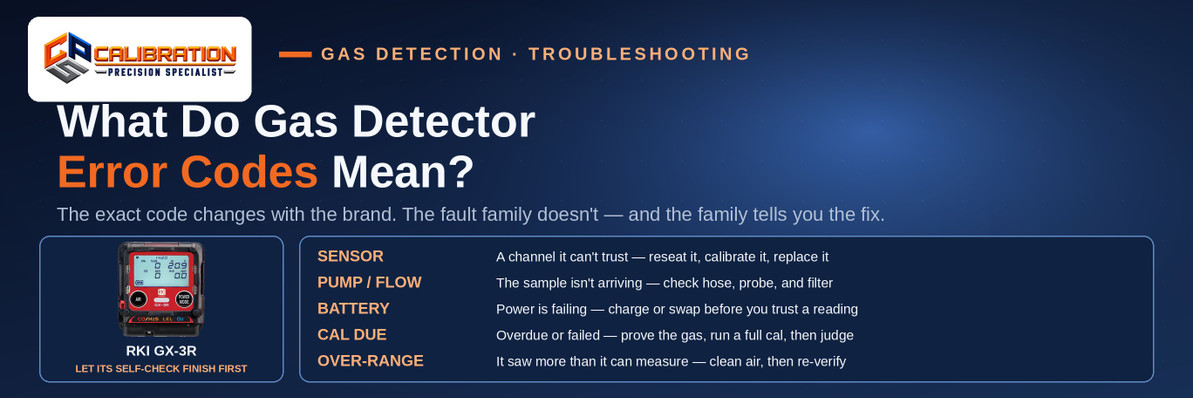
Gas detector error codes have no universal meaning — every brand words and numbers its faults its own way, and the exact code for your instrument is defined in its manual. But every fault falls into one of six families, and the family tells you the fix: a sensor fault is a channel the instrument can't trust (reseat it, calibrate, replace it if it stays); a calibration fault means the instrument is overdue or couldn't make the adjustment (prove the gas, then recalibrate); a pump or flow fault means the sample isn't arriving (clear the line, check the filter); a battery fault means power is failing; an over-range reading means the sensor saw more gas than it can measure (clean air, acknowledge, re-verify); and a temperature fault means the instrument is outside the conditions its sensors can handle. Learn the six families and you can read any fault display on any brand.
The screen is showing a code, a flashing icon, or a word you've never seen, and the manual is two buildings away. This post will not give you a list of codes — no honest list exists outside the manufacturer's own manual, and any website that prints one brand's codes as universal is setting you up to misread your instrument. What it gives you is better: the six fault families every code belongs to, what each means, why it happens, and the field action that clears it. Identify the family and you know most of the repair. For the sounds an instrument makes rather than the words it shows, see our companion post on why a gas detector chirps.
First: Codes Are Dialects, Faults Are Families
Two instruments can show completely different displays for the identical problem — one names the failed sensor at power-on, another shows a generic error in operation. (Our sensor replacement post notes the BW MicroClip: a sensor alarm naming the sensor at startup, "Err" during operation.) The wording is a dialect; the underlying fault is one of a small set of physical stories — a sensor it can't read, a calibration it couldn't complete, a sample that isn't arriving, power that's failing, a sensor overwhelmed, conditions outside its design. Every manufacturer reports from that same short list.
Three reading habits work on every brand:
- Note when it appears. At power-on, it's the self-test reporting. During a bump test or calibration, it's about that process. Mid-shift, it's about the atmosphere or the instrument's state.
- Note which channel. One channel faulted while the others read normally points at that sensor. Every channel faulted together points at something shared — sample path, power, calibration gas — because sensors wear out individually.
- Let it finish telling you. Read the screen before opening a gas valve or pressing buttons — as our post on why bump tests fail puts it, the instrument often tells you what's wrong if you let it finish its self-check.
Family 1: Sensor Fault — a Channel the Instrument Can't Trust
What it means: the instrument cannot get a believable signal from one of its sensors — the channel is missing, unreadable, or producing output the instrument recognises as impossible. This is the fault the power-on self-test exists to catch, and it usually names the channel.
Why it happens: the sensor reached end of life and its output collapsed; it wasn't reseated properly after a swap; the replacement fitted was the wrong sensor for the model (fitting the socket is not the same as being the expected sensor); or it was damaged — flooded with gas far above its range, poisoned, or shocked.
The field action: power down and reseat the sensor. If it was just replaced, confirm it is the correct sensor for that instrument. Then calibrate — a reseated or new sensor must be calibrated before returning to service. If the fault survives a reseat and a correct full calibration, the sensor is finished; on common channels that's a modest part ($121 SENKO, $160 RKI, per our sensor replacement post). What you don't do is clear the fault and carry on.
Family 2: Calibration Faults — Overdue, Failed, or Refused
What it means: this family has three members. Calibration overdue: the instrument is past the calibration interval your program set, and it says so at power-on — some configurations simply nag, others lock the instrument out until it's calibrated. Failed calibration: a calibration ran and the instrument couldn't bring a channel to the certified value. Refused adjustment: the calibration starts but won't complete the adjustment on a channel.
Why it happens: start with the gas, not the sensor. A calibration run on expired gas, the wrong concentration, or a leaking cap fails healthy instruments — our bump test failure post works that checklist in full, and expired gas invalidates the calibrations done with it as surely as it fails them. Zeroing in contaminated air corrupts the calibration from the first step (the dirty-zero mechanism behind negative readings). When the gas and setup are proven, a channel that still can't be adjusted is the classic end-of-life signature: OSHA's guidance names the endpoint — a failing sensor often displays a failure message during calibration or will not allow the reading to be fully adjusted.
The field action: prove the rig first (fresh, in-date gas; correct regulator; sealing cap; clean-air zero), then run the full zero-and-span calibration again. If it completes and holds, the fault was the process. If a channel still won't adjust on a proven rig, that's the sensor — replace it, and the instrument stays out of service until then.
Family 3: Pump and Flow Faults — the Sample Isn't Arriving
What it means: on a pumped instrument, the pump cannot pull the sample flow the instrument expects. Diffusion instruments don't have this family. When it shows, the readings are not necessarily wrong — they are not from where you think they are, which for remote sampling is the same thing.
Why it happens: a kinked or cracked sample hose, a blocked probe or inlet, a filter clogged with dust or soaked with water, or a pump running weak — the same culprits our bump test post lists from the testing side: the instrument can only measure the gas its pump actually pulls in.
The field action: disconnect the hose and probe at the instrument. If the fault clears, the blockage is in the line — work it in sections: probe, filter, hose. Replace a clogged or wet filter rather than blowing it out and hoping. If the fault persists with nothing attached, the pump itself needs the bench. Never defeat or ignore a low-flow alarm: it is the only thing standing between you and a confident reading of the air at the instrument instead of the air at the end of the hose. Pumped technique is covered in how to bump test a gas detector.
Family 4: Battery and Power Faults
What it means: the instrument's power is low, failing, or not charging — a low-battery warning, a charging fault, or an instrument that dies in service or won't complete its self-test.
Why it happens: battery packs are consumables too — they lose capacity with age and cycles until a "full" charge no longer holds a shift; charger contacts get dirty or damaged; and cold weather temporarily steals capacity from a pack that recovers indoors, which is why a detector can fault at dawn in January and seem fine by lunch.
The field action: charge fully on the proper charger and see whether the fault clears and stays cleared through a shift. Clean the contacts. A pack that repeatedly faults or dies early is replaced, not nursed — until the power is trustworthy, neither are the readings, because an instrument that dies mid-entry takes its alarms with it. One that won't power on after a known-good charge has a bench fault. The audible side of this family — the low-battery chirp — is decoded in why your gas detector is chirping.
Family 5: Over-Range — It Saw More Than It Can Measure
What it means: the sensor was exposed to gas above the top of its range. Many instruments latch an over-range indication — deliberately, so the event can't scroll past unnoticed. A latched full-scale reading in clean air is usually not a broken sensor; it's the instrument remembering the worst thing it has seen.
Why it matters after the fact: over-range exposure is also how sensors get hurt. A catalytic LEL sensor left in a high-hydrocarbon atmosphere can come back reading low, or not come back at all; a toxic sensor hit with a massive release can be permanently shifted. An over-range event is two things at once: a display to clear, and a reason to distrust the channel until it's re-verified.
The field action: get the instrument into clean air and let it purge. Acknowledge the latched alarm as the manual specifies. Then — before it works again — bump test it and run a full calibration. Channels that recover fully were overwhelmed, not damaged. Channels that now read low, respond slowly, or won't calibrate took the hit permanently, and they're in Family 1 now: replace the sensor.
Family 6: Temperature and Environmental Faults
What it means: the instrument is being asked to work outside the conditions its sensors can handle — flagged as a temperature fault on some models; on others not flagged at all, just expressed as drift, sluggish response, or a zero that won't settle.
Why it happens: electrochemical sensors respond measurably slower near and below freezing, and all electrochemical and catalytic sensors can drift with swings in temperature and humidity — the manufacturers' and OSHA's calibration guidance both list environmental extremes among the routine causes of drift. Condensation forming in a cold instrument brought into warm, wet air does the rest.
The field action: let the instrument acclimatise where it will be used, then zero it there, in clean air, at working temperature — the fix sequence from our negative readings post. Offsets that appear with a weather swing and clear after acclimatising are the environment talking. Faults that greet you every morning in the same conditions are a pattern, and patterns get benched, not zeroed away daily.
The Decoder, on One Table
| Fault family | What the instrument is telling you | First field actions |
|---|---|---|
| Sensor | One channel can't be trusted — missing, unreadable, or dead | Power down, reseat the sensor; confirm it's the right sensor; calibrate; replace if it stays |
| Calibration | Overdue, failed, or refused — it can't vouch for its own accuracy | Prove the gas and rig; clean-air zero; full zero-and-span calibration; replace the sensor if it won't adjust |
| Pump / flow | The sample isn't arriving at the sensors | Disconnect the line to isolate; clear or replace probe, filter, hose; bench if the bare pump still faults |
| Battery | Power is low, failing, or not charging | Full charge on the proper charger; clean contacts; replace a pack that won't hold a shift |
| Over-range | A sensor saw more gas than it can measure; the event may be latched | Clean air to purge; acknowledge per the manual; bump test and calibrate before trusting it |
| Temperature | It's outside the conditions its sensors can handle | Acclimatise at working temperature; re-zero in clean air there; bench it if it repeats daily |
The One Rule That Outranks the Decoder
Every family above has a field action, and none of them is "clear the message and go to work." A faulted instrument is out of service until it is proven — by a successful self-test, a passed bump test, a completed calibration, whichever proof the fault calls for. A fault means the instrument has detected that one of its own promises — a live sensor, a current calibration, an arriving sample, enough power — may not hold, and those promises are the entire reason it's on your belt. If a fault won't clear with the actions above, or clears and returns, the instrument comes to a bench like ours: CPS's calibration services handle exactly this triage — we calibrate every channel, and when a channel won't calibrate, we tell you which sensor it needs before any money moves. Ship it to the Rockwood lab or call 865-900-8844; the family is usually identifiable in one phone call.
Frequently Asked Questions
What does a sensor fault mean on a gas detector? It means the instrument cannot get a believable signal from one of its sensors — the channel is missing, unreadable, or producing output the instrument recognises as impossible. Sensor faults usually appear at the power-on self-test and usually name the channel. Causes, in order: a sensor not reseated after a swap, the wrong replacement sensor for the model, or a sensor at end of life or damaged by over-range exposure. Power down, reseat, calibrate — if the fault survives a correct full calibration, replace the sensor ($121–$160 on the common SENKO and RKI channels).
Why does my gas detector say calibration is overdue? Because the interval set in its configuration — by your safety program or the previous owner — has run out since its last full calibration. Some instruments warn at power-on; others lock the instrument out until it's calibrated. It is not a sensor diagnosis; it's a date. The fix is a full zero-and-span calibration with in-date gas. If it then fails that calibration, you've moved to a failed-calibration fault — a sensor story, covered next.
Why did my gas detector fail calibration? Work it in this order: the gas, the setup, then the sensor. Expired or degraded calibration gas fails healthy instruments and invalidates the calibrations attempted with it; a wrong concentration or a cap that isn't sealing does the same; a zero taken in contaminated air corrupts the calibration from the start. Only when gas, regulator, cap, and zero are all proven does a failed calibration indict the sensor — OSHA's guidance describes the endpoint: a failing sensor often displays a failure message or will not allow the reading to be fully adjusted, and that instrument comes out of service.
What does a pump fault or low-flow alarm mean? On a pumped instrument, it means the pump can't pull the sample flow the instrument expects — so the air being measured may not be the air at the end of your hose. Usual causes: a kinked or cracked hose, a blocked probe or inlet, or a clogged or water-soaked filter. Disconnect the hose at the instrument: if the fault clears, the blockage is in the line — work it in sections. Never bypass a low-flow alarm; it's the safeguard that tells you remote readings came from the remote location.
Why does my gas detector show an error at startup? Because the power-on self-test is doing its job. At startup the instrument checks its sensors, battery, and configuration, and a fault on screen is the self-test reporting what it found — commonly a sensor fault, a calibration-overdue flag, or a weak battery. Read the whole message before pressing anything: startup is when the instrument gives its most specific information, often naming the faulted channel. One that doesn't boot clean needs the bench or a sensor, not a restart-and-hope.
What does an over-range reading on a gas detector mean? It means a sensor was exposed to more gas than the top of its measuring range. Many instruments latch the indication until it's acknowledged, on purpose — the event can't be missed. Take the instrument to clean air, let it purge, acknowledge it as the manual directs, then bump test and fully calibrate before trusting it: over-range exposure can permanently damage a sensor (an LEL sensor flooded with hydrocarbons may come back reading low or not at all), so the channel must re-prove itself, not just clear its display.
Can I keep using a gas detector that is showing a fault? No. A fault is the instrument reporting that it cannot vouch for itself — a channel it can't read, a calibration it couldn't complete, a sample that isn't arriving, power that may not last the shift. Using it anyway means working behind readings that may be wrong in the direction that hides gas. It stays out of service until the fault is cleared and it is re-proven with a bump test or calibration. If the fault won't clear in the field, it's a bench repair or a sensor replacement, not a judgment call.
What does a low battery fault mean on a gas detector? That the instrument's power is low, not charging, or no longer holding a charge — a real fault, because an instrument that dies mid-shift takes its alarms with it. Charge fully on the proper charger and clean the contacts; cold weather temporarily shrinks capacity, so a dawn fault in winter deserves a warm recharge before condemnation. A pack that repeatedly faults or won't hold a shift is at end of life and gets replaced. The chirp that usually accompanies it is decoded in our post on why gas detectors chirp.
Why is only one channel of my gas detector faulting? Because sensors live and die individually. Each channel is a separate sensor with its own exposure history and remaining life, so a single-channel fault — one sensor erroring while the others read and calibrate normally — is the classic signature of that sensor failing: end of life, poisoning, or over-range damage. The pattern cuts both ways: when all channels fault together, suspect something shared — calibration gas, sample path, or power — because healthy sensors rarely all fail on the same morning.
Where can I find what my gas detector's error code actually means? In the operating manual for your exact model — the one authoritative source, because every manufacturer words and numbers its faults differently and no universal code list exists. Read the code through its family first (sensor, calibration, pump, battery, over-range, temperature), then confirm specifics in the manual's fault table. If the manual is long gone, manufacturers publish them by model, and a calibration bench can usually identify a fault from the instrument and message in front of them — CPS does it at 865-900-8844.
The Bottom Line
An error code is a dialect, but the fault underneath it is one of six stories: a sensor the instrument can't trust, a calibration that's overdue or couldn't be made, a sample that isn't arriving, power that's failing, a sensor that's been overwhelmed, or conditions outside the design. Read for the family and you know the field action — reseat, recalibrate, clear the line, charge, purge and re-verify, acclimatise — and the stopping rule too: a fault that survives its family's fix is a bench problem, and the instrument stays out of service until it's proven, not until it's quiet.
Detector showing a fault you can't clear? Call 865-900-8844 with the instrument in front of you, or reach us through Contact Us — and if it needs the bench, ship it to the lab or book through Calibration Services. Browse instruments and parts in Portable Gas Detection.
CPS Calibrations · 109 S. Front Street, Rockwood, TN 37854 · Calibration Gas · Calibration Services · Contact Us
Need a calibration you can file?
In-house calibration at CPS in Rockwood, Tennessee — $55 for single-gas instruments, $90 for 4- and 5-gas — every channel, as-found and as-left data, full certificate.
See Calibration Servicesor call 865-900-8844
Recent Posts
-

What Is Remote Monitoring for Fixed Gas Detection?
Remote monitoring for fixed gas detection means a fixed system's live readings, trends, and alarm hi …Nov 23rd 2026 -

What Are the Key Differences Between the GX-6000 and GX-6100?
The RKI GX-6100 is the current replacement for the discontinued GX-6000: both are pumped 6-gas monit …Nov 22nd 2026 -

How to Read a PID Correction Factor Chart
To read a PID correction factor chart, find your vapor’s row, take the factor under your own lamp en …Nov 21st 2026