
What Gas Detection Does an Auto Plant Need?
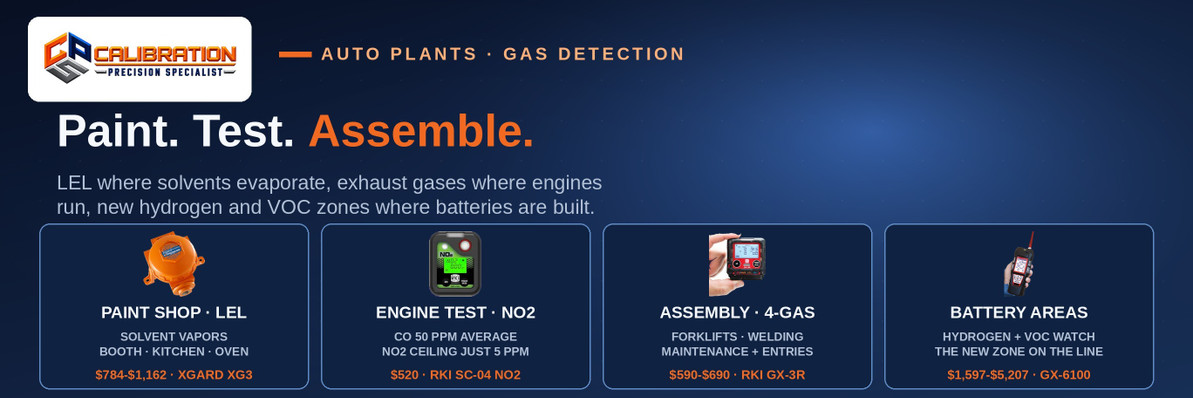
An auto plant needs combustible-gas (LEL) detection in the paint shop, where solvent vapors are the fire load; carbon monoxide and nitrogen dioxide monitoring at engine test and dyno cells, where exhaust is the product (OSHA limits: CO 50 ppm average, NO2 5 ppm ceiling); hydrogen and VOC awareness in battery assembly areas; and standard 4-gas monitors for the forklift, welding, and maintenance work that runs underneath it all. Assembly plants and the supplier plants around them — East Tennessee's corridor included — run the same five zones with the same five answers.
An auto plant is five different gas problems sharing one roof and one safety department. Paint thinks in percent LEL, engine test thinks in ppm of exhaust, and the battery area is quietly becoming a gas-detection zone of its own. This hub walks the zones; the battery side gets its own deep dive in battery gigafactories: the new gas hazards in EV manufacturing.
What Gases Does an Auto Plant Monitor, Zone by Zone?
| Zone | Main gases to monitor | Why |
|---|---|---|
| Paint shop and paint kitchens | Combustible gas (LEL) — solvent vapors | Spray booths, mixing rooms, and ovens handle flammable coatings and solvents continuously |
| Engine test / dyno cells | Carbon monoxide (CO), nitrogen dioxide (NO2) | Engines under test produce exhaust in an enclosed cell; NO2's ceiling limit is only 5 ppm |
| Vehicle and component assembly | CO (material-handling exhaust), general 4-gas for maintenance | Combustion forklifts and tuggers work indoors all shift |
| Battery assembly and storage areas | Hydrogen (H2), VOCs | Charging and forming steps can off-gas hydrogen; electrolyte and adhesives contribute solvent vapors |
| Welding and body shop | Oxygen displacement watch, CO | Shielding gases displace air in pits and enclosed fixtures; processes add fume and CO load |
| Wastewater, pits, and confined spaces | O2, LEL, CO, H2S (standard 4-gas) | Sumps, pits, and tanks are entered under permit like any industry's |
East Tennessee runs this exact map at supplier scale — the Maryville–Alcoa–Knoxville corridor's parts plants, including DENSO's long-standing Maryville operation, paint, test, mold, and assemble components with the same paint-shop, test-cell, and materials-handling hazards as a full assembly plant, just with different nameplates over the door.
Why Does the Paint Shop Think in Percent LEL?
Because its hazard is fire, not poisoning. Solvent-borne coatings, reducers, and cleaning solvents evaporate continuously in mixing kitchens, booths, and cure ovens, and the control strategy is dilution: ventilation holds vapor concentration at a fraction of the lower explosive limit, and fixed LEL detectors prove it is working and alarm before the fraction climbs. That is a fixed-detector job — transmitters of the Crowcon Xgard XG3 class (configured $784–$1,162) at booth, kitchen, and oven points, tied into ventilation and shutdown logic. Two honest limits: an LEL sensor reports flammability, not toxicity — solvent exposure for the painter is a separate assessment — and catalytic LEL sensors need oxygen and can be dulled by some paint-shop vapors, which is why their calibration checks are not optional paperwork. Siting and integration follow the fixed system installation process.
What Does Engine Test Need That Assembly Does Not?
Exhaust monitoring. A dyno or hot-test cell runs engines indoors, on purpose, at load — so CO and NO2 are present by design, held in check by cell ventilation that has to be verified, not assumed. The limits explain the pairing: CO's OSHA limit is a 50 ppm 8-hour average, but NO2 works on a 5 ppm ceiling (NIOSH recommends a 1 ppm short-term limit) — NO2 is the channel that punishes a ventilation failure first. Fixed CO/NO2 points in and around cells cover the room; a dedicated NO2 instrument like the RKI SC-04 nitrogen dioxide monitor ($520) covers the technician doing leak checks, cell entry after a trip, and troubleshooting at the tailpipe. The standard plant workhorse — a 4-gas monitor like the RKI GX-3R ($590–$690) — still covers the CO side and the maintenance rounds; see portable multi-gas monitors for the range.
What About Battery Assembly and the Rest of the Plant?
Battery pack assembly brings a newer zone map: charging and any formation-adjacent steps can release hydrogen, electrolyte filling and sealing involve flammable solvent vapors best surveyed as VOCs, and stored packs carry the thermal-runaway question covered in the battery gigafactory post. A pumped PID instrument like the RKI GX-6100 (configured $1,597–$5,207) is the survey tool that maps those vapors before anyone decides where fixed points belong. Underneath the headline zones, the everyday plant still runs on the 4-gas basics: combustion forklifts loading CO into enclosed aisles, shielding-gas displacement in welding pits, and permit entries into sumps and tanks — all standard LEL/O2/CO/H2S work for the maintenance fleet.
Every zone shares one dependency: calibration. A paint-shop LEL point drifting low and a test-cell NO2 channel drifting high fail in opposite directions and both fail silently. We calibrate every channel — ship portables to our Rockwood, Tennessee shop or have fixed points serviced on site under written quote — through calibration services, with fleet due dates tracked under the CPS Calibration Program.
Frequently Asked Questions
What gas detection does an auto plant need?
Combustible-gas (LEL) detection for solvent vapors in the paint shop and paint kitchens; carbon monoxide and nitrogen dioxide monitoring at engine test and dyno cells (OSHA: CO 50 ppm average, NO2 5 ppm ceiling); hydrogen and VOC monitoring in battery assembly and storage areas; and standard 4-gas monitors (LEL, O2, CO, H2S) for forklift areas, welding, and confined-space maintenance across the plant.
Why does a paint shop need LEL detectors?
Paint shops evaporate flammable solvents continuously — in mixing kitchens, spray booths, and cure ovens — and the safety strategy is to hold vapor concentration at a safe fraction of the lower explosive limit with ventilation. Fixed LEL detectors verify the ventilation is doing that, alarm if the fraction climbs, and can interlock with shutdown logic. They measure flammability, not toxicity, so painter exposure assessment is a separate program.
What gases are monitored in an engine test cell?
Carbon monoxide and nitrogen dioxide — the two regulated toxic gases in engine exhaust — because test cells run engines indoors at load by design. CO's OSHA limit is 50 ppm as an 8-hour average; NO2's is a 5 ppm ceiling with a NIOSH recommended short-term limit of 1 ppm, which makes NO2 the channel most sensitive to a ventilation failure. Cells typically combine fixed room points with portable instruments for troubleshooting and entry.
What is the OSHA limit for nitrogen dioxide?
A 5 ppm ceiling — the concentration must not be exceeded at any time. NIOSH recommends a 1 ppm short-term (15-minute) limit. That is far tighter than CO's 50 ppm average, which is why engine test, diesel maintenance, and similar exhaust-in-a-room work monitors NO2 as its own channel (for example, the RKI SC-04 NO2 monitor at $520) rather than assuming a CO reading covers it.
Do auto plants need gas detection for EV battery work?
Yes — battery assembly, charging, and storage add hydrogen (released in charging and formation-type steps, flammable from 4% by volume), electrolyte solvent vapors (flammable VOCs, surveyed with PID instruments), and thermal-runaway off-gas risk in storage areas. The full zone-by-zone picture is in the CPS post on battery gigafactory gas hazards; conventional plants adding a battery line usually add fixed points in the new area rather than reworking the whole plant.
What monitors do auto plant maintenance crews carry?
A standard 4-gas monitor — LEL, oxygen, carbon monoxide, hydrogen sulfide — is the maintenance default for permit entries, pit and sump work, and general rounds; the RKI GX-3R (configured $590–$690) is a typical example. Task-specific instruments layer on top: single-gas NO2 or CO monitors for test-cell work, and pumped PID instruments for solvent and leak surveys.
Are supplier plants' gas hazards different from an assembly plant's?
The zones are the same; the mix shifts. A supplier plant may paint or mold without an engine-test cell, or run battery-component work without a paint shop — but each operation it does run carries the same monitoring answer as the assembly plant's version. East Tennessee's supplier corridor around Maryville, Alcoa, and Knoxville is a good example: many plants, each running a subset of the same five zones.
How often do paint shop LEL detectors need calibration?
On the manufacturer's schedule for the transmitter, verified with calibration gas — and the checks matter more in paint service than almost anywhere, because catalytic LEL sensors can be dulled by some vapors common around coatings. A detector that reads low in a solvent atmosphere is worse than none, because the ventilation decisions are being made from its numbers. Due dates should be tracked per point, not per plant memory.
Can one fixed system cover both the paint shop and the test cells?
The controller and alarm infrastructure can be shared, but the sensing is different technology per zone: catalytic or infrared LEL points for solvent flammability in paint, electrochemical CO and NO2 points for exhaust toxicity at test. Specifying one system across zones is normal; specifying one sensor type across zones is not — each zone's gas list drives its own detector selection.
How much does it cost to calibrate an auto plant's gas detectors?
At CPS Calibrations, in-house calibration is $55 for a single-gas instrument and $90 for a 4- or 5-gas instrument, with ship-in billed at the same rates — a practical route for portable fleets. Fixed points in paint shops and test cells are calibrated on site at your facility, quoted in writing, and cost more than bench calibration.
The Bottom Line
An auto plant is five gas problems in one building: LEL in the paint shop, CO and NO2 at engine test, hydrogen and VOCs arriving with battery work, and 4-gas basics underneath everything. Match the detector to the zone — fixed LEL points where solvents evaporate, toxic channels where exhaust is made, portables where people work — and keep every channel on a tracked calibration cycle.
Mapping gas detection for a plant or a new line? Call CPS Calibrations at 865-900-8844 — monitors, fixed systems, and calibration from Rockwood, Tennessee, in the middle of East Tennessee's supplier corridor.
Need a calibration you can file?
In-house calibration at CPS in Rockwood, Tennessee — $55 for single-gas instruments, $90 for 4- and 5-gas — every channel, as-found and as-left data, full certificate.
See Calibration Servicesor call 865-900-8844
Recent Posts
-

What Is Remote Monitoring for Fixed Gas Detection?
Remote monitoring for fixed gas detection means a fixed system's live readings, trends, and alarm hi …Nov 23rd 2026 -

What Are the Key Differences Between the GX-6000 and GX-6100?
The RKI GX-6100 is the current replacement for the discontinued GX-6000: both are pumped 6-gas monit …Nov 22nd 2026 -

How to Read a PID Correction Factor Chart
To read a PID correction factor chart, find your vapor’s row, take the factor under your own lamp en …Nov 21st 2026