
Battery Gigafactories: The New Gas Hazards in EV Manufacturing
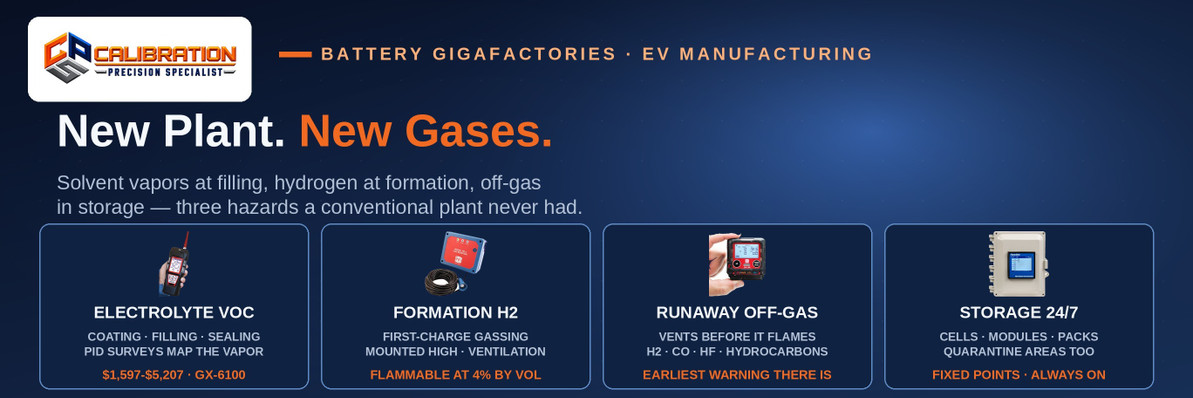
A battery gigafactory adds three gas hazards a conventional plant does not have: flammable electrolyte solvent vapors in mixing, coating, and filling (surveyed as VOCs and guarded as LEL), hydrogen released during formation and aging — the first-charge steps where cells are also at their most gassing-prone — and thermal-runaway off-gas in cell and pack storage, where a failing cell vents hydrogen, carbon monoxide, hydrogen fluoride, and hydrocarbon gases before it flames. The detection stack is layered to match: PID surveys for solvents, fixed hydrogen and LEL points in formation and storage, and off-gas thinking wherever finished cells wait.
A gigafactory looks like a very clean, very large assembly plant — until the process steps are read as a gas list. The chemistry that stores the energy is handled wet, charged for the first time under one roof, and warehoused by the megawatt-hour. Each stage has its own gas signature, and none of them is covered by the forklift-and-furnace monitoring a traditional plant already owns. The storage-side hazard is shared with stationary batteries — see thermal runaway in data center battery rooms — and the assembly context sits inside what gas detection does an auto plant need?
What Are the Three Gas Zones in a Gigafactory?
| Zone | Gases | Detection answer |
|---|---|---|
| Electrode coating, electrolyte filling, sealing | Solvent vapors (VOCs) — flammable electrolyte solvents | PID surveys to map vapor; fixed LEL points where vapor is continuous |
| Formation and aging | Hydrogen (H2), solvent VOCs | Fixed H2 / LEL points with ventilation interlock thinking; H2 is flammable from 4% by volume |
| Cell, module, and pack storage; test and quarantine areas | Thermal-runaway off-gas: H2, CO, HF, hydrocarbons | Fixed off-gas-capable points (H2/LEL and CO channels) at storage and quarantine, alarmed early |
| Plant-wide support | CO, O2 displacement, standard 4-gas hazards | The conventional fleet: forklifts, utilities, confined spaces |
Why Are Electrolyte Solvents a Gas-Detection Problem?
The electrolyte inside a lithium-ion cell is a lithium salt carried in flammable organic solvents. In slurry mixing, coating, and especially electrolyte filling, those solvents are open to plant air in process quantities — evaporating as VOCs that are simultaneously a worker-exposure question and a flammability load. Neither a plain LEL point nor a toxicity limit alone describes them well, which is why the working tool is the photoionization detector (PID): a pumped PID instrument like the RKI GX-6100 (configured $1,597–$5,207) reads solvent vapor in ppm, maps where it actually accumulates, and tells the design where fixed points earn their keep. An honest limit: a PID reports total ionizable vapor, not a named solvent — it is a survey and alarm tool, and compound-specific exposure assessment is laboratory work.
Why Does Formation and Aging Release Hydrogen?
Formation is the first controlled charging of a finished cell, and aging holds cells at charge while they are observed and graded. These steps condition the cell's internal surfaces, and gassing is part of early cell life: gases generated inside cells — hydrogen among them — are vented or accumulate in the headspace and are released in handling, degassing steps, and any cell failure. Hydrogen is the awkward gas in any room: flammable from just 4% by volume in air, ignitable by very little energy, and happy to pool at ceilings because it is far lighter than air. Formation and aging halls therefore get fixed hydrogen-capable points mounted high, tied to the ventilation that is the real control — detection's job is to prove the ventilation is winning and to alarm the moment it is not. Fixed points in this service follow the fixed system installation pattern: surveyed placement, control-room alarming, documented calibration.
What Is Thermal-Runaway Off-Gas — and Why Is Storage the Watch Point?
Thermal runaway is a cell's self-heating failure cascade. Before flame — sometimes well before — a failing cell vents gas: hydrogen, carbon monoxide, carbon dioxide, hydrocarbon gases such as methane and ethylene, electrolyte vapor, and hydrogen fluoride among the toxic products. That vent gas is the earliest reliable signal a stored cell is going wrong, and in an enclosed storage or quarantine area it is also a hazard in itself: flammable in aggregate and toxic in detail. This is why finished-cell, module, and pack storage — and especially the quarantine area where suspect cells are sent — is treated as a monitored zone with fixed points reading the flammable and CO channels, not as a warehouse with sprinklers and hope. The same off-gas logic protects stationary installations, covered in thermal runaway in data center battery rooms and the wider picture in what gas detection does a data center need? A limit worth stating plainly: gas detection warns early — it does not stop a runaway already in progress, and it layers alongside cell spacing, quarantine practice, and suppression rather than replacing them.
Calibration is heavier here, not lighter. PID lamps foul, hydrogen sensors live in the rooms they protect, and a storage off-gas point that has drifted is a promise the plant is keeping to itself. We calibrate every channel — portables shipped to our Rockwood, Tennessee shop, fixed points serviced on site under written quote — through calibration services, with due dates tracked under the CPS Calibration Program. The everyday fleet is the usual one — portable multi-gas monitors for maintenance and entry work — with the PID instruments layered on top for the battery-specific zones.
Frequently Asked Questions
What gas hazards are in a battery gigafactory?
Three battery-specific ones: flammable electrolyte solvent vapors in coating and filling (handled as VOCs and LEL), hydrogen released during formation and aging (flammable from 4% by volume), and thermal-runaway off-gas — hydrogen, carbon monoxide, hydrogen fluoride, and hydrocarbon gases — from failing cells in storage, test, and quarantine areas. The conventional plant hazards (forklift CO, confined spaces, utilities) exist on top of those.
Why is hydrogen monitored in battery formation areas?
Formation — the first charging of a finished cell — and the aging that follows it are gassing steps in early cell life, and hydrogen is among the gases released in venting, degassing, and cell failures. Hydrogen ignites at just 4% by volume in air and rises to pool at ceilings, so formation and aging halls use fixed hydrogen-capable detection mounted high, backing up the ventilation that does the actual control work.
What gases come out of a battery in thermal runaway?
A venting cell releases a mix that includes hydrogen, carbon monoxide, carbon dioxide, hydrocarbon gases such as methane and ethylene, electrolyte solvent vapor, and hydrogen fluoride. The mix is flammable in aggregate and toxic in detail, and it typically appears before flame — which is why off-gas detection in storage and quarantine areas is treated as the earliest warning layer.
Can a PID detector detect battery electrolyte vapors?
Yes, as total VOC. Electrolyte solvents are ionizable organic vapors, and a photoionization detector (for example, the pumped RKI GX-6100, configured $1,597–$5,207) reads them in ppm for surveys, leak hunting, and deciding where fixed points belong. The honest limit: a PID does not identify which solvent it is reading, so compound-specific exposure assessment still requires sampling and laboratory analysis.
Do battery storage areas in a factory need gas detection?
Yes — finished cells, modules, and packs in storage hold the plant's largest concentration of stored energy, and a cell that begins to fail vents flammable, toxic off-gas before it flames. Fixed points reading flammable-gas and carbon monoxide channels in storage and quarantine areas convert that venting into an early alarm. Detection warns; it does not stop a runaway, so it layers with spacing, quarantine practice, and suppression.
What is the difference between gigafactory gas detection and a normal auto plant's?
A normal auto plant monitors paint-shop LEL, engine-test CO and NO2, and general 4-gas hazards. A gigafactory keeps most of that list and adds process chemistry: solvent VOCs at coating and filling, hydrogen at formation and aging, and off-gas watch over stored cells. The overlapping map is laid out in the CPS post on what gas detection an auto plant needs; the battery-specific layers are the additions described here.
Where should hydrogen detectors be mounted in a formation hall?
High. Hydrogen is much lighter than air and accumulates at ceilings and in roof pockets, so formation and aging detection is mounted above the process, near likely release points and collection zones — the mirror image of pits-and-floors thinking used for heavier gases. Exact placement follows a survey of the room's airflow and vent paths, since a detector outside the gas's actual path reads clean air during a real release.
Does gas detection prevent thermal runaway?
No — and any vendor implying otherwise should be pressed. Detection cannot stop the internal failure cascade inside a cell. What it does is catch the vent gas that precedes flame, buying the minutes in which ventilation, isolation, quarantine response, and evacuation work. Prevention lives in cell quality, battery management, spacing, and storage practice; detection is the early-warning layer over all of it.
How often do PID and hydrogen sensors need calibration?
On the manufacturer's interval for each instrument — commonly every 6 months for portable PID instruments, with lamp cleaning and checks more often in continuous solvent service, because a fouled PID lamp reads low without complaining. Fixed hydrogen and off-gas points follow their transmitter schedules. Every channel's due date should be tracked per instrument; fleets this size outgrow memory-based systems quickly.
How much does it cost to calibrate gigafactory gas detectors?
At CPS Calibrations, in-house calibration is $55 for a single-gas instrument and $90 for a 4- or 5-gas instrument, with ship-in billed at the same rates. Larger multi-gas and PID instruments and fixed-system points are quoted by configuration — fixed points are calibrated on site at your facility under a written quote, which costs more than bench work.
The Bottom Line
Gigafactories industrialize a chemistry, and the gas program has to match: solvent VOCs where electrolyte is open, hydrogen where cells are formed and aged, and off-gas watch where finished energy is stored. Survey with PID, fix hydrogen and off-gas points where the process runs unattended, and calibrate every channel on a tracked cycle — the earliest warning in the building is only real if the sensor reading it is true.
Designing detection for a battery plant, a new formation hall, or a storage area? Call CPS Calibrations at 865-900-8844 — instruments, fixed systems, and calibration from Rockwood, Tennessee.
Need a calibration you can file?
In-house calibration at CPS in Rockwood, Tennessee — $55 for single-gas instruments, $90 for 4- and 5-gas — every channel, as-found and as-left data, full certificate.
See Calibration Servicesor call 865-900-8844
Recent Posts
-

What Is Remote Monitoring for Fixed Gas Detection?
Remote monitoring for fixed gas detection means a fixed system's live readings, trends, and alarm hi …Nov 23rd 2026 -

What Are the Key Differences Between the GX-6000 and GX-6100?
The RKI GX-6100 is the current replacement for the discontinued GX-6000: both are pumped 6-gas monit …Nov 22nd 2026 -

How to Read a PID Correction Factor Chart
To read a PID correction factor chart, find your vapor’s row, take the factor under your own lamp en …Nov 21st 2026