
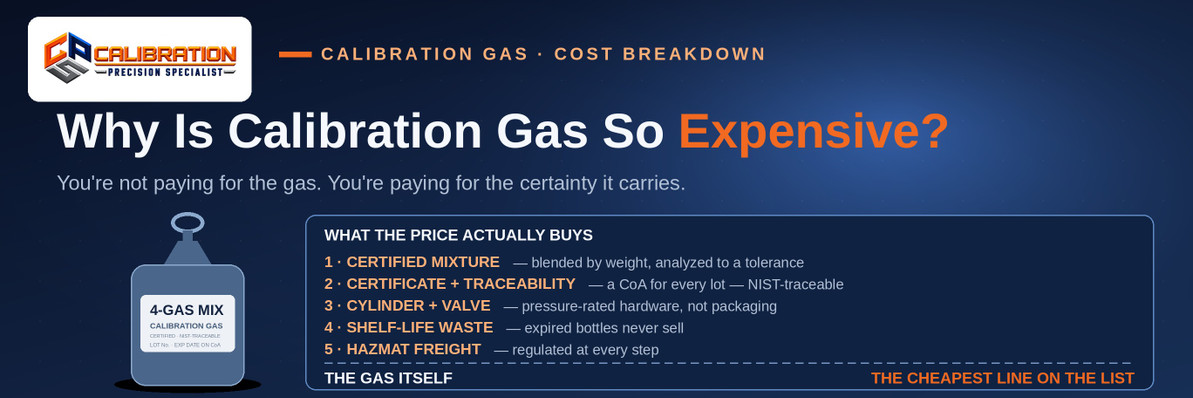
Why Is Calibration Gas So Expensive?
Calibration gas is expensive because almost none of the price is the gas itself: you are paying for a certified, NIST-traceable mixture — blended and analyzed to a stated tolerance — in a pressure-rated cylinder, with a certificate of analysis behind every lot and hazmat freight on every shipment. Spread over the work a bottle actually does, the math flips: CPS's 34L four-gas cylinder at $195 delivers about 45 full calibrations on a standard 0.5 L/min regulator, which works out to roughly $4.33 of gas per calibration — and the 120L cylinder brings that same calibration down to about $1.84.
It is the most reasonable complaint in gas detection. The bottle is small enough to hold in one hand, the gas inside is made of some of the most common substances on earth — methane, carbon monoxide, a little hydrogen sulfide, some oxygen, nitrogen — and the price tag reads like you bought the cylinder, the truck, and part of the factory. So where does the money actually go? This post breaks the price down layer by layer. No invented numbers: the only dollar figures in it are prices and worked examples already published on this site, and we'll show the math wherever a figure appears.
What Are You Actually Buying? A Standard, Not a Commodity
The first misunderstanding is thinking of calibration gas as gas. A welding shop buys argon or acetylene by the cylinder too, and pays far less per liter — but what the welding shop buys is a substance. Nobody certifies that a welding cylinder holds exactly 25.0 ppm of anything, because nothing depends on it.
What you buy in a calibration cylinder is a claim with paperwork: this bottle holds hydrogen sulfide at 25 ppm, carbon monoxide at 50 ppm, methane at 50% of its lower explosive limit, and oxygen at 12% — and the maker will state, in writing, lot by lot, how close to those numbers the contents actually are, with the values traceable back to national reference standards. A gas detector calibration is only as trustworthy as the gas used to perform it; span an instrument with a mixture that's off by 20% and the instrument will be off by 20% everywhere it goes, reading wrong with total confidence. The certification isn't decoration on the product. The certification is the product. Everything below is what producing that claim costs.
Layer 1: The Blend — Precision Is the Expensive Part
A four-gas calibration mixture is four (usually five, counting the balance) components that have to land at wildly different concentrations in the same cylinder: methane in whole percent, oxygen in whole percent, carbon monoxide in tens of parts per million, hydrogen sulfide in tens of parts per million. Parts per million is the scale to keep in mind — 25 ppm hydrogen sulfide means 25 molecules out of every million, blended evenly and staying blended.
Producing that accurately is not opening valves until a gauge looks right. Calibration mixtures are prepared gravimetrically — each component is added by weight, on precision balances, in sequence — and then the finished mixture is analyzed and compared against reference standards to confirm what actually ended up in the cylinder. The weighing, the high-purity source gases, the blending equipment, and the analyst's time are spread across a production run, and calibration-gas runs are small next to commodity gas production. A commodity gas plant amortizes its costs over tons of product. A specialty blend amortizes the same kind of careful labor over a lot of cylinders you could carry in a pickup.
Layer 2: The Analysis and the Certificate Behind Every Lot
Blending carefully isn't enough — the mixture has to be proven. Each production lot is analyzed, and each lot gets its own certificate of analysis: the document that states the certified concentration of every component, the lot number, and the expiration date. CPS's calibration gas is NIST-traceable, produced under ISO/IEC 17025:2017 and ISO 17034:2016 quality systems, and on ISG cylinders the QR code on the bottle opens that cylinder's own CoA and Safety Data Sheet.
That certificate is doing real work in your safety program. When an auditor, an insurer, or an incident investigator asks what standard your instruments were calibrated against, the CoA is the answer — which is why we wrote a whole post on how to read a calibration gas certificate of analysis. Reference standards, laboratory instruments, quality systems, and the people who run them all cost money, and none of them are optional if the certificate is going to mean anything. A cheaper bottle without that chain behind it isn't the same product at a lower price; it's an uncertified guess in the same-shaped bottle.
Layer 3: The Cylinder Is Hardware, Not Packaging
The bottle itself is a pressure vessel: a steel or aluminum cylinder built and rated to hold gas at high pressure, fitted with a CGA valve matched to the mixture, capped, labeled, and — for the disposable sizes most portable-detector programs use — not designed to come back for a refill. On a small cylinder, that hardware is a substantial share of what you're paying for before a single molecule goes in. (The regulator on top is at least a one-time purchase you keep: CPS's C-10 fixed-flow regulator is $130 and serves bottle after bottle.)
The cylinder costs more for the difficult gases, too. Reactive components — hydrogen sulfide, chlorine, sulfur dioxide, ammonia — interact with the cylinder walls they're stored against, which is why those mixtures go into aluminum cylinders with treated interior surfaces and carry the shortest shelf lives. The container for a reactive mixture is part of the chemistry, and it's priced like it.
Layer 4: Small Batches of Difficult Chemistry
Commodity gases are cheap partly because they're made in enormous, continuous quantities of substances that sit still and behave. Calibration mixtures are the opposite business: dozens of different recipes — single gases, four-gas and five-gas blends, concentrations specified detector-family by detector-family — each produced in comparatively small lots, many of them containing components that are toxic, corrosive, or both.
Every recipe is its own production run, its own analysis, its own certificate, its own inventory slot. A slow-moving specialty mixture might sell a handful of cylinders a month across the whole country, but it costs the same blending and analysis effort as the best-selling quad mix. That long tail of low-volume mixtures is a real part of the price structure: the popular bottles effectively help carry the obscure ones your particular instrument happens to need.
Layer 5: Shelf Life — the Bottles That Never Get Sold
Every calibration cylinder has an expiration date, and expired gas is worthless gas: as we covered in can you use expired calibration gas, once a mixture is out of date its certified values can't be trusted — reactive components are exactly the ones that degrade — and it can't be used for a defensible calibration.
Now run that fact backward through the supply chain. Producers blend a lot sized to expected demand, and distributors stock cylinders so yours ships today — but demand for any given mixture is lumpy, and every bottle still on a shelf when its date arrives is a total loss: blending, analysis, cylinder, and freight, all written off. That waste is a predictable cost of making fresh, in-date gas available on short notice, and like every predictable cost in a supply chain, it's carried in the price of the bottles that do sell. It's also why the biggest bottle isn't automatically the smartest buy, which we'll get to below.
Layer 6: Hazmat Freight on Every Shipment
A calibration cylinder is a pressurized container of, frequently, flammable and toxic gases — which makes every shipment, from the producer to the distributor and from us to you, regulated hazmat freight. Regulated freight costs more than ordinary parcel shipping at every step: compliant packaging, labeling, carrier restrictions, and handling by people certified to handle it. That cost is baked into calibration gas prices industry-wide, because there is no legal version of shipping these cylinders cheaply as ordinary freight.
One point of honesty about our own store: CPS does not add a hazmat fee at checkout — there's no hazmat line item on a CPS order, and nothing is collected from you for it. We absorb that cost on our side. When we say freight is part of why calibration gas costs what it costs, we mean it's a real cost inside the price of the product across this industry — not a surprise charge waiting for you at checkout here.
The Reframe: Judge It per Calibration, Not per Bottle
Here's the math that changes how the price feels — and it's worked out in full in our post on how many calibrations you get from a 34L, 58L, or 103L cylinder. The standard assumptions: a 0.5 L/min fixed-flow regulator — the most common rate for portable detectors — and 90 seconds of gas per full calibration.
- 34L four-gas cylinder — $195. At 0.5 L/min, 34 liters is 68 minutes of flow, and at 90 seconds per calibration that's about 45 calibrations — roughly $4.33 of gas each.
- 120L four-gas cylinder — $295. About 160 calibrations at the same assumptions — about $1.84 of gas each.
Bump tests stretch it further, because a bump flows gas for about 30 seconds instead of 90. And set those per-calibration gas costs against the calibration itself: as our breakdown of how much gas detector calibration costs lays out, sending an instrument to CPS costs $55 for a single-gas unit and $90 for a 4- or 5-gas unit, most of it labor, documentation, and turnaround — the gas inside a do-it-yourself program, at a few dollars per calibration, is the smallest line in the whole exercise. The bottle feels expensive because you buy a year's worth of standard in one transaction. Per use, it's one of the cheapest safety consumables you own.
How to Stop Wasting Money on Calibration Gas
The price is the price — but a surprising share of what programs spend on gas is waste:
- Size the bottle to your test volume, not your storage shelf. The 120L wins per calibration only if your calibration count uses it before it expires. A half-used big bottle that goes out of date costs more per calibration than a fully used 34L. Match the size to the fleet, using the per-cylinder counts in our cylinder math post.
- Don't drain bottles doing nothing. Gas flows at the regulator's full rate whenever the valve is open. At 0.5 L/min, a 34L cylinder left cracked open is empty in 68 minutes — whether or not an instrument was ever attached. Close the valve, every time.
- Buy the mixture that does both jobs. A proper calibration mixture can also bump test — the concentrations that span an instrument will challenge it — so most programs don't need separate bottles. We worked through that in bump test gas vs. calibration gas.
- Standardize the fleet's mixtures where you can. Every distinct recipe is another bottle to stock, track, and risk expiring. Fewer mixtures, used faster, means less shelf-life waste.
- Check the date when the bottle arrives, and keep the CoA. Your usable window starts ticking from production, not from delivery. Note the expiration, file the certificate with your calibration records, and rotate stock so the oldest bottle is used first.
Frequently Asked Questions
Why is calibration gas so expensive? Because the gas itself is a small part of what you're buying. The price covers a certified mixture blended and analyzed to a stated tolerance, values traceable to NIST, a pressure-rated cylinder and valve, a certificate of analysis for the lot, the waste from bottles that expire unsold, and hazmat freight at every step. Divided by the work the bottle does — about 45 calibrations from a 34L cylinder at standard rates — it works out to roughly $4.33 of gas per calibration.
Why does such a small bottle of gas cost so much? Because small is exactly the problem for the hardware share: the cylinder, valve, blending labor, analysis, and certificate cost roughly what they cost regardless of size, so on a 34L bottle those fixed costs sit on 34 liters of product. Bigger cylinders spread the same fixed costs over more gas — a 120L four-gas cylinder at $295 brings the cost down to about $1.84 per calibration, versus roughly $4.33 from a 34L at $195.
Is calibration gas just regular gas in a smaller bottle? No. Commodity gas — welding argon, fuel gases, bulk nitrogen — is sold as a substance, with no certified ppm-level values behind it. Calibration gas is sold as a measurement standard: every lot is analyzed, its component concentrations are certified in writing, and the values are traceable to national reference standards. Calibrating with uncertified gas would make the calibration unverifiable — the instrument would read whatever the gas told it to read, right or wrong.
What am I actually paying for when I buy calibration gas? Five things, roughly in this order: the certified mixture (precision blending plus laboratory analysis), the certificate and traceability chain behind it, the cylinder and valve, the producer's and distributor's shelf-life losses on expired stock, and regulated hazmat freight. The raw gases — methane, nitrogen, air — are commodity-cheap. The certainty is what's priced.
Does calibration gas come with a certificate? It should, and CPS's does: every lot carries a certificate of analysis stating the certified concentration of each component, the lot number, and the expiration date, with values NIST-traceable. On CPS's ISG cylinders, scanning the QR code on the bottle opens that cylinder's own CoA and Safety Data Sheet. If a supplier can't produce a CoA for the lot in your hand, that cylinder is missing the main thing you paid for.
Why does calibration gas expire? Because some components don't hold still. Reactive gases — hydrogen sulfide is the common one in four-gas mixes — slowly interact with the cylinder walls and with trace contaminants, so their concentration drifts over time; even stable mixtures are certified only for the period the producer has validated. Past the expiration date, the certified values on the certificate can no longer be trusted, and a calibration performed with the gas can't be defended. Reactive mixtures get the shortest shelf lives for exactly this reason.
Is there a hazmat fee on calibration gas? Not at CPS. Shipping compressed gas is regulated hazmat freight, and that handling cost is built into calibration gas prices across the industry — but CPS does not add a hazmat line item at checkout and collects nothing extra from you for it; we absorb it. If another seller's checkout adds a separate hazmat charge, that's their pricing choice, not a fee the carrier requires them to pass through as a line item.
How much does the gas for one calibration actually cost? About $4.33 from a 34L four-gas cylinder, and about $1.84 from a 120L — using CPS's published prices ($195 and $295) at the standard assumptions of a 0.5 L/min fixed-flow regulator and 90 seconds of gas per calibration, which yield about 45 and about 160 calibrations per cylinder. Bump tests, at roughly 30 seconds of gas, cost about a third as much per use.
Is a bigger calibration gas cylinder always cheaper? Per calibration, yes — if you use it in time. The per-calibration cost falls as cylinder size rises ($4.33 from a 34L down to about $1.84 from a 120L in our four-gas line) because the fixed costs of the cylinder, blending, and certification spread over more gas. But a big bottle that expires half-full is the most expensive gas you own: size the cylinder to your actual calibration count between now and its expiration date.
Can I calibrate my detector with a cheaper gas? You can make the instrument respond to cheaper gas, but you can't calibrate with it in any sense that would survive a question. A calibration sets the instrument's readings to match a known standard; if the gas's concentrations aren't certified, the instrument is being set to an unknown — and your calibration records would show a standard that doesn't exist on paper. The certificate is not a formality. It's the difference between a calibrated instrument and one that was merely exposed to gas.
The Bottom Line
Calibration gas costs what it costs because you're not buying gas — you're buying a certified answer to the question "how do I know this instrument is telling the truth?" The blend has to be made by weight and proven by analysis, the certificate has to chain back to NIST, the cylinder has to be hardware rated for the pressure and the chemistry, some bottles in every supply chain will expire unsold, and every mile of the journey is regulated freight. Judge the price the way the gas is actually consumed — per calibration, where a standard bottle works out to a few dollars — and spend your effort on the part you control: buying the size you'll finish before it expires, and not letting it hiss away through an open valve.
Ready to size a bottle to your fleet? Browse the Calibration Gas range, and if you're not sure which mixture or size your instruments need, call 865-900-8844 or reach us through Contact Us — we'll match the bottle to your calibration count before you spend anything. Prefer to send instruments in instead? Calibration Services covers ship-in and on-site options.
CPS Calibrations · 109 S. Front Street, Rockwood, TN 37854 · Calibration Gas · Calibration Services · Contact Us
Need a calibration you can file?
In-house calibration at CPS in Rockwood, Tennessee — $55 for single-gas instruments, $90 for 4- and 5-gas — every channel, as-found and as-left data, full certificate.
See Calibration Servicesor call 865-900-8844
Recent Posts
-

What Is Remote Monitoring for Fixed Gas Detection?
Remote monitoring for fixed gas detection means a fixed system's live readings, trends, and alarm hi …Nov 23rd 2026 -

What Are the Key Differences Between the GX-6000 and GX-6100?
The RKI GX-6100 is the current replacement for the discontinued GX-6000: both are pumped 6-gas monit …Nov 22nd 2026 -

How to Read a PID Correction Factor Chart
To read a PID correction factor chart, find your vapor’s row, take the factor under your own lamp en …Nov 21st 2026