
A2L Refrigerants (R-32, R-454B): What Changes for Leak Detection?
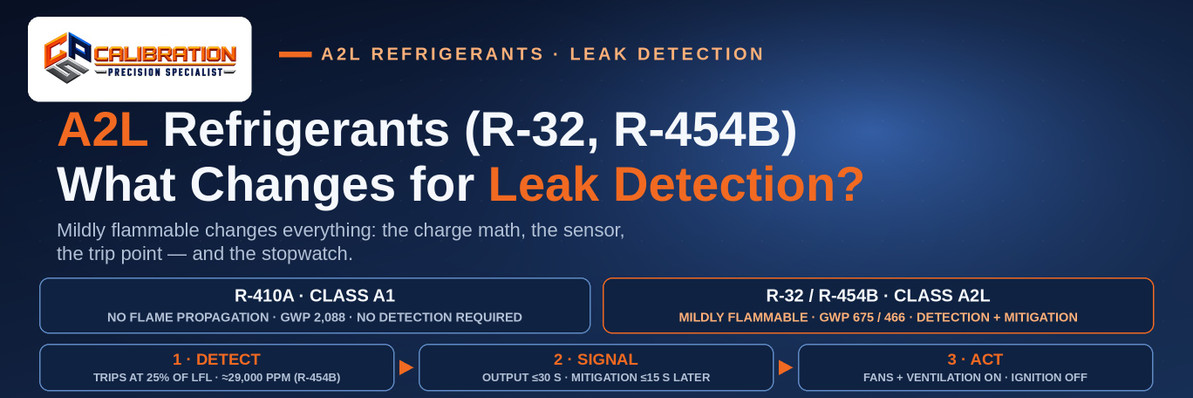
A2L refrigerants change leak detection because they can burn: R-410A is class A1 and does not propagate a flame, so it never needed flammability detection, but R-32 and R-454B are class A2L — lower toxicity, mildly flammable — and under ASHRAE 15 and UL 60335-2-40, equipment carrying more than a calculated charge threshold must have a refrigerant detection system that senses the specific refrigerant, trips at or below 25% of its lower flammability limit (about 29,000 ppm for R-454B), produces its signal within 30 seconds, and automatically starts mitigation — ventilation and circulation fans on, compressor and electric heat off, refrigerant isolated.
Nothing about the old routine prepares you for this. For thirty years, "refrigerant leak detection" meant a technician with a handheld sniffer hunting a charge leak after the fact — a performance and repair problem. With A2Ls, detection moves inside the equipment, becomes part of its safety listing, and gets a stopwatch: the standards don't just require a sensor, they specify the concentration it must trip at, how fast it must answer, and what the machine must do next. This post works through what actually changed — the classification, the charge math, the 25% LFL trip point, where sensors sit, and why the habits formed on R-410A don't transfer.
What Does A2L Actually Mean?
The classification comes from ASHRAE Standard 34, and it decodes letter by letter. A is toxicity: class A refrigerants are the lower-toxicity group. 2L is flammability: the refrigerant does propagate a flame, but it is the mildest flammable class ASHRAE defines — a 2L refrigerant has a lower flammability limit above 0.10 kg/m³, a heat of combustion below 19,000 kJ/kg, and a burning velocity of no more than 10 cm/s. R-32's burning velocity is 6.7 cm/s. Propane — class A3, the genuinely flammable end of the scale — burns at 46 cm/s and ignites off a static-grade spark of under 1 millijoule; R-32 takes a deliberate ignition source, with a minimum ignition energy of roughly 30–100 mJ.
So A2L is not "flammable like gasoline," and it is not "nonflammable like R-410A" either. It is a real, narrow middle: a gas that will burn if a large enough leak meets a strong enough ignition source, and that therefore gets engineered controls — charge limits, detection, and automatic mitigation — instead of either the full fuel-gas treatment or no treatment at all. Both of the R-410A replacements live in that middle. R-32 is a single-component refrigerant, the same molecule that made up half of R-410A, used on its own. R-454B is a blend — 68.9% R-32 and 31.1% R-1234yf, sold as Opteon XL41, Puron Advance, and Solstice 454B — with a temperature glide of about 1.5 K.
Why Is This Happening Now? The GWP Squeeze
The driver is climate policy, not cooling performance. R-410A carries a global warming potential of 2,088. Under the AIM Act's phasedown of HFCs, EPA's rules cap refrigerants in new residential and light commercial air conditioners and heat pumps at 700 GWP for equipment manufactured from January 1, 2025. R-410A is more than double the cap; the two refrigerants the industry standardized on both slide under it — R-454B at 466 and R-32 at 675. The trade the industry accepted, worldwide, is lower GWP in exchange for mild flammability: nearly every low-GWP molecule that cools well is at least a little flammable, and A2L is where the balance landed.
| R-410A | R-32 | R-454B | |
|---|---|---|---|
| ASHRAE 34 class | A1 — no flame propagation | A2L — mildly flammable | A2L — mildly flammable |
| GWP | 2,088 | 675 | 466 |
| What it is | 50/50 blend of R-32 and R-125 | Single component (the R-32 half of R-410A, alone) | 68.9% R-32 + 31.1% R-1234yf |
| Lower flammability limit | None — it does not burn | Above 10% by volume | 11.5% by volume (ASHRAE 34) |
| Burning velocity | — | 6.7 cm/s | Under the 10 cm/s class ceiling |
| Flammability leak detection | Not required | Required above charge thresholds | Required above charge thresholds |
Change #1: Charge Is Now a Calculation, Not a Default
With R-410A, charge size was an equipment-design question. With A2Ls, it is a room question. ASHRAE 15 and UL 60335-2-40 both tie the maximum allowable charge to the refrigerant's LFL and the effective dispersal volume — in practice, the smallest room the equipment serves, because that is the room a full leak would concentrate in. The framework runs in tiers (the standards work through charge thresholds labeled m1, m2, and m3): below the first threshold, a charge small enough that even a total release stays a small fraction of the LFL needs no added mitigation. Above it, detection becomes mandatory; above the higher tiers, ventilation and further measures stack on. The whole framework is built on a four-times safety factor — concentrations are managed against 25% of the LFL, not the LFL itself.
How small is "small"? Published worked examples for a typical room — about 20 m² of floor area with a 2.7 m ceiling — put the no-added-mitigation threshold at roughly 1.42 kg of R-454B or about 1.80 kg of R-32 for a floor-level installation, with the limit rising for equipment mounted higher, where leaked refrigerant is less likely to pool in the occupied zone. Those are illustrations, not code text — your number comes out of the calculation for your refrigerant, your charge, and your smallest room — but they make the point: the thresholds sit in the same range as real residential and light commercial charges, which is why detection on A2L equipment is now normal rather than exotic.
Change #2: Detection That Acts — Not Just Alarms
The bigger change is what a "leak detector" is. An A2L refrigerant detection system (RDS) is a supervised safety control, and the standards specify it like one:
- It trips at or below 25% of the LFL. UL 60335-2-40 requires the detection system to activate below a concentration of 25% of the LFL for the refrigerant in use, and ASHRAE 15's detection requirements use the same 25% of LFL trip point.
- It is fast, on a stopwatch. The sensor must generate its output signal within 30 seconds of being exposed to that 25% LFL concentration; the alarm must sound within 30 seconds of detection, and mitigation must begin within 15 seconds of the alarm.
- It acts on the building and the machine. The mitigation sequence, per ASHRAE 15 and the equipment listing, engages circulation fans, drives zone dampers to full airflow, activates mechanical ventilation, closes safety shutoff valves to isolate and pump down the refrigerant, and turns off potential ignition sources — the compressor and electric resistance heat included.
- It is factory-set and sealed. UL requires indicating-type detectors to be factory installed with sensors located to catch leaks; the setpoint is factory-set with no field adjustment permitted, and the system cannot be recalibrated in the field. It must detect the specific refrigerant the equipment is charged with.
- It supervises itself. Self-test protocols run every hour. If the detector itself fails, the system fails safe — circulation fans come on and keep diluting the space until the detector is replaced. UL also requires the sensor to resist poisoning by common household and workplace contaminants.
Compare that to the R-410A world: no sensor, no setpoint, no sequence, no stopwatch. The A2L detector is closer in spirit to the fixed gas detection systems plant people know — the world of our guide to how a fixed gas detection system works — than to anything in a residential air handler's past. One honest note on scope: that built-in RDS is part of the listed HVAC equipment, supplied by the equipment manufacturer. CPS doesn't list a fixed A2L detection system on our store — what we carry for refrigerant work is the service side, covered below — and any A2L installation's detection has to match its equipment listing and the adopted code in your jurisdiction, not a catalog page.
Why 25% of the LFL Is Not a ppm Alarm
If you come from toxic gas detection, the numbers will look wrong until you separate the two jobs. Run the arithmetic for R-454B: its LFL is 11.5% by volume, which is 115,000 ppm. Twenty-five percent of that is about 29,000 ppm. An A2L detection system trips at roughly twenty-nine thousand ppm — because its question is not "is this air healthy to breathe?" but "is this room anywhere near a mixture that could burn?" It alarms at one quarter of the concentration that could propagate a flame, holding a 4× margin below the hazard itself.
A toxic-gas alarm answers the other question at the other end of the scale — carbon monoxide alarms are set in the tens of ppm, because CO harms people at concentrations three orders of magnitude below anything flammable. Neither instrument can do the other's job: a CO-style ppm alarm tells you nothing useful about flammability margin, and the A2L system tells you nothing about exposure health. It is the same distinction our post on what LEL means draws for combustible gas generally — percent-of-LFL thinking and ppm thinking are different instruments for different hazards, and A2L detection lives firmly on the %LFL side. (How point detectors and line-of-sight approaches divide that %LFL work is the subject of our comparison of open-path vs. point gas detectors.)
Where Do the Sensors Sit?
Two placements, for two different installations:
Inside the equipment. On the unitary and split equipment most people will meet, the sensor is part of the appliance: factory installed, positioned by the manufacturer where leaked refrigerant will reach it, and verified by test under UL 60335-2-40 (the standard even prescribes leak-location testing to prove the chosen spot actually detects the leak). The refrigerant physics drives the placement — R-32 and R-454B vapors are substantially heavier than air, so leaked refrigerant sinks and pools low rather than dispersing upward; if you want the general physics, our post on where gas goes when it leaks works through vapor density and pooling. There is no field relocation decision to make: move the sensor and you have modified a listed safety system.
In the room, for machinery rooms and larger plant. Low-probability systems — chillers and plant in machinery rooms, where a leak is unlikely to reach occupied space — get room-level detection instead: detectors in the room that raise audible and visual alarms, with a remote shutoff outside the room and automatic electrical disconnection of the equipment on a leak. That machinery-room pattern follows ASHRAE 15's longstanding refrigerant-monitoring framework and will look familiar to anyone who has worked around ammonia or chiller plants: the room is monitored, the alarm is unmistakable, and the machine can be killed from outside the space.
What Sensing Technologies Do the Work?
The AHRI-sponsored sensor performance project evaluated A2L sensors built on four principles: non-dispersive infrared (NDIR), metal-oxide semiconductor (MOS), thermal conductivity, and micro-machined membrane. Each is a refrigerant-specific instrument, calibrated and listed for the refrigerant it protects — this is not a generic combustible-gas sensor reading %LEL of whatever drifts by, and a methane-calibrated LEL detector is not a substitute for the listed RDS. The MOS approach in particular carries its own quirks of drift and cross-sensitivity, which our post on semiconductor (MOS) gas sensors takes apart in detail. What the standards care about is the outcome: correct refrigerant, correct trip point, response inside the time limit, and stability across the sensor's service life — UL's fourth edition of 60335-2-40 specifically tightened the requirements around drift and deviation over the detector's claimed lifetime.
Why R-410A Practice Doesn't Transfer
Five habits from the A1 era break on A2L equipment:
- "Refrigerant systems don't need leak detection." True for A1, false above the charge thresholds for A2L — detection is part of the equipment's listing and the code calculation, not an accessory.
- "A detector is a detector." The RDS must be listed for the specific refrigerant, factory-set, and sealed. There is no field calibration visit for these sensors — a failed or expired sensor is replaced, not adjusted, and the hourly self-check exists precisely because nobody is coming to bump test it.
- "Just top it off." R-454B is a zeotropic blend with about 1.5 K of glide; a leak can fractionate, shifting the composition of what remains. Charge is weighed in against the nameplate and the room calculation — the charge number is now a compliance figure, not just a performance one.
- "We'll convert the old unit." R-410A equipment is not converted to A2L refrigerants. The flammability classification changes everything the listing rests on — components, controls, detection — so A2L means new, listed equipment.
- "The sniffer is the leak program." The handheld electronic leak detector is still the right tool for finding a leak during service — that job hasn't changed, and a detector like the Extech RD350 ($299.99) from our Refrigerant Leak Detectors category is built for exactly that. But pinpointing a leak for repair and standing guard over a room are different jobs now. The built-in RDS does the guarding; the handheld does the hunting; neither replaces the other.
Frequently Asked Questions
What does A2L mean for a refrigerant? A2L is an ASHRAE Standard 34 safety classification: A means lower toxicity, and 2L means lower flammability — the refrigerant propagates a flame, but with a burning velocity of 10 cm/s or less, an LFL above 0.10 kg/m³, and a heat of combustion under 19,000 kJ/kg. R-32 and R-454B are A2L; R-410A is A1, which does not propagate a flame at all.
Are R-32 and R-454B flammable? Yes — mildly. Both will burn if a sufficient concentration meets a strong ignition source, but both are hard to ignite and slow to burn: R-32's burning velocity is 6.7 cm/s against propane's 46 cm/s, and its minimum ignition energy (roughly 30–100 mJ) is far above propane's sub-1 mJ. That is why the codes manage them with charge limits, detection, and mitigation rather than treating them like fuel gas.
Why are R-32 and R-454B replacing R-410A? Global warming potential. R-410A's GWP is 2,088; EPA's AIM Act rules cap new residential and light commercial air conditioners and heat pumps at 700 GWP for equipment manufactured from January 1, 2025. R-454B (GWP 466) and R-32 (GWP 675) both fit under the cap, and their mild flammability is the accepted trade for getting there.
Do all A2L systems require leak detection? No — it depends on the charge against the room. ASHRAE 15 and UL 60335-2-40 set charge thresholds from the refrigerant's LFL and the effective dispersal volume of the smallest space served. Below the first threshold, no added mitigation is required; above it, a refrigerant detection system is mandatory, and higher tiers add ventilation and further measures. In practice, most real-world A2L charges land above the threshold, so detection is the norm.
At what concentration does an A2L leak detector trip? At or below 25% of the refrigerant's lower flammability limit. For R-454B, whose LFL is 11.5% by volume (115,000 ppm), that works out to roughly 29,000 ppm. The setpoint is factory-set and sealed by the equipment manufacturer — it is a flammability trip point with a 4× safety factor, not a health-based ppm alarm.
How fast does an A2L detection system have to respond? The standards put it on a stopwatch: the sensor must generate its output signal within 30 seconds of exposure to 25% of the LFL, the alarm must be generated within 30 seconds of detection, and mitigation must begin within 15 seconds of the alarm. Mitigation means circulation fans and ventilation running, dampers open, ignition sources — compressor, electric heat — shut down, and shutoff valves isolating the refrigerant.
What happens when an A2L leak detector trips? The system runs its mitigation sequence automatically: fans and mechanical ventilation start to dilute and disperse the leaked refrigerant, zone dampers open to full airflow, the compressor and other ignition sources shut off, and safety shutoff valves close to isolate the charge. If the detector itself fails its hourly self-test, the system fails safe — the circulation fans come on and keep diluting the space until the detector is replaced.
Can I retrofit an R-410A system to run R-454B or R-32? No. A2L refrigerants go in new, listed equipment only. The flammability classification changes the listing basis for the whole appliance — components, controls, ignition-source control, and the built-in detection system — so an R-410A unit cannot be converted, and refrigerant is never swapped into equipment that wasn't listed for it.
Where are A2L refrigerant sensors located? On unitary equipment, inside the appliance — factory installed and positioned by the manufacturer where leaked refrigerant will reach them, which usually means low, because A2L vapors are heavier than air and pool downward. In machinery rooms, room-level detectors are used instead, with audible and visual alarms, a remote shutoff outside the room, and automatic electrical disconnection on a leak.
Can an A2L leak sensor be adjusted or recalibrated in the field? No. UL 60335-2-40 requires the setpoint to be factory-set and sealed with no field adjustment permitted, and ASHRAE 15's detection requirements likewise call for a fixed, nonadjustable setpoint, a sensor that detects the specific refrigerant in the system, and built-in self-checks. A sensor that fails or reaches the end of its service life is replaced as a component — there is no calibration procedure to perform on it.
The Bottom Line
A2L refrigerants didn't just change the gas in the pipes — they moved refrigerant leak detection from a service tool to a listed safety system with a trip point, a stopwatch, and a mitigation sequence. If your building is taking R-32 or R-454B equipment, the questions that matter are: what is the charge against the smallest room it serves, is the detection system the one the equipment was listed with, and does the mitigation sequence actually run — fans, dampers, shutdown, isolation — when the sensor calls? Get those three right and mild flammability is exactly that: mild, managed, and monitored.
Working through an A2L changeout, or sorting out which detection belongs where? Call 865-900-8844 or reach us through Contact Us. For the service side, browse our Refrigerant Leak Detectors category, and for the fixed-system principles behind supervised detection, see how a fixed gas detection system works.
CPS Calibrations · 109 S. Front Street, Rockwood, TN 37854 · Calibration Gas · Calibration Services · Contact Us
Need a calibration you can file?
In-house calibration at CPS in Rockwood, Tennessee — $55 for single-gas instruments, $90 for 4- and 5-gas — every channel, as-found and as-left data, full certificate.
See Calibration Servicesor call 865-900-8844
Recent Posts
-

What Is Remote Monitoring for Fixed Gas Detection?
Remote monitoring for fixed gas detection means a fixed system's live readings, trends, and alarm hi …Nov 23rd 2026 -

What Are the Key Differences Between the GX-6000 and GX-6100?
The RKI GX-6100 is the current replacement for the discontinued GX-6000: both are pumped 6-gas monit …Nov 22nd 2026 -

How to Read a PID Correction Factor Chart
To read a PID correction factor chart, find your vapor’s row, take the factor under your own lamp en …Nov 21st 2026