
Crowcon FGard Flame Detectors: UV/IR, IR3, and the Hydrogen Model
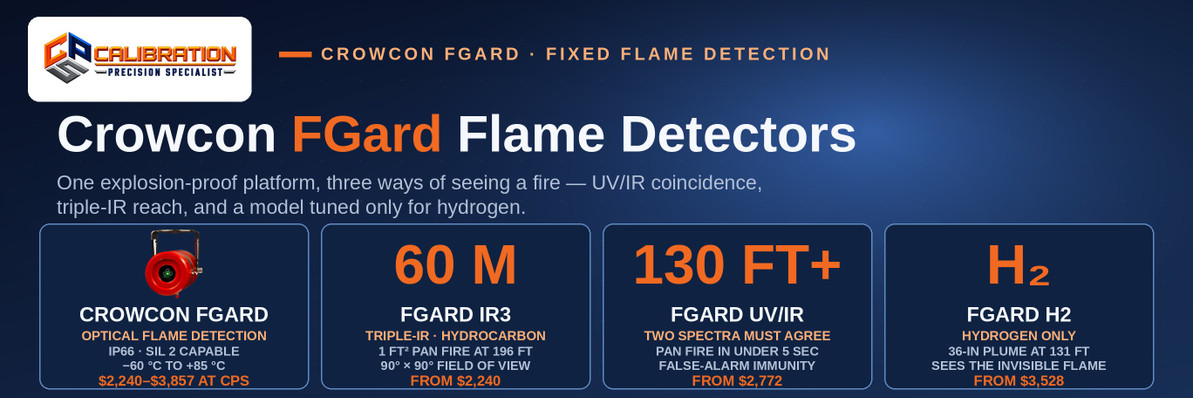
Crowcon's FGard range is three explosion-proof optical flame detectors built on one shared platform — the same housing, heated optics, continuous optical self-verification, 0–20 mA/HART/relay outputs, and SIL 2 capable electronics — split by the fire each one is tuned to see. The FGard UV/IR pairs an ultraviolet sensor with an infrared sensor and alarms only when both agree, detecting a hydrocarbon fuel pan fire at over 130 feet in under 5 seconds. The FGard IR3 watches three infrared wavelengths and reaches furthest, detecting a 1 ft² (0.1 m²) n-heptane fire at 196 feet (60 m) at high sensitivity. The FGard H2 is optimised exclusively for hydrogen's near-invisible flame, detecting a 36-inch hydrogen plume at 131 feet (40 m). At CPS, list prices run $2,240–$3,857 depending on model and housing material.
Flame detectors answer a question gas detectors can't: not "is fuel leaking?" but "has it already ignited?" — and they answer it in seconds, from across a process area, before a fire grows past the point where suppression is realistic. We covered the underlying technologies in our UV vs. IR vs. UV/IR vs. IR3 comparison. This post is about Crowcon's implementation of them: three FGard models that share everything except the sensing, how far each one actually sees, what each costs, and how to choose between them. The short version is that the fuel decides. Get the fuel wrong and the numbers on the datasheet don't matter.
One Platform, Three Ways of Seeing a Fire
All three FGard models are the same physical instrument: a cylindrical explosion-proof housing, 4 inches in diameter by 8 inches long (100 × 200 mm), in copper-free aluminium (5.5 lb / 2.5 kg) or 316 stainless steel (13.2 lb / 6.0 kg), with a red epoxy finish. Cable entries are M20, M25, or 3/4" NPT. Everything below is common to the range:
- Heated optics. A microprocessor-controlled heater keeps the lens clear of condensation, ice, and water, so the detector keeps working in snow, washdown, and humid process areas instead of fogging over at the worst moment.
- Advanced Optical Verification. The detector runs a continuous automatic optical test that verifies lens cleanliness and its own electronic circuitry — no reflector or mirror check is needed, and a dirty or failing detector reports a fault instead of silently going blind.
- Three sensitivity settings. Low, medium, and high sensitivity let you match the detector to the space — and stop adjacent detectors from cross-voting on the same fire.
- Standard outputs. 0–20 mA with fault alerts, HART®, and alarm and fault relay contacts (DPDT, rated 2 A at 30 Vdc) on every model; the IR3 adds RS485 for configuration. That is enough to land an FGard on a fire panel, a PLC, or a plant DCS without exotic interface hardware.
- Hazardous-area and performance approvals. FM 3260 and EN 54-10 performance approvals; FM Class 1 Division 1 Groups B, C, D T4 and Class 1 Zone 1 AEx db IIC T4 for North America; ATEX II 2 G Ex db IIC T4 Gb and IECEx Ex db IIC T4 internationally, plus INMETRO and PESO. Ingress protection is IP66 / NEMA Type 4X, the operating range is −60 °C to +85 °C (−76 °F to +185 °F), and the range is certified SIL 2 capable to IEC 61508 for use in safety-instrumented functions.
- Power. 24 Vdc nominal (18–32 Vdc range), drawing 3 W with the heater off.
What differs between the models is only what sits behind the lens — and that difference is the whole buying decision.
FGard UV/IR: The False-Alarm Fighter
The FGard UV/IR combines two sensors that see completely different parts of a flame's output: an ultraviolet sensor, which responds to the UV radiation every flame emits, and an infrared sensor watching the flame's flickering IR signature. The detector alarms only when both channels agree that what they see is a flame. That coincidence requirement is why UV/IR is the traditional answer where false alarms are expensive: sunlight, lightning, hot surfaces, and most single-spectrum nuisances excite one channel or the other, but not both in the pattern of a real flame. Crowcon layers its latest IR flame-detection algorithms on top, which the datasheet credits with maximum false alarm immunity.
Performance, from Crowcon's US datasheet: the UV/IR is independently tested to detect a hydrocarbon fuel pan fire at over 130 feet (40 m) in less than 5 seconds, with a typical response time under 5 seconds and three selectable sensitivity levels. It is a hydrocarbon-fire detector — gasoline, diesel, jet fuel, solvents, methane, and the other carbon-bearing fuels whose flames radiate strongly in both UV and IR.
Choose the UV/IR when the fire risk is hydrocarbon and the site is full of things that fool single-spectrum detectors — outdoor process areas in direct sun, areas with frequent lightning exposure, or anywhere a nuisance alarm triggers an evacuation or a deluge release you cannot afford to fire by accident. It is the balanced choice: strong reach, the widest false-alarm immunity of the range, and a mid-range price ($2,772 aluminium / $3,073 stainless at CPS).
FGard IR3: The Long-Reach Hydrocarbon Detector
The FGard IR3 takes the opposite approach to the same problem: instead of splitting across the spectrum, it goes deep into infrared. Three IR sensors watch three wavelengths in the 3–8 µm range, and the detector's algorithms compare the flame's signature across all three. A real hydrocarbon flame has a characteristic multi-wavelength fingerprint — dominated by the hot CO₂ emission band — that hot pipes, sunlight, and welding arcs do not reproduce across all three channels at once.
That depth buys reach. The IR3's published flame sensitivity (high sensitivity setting) is the longest in the FGard range:
| Fuel | Fire size | Detection distance (high sensitivity) |
|---|---|---|
| n-Heptane | 1 ft × 1 ft (30 × 30 cm) | 196 ft (60 m) |
| n-Heptane, with arc welding nearby | 1 ft × 1 ft | 196 ft (60 m) |
| Gasoline | 1 ft × 1 ft | 196 ft (60 m) |
| JP4 jet fuel | 1 ft × 1 ft | 196 ft (60 m) |
| Diesel | 1 ft × 1 ft | 164 ft (50 m) |
| Crude oil (heavy fuel) | 20 in × 20 in (0.5 × 0.5 m) | 164 ft (50 m) |
| Methane | 24 in (60 cm) plume | 164 ft (50 m) |
| Ethanol | 1 ft × 1 ft | 137 ft (42 m) |
| Methanol | 1 ft × 1 ft | 137 ft (42 m) |
At standard sensitivity those distances halve — the same 1 ft² heptane or gasoline fire is detected at 98 feet (30 m) — which is the honest trade you make when you turn sensitivity down for immunity. The row worth pausing on is the second one: the IR3 holds its full 196-foot heptane detection with arc welding going on in view, because welding does not produce the three-wavelength flame fingerprint. The field of view is 90° horizontal × 90° vertical, response is under 5 seconds typical, and the detector's working range (depth of field) is 2–60 m. One limit is printed plainly in Crowcon's own installation guide: the IR3 is for hydrocarbon fires only — a point the H2 section below makes concrete.
Choose the IR3 when you need to cover a large area — a tank farm, loading rack, aircraft hangar, or turbine enclosure — with fewer detectors, when welding happens in the same view, or when the distance between the detector and the credible fire is simply long. It is also the least expensive FGard at CPS: $2,240 aluminium / $2,555 stainless.
FGard H2: Built for the Flame You Can't See
Hydrogen breaks the assumptions the other two models are built on. A hydrogen flame is nearly invisible — the gas is colourless, the flame burns pale to the point of disappearing in daylight, and people have walked into hydrogen fires they could not see. Worse for conventional detectors, hydrogen contains no carbon, so its flame produces no hot CO₂ — and the strong infrared emission band that hydrocarbon-tuned IR detectors key on is largely absent. Crowcon's H2 datasheet says it directly: unlike traditional multi-spectral flame detectors, which lack the capability to discern hydrogen flames, the FGard H2 is optimised exclusively for hydrogen flame detection. (We walk through the physics in Can a Flame Detector See a Hydrogen Flame?)
The H2 is a multi-spectrum IR detector retuned around hydrogen's actual flame signature — the radiation from the water vapour a hydrogen flame produces. Its published sensitivity table shows both the capability and the price of that specialisation:
| Fuel | Fire size | Detection distance |
|---|---|---|
| Hydrogen | 36 in (90 cm) plume | 131 ft (40 m) |
| Methane | 36 in (90 cm) plume | 100 ft (30 m) |
| Methanol | 1 ft × 1 ft | 65 ft (20 m) |
| Methylated spirits | 1 ft × 1 ft | 65 ft (20 m) |
| n-Heptane | 1 ft × 1 ft | 40 ft (12 m) |
Read the last row against the IR3's table: the same 1 ft² heptane fire the IR3 sees at 196 feet, the H2 sees at 40 feet. That is not a defect — it is the tuning. The H2 trades hydrocarbon sensitivity for hydrogen sensitivity, responds in 2–5 seconds (typical, at 40 m), and carries a 5-year warranty, which Crowcon positions as market-leading for a hydrogen flame detector. Its application list is the hydrogen economy in miniature: hydrogen generators, hydrogen fuelling stations, hydrogen-to-methane production, hydrogen compressors, hydrogen trains, buses and ferries, plus refining, gas plants, semiconductor manufacturing, aerospace, and fertiliser production.
Choose the H2 when hydrogen is the fuel — produced, stored, compressed, dispensed, or burned — and accept that it is a specialist: on a mixed-fuel site it complements hydrocarbon detectors rather than replacing them.
Which FGard? The Fuel Decides
| FGard UV/IR | FGard IR3 | FGard H2 | |
|---|---|---|---|
| Sensing | UV sensor + IR sensor, both must agree | Three IR wavelengths (3–8 µm) | Multi-spectrum IR tuned to hydrogen |
| Built for | Hydrocarbon fires, maximum false-alarm immunity | Hydrocarbon fires at maximum distance | Hydrogen flames |
| Headline detection | Pan fire at over 130 ft, <5 s | 1 ft² n-Heptane at 196 ft (60 m), high sensitivity | 36 in hydrogen plume at 131 ft (40 m) |
| Response | <5 s typical | <5 s typical | 2–5 s typical at 40 m |
| Hydrogen flames | Not its design fuel | No — hydrocarbons only | Yes — its only design fuel |
| CPS list price | $2,772 alu / $3,073 SS | $2,240 alu / $2,555 SS | $3,528 alu / $3,857 SS |
Two placement rules apply to all three. First, every distance above is an on-axis figure for a defined test fire: sensitivity falls off toward the edge of the detector's cone of view, and a smaller fire is a shorter-distance fire — our guide to flame detector range works through the geometry. Second, an optical detector can only see what its lens can see: pipework, vessels, and parked equipment all cast "shadows" that have to be covered by aiming and detector count, which is a site survey question, not a catalogue question. CPS designs and installs complete fixed systems — see Fixed System Installation — and flame detection pairs with, never replaces, point gas detection: the gas detector warns you about the leak, the flame detector tells you it lit. We compare the two roles in Flame Detector vs. Gas Detector.
Prices and Configurations at CPS
FGard pricing is simple once you see the pattern: within each model, the price depends only on the housing material. Thread choice — M20, M25, or 3/4" NPT — does not change it.
| Model | Aluminium | 316 Stainless Steel |
|---|---|---|
| FGard IR3 | $2,240 | $2,555 |
| FGard UV/IR | $2,772 | $3,073 |
| FGard H2 | $3,528 | $3,857 |
Budget honestly for the rest of the installation. The detectors are priced bare, and an FGard still needs a way to be aimed: the standard 316 stainless mounting bracket is $273 (a marine-grade bracket is $462, pole-mount kits run $413–$497, and a sunshield is $175). The stainless housing premium — $301–$329 depending on model — is worth it in marine, offshore, and corrosive chemical service; aluminium is the rational default everywhere else. For proof testing, Crowcon's long-range flame simulator is $4,914: it triggers the detector from the ground at distance, which is how you function-test a detector mounted 30 feet up a column without scaffolding. CPS supplies the full FGard range and supports it alongside the rest of your fixed system — and when the wider system needs attention, our calibration services cover every channel of it.
The Honest Limits
- Fuel match is everything. The UV/IR and IR3 are hydrocarbon detectors. Point them at a pure hydrogen fire and you have spent real money on the wrong signature — Crowcon built a separate model precisely because the hydrocarbon tuning doesn't transfer. The H2 makes the mirror-image trade: superb on hydrogen, short-ranged on hydrocarbon pan fires.
- Line of sight is a hard limit. Flame detectors cannot see around corners, through vessels, or through a lens coated in oil mist or dust. Heated optics and continuous optical verification manage the lens problem and report fouling as a fault, but they do not repeal geometry — obstructed areas need more detectors, differently aimed.
- Detection distance is a test-fire number. "196 feet" means a 1 ft² n-heptane pan fire, on axis, at high sensitivity, in test conditions. A smaller fire, an off-axis fire, or the standard sensitivity setting all shorten it — at standard sensitivity the IR3's figures halve to 98 feet. Size the system on the fire you actually fear, not the brochure fire.
- Sensitivity is a dial, not a free lunch. Higher sensitivity buys distance and spends false-alarm immunity; lower sensitivity does the reverse. The three FGard settings exist so the installer can make that trade deliberately for each location.
- They detect flame, not gas. An FGard tells you nothing about a leak that hasn't ignited, and it gives you no concentration reading. Sites that need leak warning need gas detection as well — flame and gas detection are complements, not substitutes.
- "SIL 2 capable" is component wording, not a system promise. The detectors are certified SIL 2 capable to IEC 61508; whether your safety function achieves SIL 2 depends on the whole loop — detector, logic solver, final element, and proof-test interval — not on the detector alone.
- Self-verification is not proof testing. Advanced Optical Verification continuously checks the optics and electronics, but fire codes still require periodic functional testing with a real stimulus — NFPA 72 calls for semiannual functional tests of flame detectors, which is what the flame simulator is for. We cover the routine in How Do You Test a Flame Detector?
Specifications
Shared across the FGard range unless noted:
| Crowcon FGard range | |
|---|---|
| Models | FGard UV/IR · FGard IR3 · FGard H2 |
| Sensing | UV/IR: ultraviolet + infrared coincidence · IR3: three IR wavelengths, 3–8 µm · H2: multi-spectrum IR tuned to hydrogen |
| Response time | <5 s typical (UV/IR, IR3) · 2–5 s typical at 40 m (H2) |
| Field of view | 90° horizontal × 90° vertical (IR3, per installation guide) |
| Outputs | 0–20 mA with fault alerts · HART® · alarm and fault relays, DPDT 2 A @ 30 Vdc (IR3 adds RS485 configuration) |
| Self-checks | Advanced Optical Verification (continuous optical + electronic test, no reflector) · microprocessor-controlled heated optics · three sensitivity settings |
| Housing | Copper-free aluminium or 316 stainless steel, red epoxy finish · 4 in dia × 8 in (100 × 200 mm) · 5.5 lb (2.5 kg) alu / 13.2 lb (6.0 kg) SS |
| Entries | M20, M25, or 3/4" NPT |
| Power | 24 Vdc nominal (18–32 Vdc) · 3 W without heater |
| Operating range | −60 °C to +85 °C (−76 °F to +185 °F) · 0–100% RH non-condensing |
| Ingress | IP66 / NEMA Type 4X |
| Approvals | FM 3260 · EN 54-10 · FM Class 1 Div 1 Groups B, C, D T4 · Class 1 Zone 1 AEx db IIC T4 · ATEX II 2 G Ex db IIC T4 Gb · IECEx Ex db IIC T4 · INMETRO · PESO |
| Functional safety | Certified SIL 2 capable — IEC 61508 |
| Warranty | 5 years (H2; IR3 per Crowcon's EU datasheet) |
Frequently Asked Questions
How much does a Crowcon FGard flame detector cost?
At CPS, FGard list prices run $2,240–$3,857 depending on the model and housing. The FGard IR3 is $2,240 in aluminium and $2,555 in 316 stainless steel; the FGard UV/IR is $2,772 / $3,073; the FGard H2 is $3,528 / $3,857. Thread choice (M20, M25, or 3/4" NPT) does not change the price. The mounting bracket is separate — the standard 316 stainless bracket is $273.
What is the difference between the FGard UV/IR and the FGard IR3?
Sensing and reach. The UV/IR combines an ultraviolet sensor with an infrared sensor and alarms only when both agree, which gives it the range's strongest false-alarm immunity; it is independently tested on a hydrocarbon pan fire at over 130 feet. The IR3 uses three infrared wavelengths instead, compares the flame's fingerprint across all of them, and reaches further — a 1 ft² n-heptane fire at 196 feet (60 m) at high sensitivity. Both are hydrocarbon-fire detectors; neither is the tool for hydrogen.
Can a flame detector see a hydrogen flame?
A standard hydrocarbon flame detector generally cannot do it reliably — a hydrogen flame is nearly invisible and, because hydrogen contains no carbon, it lacks the strong hot-CO₂ infrared emission that hydrocarbon detectors key on. Crowcon's FGard H2 exists for exactly this case: it is a multi-spectrum IR detector optimised exclusively for hydrogen, detecting a 36-inch hydrogen plume at 131 feet (40 m) with a 2–5 second typical response.
How far can the FGard IR3 detect a fire?
At high sensitivity, the IR3 detects a 1 ft × 1 ft n-heptane pan fire at 196 feet (60 m) — the same distance for gasoline and JP4, and it holds that figure with arc welding in view. Diesel and crude oil rate 164 feet (50 m), a 24-inch methane plume 164 feet, and ethanol and methanol 137 feet (42 m). At standard sensitivity the distances halve: the same heptane fire is detected at 98 feet (30 m). All figures are on-axis test-fire values; smaller or off-axis fires are detected closer in.
What fuels does the FGard IR3 detect?
Hydrocarbon fuels only — Crowcon's installation guide states this explicitly. The published sensitivity table covers n-heptane, gasoline, diesel, crude oil, JP4, methane, ethanol, and methanol. It is not rated for hydrogen flames; that is the FGard H2's job.
Does the FGard come with a mounting bracket?
No — the detectors are priced bare, and the bracket is a separate line item. Crowcon's standard 316 stainless steel bracket is $273 at CPS list; a marine bracket is $462, pole-mount kits run $413–$497 depending on pole size, and a sunshield is $175. Every FGard installation needs at least the bracket, because the detector has to be aimed at the hazard and locked off.
What outputs does the Crowcon FGard have?
Every FGard model provides a 0–20 mA analogue output with fault alerts, HART® communication, and alarm and fault relay contacts (DPDT, rated 2 A at 30 Vdc). The IR3 additionally offers RS485 for configuration. That covers direct connection to a fire panel, PLC, or DCS without interface converters.
Is the Crowcon FGard SIL rated?
The FGard range is certified SIL 2 capable to IEC 61508 — that is the wording on Crowcon's IR3 and H2 datasheets, and the UV/IR's current US datasheet lists Certified SIL 2. "Capable" is component-level wording: achieving a SIL 2 safety function still depends on the complete loop, including the logic solver, final elements, and your proof-test interval.
How do you test an FGard flame detector?
Two layers. Continuously, the detector tests itself: Advanced Optical Verification checks lens cleanliness and the electronic circuitry automatically, with no reflector, and raises a fault if the optics foul. Periodically, you still need a functional test with a real stimulus — NFPA 72 requires semiannual functional testing of flame detectors — using a flame simulator such as Crowcon's long-range unit ($4,914 at CPS list), which triggers the detector from the ground at distance so mounted-high detectors can be tested without scaffolding.
Will welding or sunlight cause false alarms on an FGard?
The range is designed and tested against both. The UV/IR alarms only when its ultraviolet and infrared channels agree, which rejects most sunlight and hot-object signatures. The IR3 compares the flame's fingerprint across three infrared wavelengths, and Crowcon's sensitivity table certifies full 196-foot n-heptane detection with arc welding in the view. No optical detector is literally immune in every geometry, which is why the three sensitivity settings exist — but nuisance sources are the design case for this range, not an afterthought.
The Bottom Line
The FGard range is one well-built explosion-proof platform — heated optics, continuous optical self-verification, HART and relay outputs, SIL 2 capable, rated from −60 °C to +85 °C — wearing three different sets of eyes. Buy the eyes for your fuel: UV/IR where hydrocarbon fire risk shares space with sunlight, lightning, and nuisance sources; IR3 where hydrocarbon coverage distance is the problem and every detector you eliminate saves real money; H2 wherever hydrogen is made, moved, stored, or burned, because the other two were never tuned to see its flame. At $2,240–$3,857 the detector itself is rarely the expensive part of a flame-detection system — the expensive part is discovering, after an incident, that the detector you installed was watching for the wrong fire.
Planning flame detection for a fuel area, hangar, or hydrogen installation — or want a quote on any FGard model? Call 865-900-8844 or reach us through Contact Us. CPS Calibrations · 109 S. Front Street, Rockwood, TN 37854 · Fixed System Installation · Calibration Services
Need a calibration you can file?
In-house calibration at CPS in Rockwood, Tennessee — $55 for single-gas instruments, $90 for 4- and 5-gas — every channel, as-found and as-left data, full certificate.
See Calibration Servicesor call 865-900-8844
Recent Posts
-

Can You Add a Pump to a SENKO SGT-P or MGT?
Yes — SENKO's SP-Pump101 external sampling pump ($330, part AAA006000) fits the SGT, SGT-P, and MGT, …Nov 12th 2026 -

What Refrigerant Detection Does a Grocery Store Need?
A grocery store needs refrigerant detection in three places: low-mounted carbon dioxide (R-744) sens …Nov 11th 2026 -

What Is LEL and UEL? The Explosive Range, Gas by Gas
The LEL is the lowest concentration of a gas in air that can explode, and the UEL is the highest: me …Nov 10th 2026