
Inert-Gas Fire Suppression in Data Halls: The Oxygen Hazard Nobody Plans For
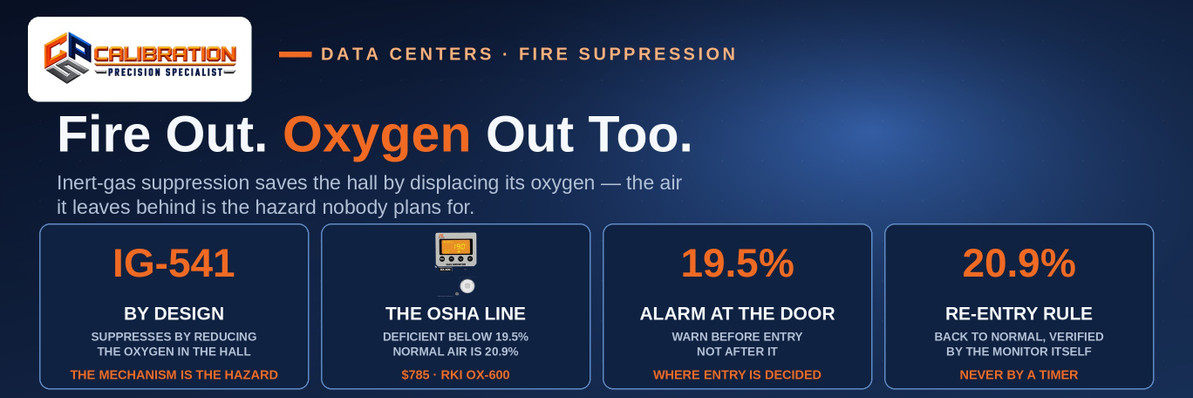
Inert-gas fire suppression protects a data hall by reducing the oxygen in it — IG-541 and similar blends extinguish fire by displacing breathable air by design — so the discharge that saves the servers leaves an atmosphere OSHA defines as oxygen-deficient (below 19.5% oxygen, against normal air at 20.9%), and the hall needs continuous oxygen monitoring, an alarm at the door, and a re-entry rule based on the monitor's reading, not a timer.
Every other gas hazard in this cluster is an accident: a battery vents, a refrigerant line leaks, an exhaust seal fails. This one is a success case. The suppression system does exactly what it was bought to do — flood the hall with inert gas, take the oxygen down, put the fire out — and in doing so it deliberately creates the one atmosphere in the building a person cannot safely breathe. Facilities plan carefully for the discharge. Far fewer plan for the hour after it: the technician at the door, the manager estimating "it's probably fine by now," the hall that looks, sounds, and smells completely normal. This post is about that hour. The general science behind oxygen displacement — nitrogen, argon, helium — is in our companion post on oxygen deficiency hazards; this one is specific to suppression halls. For the full facility map, start with what gas detection does a data center need?
How Does Inert-Gas Suppression Create an Oxygen Hazard?
By working as designed. Inert blends such as IG-541 — and CO2 suppression systems, where they are used — extinguish fire by reducing the oxygen concentration in the protected space. Fire needs oxygen; drop it far enough and combustion stops. Nothing about that is a malfunction. The hazard is the identity between the mechanism and the risk:
- The agent is not toxic — the absence it creates is the problem. Inert gas is not a poison. The danger is displacement: the hall's air, at about 20.9% oxygen, is diluted by gas that carries none.
- OSHA's line is 19.5%. Below 19.5% oxygen, 29 CFR 1910.146 defines the atmosphere as oxygen-deficient; above 23.5% it is oxygen-enriched, a fire hazard in its own right. A suppression discharge takes the hall's oxygen down through that line on purpose.
- There is no sensory warning. The discharged hall looks normal, sounds normal, and smells like nothing. The only instrument that knows the oxygen is gone is the one installed to measure it.
This post deliberately states no design discharge concentration and no recovery time — the oxygen level a specific system is engineered to reach, and how long a specific hall takes to ventilate back, come from that system's design documents and that hall's ventilation, and a general post quoting figures for them would be inventing precision.
Who Is at Risk, and When?
Three moments, three different people:
- Anyone inside at discharge. The event the evacuation alarm and discharge delay exist for — the known risk, and the one facilities do plan for.
- The first person back in. After the fire is out and the all-clear sounds, the hall can still be oxygen-depleted while every other sign reads normal. This is the moment nobody plans for, and the one this post is named for.
- Anyone near leaking storage, any day of the year. Suppression agent lives in cylinder banks, often in or beside the hall, connected by manifolds and fittings. A slow leak displaces oxygen quietly, with no discharge, no alarm event, and no fire — just a room drifting down. Only a continuous monitor sees it.
Risk two and three share a property: no event announces them. That is why the control is not a procedure taped to the door alone — it is an instrument reading, continuously, at that door.
What Controls Make a Suppression Hall Safe to Re-Enter?
Four, and they are specific:
- A continuous oxygen monitor in the hall. The stand-alone instrument for this duty is the RKI OX-600 — 0–25% range, $785 — reading the room around the clock, not just during events, which is what makes it the control for slow cylinder-storage leaks as well as discharges. Browse the stand-alone detectors range for the class.
- An alarm at the door. The reading and the warning belong where the entry decision is made — outside the hall — so the warning lands before the door opens, the same logic ASHRAE 15 applies to machinery rooms in the cooling plant.
- A re-entry rule with no timer in it. Nobody re-enters after a discharge until the monitor shows oxygen back at normal — about 20.9% — verified by the instrument. Not estimated, not "it has been an hour," not because the fire is out. The monitor is the all-clear.
- The same point covers the hall's other inert gases. Nitrogen used for purging and pressurization, and any other displacement source in the space, arrives at the same result by the same path. One oxygen point watches all of them — the broader picture is in oxygen deficiency hazards from nitrogen, argon, and helium.
Where CO2 is the suppression agent, the design adds a CO2 point alongside the oxygen point — the RKI RI-600 ($980) — because CO2 brings its own direct hazard on top of displacement. Larger halls tie every point into the fixed systems controller so the alarm reaches a staffed desk; if the system needs designing and installing, see fixed system installation.
How Is This Different from the Data Center's Other Gas Rooms?
Every room in this cluster displaces or endangers air by a different route. The battery room vents off-gas from a failing lithium-ion cell; the cooling plant leaks refrigerant that pools low; the generator room fills with exhaust CO on every run. Only the suppression hall's hazard is intentional, scheduled by design, and triggered by the building's own protective system — which is precisely why it slips out of hazard reviews written around accidents and equipment failures.
And the oxygen monitor itself needs calibration. An oxygen sensor is a consumable electrochemical cell reading continuously; it drifts like every other fixed sensor, silently. A suppression hall whose oxygen monitor reads high is a hall whose re-entry rule is enforced by a wrong number. Fixed points belong on a written calibration schedule through calibration services — we calibrate every channel — with the records kept under the CPS Calibration Program.
Frequently Asked Questions
Is inert-gas fire suppression dangerous to people?
The agent itself — blends such as IG-541 — is not a poison; the hazard is oxygen displacement. Inert-gas suppression extinguishes fire by reducing the oxygen concentration in the protected hall, and air diluted that way cannot properly support a person. OSHA defines an atmosphere below 19.5% oxygen as oxygen-deficient, against normal air at about 20.9%. The system is safe engineering for the equipment it protects; it becomes a people hazard at discharge, on re-entry afterward, and around leaking cylinder storage — which is why the hall needs continuous oxygen monitoring and a re-entry rule.
How does IG-541 put out a fire?
By taking the oxygen down. IG-541 and similar inert blends flood the protected space and reduce its oxygen concentration to a level that will not support combustion — the fire goes out because one leg of what it needs is gone. That mechanism is the entire point of this post: the discharge works by displacing breathable air, by design, so the atmosphere it leaves behind is the hazard, and it persists in a hall that otherwise looks completely normal.
What oxygen level is considered dangerous in a data hall?
Below 19.5% oxygen, OSHA (29 CFR 1910.146) defines the atmosphere as oxygen-deficient; above 23.5% it is oxygen-enriched, a fire hazard of the opposite kind. Normal air is about 20.9% oxygen. Those are the numbers a suppression hall's controls are built around: the continuous monitor watches for the room crossing the 19.5% line — from a discharge, or slowly, from a leaking cylinder bank — and re-entry after a discharge waits until the reading is back at normal.
When is it safe to re-enter a data hall after a suppression discharge?
When the oxygen monitor says so — not when a timer expires, and not when the room looks clear. The rule is: nobody re-enters until a continuous oxygen monitor shows the hall back at normal oxygen, about 20.9%, verified by the instrument. A discharged hall gives no sensory warning of its own — it looks, sounds, and smells normal while still depleted — so an estimate or an elapsed-time guess is not an all-clear. This is the control facilities most often leave unwritten, and it costs one sentence in the emergency plan.
Do data halls with inert-gas suppression need oxygen monitors?
Yes — a continuous oxygen point is the control that covers all three risk moments: a discharge with someone inside, the first re-entry into a still-depleted hall, and a slow leak from suppression cylinder storage on an ordinary day with no event at all. A stand-alone monitor such as the RKI OX-600 (0–25%, $785) reads the room around the clock and alarms at the door. An event-only approach — checking the air after a discharge with a portable — leaves the storage-leak case, and every unplanned entry, unwatched.
Can inert-gas suppression cylinders leak and cause a hazard without a fire?
Yes. The agent for a hall-sized system lives in cylinder banks, in or beside the protected space, under pressure and connected by manifolds and fittings. A slow leak displaces oxygen in the storage area quietly — no discharge, no alarm event, no fire — and the room drifts down toward the 19.5% deficient line with nobody notified. This is the strongest argument for continuous monitoring rather than event-based checking: the leak case has no event to trigger a check.
What's the difference between inert-gas and CO2 fire suppression hazards?
Both work by making the protected space's atmosphere unable to support fire, and both therefore endanger people in it — but CO2 adds a second hazard. Inert blends such as IG-541 are hazardous only by displacement: the gas itself is not toxic, the missing oxygen is the problem. Carbon dioxide displaces oxygen the same way and is also directly hazardous itself at elevated concentrations, so a CO2-protected space warrants a CO2 point (such as the RKI RI-600, $980) alongside oxygen monitoring. Inert-gas halls are covered by the oxygen point alone.
Where should oxygen monitors be placed in a suppression hall?
At occupied height in the hall — where the people in the room actually breathe — and, critically, readable at the door, where the entry and re-entry decisions are made. The monitor's job is to be seen by the person about to open the door after a discharge, so its alarm and display belong at that decision point, with larger halls tying the point into a controller that reports to a staffed desk. Placement inside the room follows the same breathing-zone logic as the oxygen deficiency hazards guidance for other inert gases.
Does oxygen monitoring cover other inert gases used in a data center?
Yes — that is one of its strengths. An oxygen monitor does not care which gas did the displacing. Nitrogen used for purging and pressurization, argon, helium, a leaking refrigerant charge, or a suppression discharge all arrive at the same result — oxygen pushed below 19.5% — and the same continuous point catches every route. Facilities with several inert gases do not need a detector per gas for the displacement hazard; they need the oxygen point, kept calibrated.
How often does an oxygen monitor in a data hall need calibration?
On the interval its manufacturer specifies — oxygen sensors are electrochemical cells that are consumed as they read, so their drift is a certainty to be managed, not a possibility. There is no single code interval for every monitor, and this post will not invent one. What is non-negotiable is the consequence of skipping it: in a suppression hall, the monitor's reading is the re-entry all-clear, so an uncalibrated monitor that reads high converts the safety rule into a false assurance. Put the point on a written calibration schedule and keep its records with the hall's life-safety documentation.
The Bottom Line
Inert-gas suppression is the one data center hazard that works perfectly when it harms the air: it protects the hall by displacing the oxygen in it, below the 19.5% line OSHA calls deficient. A continuous oxygen monitor, an alarm at the door, and a re-entry rule enforced by the instrument — never by a timer — are the whole control set, and they are cheap next to the system they guard.
Reviewing a suppression hall's post-discharge plan? Start with the stand-alone detectors range, or call CPS Calibrations at 865-900-8844.
CPS Calibrations · 109 S. Front Street, Rockwood, TN 37854 · Calibration Services · The CPS Calibration Program
Need a calibration you can file?
In-house calibration at CPS in Rockwood, Tennessee — $55 for single-gas instruments, $90 for 4- and 5-gas — every channel, as-found and as-left data, full certificate.
See Calibration Servicesor call 865-900-8844
Recent Posts
-

Can You Add a Pump to a SENKO SGT-P or MGT?
Yes — SENKO's SP-Pump101 external sampling pump ($330, part AAA006000) fits the SGT, SGT-P, and MGT, …Nov 12th 2026 -

What Refrigerant Detection Does a Grocery Store Need?
A grocery store needs refrigerant detection in three places: low-mounted carbon dioxide (R-744) sens …Nov 11th 2026 -

What Is LEL and UEL? The Explosive Range, Gas by Gas
The LEL is the lowest concentration of a gas in air that can explode, and the UEL is the highest: me …Nov 10th 2026