
Pumped Detector Filters: The Cheap Part That Decides Your Readings
Every reading from a pumped gas detector passes through its filters before it reaches a sensor — on the RKI GX-Force, a hydrophobic membrane and wire-mesh disk at the inlet and a particle filter over a second hydrophobic disk inside the probe. When those disks clog with dust or saturate with liquid, the pump starves: readings arrive low and late, response stretches past the GX-Force's specified T90 of 30 seconds, the pump strains and trips low-flow alarms — and the sensors, which are usually healthy, take the blame.
A pumped detector is a drinking instrument: its pump pulls air down a hose, through a probe, across its filters, and over its sensors, hundreds of times a shift. That sample path is the instrument. The sensors get the attention — they are the expensive parts, with model numbers and replacement schedules — but the filters in front of them are consumable disks that cost very little, load up quietly, and decide whether the sample that reaches those sensors is the air at the probe tip or a slowed, diluted version of it. This post maps the filter stack on the pumped meters CPS sells and services — the RKI GX-Force as the worked example, with the GX-6100 and RKI's clip-on RP-3R pump alongside — and gives the inspection and replacement discipline that keeps a cheap part from writing your readings. It sits next to our broader parts guide, finding the right pump, filter, and cap for your detector: that post is about matching parts by model; this one is about the pumped filter stack itself.
Where Do the Filters Sit on a Pumped Gas Detector?
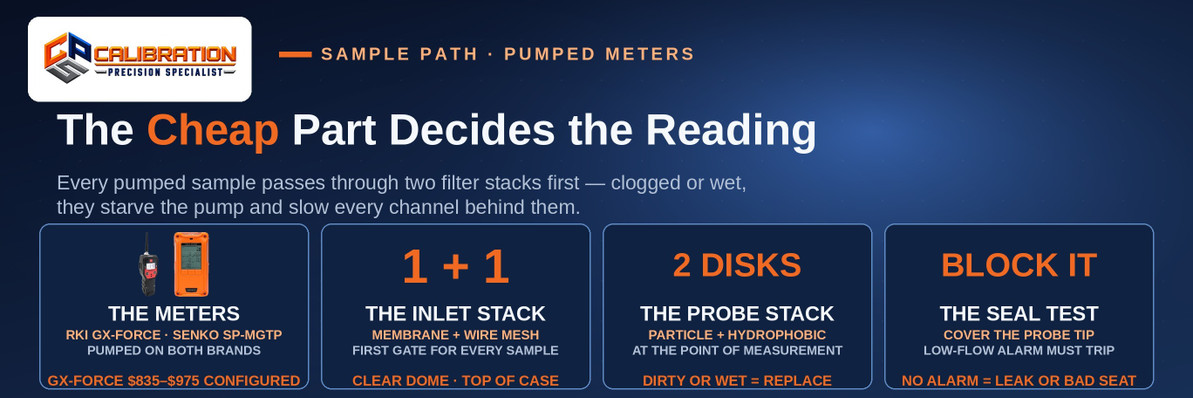
In two stations, and both of them matter. Using the GX-Force (RKI Operator's Manual, Part 71-0626) as the map:
- Station 1 — the inlet, on top of the case. The GX-Force's inlet fitting lives in a clear plastic dome-shaped filter holder. Under it sit one flat membrane hydrophobic filter, one wire-mesh disk, and a rubber retaining gasket. Every sample the pump draws enters through this stack first. The holder unscrews with a quarter turn, and the manual's replacement order matters: the wire-mesh disk goes on top of the hydrophobic filter.
- Station 2 — inside the probe. The probe at the end of the sample hose is a two-piece body holding its own pair: a particle filter sitting on top of a white hydrophobic filter disk, seated in a gasket. This is the first thing the sampled air meets, out at the point of measurement — and the first thing that gets dirty, wet, or knocked around.
The pattern repeats across the pumped line. The RKI GX-6100 — internal pump at 0.45 litres per minute, sampling up to 100 feet — ships with a probe on a 3-foot Teflon-lined hose fitted with a hydrophobic and dust filter. RKI's clip-on RP-3R pump, which turns a GX-3R or GX-3R Pro into a sample-draw instrument, holds two hydrophobic membranes in its inlet's clear holder, one on each side of a wire-mesh disk. And SENKO's pumped entry, the SP-MGTP, protects its draw path the same way, with its own inlet filtration specified in its manual. Different brands, same architecture: a gas-permeable, liquid-blocking membrane stack at the inlet, and — on probed instruments — a second stack at the probe. Browse the family under pumped monitors and you will find that layout everywhere.
Separate from the sample path, pumped meters also carry sensor filters inside the case — on the GX-Force, an H2S scrubber disk over the combustible sensor and charcoal/humidity disks over the CO and H2S sensors. Those scrub specific gases to protect or steady a channel; they are covered below only where their replacement clocks differ. The filters that decide your readings day to day are the two sample-path stacks.
What Does a Hydrophobic Filter Actually Do?
"Hydrophobic" means water-repelling. The membrane passes gas freely and blocks liquid water and dust — it is a one-job gatekeeper standing between a dirty, wet world and a pump and sensor set that want neither. Three consequences follow from that design:
- It protects the pump and the sensors. Dust and grit that reach a diaphragm pump score it and load it; liquid that reaches electrochemical sensors disturbs the cells outright. The filter takes that damage instead, sacrificially, which is exactly why it is a cheap replaceable disk and not a lifetime part.
- It only works while it can breathe. A membrane passes gas through its pores. Load those pores with dust, oil mist, or dried process grime and the flow through them falls. Saturate the membrane with liquid and it blocks flow almost completely — that liquid-blocking property is the feature, and a drowned filter doing its job feels, from the pump's side, like a wall.
- It cannot be judged by the display. The meter has no filter gauge. A loading filter announces itself indirectly — through response time, pump sound, and low-flow behaviour — which is why the inspection routine below is visual and hands-on, not a menu item.
How Does a Clogged Filter Change Your Readings?
Gradually, then all at once — and on every channel together, because every channel drinks through the same stack:
- Response stretches. The GX-Force is specified at T90 within 30 seconds — the time to show 90% of the final reading, the measure explained in what T90 response time is and why it decides how you sample. That specification assumes the sample can arrive. A restricted filter adds transport delay on top of sensor response: the gas at the probe tip is real, the reading is honest, and it is late — the worst combination in a pre-entry test, where late reads as safe. Hose length compounds it: the GX-Force draws up to 100 feet, and RKI cautions against hoses over 100 feet precisely because of flow-rate reduction.
- Readings sag. A pump pulling against a restriction moves less sample per minute, and reactive gases lose more on the way — they adsorb and react along a slow path. The displayed numbers run low, sometimes on all four channels at once. Simultaneous sag across LEL, O₂, CO, and H₂S is a path signature, not a sensor signature: four independent sensors do not age in lockstep, but one shared filter fails them all together.
- The pump tells on itself. RKI's troubleshooting instruction for the GX-Force is explicit: if the pump sounds bogged down, or an unexplained low-flow alarm occurs, inspect the probe's internal components. A fully blocked stack trips the low-flow alarm — the instrument protecting itself. A partially blocked stack is the dangerous case: flow stays above the alarm threshold, the meter stays in service, and every reading is quietly discounted.
- Bump tests start failing good meters. A bump test challenges the sensors with known gas — through the same sample path. A starved path delivers that gas slowly and weakly, so a healthy meter responds late or low and gets logged as a failure. This is one of the standard non-sensor causes in why bump tests fail, and it is why the filter check comes before any sensor is condemned.
What Loads a Pumped Detector's Filters?
Anything the probe visits, in rough order of how often CPS sees it:
- Dust and dry particulate — construction dust, grain and cement dust, rust scale around tank and vault openings. The probe lives at floor level and opening rims, where the dust is.
- Liquid draws. Pooled water in a vault, condensate in a wet well, a probe tip dipped instead of hovered. One liquid draw can saturate the probe's hydrophobic disk on the spot — and the RP-3R manual's warning for the clip-on pump applies to every pumped path: the hose and probe have no protection of their own beyond their filter stacks, so do not draw liquid through them. The full recovery routine is in what to do when your gas detector gets wet.
- Oil mist and aerosols — compressor rooms, machining areas, paint and coating work. Oil coats a membrane rather than dusting it, and coated pores do not recover.
- Wet, dirty sample points generally — wastewater headworks, sumps, manholes, tank farms after rain. The environments that most need pre-entry pumped testing are the environments that load filters fastest, which is not a coincidence to complain about; it is the maintenance schedule the work itself sets.
How Do You Tell a Filter Problem From a Sensor Problem?
Four checks, in the order a bench runs them — all of them cheaper than a sensor:
- 1. Look. Quarter-turn the inlet holder and open the probe. The manual's standard is appearance: replace the particle filter and hydrophobic disk if they appear dirty or saturated with liquid, and replace a probe gasket that appears damaged. A grey, darkened, or water-marked disk has already told you its state.
- 2. Listen. A pump straining against a restriction sounds bogged down — RKI names that sound as an inspection trigger. A pump that has changed its note since last week is reporting a load.
- 3. Run the seal test. With the probe assembled and the instrument running, cover the end of the probe tube with a finger: a low-flow alarm must occur. If it does not, tighten the probe; if it still does not, open the probe and check the hydrophobic disk's seating — a disk extending over its gasket's edge, or a pinched gasket, leaks air around the filter instead of drawing through it. This test proves the path is sealed and the pump can pull; it takes ten seconds.
- 4. Challenge at the probe tip. Apply known gas at the probe tip — not at the case — and time the response against what the meter used to do. Gas applied at the tip tests the whole path: hose, probe stack, inlet stack, pump, sensors. Slow or low at the tip, normal with gas at the inlet, localises the fault to the probe and hose side without opening a sensor.
If a fresh filter set restores response and the meter then bumps and calibrates cleanly, the sensors were never the problem. If it does not, the meter has a genuine sensor or pump fault — the point at which a bench earns its keep, through calibration services or by shipping the instrument in with its hose and probe, so the combination you actually carry is the combination that gets checked.
When Should You Replace Pumped Detector Filters?
On condition, on schedule where the manufacturer sets one, and immediately after the events that saturate them. There is no honest universal interval for sample-path filters — a meter probing dusty vaults weekly and a meter hanging in a clean plant live different filter lives — so anyone quoting one number for every fleet is guessing. What the manufacturers actually specify:
- Sample-path filters (inlet and probe): replace on condition. Dirty in appearance, saturated with liquid, damaged gasket, a pump that sounds loaded, an unexplained low-flow alarm, or response that has visibly slowed — any one of these is a replacement trigger, per the GX-Force manual's own inspection rule. After any liquid draw, do not wait for a symptom: the probe stack gets opened and the disks replaced or proven dry and clean.
- Sensor scrubber filters run on clocks. The GX-Force's H2S scrubber disk over the combustible sensor is spent after 33 ppm-hours of H2S exposure — RKI works that out as 80 minutes at 25 ppm H₂S, or 40 two-minute calibrations from a 25 ppm cylinder. Crews who calibrate often or work around H₂S burn that clock faster than the calendar suggests.
- The dual CO/H₂S sensor filter has a calendar rule for sensitive alarms. For users running a 1 ppm H₂S alarm setpoint, RKI specifies replacement every 6 months, or sooner on H₂S zero drift, unexplained readings, or visible dirt — whichever comes first. False or elevated CO readings, especially alongside H₂S, mean the charcoal half is done.
- Filters are replaced, not washed. The GX-Force manual's procedure is removal and replacement of the disks; no cleaning, washing, or blowing-out procedure is specified for the hydrophobic membranes, because a membrane's pores are the instrument — damaging them while "cleaning" them trades a visible clog for an invisible leak path. Treat the disks as the consumables they are, keep a spare set with each pumped instrument and in the calibration gas kit, and log the change the way you log a bump test.
The Filter Routine: Before the Shift, After the Dirty Job
Folded into the day, the whole discipline is minutes:
- Before the shift, with the bump test: glance at the probe stack and inlet holder, listen to the pump, run the finger-over-the-tip seal test. Thirty seconds, no tools beyond a quarter turn when something looks off.
- At the probe, every time: hover, never dip. The probe samples air; the moment it samples liquid, the job gains a filter change.
- After dusty or wet work: open the probe before the meter goes back on charge. Dust left sitting in a damp probe sets like grout; the same disk inspected the same day is a ten-second judgement.
- At every calibration: the filter state goes in the record alongside as-found readings. A meter that arrives at CPS for calibration gets its sample path inspected as part of the bench work for the same reason — a certificate written behind a clogged filter certifies the filter's behaviour, not the sensors'.
Frequently Asked Questions
What does a hydrophobic filter do on a pumped gas detector? It lets the gas sample through and blocks liquid water and dust. On a pumped detector the membrane stack — at the inlet, and on probed instruments inside the probe as well — is the sacrificial barrier that keeps dust out of the pump and liquid off the sensors. The trade-off is built into the design: a membrane saturated with liquid blocks flow almost completely, which protects the instrument and starves it at the same time, so a wet filter is replaced, not waited out.
Where are the filters on an RKI GX-Force? In two sample-path stations. The inlet filter holder — the clear plastic dome on top of the case — holds one flat hydrophobic membrane filter, a wire-mesh disk on top of it, and a rubber retaining gasket. The probe holds a second pair: a particle filter sitting on a white hydrophobic filter disk in a gasket. Inside the case there are also sensor filters — an H2S scrubber disk over the combustible sensor and charcoal/humidity disks over the CO and H2S sensors — which scrub specific gases rather than guarding the sample path.
How often should you replace a pumped gas detector's filters? Sample-path filters are replaced on condition, not on a universal calendar: when they appear dirty, are saturated with liquid, when the pump sounds bogged down, when an unexplained low-flow alarm occurs, or when response visibly slows — RKI's stated triggers for the GX-Force. Some sensor filters do carry clocks: the GX-Force's H2S scrubber disk is spent after 33 ppm-hours of H2S exposure, and its dual CO/H2S filter is replaced every 6 months for users running a 1 ppm H2S alarm setpoint. Any source quoting one interval for every pumped meter in every environment is inventing it.
Can a clogged filter make a gas detector read low? Yes — on every channel at once. A restricted filter stack reduces the sample flow the pump can move, so gas arrives at the sensors more slowly and, for reactive gases, partially lost along the way. The result is readings that sag and lag together across LEL, O₂, CO, and H₂S. Sensors age independently; simultaneous sag on all channels is the signature of a shared restriction — filter, hose, or pump — and the path gets checked before any sensor is replaced.
Why is my pumped gas detector in low-flow alarm? Because the pump cannot move its expected flow, and the restriction is usually in the filter stack: a clogged inlet membrane, a dirty or liquid-saturated probe filter, or — at the other extreme — a blockage elsewhere in the path. RKI's instruction for the GX-Force is to inspect the probe's internal components when a low-flow alarm is unexplained, and to replace the particle filter and hydrophobic disk if they appear dirty or saturated. A damaged probe gasket that leaks can also disturb flow behaviour — replace it if it appears damaged.
Can a dirty filter make a gas detector fail a bump test? Yes. A bump test delivers known gas through the same sample path the meter samples through, so a clogged or saturated filter delivers that gas slowly and weakly — the meter responds late or low and is logged as failed with healthy sensors behind the restriction. The correct sequence after a failed bump on a pumped meter is: inspect and replace the filter disks, then bump again, then calibrate. Only a meter that still fails with a proven-clean path has a sensor problem.
What happens if a pumped gas detector sucks up water? The pump pulls the liquid into the probe, hose, and filter stacks instead of merely wetting the case — the most damaging way for a detector to get wet. The probe's hydrophobic disk saturates and blocks flow, the pump strains, and liquid that passes the stack can reach the sensors. RKI's RP-3R pump manual warns that the hose and probe have no hydrophobic protection of their own and instructs users not to draw liquid through them. After any liquid draw, the probe stack is opened and its disks replaced, and the meter is bump tested and calibrated before it works again.
Can you clean a hydrophobic filter instead of replacing it? Manufacturers specify replacement, not cleaning. RKI's GX-Force maintenance procedure is to remove and replace the hydrophobic and particle filter disks — no washing, soaking, or blowing-out procedure is given, because the membrane's pores are what separate gas from liquid, and damaging them creates an invisible leak path that looks like a fix. The disks are inexpensive consumables; keep spares with the instrument and replace on the stated triggers.
How do you test whether a pumped detector's pump and filters are working? Use RKI's seal test from the GX-Force manual: with the probe assembled and the instrument running, cover the end of the probe tube with a finger — a low-flow alarm must occur. If it does not, hand-tighten the probe and retest; if it still does not, open the probe and check that the hydrophobic disk sits flat inside its gasket without extending over the edge. Follow it with a response check: known gas at the probe tip, timed against the meter's specified T90 — 30 seconds on the GX-Force.
Do pumped and diffusion detectors use the same filters? No — they guard different paths. A diffusion detector such as the RKI GX-3R breathes through a hydrophobic dust filter fitted over its sensor ports, under the case cover. A pumped detector keeps a filter arrangement over its sensors too, but adds the sample-path stacks this post covers: an inlet membrane stack the pump draws through, and on probed instruments a particle-plus-hydrophobic pair inside the probe. The parts are model-specific in both cases — order by the instrument you own, never by resemblance.
The Bottom Line
A pumped detector's filters are the cheapest parts on the instrument and the only parts every single reading passes through. On the GX-Force that is two stacks — a hydrophobic membrane and mesh at the inlet, a particle filter and hydrophobic disk in the probe — and RKI's maintenance rule for them is refreshingly plain: dirty or saturated means replaced, a straining pump or an unexplained low-flow alarm means inspect now, and the finger-over-the-tip test proves the path in ten seconds. Fleets that run that routine stop failing good meters on bump tests, stop condemning healthy sensors, and stop discovering — mid-entry — that a pre-entry reading arrived late. CPS Calibrations in Rockwood, Tennessee inspects the sample path on every pumped meter that crosses the bench, because a calibration is only worth the path the gas travelled to get there.
Need a calibration you can file?
In-house calibration at CPS in Rockwood, Tennessee — $55 for single-gas instruments, $90 for 4- and 5-gas — every channel, as-found and as-left data, full certificate.
See Calibration Servicesor call 865-900-8844
Recent Posts
-

What Is Remote Monitoring for Fixed Gas Detection?
Remote monitoring for fixed gas detection means a fixed system's live readings, trends, and alarm hi …Nov 23rd 2026 -

What Are the Key Differences Between the GX-6000 and GX-6100?
The RKI GX-6100 is the current replacement for the discontinued GX-6000: both are pumped 6-gas monit …Nov 22nd 2026 -

How to Read a PID Correction Factor Chart
To read a PID correction factor chart, find your vapor’s row, take the factor under your own lamp en …Nov 21st 2026