
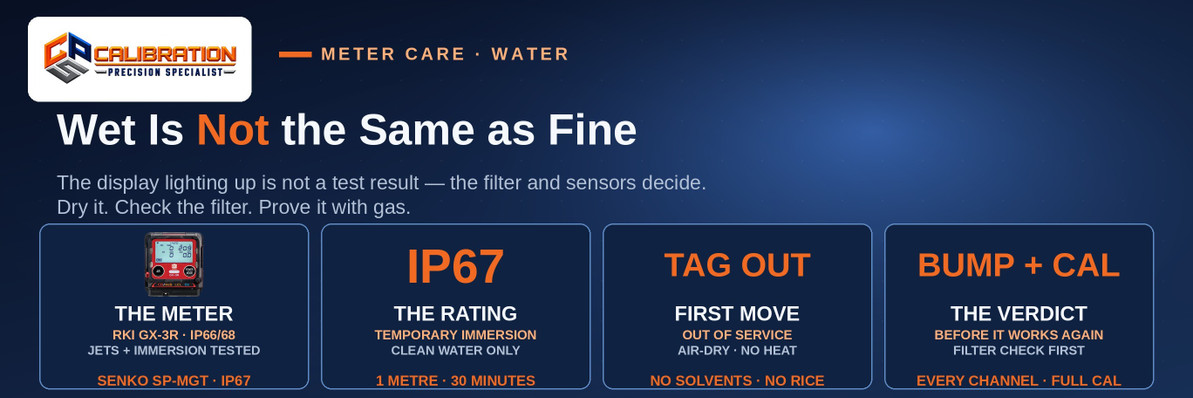
What Should You Do When Your Gas Detector Gets Wet?
Take a gas detector that has been soaked or immersed out of service immediately, and do not trust its readings until it is completely dry, its hydrophobic filter has been inspected or replaced, and it has passed a bump test and a full calibration. An IP67 rating certifies only temporary immersion in clean water — 1 metre for 30 minutes — and SENKO states in its own manual that an IP rating does not imply the equipment will detect gas during or after exposure to those conditions.
It happens on ordinary jobs, not dramatic ones. The meter goes into a wet well with its wearer, gets hosed down with the rest of the gear, rides out a storm on a collar, or takes a short swim in a sump, a ditch, or a tank of something nobody wants to name. It comes out dripping, the display lights up, the numbers look normal — and that normal-looking display is the trap. A gas detector is a measuring instrument whose sensors breathe through a filter, and water attacks exactly that path. This post is the honest version of what the rating on the case does and does not promise, what to do in the first minutes after a soaking, and the checks that decide whether the meter goes back to work or goes on a bench. It applies across the portable multi-gas monitors CPS sells and services, from the RKI GX-3R to the SENKO SP-MGT.
What Does Your Gas Detector's IP Rating Actually Promise?
The IP code (IEC 60529) is two separate tests wearing one label. The first digit grades solids — a 6 means dust-tight, no dust ingress at all. The second digit grades water, and each number is a different test, not a rung on one ladder:
- 5 — water jets: a 6.3 mm nozzle at 12.5 litres per minute and about 30 kPa. Rain and light spray territory.
- 6 — powerful water jets: a 12.5 mm nozzle at 100 litres per minute and about 100 kPa — roughly eight times the flow of the 5 test. Hose-downs and storm-driven water.
- 7 — temporary immersion: submerged at 1 metre for 30 minutes.
- 8 — continuous immersion: beyond 1 metre, for longer, under the exact depth and time the manufacturer specifies — there is no single standard 8 test.
Two consequences follow, and both matter after a soaking. First, the jet tests and the immersion tests are different tests: passing immersion does not by itself prove the jets, which is why a dual rating exists. The RKI GX-3R carries IP66/68 — it passed the powerful-jets test and the immersion test. The SENKO SP-MGT carries IP67 — dust-tight and immersion-tested, with no jets rating claimed. Neither instrument is "waterproof" in the everyday sense; each is certified against the specific tests printed on it. The full ratings tour is in what IP ratings and intrinsic-safety marks actually mean.
Second, every one of those tests is run in clean, fresh water, in a lab, on a new instrument with intact seals. The rating says nothing about salt water, chlorinated water, sewage, fuel-contaminated water, or hot chemical washdown — all of which attack seals and sensor membranes harder than clean water does — and nothing about a three-year-old meter whose case has been dropped, opened, and resealed in the field. Treat the rating as "this design survived a defined clean-water test when new," not as a lifetime guarantee about your unit in your water.
Rain, a Puddle, and a Sewer Are Not the Same Water
What the meter fell into decides how worried to be, because the failure modes are different:
- Rain, spray, and a brief clean-water dunk inside the rating — a meter rained on, or a GX-3R fished straight out of a clean puddle — is the event the rating was built for. The case did its job. The risk that remains is the filter and the sensor faces, covered below.
- Immersion past the rating — deeper than the rating, longer than the rating, or any immersion at all for a meter with damaged seals — is where water gets inside the case. Once liquid reaches the board and the sensor backs, drying the outside proves nothing about the inside.
- Dirty water is a different event entirely. Wastewater, sump water, and process water carry grit, oils, and dissolved chemicals. They load and contaminate the hydrophobic filter, coat sensor membranes, and leave residue that keeps interfering after the meter looks dry. A meter that comes out of a sewer wet well has had a contamination event, not just a wetting — which is one reason wastewater crews treat the meter check after a job as part of the job.
- A pumped meter that drank is the worst case. A diffusion meter gets wet on its surfaces. A pumped meter actively pulls the liquid in. RKI's manual for the RP-3R sample-draw pump puts it plainly: the hose and probe do not have their own hydrophobic filters, so do not draw liquid through them — the pump's inlet holds two hydrophobic membranes precisely because liquid in the sample path is the failure the design fears. If the pump pulled water, assume the whole sample path — hose, filters, pump, and sensor chamber — is wet until it is opened up and proven otherwise.
What Should You Do in the First 10 Minutes After a Gas Detector Gets Wet?
Work this list in order. None of it requires tools, and all of it is about not making a survivable soaking worse:
- Take it out of service and tag it. The meter is not protecting anyone until it passes the return-to-service checks below. A spare goes on the collar; the wet meter goes on the bench list. This is the step crews skip, because the display still works — and it is the step that matters most, for the reason SENKO prints in its manual: the rating never promised detection during or after the exposure.
- Do not charge it, dock it, or leave it running to "dry itself out." Water and charging contacts are a poor mix, and a running pumped unit keeps pulling wet air — or worse — through the sensors. Power it down once it is out of the hazardous area.
- Get the outside dry with a clean, soft cloth. RKI's GX-3R Pro manual gives the cleaning rule for the line: a cloth dampened with water if the instrument is dirty, and no alcohol or other cleaning solvents. Solvents and alcohol cleaners can attack sensor membranes and seals — the meter has had enough chemistry for one day.
- Drain and air-dry it in a clean, dry place at normal room conditions. Tip it sensor-side down so water runs away from the sensor ports rather than pooling on them, and let air do the work. No heat gun, no oven, no dashboard in the sun: heat is what ages these sensors and batteries in storage, and cooking a wet meter trades a drying problem for a sensor problem. Skip the bag of rice, too — no manufacturer lists it as a drying method, its dust works against a dust-sensitive filter, and it cannot pull water out of a sealed case in any case.
- Write down what happened while it is fresh: what liquid, how deep, how long, pumped or diffusion, and whether it was running. That note decides the bench work later — clean rain for 30 seconds and sewage for 10 minutes are different repairs, and the technician should not have to guess which one arrived.
Why Can't You Trust the Readings After a Wet Gas Detector Dries?
Because the display drying out and the measurement path drying out are two different events, and the second one is the one that protects people:
- A wet hydrophobic filter starves every sensor behind it. On the GX-3R line, RKI fits an oval hydrophobic dust filter over the sensor ports, covering the sensors and their individual filters — it is the membrane that lets gas through and keeps liquid and dust out. Saturated or grit-loaded, it slows diffusion to a crawl or blocks it outright. The meter still displays numbers; they are just late, low, or frozen near zero, which is the most dangerous output a gas detector produces. The filter and its gasket are replaced as a set, and a wetting event is a standing reason to inspect them — the same small-parts logic covered in finding the right pump, filter, and cap for your detector.
- Water changes the sensors themselves. The CO, H2S, and similar channels are electrochemical cells built around an aqueous electrolyte. Immersion — especially in contaminated water — can dilute, contaminate, or physically disturb that chemistry. A cell can read plausibly in clean air and still be slow or under-responsive to its target gas, which only a gas challenge reveals.
- Pumped paths hide their damage. Water sitting in a hose, a pump head, or a filter housing keeps the sample wet long after the case is dry, dilutes the sample on its way in, and shows up as sluggish response and low readings — the same symptoms as the clogged-filter failures in why bump tests fail.
- Corrosion is a delayed failure. Liquid that reached the board, the charging contacts, or the sensor pins may not stop the meter today. It stops it in three weeks, mid-shift, as an intermittent fault. That is why the depth, duration, and liquid type from step 5 above matter: they are how a bench decides whether "dry and passing" is enough or the meter needs opening.
The Return-to-Service Check: Dry, Inspect, Bump, Calibrate
A wet meter earns its way back in four stages, and it does not skip stages:
- Completely dry — inside the sample path, not just the case. Allow real drying time in a clean, dry room, longer for a pumped unit with a hose and pump head to clear. If there is any sign water got inside the case — fogging, droplets, residue — drying time is over and bench service is next; that meter does not go back on a collar on hope.
- Inspect the wear parts. Hydrophobic filter and gasket, sensor faces, calibration cap, pump filters and hose on a pumped unit, charging contacts. Replace the filter set if it was saturated or the water was dirty — it is the cheapest part on the instrument and the one standing between the sensors and the next event.
- Fresh-air zero, then a bump test on every channel. Each sensor must respond to its challenge gas inside its expected time. A channel that is slow, low, or silent has told you the water reached it — believe it. Bump testing is the verdict step, not a formality.
- A full calibration. Zero and span every channel as configured, the same bench routine as a normal calibration — the GX-3R version is walked through in how to calibrate an RKI GX-3R. If a channel will not span after a proper calibration attempt, the sensor is finished and gets replaced, then the meter gets calibrated again. What happens at each branch of that decision is covered in your detector failed calibration: what happens next.
Only a meter that clears all four stages goes back to work — and the wetting event, the filter change, and the passing calibration belong in its record, so the next intermittent fault has a history to be read against.
When Is a Wet Gas Detector Done?
Some soakings end the meter or the sensor set, and calling that early is cheaper than trusting it late. Send it in — or retire the affected parts — when any of these is true:
- Water was inside the case, or the liquid was sewage, salt water, fuel, or a chemical stream rather than clean water.
- Any channel fails or barely passes its bump test or will not span in calibration after drying and a filter change.
- A pumped unit drew liquid and now shows low-flow faults, sluggish response, or a pump that sounds wrong.
- The display, buzzer, or buttons behave intermittently after drying — corrosion announcing itself.
- The meter was immersed past its rating: deeper or longer than its printed test, or at all with a cracked case or a damaged seal.
CPS benches wet meters the same way it handles any ship-in: check it in, dry and inspect it, test every channel as-found, and quote any sensor or repair work in writing before doing it — through calibration services in Rockwood or by shipping the instrument in. A drowned meter that comes back with a full certificate is a meter you can defend. One that "seemed fine" is not.
Frequently Asked Questions
Can a gas detector get wet?
Yes, within its rating. Most modern portables are built for wet work — the SENKO SP-MGT is rated IP67 and the RKI GX-3R is rated IP66/68 — so rain, spray, hose-downs within the jets rating, and brief clean-water immersion within the immersion rating are survivable by design. What the rating never covers is detection accuracy during or after the exposure: SENKO states in its own manual that an IP rating does not imply the equipment will detect gas during or after exposure to those conditions.
What happens if a gas detector gets wet?
The case usually keeps liquid out if the exposure stayed inside the rating, but the hydrophobic filter over the sensor ports can saturate or load with grit, which slows or blocks gas reaching the sensors — the meter displays numbers that are late, low, or stuck near zero. Immersion past the rating, dirty water, or a pumped meter drawing liquid can put water into the sample path or the case, where it disturbs electrochemical sensors and corrodes contacts and boards over the following weeks.
What does IP67 mean on a gas detector?
Under IEC 60529, the 6 means dust-tight — no dust ingress — and the 7 means the enclosure passed temporary immersion in clean water at 1 metre for 30 minutes. It is a specific lab test on a new instrument, not a general promise: it does not cover deeper or longer immersion, high-pressure jets, salt water, chlorinated water, sewage, or chemical washdown, and it does not certify that the detector measures gas accurately while wet or after drying.
Is the RKI GX-3R waterproof?
The GX-3R is rated IP66/68: the 66 covers powerful water jets (a 12.5 mm nozzle at 100 litres per minute), and the 68 covers continuous immersion beyond 1 metre under the conditions RKI specifies — two separate tests, both passed. That makes it one of the best-sealed small portables made, and it still is not a license to work it underwater or to trust it after a soaking without drying, a filter check, a bump test, and a calibration.
Can you use a gas detector after it was dropped in water?
Not until it has earned its way back: completely dry, hydrophobic filter inspected or replaced, fresh-air zero, a bump test passed on every channel, and a full calibration. A meter fished out of clean water inside its rating often clears all of that. One that went into dirty water, went past its rating, or fails any stage belongs on a service bench, not on a collar — the display lighting up is not a test result.
How long does a gas detector need to dry after getting wet?
There is no universal number, and any source that gives one without asking what the meter fell into is guessing. Drying time depends on the liquid, the depth and duration, and whether the sample path of a pumped unit took water in. The honest rule is condition-based, not clock-based: the meter stays out of service until it is completely dry — case, filter, and sample path — and then it still has to pass its bump test and calibration before it works again.
Should you put a wet gas detector in rice?
No. No gas detector manufacturer lists rice as a drying method, rice dust works directly against the dust-sensitive hydrophobic filter the sensors breathe through, and rice in a bag cannot pull moisture out of a sealed instrument case in any event. Dry the meter in clean, dry room air, sensor-side down, with no added heat — then prove it with gas, not with a kitchen remedy.
Can a pumped gas detector suck up water?
Yes — and it is the most damaging way for a detector to get wet, because the pump actively pulls the liquid into the hose, filters, pump, and sensor chamber instead of merely wetting the case. RKI's RP-3R pump manual warns that the hose and probe have no hydrophobic filters of their own and instructs users not to draw liquid through them; the pump inlet's two hydrophobic membranes are the last line of defense, not a license to sample water.
Does an IP rating cover sewage or salt water?
No. IP immersion and jet tests are performed in clean, fresh water. Sewage carries grit and chemicals that load the hydrophobic filter and contaminate sensor membranes, and salt water is corrosive to contacts and seals in a way fresh water is not. A meter soaked in either has had a contamination event: it gets dried, its filter set replaced, and its channels proven by bump test and calibration before it is trusted again.
Do you have to calibrate a gas detector after it gets wet?
After any real soaking, yes — once it is fully dry and its filter has been inspected or replaced. The bump test comes first and tells you whether each channel still responds; the full calibration then re-establishes zero and span on every channel as configured. A channel that will not span after a proper calibration attempt is a finished sensor: it gets replaced, and the meter gets calibrated again before it returns to service.
The Bottom Line
A wet gas detector is not automatically a dead one — the IP66/68 GX-3R and the IP67 SP-MGT are sealed for exactly the rain, washdowns, and short clean-water dunks their ratings describe. But a rating is a clean-water lab test with limits printed in numbers — 1 metre, 30 minutes for IP67; jets and manufacturer-specified immersion for IP66/68 — and no rating anywhere promises the meter still measures gas correctly afterward. So the routine never changes: out of service, dried with air and patience rather than heat or solvents, filter inspected or replaced, bump tested, and fully calibrated before it protects anyone again. CPS Calibrations in Rockwood, Tennessee benches wet meters the same way — every channel tested as-found, any repair quoted in writing first, full certificate when it goes back.
Need a calibration you can file?
In-house calibration at CPS in Rockwood, Tennessee — $55 for single-gas instruments, $90 for 4- and 5-gas — every channel, as-found and as-left data, full certificate.
See Calibration Servicesor call 865-900-8844
Recent Posts
-

Which GfG Portable Gas Detector Is Best for You?
The right GfG portable is decided by three questions — how many gases, pumped or diffusion, and PID …Nov 24th 2026 -

What GfG Fixed Gas Detection Systems Are There? Every Transmitter and Controller Explained
GfG’s fixed gas detection line at CPS is 39 products in two layers: 23 transmitters and detection sy …Nov 24th 2026 -

What GfG Portable Gas Detectors Are There? Every Model Explained
GfG’s portable line at CPS is 14 products built around six instruments: the Micro IV single-gas dete …Nov 24th 2026