
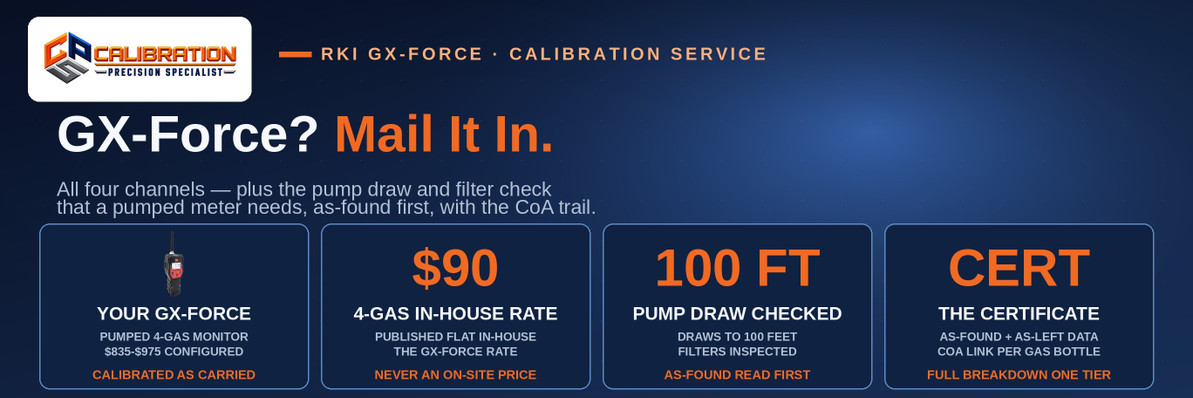
RKI GX-Force Calibration Service: Mail In Your Meter
Mail-in calibration for the RKI GX-Force costs $90 at CPS Calibrations — the published in-house rate for a 4-gas instrument — and covers every channel the meter carries: combustible gas 0–100% LEL, oxygen 0–40.0% vol., carbon monoxide 0–2,000 ppm, and hydrogen sulfide 0–200.0 ppm, with as-found readings recorded before any adjustment, a draw check and filter inspection on the internal sample pump that pulls from up to 100 feet away, a sensor health check, and the meter returned with a certificate showing as-found and as-left data and a Certificate of Analysis link for each calibration gas bottle used. Ship it to 109 S. Front Street, Rockwood, TN 37854; call 865-900-8844 first to confirm the current turnaround.
The GX-Force is the meter crews reach for before they enter a space: a pumped 4-gas monitor — LEL, O2, CO, and H2S — with an internal sample pump rated to draw from up to 100 feet away, about 9.87 oz, IP67, with roughly 30 hours of runtime in Normal Mode (about 20 hours in Leak Check Mode). That pump is exactly why its calibration is not a diffusion-meter job. A bench that calibrates the sensors but never checks whether the pump still draws, or whether its filters are clogged, has documented a different instrument than the one pulling air down 50 feet of hose on your next entry. This post is the service page for the GX-Force: what its calibration covers channel by channel, what the bench checks around the calibration — pump and filters included — and what comes back in the box. If you are still deciding between pumped instruments, the head-to-heads are RKI GX-Force vs. GX-6100 and RKI GX-3R vs. GX-Force. The meter itself, configured, runs $835–$975 on our store — the RKI GX-Force is priced by its charger and hose-and-probe package, which is why this post quotes the configured range.
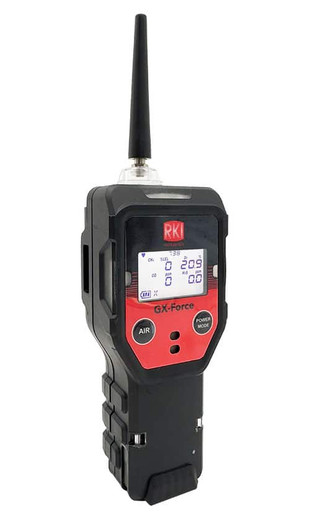
RKI GX-Force Pumped 4-Gas Monitor
Pumped LEL, O2, CO, H2S — draws a sample from up to 100 feet away.
$835–$975 configured
See the GX-ForceWhy Does the Pump Change the Calibration?
Because on a pumped meter, the reading is only as good as the sample path. The GX-Force's internal pump runs at a nominal 0.5 L/min with a minimum suction of 0.35 L/min, and it is specified to sample from up to 100 feet away. A weak pump, a cracked hose, or a clogged hydrophobic filter slows the sample, stretches response time, and can starve the sensors — the meter can read low on a space that is not low. So the bench checks the whole path you actually use: that the pump draws, that its filters are inspected, and that the meter leaves calibrated as the pumped instrument it is, not as four sensors in a case. We calibrate every channel — and on a GX-Force, the pump check is part of what "every channel" honestly means.
What a GX-Force Calibration Covers, Channel by Channel
Every channel the meter carries, every time, against documented calibration gas:
- Combustible gas (LEL), 0–100% LEL. Its as-found reading is recorded first — what the sensor was actually reporting against known gas when the meter arrived — then it is adjusted and its as-left reading recorded.
- Oxygen (O₂), 0–40.0% vol. The channel that catches both deficient and enriched air. Oxygen sensors drift with age and exposure, so the as-found figure is the evidence of how far this one had moved.
- Carbon monoxide (CO), 0–2,000 ppm. Calibrated as configured, and reported in its own units on the same certificate.
- Hydrogen sulfide (H₂S), 0–200.0 ppm. The fast, unforgiving toxic channel — as-found and as-left beside the others, so one document tells the meter's whole story.
Those ranges are the GX-Force's own specification, from the meter's product data. The certificate reports each channel separately — four channels, four results — rather than collapsing the instrument into a single pass.
The Pump Check, the Filter Check, and the Sensor Health Check
Send the hose and probe you actually sample with, if you use one, and the bench treats the sample path as part of the instrument: the pump's draw is checked, and its filters are inspected — a clogged filter is a cheap part that decides whether a pumped reading arrives at all. A calibration performed on a meter whose pump is starved in the field is documentation for a different instrument than the one on the job.
Around the calibration itself sits the sensor health check. Calibration answers whether the meter reads correctly against known gas today; the health check answers whether anything is heading for trouble. A channel that calibrates back into specification behaves differently from one that is sluggish, unstable, or at the edge of its range, and the as-found data shows how far each channel had drifted since its last calibration. If a sensor is spent or failing, you hear it in a specific form: a written quote before any work, with the choice yours. A calibration booking is never a blank check.
What Comes Back in the Box
Your GX-Force, calibrated — and its documentation. The certificate is the CPS standard, one tier with the full breakdown: as-found and as-left readings for every channel, and the gas trail behind them — when a calibration gas bottle enters service at CPS, the supplier QR code on it is scanned and its Certificate of Analysis link is stored on the bottle's record, and the certificate carries a clickable CoA link for each bottle used on your meter. The meter is checked in and tracked against its serial number from arrival to return, and its record joins the CPS Calibration Program: its history builds calibration by calibration behind one fleet history link, and a due-date reminder email arrives before the next calibration comes due. No contract, no monthly fee. Send the meter, its charger, and the hose and probe you use; do not send calibration gas cylinders — we calibrate with our own documented gas. Return shipping is the customer's cost, arranged when the service is booked. The general ship-in process, for any instrument, is in how mail-in gas detector calibration works, and our calibration services page covers the wider bench. You can also start with the ship-in calibration and repair request.
Frequently Asked Questions
How much does it cost to calibrate an RKI GX-Force?
Ninety dollars at CPS Calibrations. The GX-Force is a 4-gas instrument, so it takes the published in-house rate for 4- and 5-gas instruments: $90. That is a bench rate for calibration performed in-house at our Rockwood, Tennessee shop; it never applies to on-site work, which is quoted in writing. Shipping is separate in both directions, and any sensor or repair work beyond calibration is quoted in writing before it is done.
What does a GX-Force calibration include?
Calibration of every channel the meter carries — LEL, O₂, CO, and H₂S — with as-found readings recorded before any adjustment and as-left readings after, a draw check and filter inspection on the internal sample pump, a sensor health check on the bench, and a full certificate showing both sets of readings plus a Certificate of Analysis link for each calibration gas bottle used. The meter's record is entered in the CPS Calibration Program, so its history is kept by serial number and you are reminded before the next due date. There is one certificate tier; the full breakdown is the standard, not an upgrade.
Does the calibration check the GX-Force's pump?
Yes. The GX-Force samples through an internal pump rated to draw from up to 100 feet away, at a nominal 0.5 L/min with a minimum suction of 0.35 L/min. The bench checks that the pump draws and inspects its filters as part of the visit, because a weak pump or a clogged filter changes what the sensors actually see in the field. Send the hose and probe you sample with, if you use one, so the sample path you carry is the one that leaves checked.
How far can a GX-Force sample from?
Up to 100 feet, per RKI's specification for the instrument — that is the point of a pumped monitor: test the space from outside it, before entry, instead of carrying a diffusion meter into an untested atmosphere. The pump's nominal flow is 0.5 L/min. Drawing from distance only works if the pump and filters are healthy, which is why the draw and filter check is part of a GX-Force calibration at CPS, not an extra.
Should I send the hose and probe with my GX-Force?
Yes, if you use one. The combination you carry is the combination that should leave calibrated and checked: send the hose and probe and the bench checks the sample path as part of the visit. Also send the charger your configuration uses and a note inside the box with your company name, a contact, and the meter's serial number. Do not send calibration gas cylinders; CPS calibrates with its own documented gas, and the certificate links to that gas's Certificate of Analysis.
What happens if my GX-Force fails calibration?
The bench finds it and you decide what happens next. The as-found readings and the sensor health check show whether each channel calibrated back into specification or whether a sensor is spent or failing. Anything beyond calibration is quoted in writing for your approval before work begins. Approve the quote and the meter is repaired and calibrated; decline it and the meter returns as-is with its as-found record, which documents exactly where it stands.
Is GX-Force calibration different from GX-3R calibration?
The bench discipline is identical — every channel, as-found first, full certificate — and so is the price: $90 in-house for either meter, because both are 4-gas instruments in the published 4- and 5-gas rate. The difference is the sampling method: a GX-3R is a diffusion monitor, while a GX-Force draws its sample through an internal pump from up to 100 feet away, so its calibration visit also includes the pump draw and filter check. The meters themselves are compared in RKI GX-3R vs. GX-Force.
Can I calibrate my GX-Force myself instead?
You can — RKI designs the platform for user calibration, with field-replaceable sensors and filters. The honest trade-off is gases, the pump check, and documentation: doing it yourself means owning the correct documented 4-gas mix, checking the draw and filters yourself, and keeping the records. Mailing the meter in means the bench does it with documented gas and returns a certificate with as-found and as-left data for all four channels and the gas's CoA trail, with the record kept in the CPS Calibration Program.
How long will my GX-Force be gone?
Call 865-900-8844 before you ship and we will confirm the current turnaround for the bench queue. We do not publish a fixed turnaround, because it honestly depends on the queue that week and on what the meter needs — a straightforward calibration moves with the queue, while a meter waiting on your approval of a sensor quote waits on that decision and on parts. Transit time in both directions is the carrier's. The rate, by contrast, is fixed and published: $90 in-house for the GX-Force's channels.
What does a new GX-Force cost, if mine is beyond repair?
Configured, $835–$975 on our store — charger packages and hose-and-probe lengths move the figure inside that band, from no-hose builds at the bottom to 20-foot hose-and-probe builds at the top. The live page is the RKI GX-Force. Most GX-Forces that fail calibration need a sensor, not a replacement — and because repairs are quoted in writing first, you will have the real repair figure in hand before a repair-or-replace decision has to be made.
The Bottom Line
A pumped meter is only as honest as its pump. Mail your GX-Force to CPS Calibrations and for the published $90 in-house rate you get every channel calibrated — LEL, O₂, CO, and H₂S — as-found readings recorded before adjustment, a pump draw check and filter inspection, a sensor health check, a written quote before any repair, and a certificate with as-left data and the calibration gas's CoA trail, plus a program record that reminds you next time.
Ready to mail your GX-Force in? Call CPS Calibrations at 865-900-8844 to confirm the turnaround, then ship it to 109 S. Front Street, Rockwood, TN 37854.
--- CPS Calibrations · 109 S. Front Street, Rockwood, TN 37854 · RKI GX-Force · RKI GX-Force vs. GX-6100 · Calibration Services
Ready to mail in your GX-Force?
Start the ship-in request, pack the meter, and we handle the rest — every channel calibrated as configured, full certificate returned with it.
Start Your Ship-In Requestor call 865-900-8844
Recent Posts
-

Which GfG Portable Gas Detector Is Best for You?
The right GfG portable is decided by three questions — how many gases, pumped or diffusion, and PID …Nov 24th 2026 -
What GfG Fixed Gas Detection Systems Are There? Every Transmitter and Controller Explained
GfG’s fixed gas detection line at CPS is 39 products in two layers: 23 transmitters and detection sy …Nov 24th 2026 -
What GfG Portable Gas Detectors Are There? Every Model Explained
GfG’s portable line at CPS is 14 products built around six instruments: the Micro IV single-gas dete …Nov 24th 2026