
What Gas Detectors Does a Drilling Rig Need?
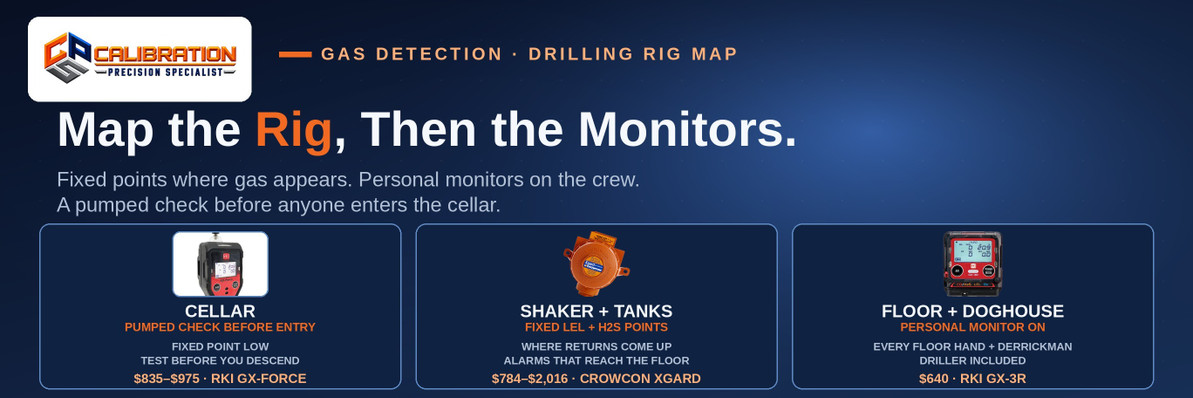
A drilling rig needs three layers of gas detection: fixed LEL and H2S points at the cellar, shale shaker, and mud tanks, a personal multi-gas monitor on every floor hand, derrickman, and driller, and a pumped 4-gas unit — $835–$975 for an RKI GX-Force — to test the cellar and other low spaces before anyone enters them. No single detector covers all three jobs, because the cellar, the returns system, and the person each present the hazard in a different place.
Work the rig as a map, not a shopping list. Each location below gets the layer that matches how gas actually reaches a person there — and at the end, a who-wears-what table pulls it together.
Start With the Map: Where Does Gas Reach People on a Rig?
Drilling moves gas whether the well is sweet or sour. Circulating mud brings formation gas back to surface at the returns; that gas breaks out where the mud is handled — the shaker and the tanks. Gas that escapes at the wellhead or through the floor collects in the lowest enclosed space on the rig — the cellar. And the crew works across all of it, moving between the floor, the tanks, and the doghouse. So the detector plan has three shapes: fixed points where gas reliably appears, personal monitors on the people who move, and a pumped instrument for the spaces a person is about to enter. If the field is sour, the personal layer widens to everyone on location — that change is covered in sour vs. sweet wells and H2S in oil and gas.
The Cellar: What Watches the Lowest Spot on the Rig?
Use this when: any rig with a cellar or substructure space a hand has to descend into.
- A fixed point, low. The cellar is where heavier gas collects and where oxygen can be displaced, out of sight of the floor. A fixed LEL/H2S point mounted low — a detector head from the fixed systems range, such as the Crowcon Xgard family ($784–$2,016) or the SENKO SI-200E ($950) — reporting to a controller where the driller will see and hear it, such as the RKI Beacon 110 ($1,275, single channel), warns the floor before anyone goes down.
- A pumped check before entry, every time. A fixed reading from outside the space is not a pre-entry test of the space itself. Before a hand enters the cellar, the atmosphere is sampled from outside with a pumped 4-gas monitor — the RKI GX-Force ($835–$975) or the pumped SENKO SP-MGTP ($850 base) — drawing air from the level the entrant will actually occupy. See pumped monitors. The fixed point watches continuously; the pumped check answers "what is down there, right now, where I am about to stand?"
The Shale Shaker and Mud Tanks: Where Do the Fixed Points Go?
Use this when: laying out the returns side — the shaker house/area and the mud pits or tanks.
This is where formation gas carried up in the mud breaks out at surface, continuously, for as long as the well is circulating. People work here, but the hazard is present whether or not a hand is standing at the shaker — which is exactly the fixed-detection case from fixed vs. portable gas detection:
- Fixed LEL points at the shaker and over the mud tanks, to catch combustible gas as returns come up.
- Fixed H2S points at the same locations on any well where H2S is present or possible — the shaker is routinely the first place sour gas announces itself at surface.
- Alarms that reach the floor. Points at the returns are only useful if their alarms land where decisions are made — at a controller with horns/strobes the driller and floor crew will actually register, not a silent display at the tank. Browse detector heads and controllers to see how a point is built.
Installed cost depends on the rig's layout, cable runs, and mounting, and is quoted in writing after a review — detector hardware per point is the Xgard/SI-200E range above, plus the controller.
The Floor and the Doghouse: Who Wears What?
Use this when: building the personal-monitor issue list for a crew.
The floor is where people and the well are closest, and it is a personal-monitor zone — fixed points cannot follow a hand from the floor to the tanks to the cellar stairs:
| Who | What they wear | Why |
|---|---|---|
| Floor hands | 4-gas personal monitor (LEL · O2 · CO · H2S) — RKI GX-3R, $640 | They work the floor, the cellar stairs, and the returns — the full hazard set, wherever they stand |
| Derrickman | 4-gas personal monitor, same as the floor — and it stays on for mud-tank and derrick work | His workplace includes the tanks, where fixed points warn but do not travel with him |
| Driller | 4-gas personal monitor, even though the doghouse feels like an office | He is the person the fixed alarms report to and the first person who leaves the doghouse when something alarms — he should be monitored on the way out, not just informed |
| Everyone else on a sour location | At minimum a personal H2S monitor — a disposable single-gas unit such as the Crowcon Clip SGD, $137.50–$226 | The sour rule from post #182: H2S does not respect job titles, so the monitor rule is location-wide |
All personal monitors are worn in the breathing zone, turned on before the tour, and bump tested before each day's use — OSHA's guidance, following the ISEA position. A monitor hanging in the doghouse is documentation, not protection. The full personal range is in portable multi-gas monitors and single-gas monitors.
Connections and Trips: When Does an Area Monitor Earn Its Place?
Use this when: the operation changes the gas picture for a shift or a phase of the well.
Connections and trips change how gas moves — the circulating pattern that normally carries gas to the shaker in a predictable way is interrupted, and gas can show up at the floor and around the wellhead in a different pattern than steady drilling produces. At a general level, that is when a transportable area monitor — the Crowcon DetectiveIQ class of unit, $4,915–$6,115 in our range — earns its footprint: positioned at the work zone for the duration of the operation, alarming for the whole area rather than one wearer, then moved when operations change again. It layers on top of the personal monitors, never instead of them: the area unit watches the zone, the personal units watch the people in it, and the pumped unit still does the cellar check before entry.
What About the Sweet-Well Rig?
Everything above except the sour additions. A sweet rig still circulates flammable gas to the shaker and tanks, still has a cellar that collects gas and loses oxygen, and still puts a crew on the floor next to the well — so the fixed LEL points, the 4-gas personal monitors, and the pumped cellar checks all still apply. What a sour classification adds is the H2S points at the returns and cellar, an H2S monitor on every person on location, and the contingency discipline covered in sour vs. sweet wells: how H2S changes your gas detection program. Sweet is a shorter toxic list, not an empty detector list.
What Does a Rig Detector Program Cost?
Budget by layer, the way the rig is laid out:
- Personal layer — per person. $640 per crew member for a 4-gas GX-3R; $137.50–$226 per additional person on a sour location for a disposable H2S unit; plus spares so a failed bump test never sends a hand out unmonitored.
- Pumped layer — per rig, at least one. $835–$975 for a GX-Force (or $850 base for an SP-MGTP), with its sampling hose — this is the cellar-check instrument, and a rig that cannot test before entry does not have a substitute for it.
- Fixed layer — per point, plus the system. $784–$2,016 per Xgard point or $950 for an SI-200E, plus a controller ($1,275 for a single-channel Beacon 110), plus wiring, mounting, and commissioning quoted in writing for that rig.
- The program behind all three. Calibration gas — every CPS cylinder's QR code opens its SDS and CoA, and CPS never charges a hazmat fee — bump gas and discipline before each day's use, and full calibration at the manufacturer's interval on every channel. CPS in-house calibration is $55 single-gas / $90 multi-gas; those are in-shop rates, and on-site work is quoted in writing. See calibration services.
Frequently Asked Questions
What gas detectors does a drilling rig need? Three layers. Fixed LEL and H2S points at the cellar, the shale shaker, and the mud tanks, where gas reliably appears. A personal 4-gas monitor (LEL, oxygen, CO, H2S) on every floor hand, the derrickman, and the driller, worn in the breathing zone. And a pumped 4-gas monitor — $835–$975 for an RKI GX-Force — to test the cellar and other low spaces from outside before anyone enters them. Each layer does a job the other two cannot.
Why does the cellar need both a fixed detector and a pumped check? They answer different questions. The fixed point watches the cellar continuously and warns the floor before anyone goes down — including during hours when nobody is thinking about the cellar at all. The pumped check, done from outside with a sampling hose at the level the entrant will occupy, answers what the air is in that space, right now, before this entry. A continuous monitor elsewhere in the cellar is not a pre-entry test of the spot a hand is about to stand in, so the pumped check is never skipped because the fixed point reads clear.
Where should fixed gas detectors be placed on a drilling rig? At the shale shaker and over the mud tanks or pits, where formation gas breaks out of the returns — LEL points there, plus H2S points on any well where H2S is present or possible. Low in the cellar, where heavier gas collects and oxygen can be displaced. And at the wellhead area. Fixed points report to a controller positioned where the driller will see and hear the alarm, with horns or strobes the floor crew will register — a point whose alarm nobody notices is a reading, not a warning.
Does the driller need to wear a gas detector if he is in the doghouse? Yes. The doghouse feels separate from the hazard, but the driller is the person fixed alarms report to and the first person to leave the doghouse and walk toward the problem when one sounds. A personal 4-gas monitor — $640 for an RKI GX-3R — protects him on exactly the walk where he is most likely to meet the gas, and covers him everywhere else his tour takes him on the rig. A monitor left hanging in the doghouse protects the doghouse.
What detector should be used to check the cellar before entry? A pumped 4-gas monitor — LEL, oxygen, CO, and H2S — such as the RKI GX-Force at $835–$975 or the SENKO SP-MGTP at $850 base, sampling through a hose from outside the space, at the level the entrant will occupy. A diffusion monitor worn on a person already in the cellar tests the air after the person is in it, which reverses the order entry testing exists to keep: test first, from clean air, then enter on a known atmosphere, with monitoring continuing while the work goes on.
Do you need H2S detectors on a sweet drilling rig? The crew's 4-gas monitors include an H2S channel either way — that is part of the standard four (LEL, oxygen, CO, H2S) on an instrument like the $640 GX-3R — so the personal layer already covers H2S if a stream changes character. What a sweet rig typically does not carry is the sour additions: fixed H2S points at the returns and cellar, a personal H2S monitor on every person on location including visitors and drivers, and a written H2S contingency plan. If a sweet well starts showing H2S, those additions are the first changes to make.
What is an area monitor used for on a rig? A transportable area monitor — $4,915–$6,115 for the Crowcon DetectiveIQ in our range — is positioned at a work zone for a phase of work whose gas pattern differs from steady drilling, such as connections and trips at a general level, and alarms for the whole area rather than a single wearer. It is moved when operations move. It layers on top of personal monitors and fixed points; it replaces neither the monitor on a person nor the pumped check before a cellar entry.
How many personal gas detectors does a rig crew need? One per person who works in the monitored areas — floor hands, derrickman, and driller at minimum, each on a 4-gas monitor — plus spares, so a unit that fails a bump test or goes down mid-tour is swapped, not shared or skipped. On a sour location the count widens to every person on location, with disposable H2S units at $137.50–$226 covering visitors, drivers, and other non-crew entrants. Count people, then add spares; a program with exactly enough monitors has no answer for the first failure.
How much does it cost to equip a drilling rig with gas detectors? By layer: $640 per crew member for a 4-gas personal monitor, $137.50–$226 per additional person for a disposable H2S unit on a sour location, $835–$975 per rig for the pumped GX-Force that does cellar checks, $784–$2,016 per fixed point for Xgard heads ($950 for a SENKO SI-200E) plus a controller from $1,275 and installation quoted in writing, and $4,915–$6,115 if an area monitor is added. Ongoing: calibration gas, daily bump tests, and calibrations at $55 single-gas / $90 multi-gas in-house at CPS.
How often do rig gas detectors need bump testing and calibration? Bump test before each day's use — every personal monitor, and the pumped entry instrument before it is relied on for a check — following OSHA guidance and the ISEA position. A failed bump means the unit is swapped for a spare and calibrated, not carried anyway. Full calibration is done at the manufacturer's recommended interval and whenever a bump test fails, on every channel the instrument carries. On a rig, where tours rotate, the discipline that makes this work is simple: no monitor leaves the doghouse or the trailer for a tour until it has passed that day's bump.
The Bottom Line
Map the rig first, then buy detectors. Fixed LEL and H2S points where gas reliably appears — cellar, shaker, mud tanks. A personal 4-gas monitor on every hand who works the floor, the tanks, and the derrick. A pumped instrument for the one question nothing else can answer — what is in the cellar before a person goes into it. A rig equipped by location instead of by catalog page has no layer doing another layer's job, and no spot on the location that nobody is watching.
Laying out a rig, or auditing the detectors on one already drilling? Call 865-900-8844 or reach us through Contact Us. We will walk the map with you — fixed systems, portable multi-gas monitors, pumped monitors, calibration gas with QR-linked SDS and CoA and no hazmat fee, and calibration services that calibrate every channel.
CPS Calibrations · 109 S. Front Street, Rockwood, TN 37854 · Calibration Gas · Calibration Services · Contact Us
Need a calibration you can file?
In-house calibration at CPS in Rockwood, Tennessee — $55 for single-gas instruments, $90 for 4- and 5-gas — every channel, as-found and as-left data, full certificate.
See Calibration Servicesor call 865-900-8844
Recent Posts
-

What Is Remote Monitoring for Fixed Gas Detection?
Remote monitoring for fixed gas detection means a fixed system's live readings, trends, and alarm hi …Nov 23rd 2026 -

What Are the Key Differences Between the GX-6000 and GX-6100?
The RKI GX-6100 is the current replacement for the discontinued GX-6000: both are pumped 6-gas monit …Nov 22nd 2026 -

How to Read a PID Correction Factor Chart
To read a PID correction factor chart, find your vapor’s row, take the factor under your own lamp en …Nov 21st 2026