
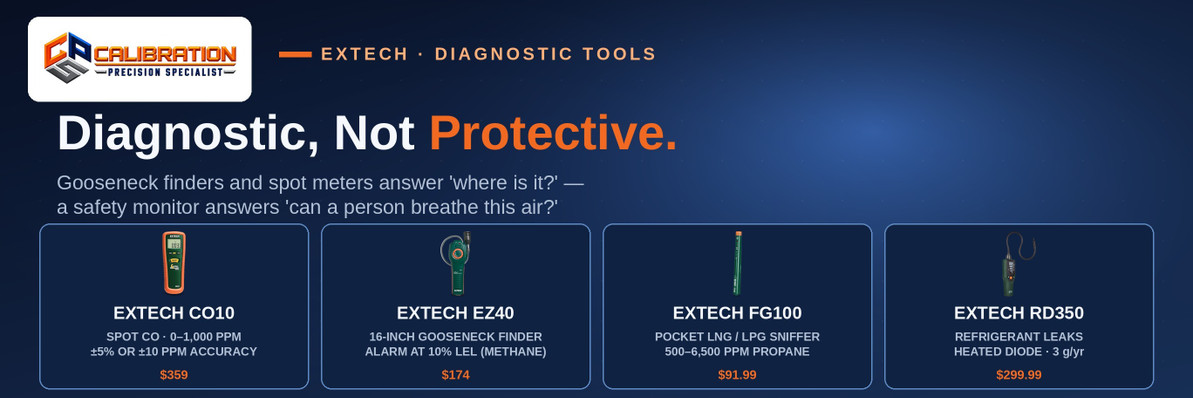
Handheld Leak Detectors vs. Safety Monitors: The Extech Wrenches in the Toolbox
Handheld leak detectors and personal safety monitors answer different questions. An Extech gooseneck leak finder or spot CO meter — the EZ40 ($174), the CO10 ($359), the CO15 ($170), the FG100 ($91.99), the RD350 refrigerant detector ($299.99) — is a diagnostic tool: you pick it up to find a leak or investigate a reading, and it tells you where the problem is. A personal safety monitor is protection: worn in the breathing zone, bump tested daily, and calibrated on a certificate, it exists to get a specific worker out of bad air. Using a diagnostic tool as protection — or expecting a protection monitor to pinpoint a leak — is using the wrong wrench.
Toolbox logic applies to gas instruments exactly as it does to hand tools: a wrench is not a hammer even when both are steel. The Extech handhelds in this post are excellent wrenches. This piece is about what each one is for, what none of them is for, and how to tell the two tool classes apart on any spec sheet — because the difference is not price or size. It is the contract the instrument makes with the person holding it.
What Is the Contract of a Safety Monitor?
A personal safety monitor promises: I am watching the air you breathe, continuously, and I will alarm at the thresholds your safety program set — and my readings are maintained under a regime (daily bump tests, scheduled calibrations, documented certificates) that makes them trustworthy enough to bet a life on. Everything about its design serves that contract: it is worn in the breathing zone, it is assigned to a worker, and its sensor or sensors match the hazards of the job — a wrist-worn single-gas unit like the RKI GasWatch 3 for one known gas, a multi-gas monitor where the job needs four channels, a sample-draw instrument like the RKI SC-8000 for exotic toxics.
A diagnostic tool makes a different promise: when you pick me up and go looking, I will help you find the problem. It is picked up on purpose, pointed at suspects, and put down when the question is answered. Nobody wears it all shift; it is not assigned; its job is location and investigation, not vigilance. Confusing the two contracts — walking into a suspect atmosphere 'protected' by a leak finder — is the failure this post exists to prevent.
The Extech Wrenches, One by One
| Tool | Price | The job it does |
|---|---|---|
| Extech EZ40 EzFlex | $174 | Combustible leak pinpointing: 16-inch gooseneck, solid-state sensor, thumb-controlled sensitivity, visible/audible alarm at 10% LEL for methane |
| Extech FG100 | $91.99 | Pocket combustible sniffer for LNG/LPG: 500–6,500 ppm propane, 1,000–6,500 ppm natural gas, pen-style with pocket clip |
| Extech CO10 | $359 | Spot CO measurement: 0–1,000 ppm at ±5% or ±10 ppm accuracy, alarm from 35 ppm — the HVAC/appliance investigation meter |
| Extech CO15 | $170 | Budget spot CO check: 0–999 ppm, alarm beeping from an adjustable 25 ppm preset, ±20%/±15% accuracy |
| Extech RD350 | $299.99 | Refrigerant leak finding: heated diode, 15.5-inch flexible probe, sensitivity down to 3 g/yr — see the full refrigerant leak detector category |
When Is Each Extech Tool the Right Tool?
- *The EZ40 is the right tool when a combustible leak is confirmed or suspected and the question is where.* Its gooseneck reaches behind appliances and into cabinets; its thumb sensitivity dial lets you zero out background gas so the gradient points at the fitting; and its gas list — methane, propane, butane, gasoline vapor, solvents, and more — is a diagnostician's list, not a safety list. For a pumped ppm search over longer runs, that's the SENSIT HXG-3P's territory; for utility-grade investigation with %LEL and %volume, the GOLD G2/G3's.
- *The CO10 is the right tool when the question is how much CO is this equipment making?*** A furnace, water heater, or forklift investigation needs a number, and the CO10's gas-specific electrochemical sensor gives one at ±5% or ±10 ppm across 0–1,000 ppm, with an alarm that starts at 35 ppm and goes continuous above 200 ppm.
- The CO15 is the right tool for a quick, inexpensive CO check — a first look at a suspect appliance or a screening sweep — accepting its wider ±15–20% accuracy as the price of $170. It is a screening wrench; findings that matter get confirmed with a tighter instrument.
- The FG100 is the right tool for a pocket-sized yes/no on LNG/LPG — meter sets, RV and forklift fuel systems, grill lines — where a pen-style sniffer at a connection tells you whether to get the soap solution or the bigger instruments out.
- The RD350 is the right tool when the leaking gas is a refrigerant. Nothing else in this post detects R-410A, R-134a, R-32, or their cousins at all — combustible sensors don't see refrigerants — and its 3 g/yr high sensitivity finds leaks that cost real money in charge and efficiency long before they'd ever be a safety event.
What Are the Spec-Sheet Tells That a Tool Is Diagnostic, Not Protective?
You don't need CPS to classify an instrument — the records classify themselves, if you read for these tells:
- 'Indication only.' The EZ40's record states, of carbon monoxide: indication only, not to quantify. A protective instrument is never allowed to shrug like that about a toxic gas.
- Accuracy with wide bands. The CO15 specifies ±20% at low range and ±15% above it — perfectly serviceable for screening an appliance, and not the tightening a life-safety reading demands. Compare the CO10's ±5% or ±10 ppm, which is why it costs $359 to the CO15's $170.
- Alarms described as finders' aids. The EZ40 alarms at 10% LEL for methane — as a 'you are close' signal during a search. The FG100's LEDs indicate leak presence. These are search feedback, not a program's alarm setpoints on an assigned monitor.
- No wearing story. Nothing in any of these records describes a breathing-zone position, an assigned wearer, a bump-test-before-use regime, or a calibration certificate — because that is not their contract. When an instrument's paperwork never mentions the things a safety program runs on, it is telling you its class.
So When Do You Put the Wrench Down and Pick Up a Monitor?
The moment the question changes from where is it / how much is it making to is it safe for a person to be in this air, continuously, while work happens. That moment always belongs to a personal safety monitor matched to the gases involved — bump tested that day, calibrated on schedule, alarmed at your program's setpoints. CPS's work sits on that side of the line: our calibration services keep safety monitors on certificate, the CPS Calibration Program tracks their due dates, and who can calibrate my gas detector explains what to demand of anyone doing it. The wrenches and the armor both belong in the truck — the craft is knowing which one your hand should be holding.
Frequently Asked Questions
What is the difference between a leak detector and a safety monitor?
A leak detector is a diagnostic tool picked up to find a problem: it is pointed at fittings and equipment, follows a gas gradient, and pinpoints the source. A safety monitor is personal protection worn in the breathing zone: it watches the air continuously, alarms at the safety program's setpoints, and is maintained with daily bump tests and scheduled, certified calibrations. The Extech EZ40, FG100, CO10, CO15, and RD350 are diagnostic tools; none of them is a substitute for a personal safety monitor.
Can an Extech EZ40 replace a 4-gas monitor?
No. The EZ40 is a combustible leak finder: a solid-state gooseneck detector that alarms at 10% LEL for methane and responds to a wide list of combustible vapors, with carbon monoxide listed as indication only — not to quantify. It has no oxygen or toxic-gas measurement channels, no breathing-zone wearing role, and no bump/calibration regime. A 4-gas monitor measures LEL, O2, CO, and H2S as protection for a worker. The EZ40 finds the leak the 4-gas monitor told you exists.
What is the Extech EZ40 used for?
Pinpointing combustible gas leaks. The EZ40 has a 16-inch gooseneck for reaching behind appliances and into cabinets, a solid-state sensor with high sensitivity, one-hand operation with a thumb-controlled sensitivity dial to cancel background gas, and visible and audible alarms at 10% LEL for methane. Its detectable list includes natural gas, propane, butane, gasoline vapor, solvents, and more. It costs $174 at CPS Calibrations.
Which Extech CO meter is better, the CO10 or the CO15?
They sit at different points on the same job. The CO10 ($359) measures CO from 0–1,000 ppm at ±5% or ±10 ppm accuracy with a gas-specific stabilized electrochemical sensor — an investigator's meter, with an alarm starting at 35 ppm that goes continuous above 200 ppm. The CO15 ($170) measures 0–999 ppm at ±20% (low range) to ±15% accuracy, with an adjustable alarm preset at 25 ppm — a screening meter. Confirm important findings with the tighter instrument; choose by how much the number matters.
Can I use an Extech CO15 as my personal CO monitor at work?
No. The CO15 is a spot-check meter: you hold it, take a reading, and investigate. It is not assigned to a worker, not worn in the breathing zone, not bump tested daily, and its accuracy is ±15–20% — a screening tolerance, not a life-safety one. If your job exposes you to carbon monoxide continuously, your protection is a calibrated personal CO monitor worn on your body, alarmed at your program's setpoints. The CO15's job is checking the equipment that might be making the CO.
What does the Extech FG100 detect?
The FG100 is a pocket combustible gas leak detector for liquefied natural gas (LNG) and liquefied propane gas (LPG): it reads propane from 500 to 6,500 ppm and natural gas from 1,000 to 6,500 ppm, with audible and visual alarms and LED leak indicators. It is pen-sized with a pocket clip, runs up to 4 hours continuously on 2 AAA batteries, and costs $91.99 — a quick yes/no sniffer for connections and fuel systems, not a personal monitor.
What refrigerants does the Extech RD350 detect?
The RD350's heated diode sensor detects R-22, R-134a, R-404a, R-410a, and all CFCs, HCFCs, and HFCs, with R32 and HFO-1234yf included in its sensitivity table. Sensitivity is selectable: high at 0.11 oz/yr (3 g/yr), medium at 0.53 oz/yr (15 g/yr), low at 1.06 oz/yr (30 g/yr) for the common HFCs. Its 15.5-inch flexible probe and tri-colored LED indicator make pinpointing a leaking joint or coil a short job. It costs $299.99 at CPS.
Why can't a refrigerant leak detector find a natural gas leak, or vice versa?
Because the sensors see different chemistry. The RD350's heated diode responds to halogenated refrigerants; a combustible detector's sensor responds to flammable gases and vapors, which refrigerants like R-410A are not. Each tool is blind to the other's gases — one more reason 'a gas detector' is not a category you can substitute within. The leaking substance decides the tool.
Do handheld leak detectors need calibration like safety monitors do?
Not under the same regime, and the difference is the point. A personal safety monitor is bump tested before each day's use and calibrated on a documented schedule because lives are bet on its numbers. A diagnostic leak finder is a comparative tool — it is checked for response and used to follow gradients — and it carries no safety-program certificate. If a tool in your hand is being relied on to declare air safe for a worker, it has crossed into safety-monitor territory and must meet that standard, whatever its box says.
Who calibrates personal safety monitors, and what does it cost?
CPS Calibrations calibrates personal gas monitors in-house at 109 S. Front Street, Rockwood, TN — $55 for a single-gas instrument and $90 for a 4- or 5-gas instrument — with a certificate carrying as-found and as-left readings on every channel we calibrate. See our calibration services page or call 865-900-8844. Diagnostic tools like the Extech handhelds are sold as the workshop instruments they are; the certificate regime belongs to the monitors your people wear.
The Bottom Line
A leak finder answers 'where is it?'; a safety monitor answers 'can a person breathe this air while they work?' Extech's EZ40, FG100, CO10, CO15, and RD350 are fine wrenches for the first question — $91.99 to $359, each matched to a gas family and a hunt. None of them is armor, and the spec sheets say so, if you read the tells.
Building or auditing a kit that needs both sides of the line? Call CPS Calibrations at 865-900-8844. We'll help you match diagnostics to the hunt and monitors to the hazard — and we calibrate every channel of the monitors your crew's lives run on.
CPS Calibrations · 109 S. Front Street, Rockwood, TN 37854 · Calibration Services · The CPS Calibration Program
Need a calibration you can file?
In-house calibration at CPS in Rockwood, Tennessee — $55 for single-gas instruments, $90 for 4- and 5-gas — every channel, as-found and as-left data, full certificate.
See Calibration Servicesor call 865-900-8844
Recent Posts
-

What Is Remote Monitoring for Fixed Gas Detection?
Remote monitoring for fixed gas detection means a fixed system's live readings, trends, and alarm hi …Nov 23rd 2026 -

What Are the Key Differences Between the GX-6000 and GX-6100?
The RKI GX-6100 is the current replacement for the discontinued GX-6000: both are pumped 6-gas monit …Nov 22nd 2026 -

How to Read a PID Correction Factor Chart
To read a PID correction factor chart, find your vapor’s row, take the factor under your own lamp en …Nov 21st 2026