
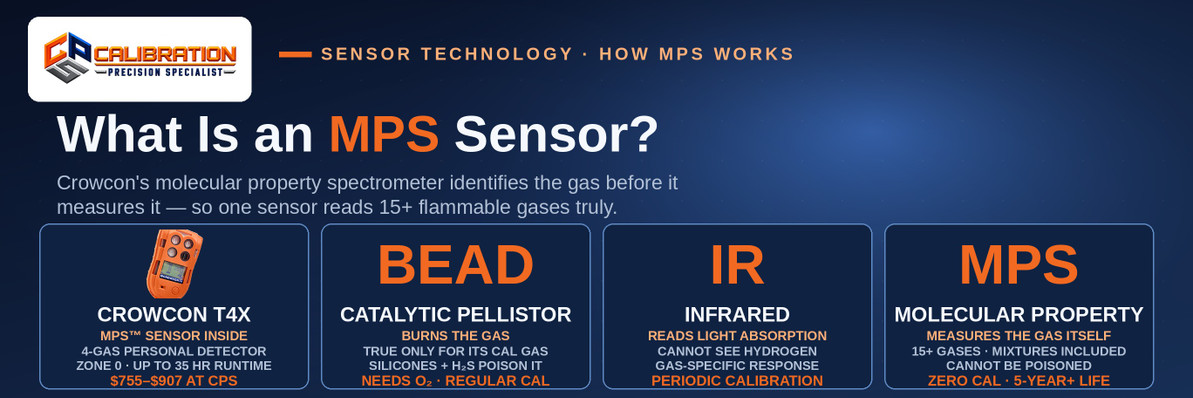
What Is an MPS Sensor? How Crowcon's Molecular Property Spectrometer Reads 15+ Flammable Gases
An MPS (molecular property spectrometer) sensor is a flammable-gas sensor that identifies a gas by measuring its molecular properties — starting with how the gas carries heat — instead of burning it on a catalytic bead or shining infrared light through it. Because it identifies the gas first and then computes the reading, Crowcon's MPS sensor accurately measures more than 15 flammable gases, including hydrogen and mixtures, as a true %LEL: no correction factors, no catalyst to poison, and zero calibration across a 5-year-plus sensor life.
Every flammable channel in every gas detector your crew carries works one of three ways. Two of them are decades old and carry well-known compromises. The third — MPS — is the one Crowcon is building its newest instruments around, and it is worth understanding on its own terms: how it works, why it makes correction factors disappear, where it honestly falls short, and which instruments you can actually buy it in.
How an MPS Sensor Works
Start with what the older technologies do, because MPS is best understood against them:
- A catalytic pellistor burns the gas. A heated catalyst-coated bead oxidizes flammable gas on its surface, and the heat of that combustion changes the bead's electrical resistance. Simple and proven — but the reaction only happens in the presence of oxygen, the response differs for every gas, and anything that coats or attacks the catalyst (silicones, lead compounds, heavy H₂S exposure) degrades it, usually without any outward sign.
- An infrared (IR) sensor shines light through the gas. Hydrocarbon molecules absorb infrared at characteristic wavelengths, and the sensor measures how much light disappears. Nothing is consumed and there is no catalyst to poison — but the measurement only works on gases that absorb infrared, and hydrogen does not. An IR flammable sensor is physically blind to H₂.
- An MPS sensor measures the gas itself. Inside the MPS sensor is a MEMS (micro-electromechanical) sensing element that characterizes the sample's physical behavior — how readily the gas conducts heat away from the element, together with related molecular properties. Different flammable gases move heat in measurably different ways, so the sensor can identify which gas — or which blend — it is looking at, then report a true %LEL for that gas. Crowcon calls this TrueLEL™ multi-gas accuracy.
Three design consequences matter in the field:
- No chemistry, no consumption. There is no combustion and no catalyst, so there is nothing for silicone vapors or H₂S to poison, and no sensing element being burned away shift by shift. Crowcon's datasheet puts it plainly: the sensor resists contamination and prevents sensor poisoning.
- Environmental compensation is built in. The sensor continuously compensates for temperature, pressure, and humidity in real time — the variables that push conventional sensors off their readings — and Crowcon's datasheet groups gases into classes by their measured behavior, which is how a single factory calibration stays valid across all of them.
- It watches itself. The MPS sensor self-monitors continuously and automatically reports any problem with its own operation. That is the direct opposite of the pellistor's worst failure mode — the silent poisoning that leaves a detector reading clean air in a flammable atmosphere until a bump test happens to catch it.
The published performance figures round out the picture: 0–100% LEL range with 0.1% LEL resolution, a response time (T90) under 20 seconds, and a sensor environmental operating range of −40 °C to +75 °C. Those are sensor-level figures from Crowcon's MPS datasheet; the instrument around the sensor sets its own limits.
Pellistor vs. Infrared vs. MPS: The Three-Way Comparison
| Catalytic pellistor | Infrared (IR) | MPS™ | |
|---|---|---|---|
| How it senses | Burns gas on a heated catalyst bead | Measures infrared light absorbed by the gas | MEMS element measures the gas's molecular properties (thermal behavior) |
| Correction factors | Yes — accurate only for its calibration gas; other gases need a factor | Response is gas-specific — effectively a single-target-gas calibration | None — TrueLEL™ identifies the gas and reports a true %LEL |
| Poisoning | Yes — silicones, lead, H₂S; fails silently | No catalyst to poison | Immune — no catalyst; self-monitors and reports faults |
| Oxygen required | Yes — combustion stops without it, so it under-reads as O₂ falls | No | Not consumed — no combustion; %LEL calculation assumes a normal air background |
| Hydrogen | Detects it, with accuracy limits and poisoning exposure | Cannot detect it — H₂ does not absorb infrared | Yes — ±5% LEL accuracy (0–50% LEL) |
| Calibration burden | Frequent bump tests and calibration | Periodic calibration | Zero calibration — factory calibrated, no scheduled maintenance |
| Sensor life | Shortest of the three — the bead ages, and poisoning shortens it further | Long — solid-state optics | 5-year-plus rated life (5-year warranty on the Xgard Bright's MPS sensor) |
No row of that table makes the older technologies useless — pellistors are cheap and everywhere, and IR is an excellent choice for a fixed point watching one known hydrocarbon in a low-oxygen process. What the table shows is that MPS is the first flammable technology that does not ask you to pick which compromise you will live with.
Why Correction Factors Disappear
A correction factor exists because a conventional sensor cannot tell one flammable gas from another. Calibrate a pellistor on methane and walk it into pentane vapor, and the bead produces a signal sized for methane — the reading can be off by a factor approaching 2× until someone multiplies by the right correction factor, as our guide to LEL correction factors works through in detail. Get the factor wrong, forget it, or walk into a mixture of two gases — where no single factor exists — and the number on the screen is a guess wearing a uniform.
MPS removes the problem at the root: identification comes first. Because the sensor works out which gas or blend is present from its molecular properties, it applies the right response internally and displays a true %LEL for the gas actually in front of it. Mixtures are read as mixtures in a single reading instead of one gas masking another. Crowcon's published accuracy table (0–50% LEL) shows how tight that identification is:
| Gas | MPS accuracy (0–50% LEL) |
|---|---|
| Methane | ±3% LEL |
| Hydrogen | ±5% LEL |
| Propane, butane, ethane, pentane, heptane, octane, MEK, propylene, isobutane, isobutylene | ±5% LEL |
| Isopropanol | ±10% LEL |
| Toluene, xylene | ±12% LEL |
Beyond the table, Crowcon confirms the sensor also detects acetylene, ethanol, methanol, and ammonia. Notice the pattern in the numbers, though — it leads directly to the honest limits below.
The Honest Limits of MPS
MPS is a better flammable sensor, not a universal one. Crowcon's own datasheet is candid about the edges, and buyers should be too:
- It reads %LEL, and only %LEL. The MPS channel measures flammable gas from 0–100% LEL. It says nothing about ppm-level toxic exposure — that remains the job of electrochemical CO and H₂S sensors — and it is not a VOC measurement. For ppm VOCs you still need a PID; our PID vs. LEL comparison covers why the two measurements answer different questions. An MPS detector does not replace a PID, and a PID does not replace it.
- Accuracy is not uniform across gases. Methane is the tightest at ±3% LEL. The aromatic solvents toluene and xylene are the loosest of the published table at ±12% LEL. Crowcon guarantees full accuracy for methane across the whole environmental range; for other gases, published tolerances are guaranteed near standard conditions (20 °C, 50% RH).
- Extreme atmospheres can cross-talk. Per the MPS datasheet, strong oxygen enrichment — above roughly 21.8% vol O₂ — can begin to register as flammable gas (about 1.07% LEL per extra 1% vol of O₂), and CO₂ above roughly 5,000 ppm can be misread as flammable (about 1.74% LEL per 1,000 ppm of CO₂), which is also why breathing directly onto the sensor can blip it. In normal air neither effect is in play.
- The %LEL math assumes air. Crowcon's datasheet notes the calculated %LEL assumes a normal air background, and the true %LEL in an oxygen-depleted atmosphere is dictated by the limiting oxygen concentration. The sensor does not need oxygen to work — but flammability itself is an oxygen-dependent property, and the reading is honest about that.
- "Zero calibration" has an exact scope. The claim covers the MPS sensor: factory calibrated, no scheduled maintenance, 5-year-plus life. The electrochemical and oxygen sensors sharing the same instrument still drift and still need bump tests and calibration on schedule — and your site policy, not a datasheet, is what an auditor will hold you to.
Where MPS Shows Up in Crowcon's Range
MPS is not a concept part — Crowcon ships it across the range, and CPS's Crowcon coverage follows it:
- Crowcon T4x (portable). The MPS sensor is the flammable channel of the T4x personal 4-gas detector, alongside a long-life O₂ sensor and CO/H₂S channels. The low-power MPS sensor is a big part of how the T4x runs up to 35 hours, and its Zone 0 (Type 1) approval suits it to the harshest classified areas. Our T4x spotlight covers configurations and prices — six US builds at CPS from $755 to $907.
- Crowcon DetectiveIQ (area monitor). MPS is one of six sensor technologies in Crowcon's networked area monitor, and it is the build behind the datasheet's longest runtime figure: the MPS + toxic + O₂ configuration runs 101+ days — up to 15 weeks — in diffusion mode. See our DetectiveIQ area monitor post for the mesh networking and configuration story.
- Crowcon Xgard Bright (fixed). Crowcon's flagship fixed detector offers MPS as its flammable sensor option — the multi-gas answer for fixed points where the gas in the line can change — and the MPS sensor carries a 5-year warranty in that platform. Our Xgard Bright spotlight covers the transmitter, relays, and configuration range.
- Also in the family: Crowcon's MPS datasheet names the Gasman single-gas portable among the products the sensor is fitted into — worth knowing if a one-gas MPS build fits your hazard better than a 4-gas instrument.
Frequently Asked Questions
What is an MPS sensor? MPS stands for molecular property spectrometer. It is a flammable-gas sensor that identifies a gas by measuring its molecular properties — how the gas carries heat and behaves physically — instead of burning it on a catalytic bead or measuring it with infrared light. Because it identifies the gas first, it reports a true %LEL for more than 15 flammable gases, mixtures included, with no correction factors.
How does an MPS sensor work? A MEMS sensing element characterizes the sample gas's thermal and molecular properties, and the sensor's onboard processing — with real-time compensation for temperature, pressure, and humidity — works out which flammable gas or blend is present and computes its %LEL. Nothing is burned, nothing is consumed, and the sensor self-monitors continuously and reports any fault in its own operation.
What gases can an MPS sensor detect? Crowcon publishes accuracy figures for 15 flammable gases, including methane (±3% LEL), hydrogen, propane, butane, ethane, pentane, heptane, octane, propylene, isobutane, isobutylene, and MEK (±5% LEL), isopropanol (±10% LEL), and toluene and xylene (±12% LEL) — and confirms detection of acetylene, ethanol, methanol, and ammonia as well. It reads mixtures of these gases in a single reading.
Does an MPS sensor need correction factors? No. Correction factors exist because a pellistor or IR sensor cannot tell which gas it is measuring, so its reading has to be adjusted when the gas differs from its calibration gas. An MPS sensor identifies the gas from its molecular properties and applies the correct response internally — Crowcon calls this TrueLEL™ multi-gas accuracy — so the displayed %LEL is already true for the gas present.
Can an MPS sensor be poisoned? No. Poisoning is a catalytic-bead failure: silicones, lead compounds, and high H₂S exposure destroy the bead's sensitivity, silently. The MPS sensor has no catalyst and performs no combustion, so those exposures do not blind it — and because it self-monitors and reports faults, it does not fail quietly either.
Can an MPS sensor detect hydrogen? Yes — hydrogen is one of its published gases, at ±5% LEL accuracy across 0–50% LEL. That is a genuine differentiator: infrared flammable sensors cannot detect hydrogen at all, because H₂ does not absorb infrared, and pellistors detect it only with accuracy limitations and poisoning exposure.
Does an MPS sensor need calibration? No. Crowcon rates the MPS sensor for zero calibration and no scheduled maintenance over its 5-year-plus life: it is factory calibrated and continuously self-monitoring. That claim covers the MPS sensor itself — the electrochemical toxic and oxygen sensors in the same instrument still need routine bump tests and calibration, and site policy still applies to the detector as a whole.
How long does an MPS sensor last? Crowcon rates the MPS sensor for a 5-year-plus lifecycle with no scheduled maintenance, and in the Xgard Bright fixed detector the MPS sensor carries a 5-year warranty. In portables, the sensor's low power draw also more than doubles battery life versus a pellistor build — the T4x runs up to 35 hours on a charge.
What is the difference between MPS and infrared gas sensors? An infrared sensor measures how much IR light a gas absorbs, which works well for hydrocarbons but makes it blind to hydrogen and gives it a gas-specific response — effectively a single-target-gas calibration. An MPS sensor measures the gas's molecular properties, identifies which of 15+ flammable gases (or blend) is present, detects hydrogen, and needs no correction factors or calibration. Neither technology can be poisoned the way a catalytic bead can.
Can an MPS sensor measure VOCs or toxic gases in ppm? No. MPS is a flammable measurement, 0–100% LEL. It does not measure ppm-level toxic exposure — that is the electrochemical sensors' job — and it does not replace a PID for ppm VOC work. An instrument that needs all three measurements needs all three sensor types; the MPS sensor replaces the flammable channel only.
The Bottom Line
For fifty years, choosing a flammable sensor meant choosing a compromise: the pellistor's correction factors and silent poisoning, or infrared's hydrogen blindness and single-gas response. The MPS sensor is the first design that declines the trade — it identifies the gas from its molecular properties, so one sensor reads 15+ flammables and their mixtures truly, cannot be poisoned, sees hydrogen, and asks for no calibration across a five-year-plus life. Its limits are real but narrow: %LEL only, looser accuracy on aromatics, and no exemption for the other sensors in the same housing. If your sites see mixed hydrocarbons, solvent vapors, hydrogen, or silicone-heavy air, MPS is the flammable channel to spec — and it is already shipping in Crowcon's portable, area, and fixed instruments.
Questions about MPS instruments — or about the calibration your current fleet still needs? CPS calibrates every channel of the detectors you already own, MPS or not. Call 865-900-8844 or reach us through Contact Us. CPS Calibrations · 109 S. Front Street, Rockwood, TN 37854
CPS Calibrations · 109 S. Front Street, Rockwood, TN 37854
Need a calibration you can file?
In-house calibration at CPS in Rockwood, Tennessee — $55 for single-gas instruments, $90 for 4- and 5-gas — every channel, as-found and as-left data, full certificate.
See Calibration Servicesor call 865-900-8844
Recent Posts
-

What Is Remote Monitoring for Fixed Gas Detection?
Remote monitoring for fixed gas detection means a fixed system's live readings, trends, and alarm hi …Nov 23rd 2026 -

What Are the Key Differences Between the GX-6000 and GX-6100?
The RKI GX-6100 is the current replacement for the discontinued GX-6000: both are pumped 6-gas monit …Nov 22nd 2026 -

How to Read a PID Correction Factor Chart
To read a PID correction factor chart, find your vapor’s row, take the factor under your own lamp en …Nov 21st 2026