
What Happens If You Don't Calibrate a Gas Detector?
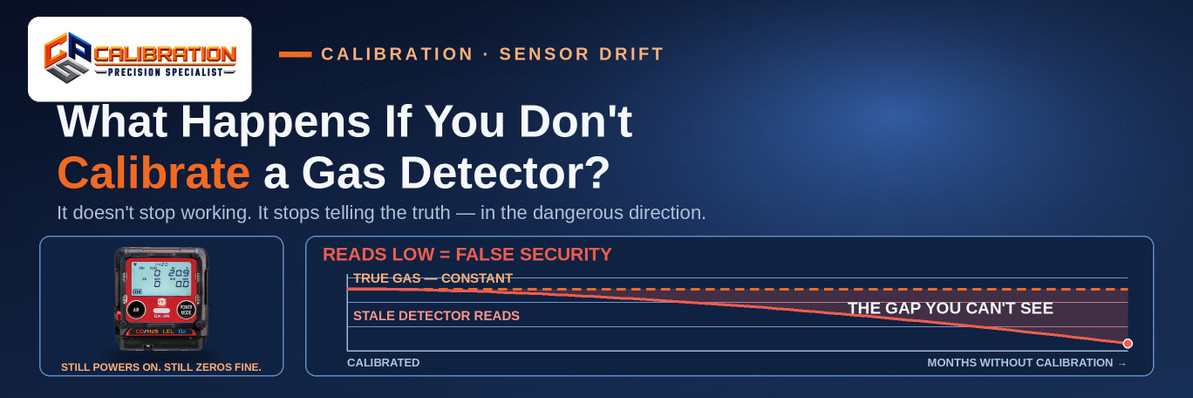
If you don't calibrate a gas detector, it doesn't stop working — it stops telling the truth, in the dangerous direction. Electrochemical and catalytic sensors lose sensitivity as they age, so an uncalibrated detector reads low: lose 30% of a sensor's sensitivity and it displays about 70 ppm in a real 100 ppm atmosphere, its alarms fire late because the true gas has to climb past the setpoint before the sagging display does, and a sensor that has lost enough sensitivity reads zero in gas that is actually there. Nothing announces it — the zero in clean air still looks perfect, and the daily bump test only proves the detector responds, not that it reads right; only a full calibration against certified gas re-sets its accuracy.
That combination — a failure that feels exactly like health — is what makes skipped calibration different from other maintenance lapses. A dead detector gets replaced. A drifted detector gets carried into the space, trusted, and quoted afterward. This post works through the chain: what calibration corrects, what drift does to the numbers and the alarms, why the instrument never warns you, what skipping does to your bump tests and sensors, and the two problems that outlive the readings — compliance and the paper trail. For the scheduling side of the question, see our guide to how often gas detectors should be calibrated; this post is about consequences.
What Does Calibration Actually Correct? Drift
Sensors drift. That is not a defect in a particular brand; it is the physics of how the common sensor types work. An electrochemical cell consumes and ages its chemistry as it measures; a catalytic bead's catalyst loses activity as it burns gas and everything else that reaches it. The output the instrument receives for a given concentration slowly shrinks — and since nobody has told the instrument the conversion has changed, it keeps converting the smaller signal with the old arithmetic and reports a smaller number.
A full calibration is the correction, and it has two halves, covered in full in our post on zero vs. span calibration: zero re-sets the baseline — what the instrument believes "no gas" looks like — and span re-sets the slope, exposing the sensors to a certified gas of known concentration and adjusting the reading to match it. Sensitivity loss is a span problem: it shows up at working concentrations, at the top of the scale where alarms live, while the zero can still sit perfectly at zero. Skip calibration, and you have chosen to let the slope wander wherever aging takes it.
What Drift Does to the Numbers: It Reads Low
The defining fact of sensor drift — the one our calibration-interval guide puts first — is its direction: readings creep away from reality usually reading low. That is the dangerous direction. A detector that read high would cry wolf, get investigated, and get fixed. A detector that reads low says the one thing everyone on site wants to hear — it's fine in here — and it says it more convincingly the worse it gets.
The arithmetic is simple proportion. Sensitivity loss scales every reading by the same factor:
- Lose 30% of sensitivity and the instrument displays about 70 ppm in a true 100 ppm atmosphere — the worked example from our zero-and-span post, where an instrument that is only ever zeroed quietly under-reads exactly this way.
- Lose half — the state of a significantly poisoned catalytic sensor — and a true 50% LEL displays as roughly 25% LEL.
- Lose all of it and the display reads zero in gas that is really there, which is the documented end state of a fully poisoned bead.
What Does a Low Reading Do to Your Alarms?
Alarms do not trigger on the atmosphere. They trigger on the displayed value — and drift inserts itself between the two. If a sensor has lost half its sensitivity, the true atmosphere has to reach twice the alarm setpoint before the display climbs to the setpoint and the alarm sounds. Every alarm the instrument owns — low, high, TWA, STEL — is silently relocated upward by the same factor.
Put plainly: the setpoints in your safety program are only the setpoints the instrument enforces if its span is current. An uncalibrated detector enforces some other, higher set nobody chose and nobody knows. The worker's experience of this is not an alarm that fails to ring — it is an alarm that rings late, after the exposure the setpoint was chosen to prevent has already happened, with the instrument insisting throughout that the air was below the limit. And at the far end of the drift, where sensitivity is mostly gone, the alarm does not ring late. It does not ring.
The Second Drift: A Baseline That Wanders
Sensitivity loss is the main road, not the only one. The baseline itself moves. Temperature and humidity swings, aging electronics, and contamination all shift what the instrument treats as zero — which is how you get the subject of our post on why gas detectors read negative: an instrument whose baseline has shifted reports small negative numbers in clean air, or — more subtly and worse — has its offset masked. Instruments configured to hide negative readings as zero also hide the underlying offset, so a real 10 ppm exposure can display as 0.
Zeroing in clean air re-sets the baseline, and that helps — but notice what it does not do. A fresh zero on a sensor that has lost span sensitivity produces a detector that reads a perfect, reassuring zero and still under-reads every real atmosphere by the lost percentage. Zeroing is the cheap half of calibration, and the half that makes the instrument look maintained. The span is the half that makes it true.
Why Doesn't the Detector Warn You?
Because from the instrument's point of view, nothing is wrong. Its power-up self-tests exercise electronics — processor, display, battery, alarm circuits — and electronics are not what drifted. The failure is chemical, in the sensor's conversion of gas to signal, and no self-test measures that conversion. A drifted sensor produces a clean, stable, plausible signal. It just produces less of it than it should.
This is also why the daily bump test, essential as it is, does not close the hole. OSHA defines the bump test as a qualitative function check — gas reaches the sensors, alarms fire — and is explicit that it does not provide a measure of the instrument's accuracy. As our step-by-step bump test guide puts it, a detector can pass a bump test while reading 15% low. The bump test answers "is it alive?" Only a calibration check — comparing the reading against the cylinder's certified concentration, typically within ±10–20% per OSHA, with the manufacturer's tolerance governing — or a full calibration answers "is it right?" Skipping calibration means the second question is never asked: a fleet can have a perfect bump-test record and a completely unknown accuracy, at the same time, for months — the distinction our bump test vs. calibration post works through.
Skipping Doesn't Pause the Aging — It Compounds It
Drift is not a one-time slip that settles at some stable offset. The processes that cause it keep running, and some common events accelerate them hard:
- Over-range exposure. A sensor slammed with gas far beyond its range — the event our bump guide lists among the triggers for an immediate bump test — comes back changed, and not for the better.
- Sensor poisons. Silicones, lead, and sulfur compounds permanently strip a catalytic bead's sensitivity, in proportion to dose; our post on what happens when a sensor is poisoned works through that failure in full. Poisoning and ordinary aging are the same symptom — sensitivity loss — at different speeds.
- Harsh environments. Heat, humidity, and dust are why manufacturer intervals are ranges rather than numbers: the same sensor drifts faster in a refinery summer than in a climate-controlled plant.
Calibration compensates for all of this while sensitivity remains: each span adjustment raises the gain back to truth. But the compensation has a ceiling. As the sensor keeps losing ground, the adjustments grow, calibrations are needed more often, and eventually there is not enough signal left to adjust — the calibration fails. Industrial Scientific describes the poisoned end of that road bluntly: the sensor will not be able to read the calibration gas applied and will show a failed calibration. A detector that has been skipped long enough does not get caught up with a calibration. It gets a new sensor — the subject of our post on when to replace a gas detector sensor — if it gets caught at all.
What Skipping Does to Your Bump Tests
The bump test is where skipped calibration usually surfaces first, because it is the only routine moment the sensor is asked to perform. A sensor whose sensitivity has sagged far enough responds weakly or slowly to the bump gas, or fails outright — and the protocol that follows is fixed. The ISEA position statement carried in OSHA's bulletin on direct-reading monitors: an instrument that fails a bump test must be adjusted by means of a full calibration before further use, and one that fails the full calibration comes out of service.
So the shop that skips scheduled calibration does not avoid calibration. It meets calibration anyway — unplanned, at the start of a shift, with a crew standing idle, and with a materially worse chance that the session ends in a sensor replacement instead of an adjustment. It also tends to misread the evidence: a run of failed bumps gets blamed on the gas, the cap, or the regulator — all real causes, worked through in our post on why bump tests fail — when the pattern across several instruments is the fleet's drift arriving at the one test that can see it.
The Compliance Problem
OSHA does not publish a single calibration interval; under the confined-space and hazardous-waste rules it does something with sharper teeth — it requires calibration per the manufacturer's guidelines, which makes the manual's interval the enforceable one. Manufacturers typically put full calibration somewhere between every 30 and 180 days depending on the sensor, the environment, and the use; BW's standing recommendation for its portables, for example, is a calibration at least once every 180 days. Some regimes are stricter still: MSHA requires methane detectors in underground coal mines to be calibrated at least every 31 days. The ISEA position carried in OSHA's bulletin ties it together: a functional (bump) check before each day's use, and full calibration on the manufacturer's schedule and immediately whenever a check fails.
A detector past its manufacturer's interval is not in a grey area — and as our interval guide notes, "not per manufacturer guidelines" is an easy citation to write. The citation is the small version of the problem. The large version follows.
The Paper-Trail Problem
Calibration is a record as much as an adjustment. OSHA recommends documenting testing and keeping calibration records for the life of the instrument, and a proper calibration produces the artifact that does the proving — the certificate, whose real evidentiary weight is the subject of our post on what a calibration certificate actually proves. Dated records, by serial number, with the gas lot and the result, are how a program demonstrates — to an auditor, an insurer, or an investigator — that an instrument's readings could be trusted on a given day.
Skip the calibrations and there is nothing to document; document around the skipping and you have made it worse. Either way, after an incident the question is never just "what did the detector read?" It is "show me why anyone should believe what it read." A detector months past its interval, with thin records, gives the investigator the drift arithmetic from the first half of this post and no evidence against it: the readings cannot be verified as accurate, and the instrument's silence on the day cannot be distinguished from the silence of a sensor that had lost its sensitivity. Undocumented does not mean "probably fine." In an investigation, undocumented means unverifiable — and unverifiable is treated accordingly.
Can You Catch Up — or Is It Too Late?
Usually, you can catch up — if the sensor still has sensitivity left to calibrate. The recovery is the ordinary routine, done properly: bump test the instrument, then run a full zero-and-span calibration with certified gas that is in date, and judge the result honestly. Three outcomes are possible:
- It calibrates cleanly and holds. The detector goes back on a real schedule — before each day's use for the bump, the manufacturer's interval for the calibration — and the episode costs you a cylinder and an hour.
- It calibrates, but the span adjustment is large or the instrument has needed calibration again suspiciously soon. That is the drift timeline announcing itself: shorten the interval, watch the bump results, and budget for the sensor.
- It fails the full calibration. Out of service, per the protocol. No amount of re-zeroing fixes a sensor with nothing left to amplify; replacement is the repair.
One shortcut is not a shortcut: reaching for the expired cylinder in the back of the cabinet to "catch up" today. Reactive components in an expired mix fall below their labeled concentrations, so a span performed with it sets the instrument's gain wrong in the opposite direction — and, as our post on expired calibration gas lays out, the calibration cannot be defended afterward. Catch up with fresh gas or not at all.
The Bottom Line
What happens if you don't calibrate a gas detector is not that it stops — it is that it drifts, low, silently, and progressively. The display keeps producing confident numbers that understate the atmosphere; the alarms keep their labels while their real trigger points climb; the bump tests keep passing an instrument whose accuracy nobody has checked; and the sensors keep aging toward a calibration they will one day fail, at which point the catch-up you postponed becomes a replacement you didn't budget. Layered over all of it is a record that cannot prove the instrument was ever right. Calibration is the only routine act that re-sets the number against a certified truth — which is why it belongs on a schedule, not on a feeling.
Detector overdue, reading low, or failing its bump? Send it to the bench or stock the gas to do it right — CPS calibrates every channel, and when a channel won't calibrate, we'll tell you straight whether it's a sensor. Call 865-900-8844 or reach us through Contact Us. Certified gas for the fleet is in our calibration gas range; the bench is at calibration services.
Frequently Asked Questions
What happens if you don't calibrate a gas detector? Its sensors lose sensitivity with age and nothing corrects for it, so the detector reads low — a sensor that has lost 30% of its sensitivity displays about 70 ppm in a real 100 ppm atmosphere — and its alarms fire late, because alarms trigger on the displayed value, not the true one. Drift compounds until the sensor can no longer be calibrated at all — outside the manufacturer's interval, with no records to prove the readings were ever accurate.
How long can a gas detector go without calibration? Only as long as its manufacturer allows. Typical full-calibration intervals run 30 to 180 days depending on the sensor, environment, and use — BW's standing recommendation for its portables is at least once every 180 days — and some regimes are stricter: MSHA requires methane detectors in underground coal mines to be calibrated at least every 31 days. Past the manufacturer's interval, the detector is out of compliance and its accuracy is unknown, however healthy it looks. The daily bump test before each use continues regardless.
Will a gas detector still work if it isn't calibrated? It will power on, zero cleanly, respond to gas, and very possibly pass its bump tests — while reading low the whole time. OSHA is explicit that a bump test does not measure accuracy, and a detector can pass one while reading 15% low. "Working" in the sense of switching on and reacting is not the same as working in the sense of reporting the true concentration, and only calibration verifies the second one.
Does a bump test replace calibration? No. A bump test is a qualitative function check: it proves gas reaches the sensors and the alarms activate. It adjusts nothing. Calibration is the quantitative act — zero and span against certified gas — that re-sets the instrument's accuracy. The ISEA position carried in OSHA's bulletin pairs them: bump before each day's use, full calibration on the manufacturer's schedule, and a full calibration immediately whenever a bump test fails.
How do you know if a gas detector has drifted? By checking it against a known truth: a calibration check compares the reading with the cylinder's certified concentration (typically within ±10–20% per OSHA, with the manufacturer's tolerance governing), and a full calibration measures exactly how much adjustment the span needs. The field signs are repeated or slow bump-test responses, calibrations needed more and more often with growing span adjustments, and baseline oddities such as negative readings in clean air. Absent a check against certified gas, drift is invisible — the display cannot tell you it is lying.
Can a gas detector read zero in gas that's actually there? Yes. Sensitivity loss is proportional, and at the end of it the sensor produces no signal at all: a fully poisoned catalytic bead reads zero in combustible gas that is present, with a perfect zero in clean air and no fault code — the failure documented in our post on sensor poisoning. Long before that end state, the same mechanism produces the quieter version: readings that are half the truth, and alarms that need twice the real concentration to fire.
What happens if you calibrate with expired gas instead of skipping? You trade a low-reading detector for a wrongly-set one, plus a record you can't defend. The reactive components of an expired mix fall below their labeled concentrations, so spanning against the label value sets the instrument's gain too high and it over-reads real gas by the same percentage. Worse, the concentration is no longer certified past the date, so the calibration proves nothing — OSHA's rules require certified test gas used before its expiration date.
How often should a gas detector be calibrated? On the manufacturer's schedule — typically every 30 to 180 days, with harsher environments and higher-risk work at the short end — and immediately after any failed bump test, failed calibration check, over-range event, or suspected poison exposure. The bump test runs before each day's use in between. Our guide to how often gas detectors should be calibrated lays the intervals out by regime and brand.
Can you calibrate a detector that hasn't been calibrated in a long time? Usually, yes — if the sensor still has enough sensitivity left to adjust. Run a bump test, then a full zero-and-span calibration with certified in-date gas. If it calibrates and holds, return it to a real schedule. If the span adjustment is extreme, treat the sensor as near end of life. And if it fails the full calibration — as a poisoned or exhausted sensor eventually does — the protocol is out of service and a replacement sensor, not another attempt.
Do you need to keep calibration records? Yes — the records are half the point. OSHA recommends documenting testing and keeping calibration records for the life of the instrument, logged by serial number with dates, results, and gas details. After an incident, those records are the only evidence that the detector's readings could be trusted on the day in question. A detector with no calibration history is, to an investigator, a detector whose readings cannot be verified — which is treated accordingly.
CPS Calibrations · 109 S. Front Street, Rockwood, TN 37854 · Calibration Gas · Calibration Services · Contact Us
Recent Posts
-

Why Does Gas Detector Data Logging Matter? The Paper Trail Your Incidents Need
Gas detector data logging matters because it is the only objective record of an incident: a data-log …Oct 22nd 2026 -

What Is a Confined Space? OSHA's Definition, the 3 Tests, and When It Becomes Permit-Required
A confined space is a space that passes all three of OSHA's tests at the same time: it is large enou …Oct 21st 2026 -

PID vs. LEL for VOC Detection: Which Sensor Do You Actually Need?
Use a PID to detect VOCs and an LEL sensor to detect explosive atmospheres — they measure different …Oct 21st 2026