
How to Plan a Fixed Gas Detection System: Detectors, Controllers, and Coverage
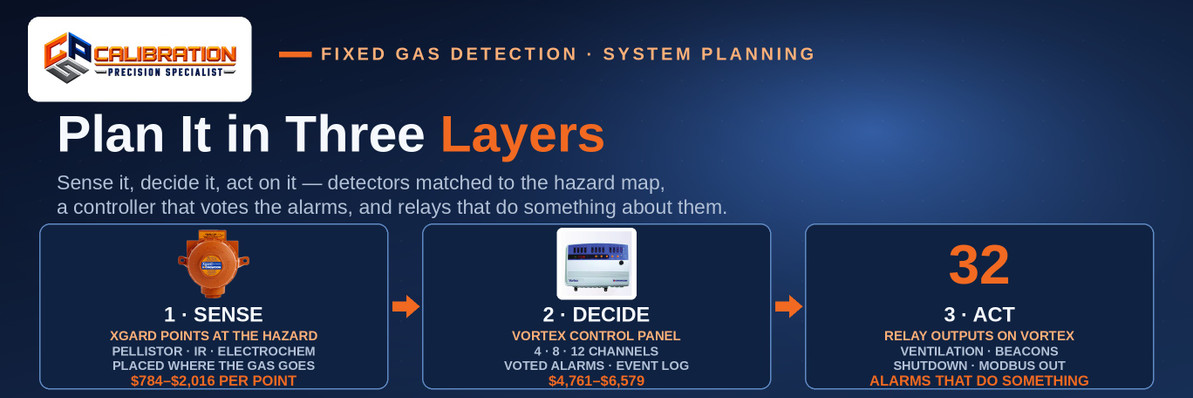
A fixed gas detection system is planned in three layers that have to be designed together: a sensing layer of detectors matched sensor-by-sensor to the hazard map (pellistor or infrared for flammables, electrochemical for toxics and oxygen, thermal conductivity for percent-volume gases), a control layer — a panel such as Crowcon's Vortex (4, 8, or 12 channels, $4,761–$6,579) or GMS (1 or 4 channels) — that watches every point and votes the alarms, and an action layer of relays that start ventilation, raise beacons and sounders, or shut equipment down. Detector placement follows the gas: high for methane and hydrogen, low for heavy vapours, breathing zone for toxics. Plan the layers in that order and the system covers the facility instead of just decorating it.
Most fixed systems we are asked to look at were never planned at all. A detector went in after a scare, a second one after an insurance visit, a panel got swapped when the old one died — and the result is coverage by accident: points where the conduit was easy, a controller nobody can expand, alarms that light a lamp in an empty room. Planning a system from scratch, or re-planning one that grew this way, is a defined sequence. This guide walks it using Crowcon's range as the working example, with real prices at every step. (If your first question is how many detectors a building needs, start with our companion guide — how many gas detectors does a facility need? This post is about what those detectors should be, where they go, and what they connect to.)
The Three Layers, in Plain Terms
Sensing layer. The detectors themselves — fixed points mounted where gas can appear. Each point answers one question: is the gas it watches present, and how much? Everything downstream depends on choosing the right sensing technology for each point, which is why this layer gets most of the planning effort.
Control layer. The controller or panel the detectors wire back to. It powers the points, displays their readings, compares each against alarm levels, and decides what an alarm means — including voting, where two detectors in alarm together trigger a bigger response than one alone. Crowcon's Vortex panels vote any combination of their channels across up to 32 relay outputs; that logic lives here, not in the detectors.
Action layer. What physically happens on alarm: relays starting exhaust ventilation, flashing beacons and sounding horns at the door, notifying the plant system over Modbus, or shutting a process down. A detector that only ever lights a screen in an unmanned room is a sensing layer with no action layer — the most common design failure we see, and the cheapest to avoid at planning stage.
Step 1: Build the Hazard Inventory First
Before any product is chosen, list the hazards as rows: gas, where it can be released, where it travels, and who or what is exposed. Work from the process, not from a catalogue — walk the site with the SDS file and the maintenance crew and mark every vessel, valve row, sump, dock, charging station, and storage rack where gas can escape or accumulate. Three things come off that walk:
- The gas list. Flammables (%LEL), toxics (ppm), oxygen depletion or enrichment, percent-volume gases (CO₂, hydrogen, inert-gas blanketing), and — separately — fire risk, which gas detectors do not cover at all (see Step 5).
- The release character. A slow fugitive leak wants a detector close to the source; a catastrophic release wants area coverage and fast alarming. The same room can need both.
- The area classification. Which spaces are classified (hazardous) locations and which are safe areas decides which detectors are legally installable in each — and, in Crowcon's range, it is a real price lever, covered in Step 3.
Step 2: Match a Detector Technology to Every Point
There are four mainstream sensing technologies in fixed detection, and each has a job it does well and one it cannot do. Matching them point by point is the technical heart of the design.
| Technology | Measures | Choose it when | Know its limits |
|---|---|---|---|
| Catalytic pellistor | Flammable gas, 0–100% LEL | General flammable cover; the workhorse point (Crowcon Xgard Types 3 and 5) | Needs oxygen to work; the catalyst can be poisoned by silicones and sulphur compounds |
| Infrared (IR) | Flammable gas; CO₂ | Low-oxygen spaces, poison-prone atmospheres, CO₂ points (Crowcon IRmax, $2,591–$3,654) | Cannot see hydrogen at all |
| Electrochemical | Toxics in ppm; oxygen | Toxic-gas and O₂ points (Crowcon Xgard Types 1 and 2) | Cells are consumables with a finite life; each cell is gas-specific |
| Thermal conductivity | Percent-volume gases | CO₂, hydrogen, helium, argon at % levels pellistors and %LEL sensors can't express (Crowcon Xgard Type 6) | A specialist point, not a general detector |
Two more technologies complete the picture. Photoionisation (PID) covers VOCs in ppm where exposure limits live — in Crowcon's range that is mainly a portable-layer tool (the pumped Gas-Pro builds). MPS (molecular property spectrometer) sensors read 15+ flammable gases accurately with no correction factors and no catalyst to poison — today that is the Crowcon T4x portable, and it is the technology to watch for points where mixed flammable gases make a single-gas-calibrated pellistor read wrong.
The Xgard range is built exactly around this matching exercise: Types 1 and 2 are electrochemical points for toxics and oxygen, Types 3 and 5 are pellistor flammable points (the difference is the output signal — 3-wire mV bridge versus 3-wire 4-20mA — which matters to the controller, Step 4), and Type 6 is the thermal-conductivity percent-volume point. Across the 445 configurations in Crowcon's current book, Xgard points run $784–$2,016 at CPS.
Placement follows the gas — as a rule of thumb, confirmed against your site hazard assessment. Methane and hydrogen are lighter than air and rise: their detectors go high, near the ceiling and above likely release points. Heavier-than-air vapours — most solvent vapours, gasoline, LPG — sink and spread along the floor: their detectors go low, near ground level and at sumps and pits. Toxic gases are a people problem before they are a property problem: their points belong at breathing-zone height where workers actually stand, with hydrogen sulphide (slightly heavier than air) typically low-to-breathing-zone. Oxygen points go where people work and where displacement would happen first. Manufacturer guidance and the hazard assessment always outrank rules of thumb — but a detector mounted at the wrong height for its gas is the single most common coverage failure, and it is designed in on paper long before it is drilled into a wall.
Step 3: Face the Certification Reality Early (US Sites)
A detector can only be installed in a classified location if it carries a certification that location accepts — and this is where buyers most often lose weeks. In Crowcon's current price book the picture is mixed, and a real design has to be built around it:
- Xgard and Xgard Bright carry UL/cUL builds. The Xgard range CPS leads with is its 125 UL/cUL-certified configurations; the Xgard Bright — the flameproof point with an OLED display, three built-in relays, and optional HART — has 22 UL builds at $1,000–$2,170 within its $1,000–$2,310 range. For a US classified location, these are the Crowcon fixed points that fit without argument.
- The XgardIQ and IRmax are ATEX/IECEx-only in the current book — no UL or CSA variant exists. The XgardIQ is otherwise a compelling design (a $1,680–$1,904 transmitter plus a hot-swappable $422–$1,036 sensor module, $2,102–$2,940 per complete point), and the IRmax is Crowcon's dedicated infrared flammable point — but on a US site that requires a listed detector, that certification gap decides the matter, and it is far better to know it at the drawing stage than at inspection.
- Safe areas change the economics. Where a space is not classified at all — plant rooms, labs, boiler rooms — the XSafe skips explosion protection entirely: the classic XSafe flammable point is a flat $546, and the display-and-relays XSafe Bright runs $1,329.73–$2,687.90. Neither may ever be installed in a classified area; inside their lane, they are the cheapest legitimate points in the range.
The design consequence: a US system is usually a blend — UL-build Xgard or Xgard Bright points in classified spaces, XSafe points where the classification allows, and ATEX-only families only where the site's authority accepts them.
Step 4: Size the Controller to the Points — and the Actions
The controller has to fit three numbers: the points it watches today, the points it can still accept tomorrow, and the outputs the action layer needs.
Small systems: GMS. Crowcon's GMS controllers come as the 1-channel GMS-1 ($1,386–$1,722) and the up-to-4-channel GMS-4 ($1,819–$2,784), accepting mixed 4-20mA and mV pellistor inputs, with DPCO alarm relays and RS-485 Modbus RTU. One honest limit: they are European CE builds — no UL variant exists — which suits them to safe-area, non-classified control duties rather than listed US systems.
Larger or listed systems: Vortex. The Vortex is Crowcon's modular panel in 4-, 8-, and 12-input configurations at $4,761–$6,579 in the standard safe-area wall enclosure. Every channel carries a fault level and three alarm levels that can be voted in any combination to drive up to 32 relay outputs — so a single detector in alarm can start ventilation, while two in alarm shut the process down; that voting logic is what separates a control system from a row of buzzers. The panel logs up to 300 events and reports over Modbus or Profibus. Where the panel itself must sit in a classified location, the flameproof Vortex FP ($18,481–$20,441) and FP Compact ($14,979–$16,379) carry the same electronics into ATEX Zone 1 and 2 — a serious price step that usually settles the argument for putting the panel in a safe area and running cable to the points.
Match the detectors' outputs to the panel's inputs at this step: mV-bridge pellistor points (Xgard Type 3) need bridge inputs, while 4-20mA points (Types 1, 2, 5, 6, and most of the range) suit any modern controller. And always leave spare channels — the system that cannot accept the next point is the system that gets bypassed.
Step 5: Design the Layers Beyond the Fixed Points
Fixed points watch fixed locations. Three more layers close the gaps they structurally cannot:
Flame detection — where fire precedes gas buildup. A gas detector alarms when gas reaches it; an optical flame detector alarms when it sees the fire itself, often before a flammable cloud has travelled anywhere. Crowcon's FGard range — UV/IR, IR3, and a hydrogen-specific model, $2,240–$3,857 at CPS — is the layer for fuel farms, loading racks, and hydrogen service, where the event you fear starts as ignition, not as a leak.
Area monitors — for the work that moves. Turnarounds, shutdowns, tank work, and hot work happen where fixed points were never installed. The DetectiveIQ is Crowcon's answer: up to 7 gases at once, units linked into a Bluetooth Mesh network that passes alarms from unit to unit, and up to 15 weeks on a charge in diffusion mode — a temporary sensing layer that can be deployed for the job and lifted after it. (It is quote-only from CPS; it is not priced in Crowcon's current book.)
Portables — the layer on the person. Fixed systems watch places; people move between them. The personal layer is a 4-gas portable on every worker in the covered areas — the Crowcon T4 at $465.75–$900 is the standard personal point — with pumped units like the Gas-Pro for pre-entry testing of the confined spaces the fixed system does not enter. A fixed design that ignores the portable layer protects the building and forgets the workforce.
A Worked Example: Six Points, Priced Honestly
Labelled plainly as an example — a solvent blending room and drum store, designed from the steps above. Flammable cover at the vessels and drum store, a toxic point at the sump, panel in the adjacent safe-area electrical room, flame cover over the vessel farm, personal monitors for the crew. Prices are Crowcon's current-book figures at CPS; every line is a range because each point's final price depends on its exact configuration.
| Component | Qty | Unit price | Line total |
|---|---|---|---|
| Crowcon Xgard detection points (pellistor flammable + electrochemical toxic/O₂ mix) | 6 | $784–$2,016 | $4,704–$12,096 |
| Crowcon Vortex controller, 8-channel (6 points + 2 spare) | 1 | $4,761–$6,579 | $4,761–$6,579 |
| Crowcon FGard flame detector over the vessel farm | 1 | $2,240–$3,857 | $2,240–$3,857 |
| Crowcon T4 personal 4-gas monitors | 4 | $465.75–$900 | $1,863–$3,600 |
| Hardware total | $13,568–$26,132 |
Not in that number: cabling, installation labour, and commissioning — which our turnkey fixed-system installation service scopes and quotes separately, because cable runs and site conditions move those costs more than hardware choice does — and the ongoing calibration programme below. What the example shows is the shape of a real budget: the controller and the action layer are not accessories to the detectors; in a six-point system they are a third to a half of the hardware cost, and leaving them out of the plan is how systems end up as sensors wired to nothing.
Step 6: Plan the Maintenance Before the First Alarm
A fixed system is a measuring instrument, and measuring instruments drift. Pellistor and electrochemical sensors age from the day they are installed; a system with no calibration plan is a system whose readings quietly become fiction. Plan for it at design stage: access to every point for a technician with a calibration-gas cylinder, a scheduled calibration interval per point, spare sensor budget, and records kept the way your insurer and your authority having jurisdiction expect. CPS's calibration services cover the gas channels on fixed systems like these alongside our portable work — we calibrate every channel — and a service agreement written into the project from the start costs a fraction of the emergency call-out after a failed proof test.
Frequently Asked Questions
How much does a fixed gas detection system cost? Hardware for a small planned system runs from a few thousand dollars — a GMS-4 controller at $1,819–$2,784 watching a handful of Xgard points at $784–$2,016 each — up to the $13,568–$26,132 worked example in this guide for six points plus flame cover and personal monitors. Cabling, installation, and commissioning are quoted separately; on most sites they rival the hardware figure, which is why planning before purchase matters.
How many gas detectors does a facility need? Enough to cover every credible release point and accumulation zone on the hazard map — the count comes from the inventory in Step 1, not from square footage alone. Our companion guide works through the counting question in full: how many gas detectors does a facility need?
Where should fixed gas detectors be mounted — high or low? Follow the gas. Methane and hydrogen detectors go high, near the ceiling; heavy solvent vapours and LPG go low, near the floor, sumps, and pits; toxic-gas points go at breathing-zone height where people work. These are rules of thumb — the site hazard assessment and the manufacturer's guidance for each point settle the final positions.
What is the difference between a gas detector and a gas controller? The detector senses gas at its location and sends a signal — 4-20mA or an mV bridge. The controller powers and watches all the detectors, compares readings to alarm levels, applies voting logic, drives the relays that act on alarms, and logs events. Detectors without a controller sense; a controller turns sensing into a system.
Can one controller run different types of detectors? Yes, if the inputs match. Crowcon's GMS panels accept a mix of 4-20mA and mV pellistor inputs, and the Vortex watches up to 12 channels — so flammable, toxic, and oxygen points can share one panel. The check that matters at design stage is each detector's output signal against the panel's input cards.
Do fixed gas detectors have to be UL listed? In classified (hazardous) locations on US sites, the detector must carry a certification the authority having jurisdiction accepts — in practice, UL/cUL for most US installations. Within Crowcon's range, the Xgard and Xgard Bright include UL/cUL builds; the XgardIQ and IRmax are ATEX/IECEx-only in the current book, and the GMS controllers are CE builds. Confirm the requirement with your AHJ before the design is fixed.
Should I choose pellistor or infrared flammable detectors? Pellistors are the lower-cost, general-purpose choice and cover hydrogen, but they need oxygen to work and their catalysts can be poisoned by silicones and sulphur compounds. Infrared points cost more — Crowcon's IRmax runs $2,591–$3,654 — but work in low-oxygen atmospheres, cannot be poisoned, and cannot detect hydrogen at all. Poison-prone or oxygen-poor points argue for IR; hydrogen points settle it for pellistor (or MPS portables on the personal layer).
How often do fixed gas detectors need calibration? On a scheduled interval set by the manufacturer, the sensor technology, and the site's own safety case — electrochemical and pellistor points drift continuously, so an uncalibrated system reads with unknown error. Build the interval, access, and record-keeping into the project plan, and cover it with a service arrangement rather than relying on someone remembering.
Can a fixed gas detection system start ventilation or shut down equipment automatically? Yes — that is the action layer, and it is designed, not incidental. Controller relays (up to 32 outputs on the Vortex, votable in any combination) and the Xgard Bright's three built-in relays can start exhaust fans, trigger beacons and sounders, or signal a process shutdown. One detector in alarm can ventilate; two in alarm can shut down — the voting logic is set at the controller.
Should a fixed system include flame detectors or area monitors? Where the feared event starts as ignition rather than a slow leak — fuel farms, loading racks, hydrogen — add flame detection (Crowcon FGard, $2,240–$3,857); gas points alone will always be late to a fire. Where the work moves — turnarounds, shutdowns, temporary jobs — add an area-monitor layer such as the DetectiveIQ (up to 7 gases, mesh-linked, quote-only) rather than pretending fixed points cover ground they were never installed on.
The Bottom Line
Plan a fixed gas detection system in the order this guide walks: inventory the hazards gas by gas, match a sensing technology to every point, place each point where its gas actually goes, check the certification against the site before falling for any product, size the controller to the points and the actions, then add the flame, area, and personal layers the fixed points cannot be. In Crowcon's range that means Xgard points at $784–$2,016 (UL builds available), Vortex control at $4,761–$6,579 or GMS for small safe-area systems, FGard flame cover at $2,240–$3,857, and a T4 on every worker — a complete, honest architecture with no orphan sensors wired to nothing.
CPS Calibrations designs, supplies, installs, and calibrates fixed gas detection systems — call 865-900-8844 or visit us at 109 S. Front Street, Rockwood, TN 37854, and we will work your hazard map into a priced system design.
Need a calibration you can file?
In-house calibration at CPS in Rockwood, Tennessee — $55 for single-gas instruments, $90 for 4- and 5-gas — every channel, as-found and as-left data, full certificate.
See Calibration Servicesor call 865-900-8844
Recent Posts
-

What Is Remote Monitoring for Fixed Gas Detection?
Remote monitoring for fixed gas detection means a fixed system's live readings, trends, and alarm hi …Nov 23rd 2026 -

What Are the Key Differences Between the GX-6000 and GX-6100?
The RKI GX-6100 is the current replacement for the discontinued GX-6000: both are pumped 6-gas monit …Nov 22nd 2026 -

How to Read a PID Correction Factor Chart
To read a PID correction factor chart, find your vapor’s row, take the factor under your own lamp en …Nov 21st 2026