
Hydrogen Gas Detection: Why H2 Breaks the Usual Rules (and Which Crowcon Detectors See It)
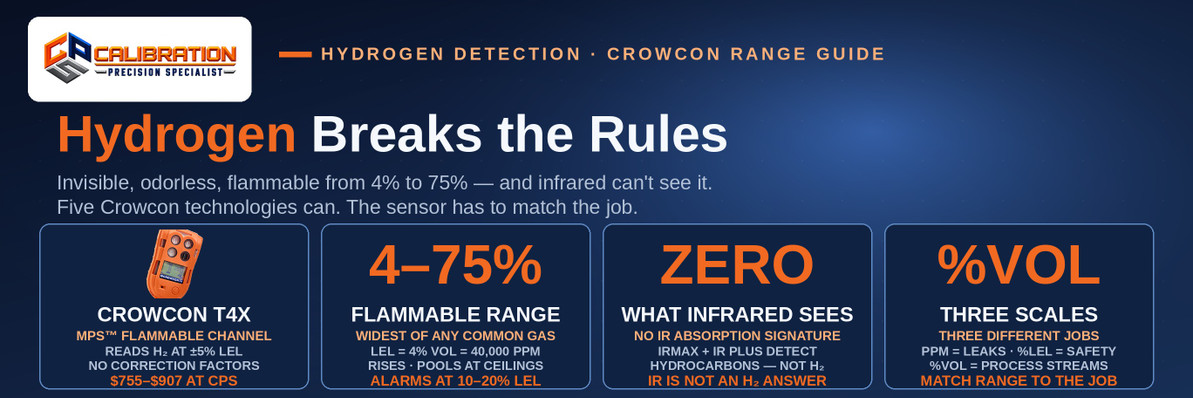
Hydrogen breaks the usual gas-detection rules: it is colorless and odorless, it is flammable across 4–75% by volume — the widest range of any common industrial gas — it rises and pools at ceilings instead of settling at floor level, its flame is nearly invisible, and infrared gas detectors cannot see it at all, because hydrogen has no infrared absorption signature. Crowcon answers hydrogen with five different sensing technologies — MPS, catalytic pellistor, electrochemical, thermal conductivity, and a hydrogen-tuned flame detector — because the right hydrogen sensor depends on the job: ppm leak warning, %LEL life safety, %vol process measurement, or battery-room off-gas monitoring.
Hydrogen is having an industrial moment — electrolyzers and green hydrogen projects, hydrogen fueling, fuel-cell vehicles and backup power, battery rooms full of charging cells. Every one of those installations needs hydrogen detection, and every one discovers the same thing: the habits that work for methane and hydrocarbons do not transfer. This guide works through why hydrogen is different, which sensor technologies can and cannot see it, and which Crowcon instrument fits which hydrogen job.
Why Hydrogen Is Different
You get no warning from your senses. Hydrogen is colorless and odorless. There is no smell to catch and nothing to see — the first indication of a leak is an instrument or an ignition. (Hydrogen sulfide at least announces itself before it takes your sense of smell away; hydrogen never announces itself at all.)
The flammable range is enormous. Most flammable gases ignite across a band of a few percent to perhaps fifteen percent by volume. Hydrogen burns from 4% to 75% by volume — a span so wide that a leaking fitting passes through the flammable range on its way up and stays in it across almost any dilution scenario short of open air. Its lower explosive limit (LEL) is 4% vol, which is why hydrogen alarm math runs in big numbers: 100% LEL = 4% vol = 40,000 ppm, and a typical first alarm at 10% LEL is 0.4% vol — 4,000 ppm.
It goes up, not down. Hydrogen is the lightest gas there is. Released indoors it rises fast and collects at ceilings, roof peaks, and the tops of enclosures — the exact opposite of propane, solvent vapors, and most hydrocarbon hazards that pool at floor level. Where a gas goes when it leaks decides where its detectors belong, and hydrogen detectors belong high: at ceiling level, at high points, and above likely leak sources like fittings, valves, and charging batteries. Our guide to where gas goes when it leaks works through the placement logic gas by gas.
Its flame is nearly invisible — and it carries no carbon. A hydrogen flame burns so pale it can disappear in daylight, and people have walked into hydrogen fires they could not see. It also defeats hydrocarbon-tuned flame detection: hydrogen contains no carbon, so its flame produces no hot CO₂, and the strong infrared emission band that IR flame detectors key on is largely absent. We covered the flame side in depth in Can a Flame Detector See a Hydrogen Flame? — the short version is that hydrogen flame duty needs a detector tuned for hydrogen, which is why Crowcon builds one (below).
It leaks, and it works on the materials around it. Hydrogen's molecule is the smallest there is, and it escapes through seals, threads, and fittings that hold other gases without complaint. Prolonged hydrogen exposure also embrittles some steels, weakening the very pipework carrying it. The practical consequence for detection: on hydrogen plant, leak checking is a routine discipline rather than an occasional event, and a ppm-range leak instrument earns its keep.
Three Scales: ppm, %LEL, and %vol
Hydrogen instruments come in three measurement scales, and they are not interchangeable — they answer three different questions:
- ppm (parts per million) — "Is it leaking?" Trace-level measurement for early leak warning, far below any flammability concern. The Crowcon Gasman's hydrogen version reads 0–2,000 ppm; Crowcon's incoming UnoIQ carries a hydrogen tray at 0–40,000 ppm.
- %LEL — "Is it safe?" Life-safety alarming against the flammable limit. Typical US alarm settings are 10% and 20% LEL. This is the scale of personal monitors and fixed safety points: Gasman %LEL builds, T4/T4x personal detectors, Xgard Types 3 and 5, BESafe battery bays.
- %vol — "How much is in the stream?" Bulk concentration at process levels, far above any LEL reading. The Xgard Type 6 (thermal conductivity) measures hydrogen at 0–5%, 0–10%, and 0–50% vol in air, plus percentage ranges of hydrogen in nitrogen.
One line of arithmetic connects the catalog: 100% LEL = 4% vol = 40,000 ppm. That's why the UnoIQ's 40,000 ppm tray is a full flammable-range instrument wearing a ppm label, and why a 0–2,000 ppm Gasman tops out at 5% LEL — it is a leak instrument, not a safety alarm, and it is priced and bought as one.
The Technology Matrix: What Can Actually See Hydrogen
| Technology | Sees hydrogen? | Scale | Strengths | Limits | Crowcon examples |
|---|---|---|---|---|---|
| Catalytic pellistor | Yes | %LEL | Proven, fast, inexpensive; Crowcon specifies poison-resistant pellistors | Needs oxygen to burn gas on the bead; can still be poisoned; accuracy is calibration-gas specific | Xgard Type 3 / Type 5, Gasman %LEL, BESafe bays |
| Electrochemical | Yes | ppm and %LEL | Low power (suits intrinsically safe designs); reads hydrogen without a heated bead | Cell is a consumable; range- and life-limited | Gasman 0–2,000 ppm version; TXgard-IS+ (legacy) |
| MPS™ | Yes — ±5% LEL | %LEL | Identifies 15+ flammable gases incl. hydrogen and mixtures, no correction factors; cannot be poisoned; zero calibration over a 5-year-plus life | %LEL flammables only — no ppm toxics; aromatic vapors read less precisely | T4x |
| Thermal conductivity | Yes | %vol | Measures bulk hydrogen, including hydrogen in nitrogen where there is no oxygen for a pellistor; full 0–100% vol method | Not a life-safety %LEL or ppm instrument; narrower temperature window | Xgard Type 6 |
| Infrared (IR) | No | — | Superb for hydrocarbons: unpoisonable, no oxygen requirement, self-monitoring optics | Hydrogen has no infrared absorption signature. Full stop. | IRmax and IR Plus — hydrocarbons only, never hydrogen |
Two rows of that table deserve emphasis. The first is the infrared row, because it is the most expensive mistake available: infrared is the premium fixed-detection technology for hydrocarbons, and it is completely blind to hydrogen. Crowcon's own documentation is blunt — the IRmax and the methane-only IR Plus both state that hydrogen is not detectable. A hydrogen hazard specified with IR detectors is an unmonitored hazard with expensive hardware on the wall.
The second is the correction-factor problem on the pellistor row. A catalytic sensor is only accurate for the gas it was calibrated on; measure a different gas and the raw reading needs a correction factor — as our guide to LEL correction factors shows, that factor can approach 2× for some gases. The Crowcon T4x exists largely to delete that problem: its MPS sensor identifies the gas — hydrogen included, at ±5% LEL — and reads it correctly in a single reading, mixtures included. It also cannot be poisoned the way a bead can; our post on what happens when a sensor is poisoned explains the silent-failure mode MPS removes. And where hydrogen cross-interference corrupts CO readings on ordinary instruments, the T4x's configuration options include a hydrogen-resistant CO sensor — hydrogen jobs touch more channels than the flammable one.
Which Crowcon Instrument for Which Hydrogen Job
Battery rooms, UPS, and battery energy storage. Charging and failing batteries generate hydrogen: lead-acid cells gas it during charging, and a lithium-ion cell heading for thermal runaway vents hydrogen early — before smoke, before heat. The Crowcon BESafe is built for exactly this: every configuration CPS stocks pairs a hydrogen bay — 0–25% LEL for early warning (a failing cell's hydrogen shows up long before it approaches full LEL) or 0–100% LEL — with a carbon monoxide or methane bay, the other thermal-runaway off-gases. Its relays can start ventilation, its sensor trays can sit on cables up to 15 m away inside cabinets, and the five configurations run $1,274–$1,498. The honest limit: BESafe is a CE-built, safe-area detector — no UL, CSA, or ATEX certification — so classified locations need a different answer.
Electrolyzers and green hydrogen production. Production plant layers all three scales. Fixed %LEL safety points belong at ceiling level and above the equipment: Xgard Type 3 or Type 5 pellistor builds are the workhorses, inside the Xgard range's $784–$2,016 span across 445 CPS configurations. Process streams and hydrogen-in-nitrogen measurements belong to the Type 6 thermal conductivity builds ($1,260 in UL/cUL form), which read hydrogen at percent-volume where a pellistor cannot work at all. Leak hunting on rounds — fittings, seals, compressor connections — is the Gasman 0–2,000 ppm version's job at $1,017.64, and maintenance crews who want their 4-gas to read hydrogen correctly without correction factors carry the T4x at $755–$907.
Refineries and chemical plants. Hydrogen service here is high-pressure, high-temperature, and unforgiving of the embrittlement and small-molecule leaking described above. Fixed Xgard %LEL points cover the safety layer, mounted high; personal cover for unit rounds is the Gasman — its flammable builds include hydrogen at $475 in %LEL form, and the 0–2,000 ppm version covers leak surveys. Zone 0 hydrogen points carry one legacy note: the discontinued TXgard-IS+ read hydrogen electrochemically in ppm or %LEL, its installed base is supported for three years, and Crowcon names the Xgard Type 1 as the replacement path — the full story is in our TXgard-IS+ post.
Laboratories and fuel-cell work. Bench-scale hydrogen — fuel-cell test stands, research electrolyzers, cylinder-fed instruments — is mostly a ppm problem: small leaks, early, in occupied space. The Gasman 0–2,000 ppm version is the personal and survey answer today. Crowcon's UnoIQ adds a hydrogen tray at 0–40,000 ppm on the swappable-tray IQ platform — but its US configurations are still marked "Not Released" in Crowcon's current price book, so there is no US price yet; CPS will list it when Crowcon releases it.
Hydrogen fueling and compression. The gas layer is Xgard %LEL points and Gasman rounds, as above. The flame layer is below — fueling stations and compressors are headline applications for the FGard H2, because a hydrogen jet fire at a dispenser is precisely the fire nobody will see.
The Flame Side: FGard H2
Gas detection is the layer that catches hydrogen before it ignites. If it ignites anyway, the flame layer has its own hydrogen problem: hydrocarbon-tuned flame detectors key on signatures a hydrogen flame largely lacks. Crowcon's answer in the FGard range is a dedicated model — the FGard H2, a multi-spectrum infrared detector optimised exclusively for hydrogen flame detection. It detects a 36-inch hydrogen plume at 131 feet (40 m), responds in 2–5 seconds at that distance, and carries a 5-year warranty — at $3,528 in aluminium or $3,857 in 316 stainless at CPS list. The trade is deliberate and stated on Crowcon's own datasheet: the same detector sees a 1 ft² heptane pan fire at only 40 feet. It is a hydrogen instrument, not a general flame detector — its application list reads like the hydrogen economy: hydrogen generators, fueling stations, hydrogen-to-methane production, compressors, hydrogen trains, buses and ferries, refining, gas plants, semiconductors, aerospace, and fertiliser production. Our published guide to hydrogen flames walks through why the physics forces a dedicated model.
Placement Rules and Honest Limits
- Mount high. Ceilings, roof peaks, high points of enclosures, and directly above likely leak sources. Hydrogen found at ankle height on a drawing is a detector installed for a different gas's behavior.
- Infrared is not a hydrogen layer. Not point IR, not open-path IR. If the hazard list says hydrogen, the detector list must say pellistor, electrochemical, MPS, or thermal conductivity.
- Pellistors need oxygen and discipline. A catalytic sensor under-reads in oxygen-depleted or inert atmospheres and can still be poisoned despite poison-resistant design — bump testing and calibration on schedule are what keep it honest. In inerted or nitrogen-blanketed service, thermal conductivity is the technology that still works.
- "Zero calibration" has a scope. The T4x's zero-calibration claim covers its MPS flammable sensor. Its CO, H₂S, and O₂ sensors — like every electrochemical sensor in this guide — still need bump tests and calibration on schedule. Hydrogen's electrochemical instruments are consumable-cell instruments; plan sensor replacement as a running cost.
Frequently Asked Questions
Can an infrared gas detector detect hydrogen?
No. Hydrogen has no infrared absorption signature at the wavelengths gas detectors use, so no infrared detector — point or open-path — can measure it. Crowcon's infrared fixed detectors state it plainly: the IRmax and IR Plus cannot detect hydrogen. Hydrogen needs a catalytic pellistor, an electrochemical cell, an MPS sensor, or a thermal conductivity sensor.
What is the LEL of hydrogen?
Hydrogen's lower explosive limit is 4% by volume, and its flammable range runs from 4% to 75% by volume — the widest of any common industrial gas. In the units hydrogen instruments use, 100% LEL = 4% vol = 40,000 ppm, so a 10% LEL first alarm sounds at 4,000 ppm.
Where should hydrogen gas detectors be mounted?
High. Hydrogen is the lightest gas and rises rapidly, pooling at ceilings, roof peaks, and the tops of enclosures. Fixed hydrogen detectors belong at ceiling level, at high points, and above likely leak sources such as fittings, valves, compressors, and charging batteries — the opposite placement from heavier-than-air gases like propane.
Should I measure hydrogen in ppm, %LEL, or %vol?
Match the scale to the question. ppm is for leak warning — the Gasman hydrogen version reads 0–2,000 ppm, far below flammability. %LEL is for life-safety alarming at a fraction of the 4% vol limit — personal monitors and fixed safety points. %vol is for process concentration — the Xgard Type 6 reads hydrogen at 0–5%, 0–10%, and 0–50% vol, including hydrogen in nitrogen.
Can a standard 4-gas detector measure hydrogen?
Partly, with a catch. Its catalytic LEL channel responds to hydrogen, but a pellistor is only accurate for its calibration gas — a methane-calibrated channel needs a correction factor to read hydrogen truthfully. The Crowcon T4x removes the guesswork: its MPS sensor identifies hydrogen directly at ±5% LEL with no correction factors, alongside its O₂, CO, and H₂S channels.
Does hydrogen have a smell or a color?
No — hydrogen is colorless and odorless, which is why instrument detection is the only warning layer. Its flame is also nearly invisible in daylight, so a hydrogen leak can become a hydrogen fire with no sensory warning at either stage.
How do you detect a hydrogen flame?
With a flame detector tuned for hydrogen. Hydrocarbon-tuned detectors key on the hot CO₂ emission band that a carbon-free hydrogen flame largely lacks. Crowcon's FGard H2 is optimised exclusively for hydrogen flames and detects a 36-inch hydrogen plume at 131 feet (40 m) in 2–5 seconds; it costs $3,528 in aluminium or $3,857 in stainless at CPS list.
What is the best detector for a battery room?
For battery energy storage and backup-power rooms, the Crowcon BESafe: every CPS configuration pairs a hydrogen bay — 0–25% LEL for early thermal-runaway warning, or 0–100% LEL — with a CO or methane bay, with relays that can start ventilation. The five configurations run $1,274–$1,498. Note it is a CE-built safe-area detector, without UL, CSA, or ATEX certification.
How much does a personal hydrogen monitor cost?
At CPS list: a Crowcon Gasman in hydrogen %LEL form is $475, and the 0–2,000 ppm leak-range version is $1,017.64. The Crowcon T4x 4-gas with an MPS flammable channel that reads hydrogen at ±5% LEL runs $755–$907 across six configurations. Crowcon's UnoIQ hydrogen tray (0–40,000 ppm) is not yet released in the US, so it has no US price.
Can a catalytic LEL sensor detect hydrogen in an inert atmosphere?
No. A pellistor burns gas on a heated bead and needs oxygen to do it, so it under-reads or fails in inerted and nitrogen-blanketed spaces. For hydrogen in nitrogen and other oxygen-free streams, thermal conductivity is the working technology — Crowcon's Xgard Type 6 measures percentage ranges of hydrogen in nitrogen as well as 0–5%, 0–10%, and 0–50% vol in air.
The Bottom Line
Hydrogen punishes generic detection. It hides from your senses, ignites across 4–75% by volume, collects at the ceiling, burns invisibly, leaks through fittings that hold everything else — and the infrared technology that anchors hydrocarbon detection cannot see it at all. The Crowcon range answers it technology by technology: MPS in the T4x for correction-factor-free personal %LEL, pellistors in the Xgard and Gasman for the fixed and personal safety layers, electrochemical ppm instruments for leak work, thermal conductivity in the Xgard Type 6 for percent-volume process streams, BESafe hydrogen bays for battery rooms, and the FGard H2 for the flame itself. Pick the scale first — ppm, %LEL, or %vol — and the instrument choice mostly makes itself.
CPS Calibrations sells and calibrates the Crowcon range, and hydrogen instruments are no exception: every channel on every detector in this guide needs its bump tests and calibrations kept current, and we calibrate every channel. Talk to us about a hydrogen application — production, storage, fueling, or batteries — at 865-900-8844, or visit us at 109 S. Front Street, Rockwood, TN 37854.
Need a calibration you can file?
In-house calibration at CPS in Rockwood, Tennessee — $55 for single-gas instruments, $90 for 4- and 5-gas — every channel, as-found and as-left data, full certificate.
See Calibration Servicesor call 865-900-8844
Recent Posts
-

Can You Add a Pump to a SENKO SGT-P or MGT?
Yes — SENKO's SP-Pump101 external sampling pump ($330, part AAA006000) fits the SGT, SGT-P, and MGT, …Nov 12th 2026 -

What Refrigerant Detection Does a Grocery Store Need?
A grocery store needs refrigerant detection in three places: low-mounted carbon dioxide (R-744) sens …Nov 11th 2026 -

What Is LEL and UEL? The Explosive Range, Gas by Gas
The LEL is the lowest concentration of a gas in air that can explode, and the UEL is the highest: me …Nov 10th 2026